Frozen and chilled food packs: why does foil survive both ways?
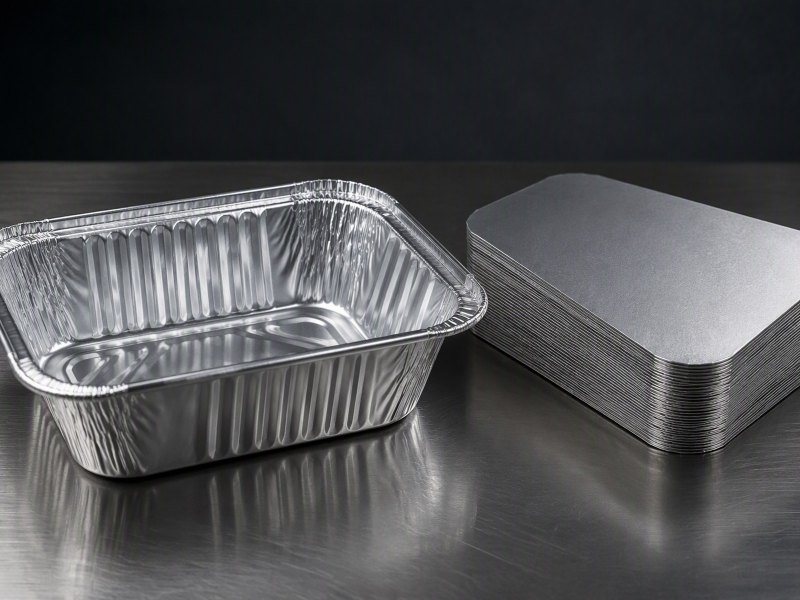
A chilled or frozen pack meets two climates in one life. Why foil trays and foil lidding hold the seal through the cold leg and still work in the oven, and what a buyer must state to get the right pair.
Frozen and chilled food packs: why does foil survive both ways?
A pack that leaves a freezer and enters an oven crosses two climates in one life, and the seal has to carry both.
A chilled or frozen pack is filled, stored cold, shipped, then heated in its own container. Foil holds a seal through the cold leg and still conducts heat in the hot leg; a plastic pack has to compromise.
The route below runs from the filling line to the cold store, the vehicle and the oven, then to the enquiry.
How does a frozen or chilled pack differ from an ambient one?
An ambient pack meets one climate. A frozen or chilled pack meets several, in sequence, and often more than once.
The pack is filled warm or cold, sealed, chilled or frozen, stored, distributed, then reheated in the same container. Two thermal directions act on one seal: contraction on the way down, expansion and internal pressure on the way up.
Dive deeper
Start with the route, not the material. An ambient pack is filled, closed and cased, and after that the threats are water vapour and handling. A frozen pack is closed while the food is still warm, stored cold, shipped cold, held in a cabinet, then heated by the consumer.
On the way down, the pack contracts. Lid and tray differ in thickness and often in alloy, so they contract at different rates and load the seal in shear as well as peel. Moisture migrates to the coldest surface, the underside of the lid, and freezes on the seal line. How aluminium foil is rolled matters, because thickness tolerance decides how evenly the lid follows.
On the way up, the same seal meets steam pressure and tray expansion, and the lid may have to stay on until the consumer lifts it. A pack that behaves on a dry shelf can leak in a cold store without visible damage, because the failure runs quietly along the seal line.
The lidding is the thin half of the pair, so it tracks food temperature while the tray wall lags, and that lag loads the seal. The route has to be written down before a specification is fixed: filling, chilling, storage, transport, final heating.
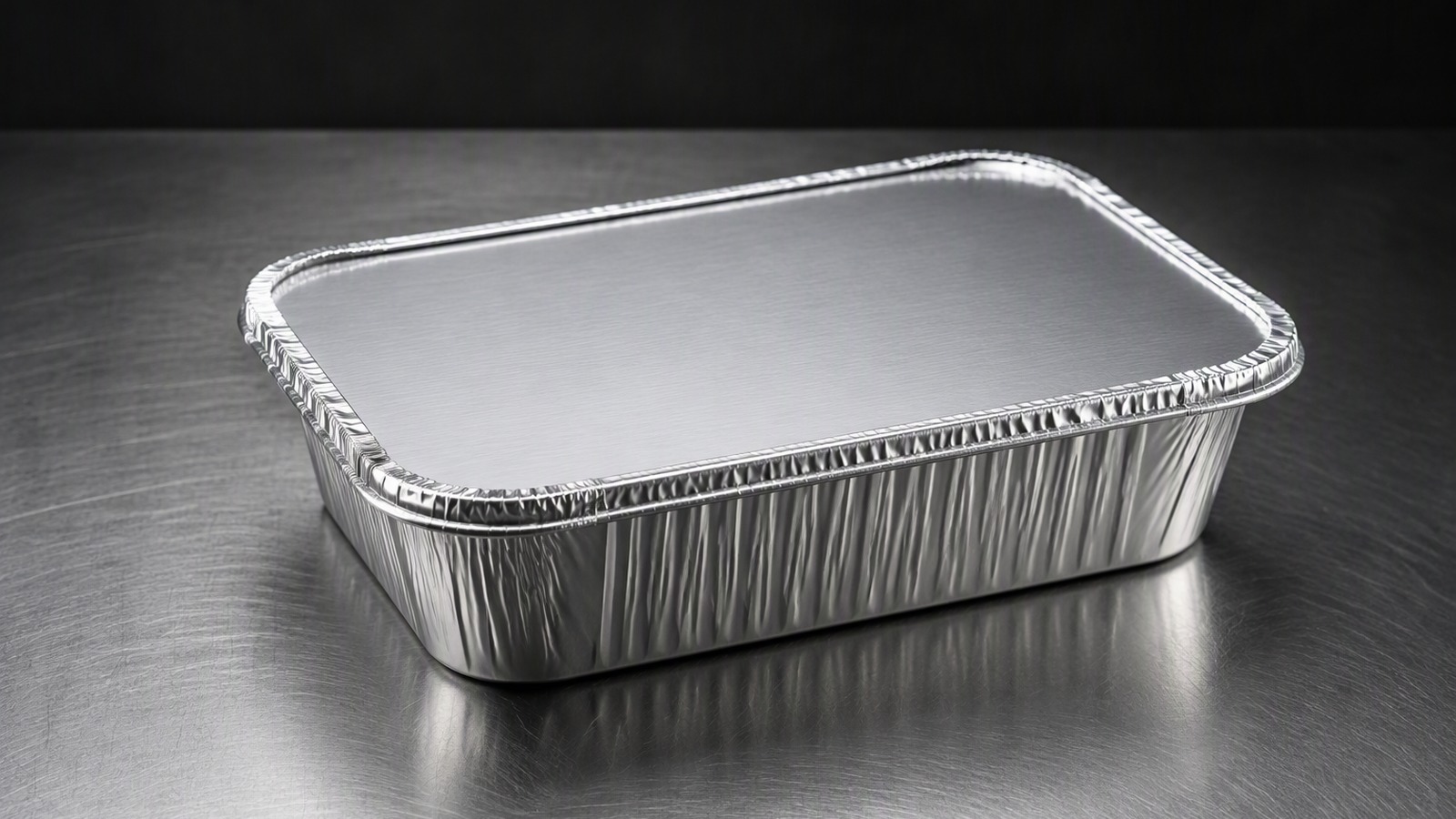
Why are foil trays and foil lidding chosen for these packs rather than plastic?
Because one material must do two jobs that plastic splits between two grades, and the pack is heated in the container it was sold in.
Foil conducts heat into the food, holds a dead-folded shape, blocks light and moisture, and does not soften in an oven. A plastic pack can be excellent in the cold leg or in the microwave, but rarely both.
Dive deeper
Heat reaches the food through base and walls at once, so a frozen block thaws and then cooks from more than one face. The thin lid lets radiant heat get to the surface once it is folded back or vented, which is why a foil container browns a gratin where a plastic tray only steams it.
Rigidity comes from geometry rather than gauge. A shallow tray with a formed flange and a crimped wall carries a filled load with a wall far thinner than a moulded tray needs, and it stays stiff in a freezer instead of turning brittle. That is why an aluminium foil container is often the lighter pack for the same filled weight.
Plastic is not wrong, it is narrower. A polypropylene tray suits microwave reheating and a film lid suits a sealed chilled pack, but the pair usually comes from one family and the oven step falls away. Where one pack must cover chill, freeze and oven, foil does it with a single material.
The trade-off is that foil conducts, so the property that cooks the food also carries heat to the seal. That is why tray and lid are specified as a pair rather than bought separately.
What does the cold chain demand from the material?
It demands that nothing becomes brittle, that nothing shrinks apart, and that the seal survives being loaded while it is cold and stiff.
The metal must stay ductile, the coating must stay adherent through contraction, and the seal must hold when lid and tray move against each other. None of that can be inspected into a pack afterwards.
Dive deeper
Aluminium has no ductile-to-brittle transition of the kind some steels show, a quiet advantage in a freezer. The risk sits in temper and forming. A soft temper such as O, H22 or H24 bends and creases without cracking where a harder H18 lid would score and split along the fold.
Alloy choice follows the same logic. Lidding is commonly 1235, 8079 or 8011 because those alloys roll thin and form a reliable seal surface, while trays are usually 3003 or 3004 for strength through the wall, with 1050, 1060 or 1100 in simpler shallow containers.
The seal is the weak point. A hot-melt or lacquer seal that is compliant at room temperature may pass through a region on the way down where it becomes glassy and less able to follow movement, and that is where a chilled pack is handled and dropped. Condensation makes it worse: moisture trapped on the flange before sealing, or ice on it after storage, sits in the interface.
The cold chain adds abuse an ambient pack never sees: gloves, frost, wet floors, repeated loading. The European aluminium industry describes the material behaviour behind this, but the decision is local: which alloy, which temper, which coating, agreed for one route.
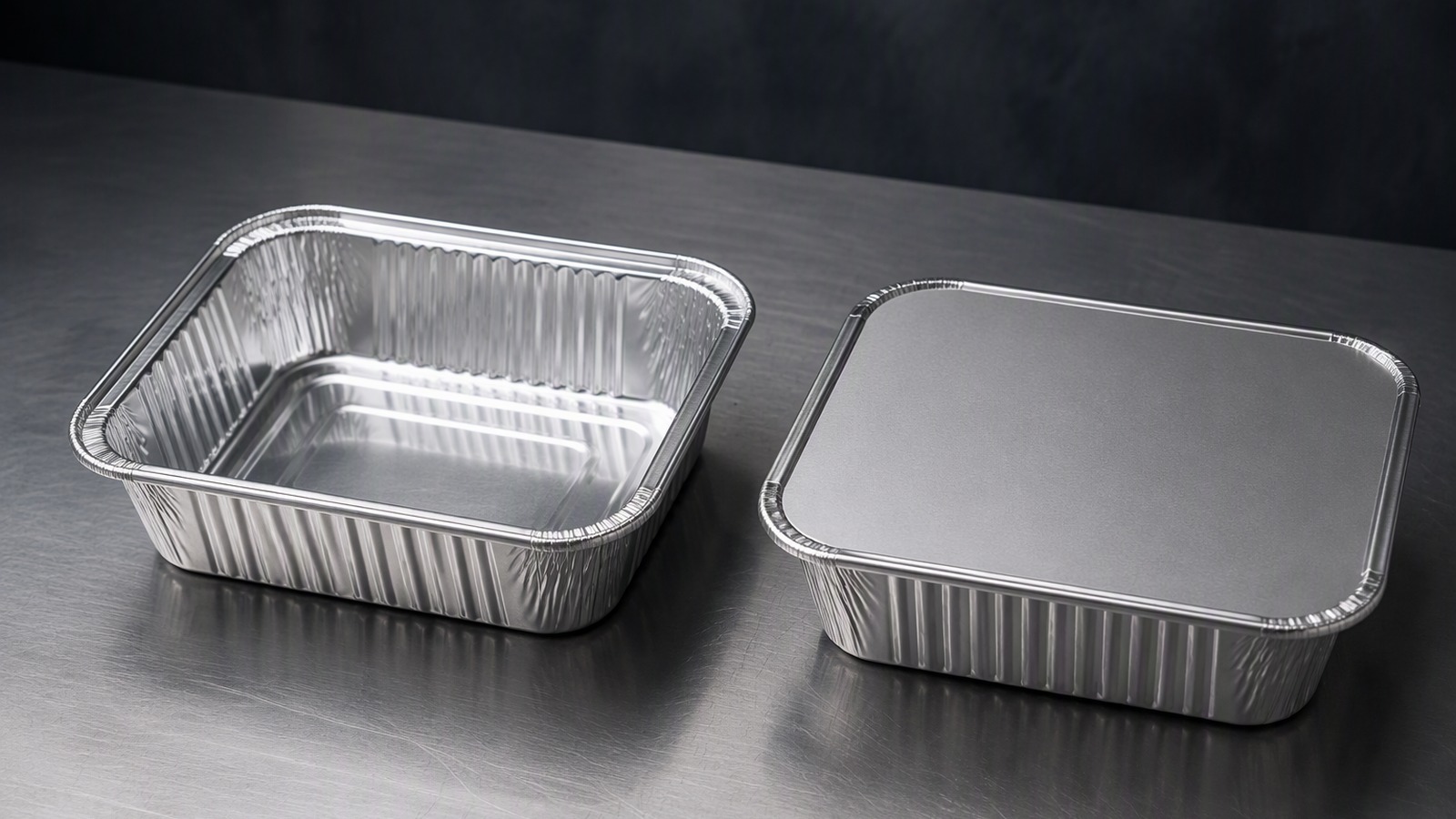
What does oven use demand from the same pack?
It demands a tray that keeps its shape while hot, a lid that is removed or vented cleanly, and a coating that does not react with the food.
An oven step loads the pack in a different direction from the freezer. Heat arrives by air and radiation, fat and steam attack the surface, and the consumer lifts a full, hot container by its flange.
Dive deeper
The tray carries a filled load at a temperature where the metal is weaker, so wall angle, corner radius and flange width do the work. A deep draw with tight corners buckles first, and a buckled tray distorts the flange where the lid was sealed.
The lid has two possible roles, decided early. It can be removed before the pack goes in, so the seal only has to survive until the consumer opens it, or folded back as a loose cover, so the hinge is creased and must not crack. A partial peel is the hardest of the three to specify, because the seal must fail part way and then hold.
The surface matters as much as the shape. Cooking releases fat, sugar and steam, and those attack a coating chosen only for cold storage. A lacquer right for a frozen pack is not automatically right for a pack that will be heated.
3004 aluminium foil at 0.05 mm is a common starting point for lids that must stay flat and sealable, while the tray takes the structural duty. Where a specification claims oven use it should say so for the pair that was tested, and the UK aluminium federation publishes general guidance for buyers.
What does microwave use demand from the same pack?
It demands control of an edge: in a microwave, foil is a conductor in a field, and the risk is arcing at a sharp corner rather than a melted pack.
A foil pack can be used in a microwave where geometry, food load and instructions are designed for it: smooth edges, foil covered by food, a lid that vents. Without those conditions the pack is unsuitable.
Dive deeper
The mechanism is field concentration. A microwave field drives currents in a conductor, and at a thin edge or a point the local field becomes strong enough to break down the surrounding air, which shows as sparking. A smooth, rounded rim spreads that field; a torn edge or a scrap of foil concentrates it.
The food load changes the answer. Where food covers the foil, energy is absorbed before it reaches the metal, and the foil behaves as a shield that shapes the heating pattern rather than an antenna. A shallow tray heaped above the rim is a different case from a deep tray filled to the top.
Venting is the second demand. A sealed pack generates steam and the lid has to release it in a controlled way rather than bursting. Some designs punch a small opening, some rely on a partial peel, and some pair a film lid with a foil tray. The comparison of foil and PP film for lidding sets out where each type fits.
Instruction is part of the specification, because a pack that is right in one appliance can be wrong in another. Remove the lid, pierce here, stand for a moment: that wording carries as much weight as the alloy.
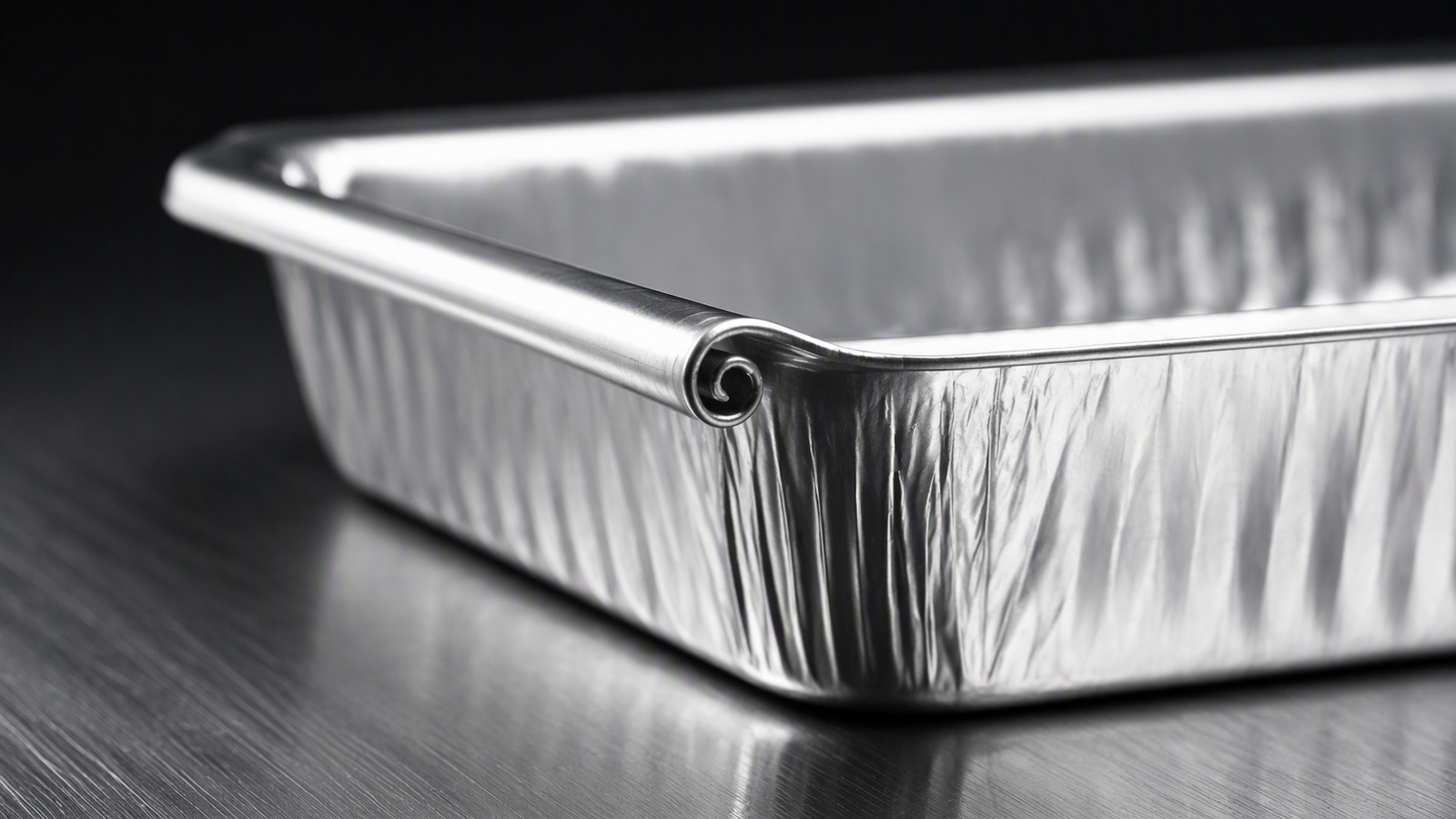
Why must the lid material and the tray material be specified together?
Because the seal is a joint, not a component. It exists only where two surfaces meet, and either surface can decide the result.
The lid brings coating and temper, the tray brings alloy, flange flatness and wall stiffness, and the tool brings heat and pressure. Change one and the window has moved.
Dive deeper
Sealing is a short, local event. Heat passes through the lid, activates the coating on one or both surfaces, and the two are pressed together long enough for the interface to form. The lid is thin and heats quickly while the tray flange is still drawing heat away, so a heavier wall needs a different setting.
Alloy and temper on the tray side are part of the joint. A formed 3003 or 3004 flange presents a different surface from a shallow 8011 container, and flange flatness after forming decides how much tool pressure reaches the seal line. A flange that waves seals in patches and leaks between them.
This is why the pair should be quoted as a pair. A converter asked only for lids has to assume a tray, and that assumption is where most sealing problems begin. The alloy choice between 8011, 3003 and 3004 for containers is a joint decision, because a harder tray pushes the specification towards a more compliant lid coating.
Lid and tray from two suppliers means two sets of tolerances and two parties to a failure; one pair and one trial on the customer's machine gives the buyer a single answer when a pack leaks.
How is the sealing window agreed with the customer's machine?
On the machine, with the customer's own tray, and with the food or a representative load in it. A window agreed in a laboratory is only a starting point.
Tool temperature, dwell, pressure and machine speed are set together, then tested against the two failures that matter: a seal that opens cold and a lid that cannot be peeled at the table.
Dive deeper
The window is the overlap between two limits. Below it the coating does not activate and the seal is weak from the start; above it the coating flows too far and the lid welds to the tray, so the consumer tears the foil instead of peeling it.
Machine geometry sets part of the band. Tool flatness, the condition of the sealing face, platen parallelism and the way the tray is located all change the pressure that reaches the flange. A worn tool shifts the band with nobody changing a setting, so the trial has to record the machine as it is, not as it was commissioned.
The load matters. An empty tray conducts heat away differently from one filled with frozen food, and a cold flange pulls heat out of the seal as it forms. Trials run empty and then transferred to a cold filling line are a common source of drift.
Write the agreement as a range with settings, the tray and lid combination, the load condition and the acceptance method both sides will use. The aluminium association's industry pages are useful background on material consistency, but the sealing window is always local to one machine, one tool and one pair.
What must a buyer state in an enquiry?
The route the pack will take, the materials already in use, and the machine it will run on. Without those three, a converter can only quote a generic foil.
Then the dimensions, alloy and temper if fixed, thickness, width, core, finish, quantity and destination. An enquiry that describes the application gets a proposal for a pair; one that lists a size gets a price for a coil.
Dive deeper
Start with the application in plain terms: what food, how it is filled, chilled or frozen, oven or microwave, and whether the lid comes off fully or partly. Those answers decide alloy family, temper and coating, and cannot be inferred from a drawing.
Then the physical specification: thickness within the 0.005-0.20 mm range, width within 100-1500 mm, core at 76 or 152 mm, inside and outside diameter, and the tolerance the customer's machine can accept. For a tray add blank diameter, depth, flange width and corner radius; for a lid add the emboss pattern and the lacquer.
Then the commercial frame: quantity per size against a minimum order of 3 MT per size, packing format, coils or cut sheets, the destination port from Qingdao, Tianjin or Shanghai, and the documents needed for import. Where the specification is open, say which parameters are free. A note on the trial machine, its tool and the way the line runs is worth more than a long specification with no route attached.
Finally, ask for the pair. A serious enquiry names tray and lid together and asks for a packaging and container foil proposal covering both, with the sealing conditions the supplier expects to hold on the named machine.
A frozen or chilled pack is one seal tested twice: specify the pair, agree the window on the customer's machine, and put the route in the enquiry.