What Does Aluminium Foil Do in a Bag-in-Box Liner?
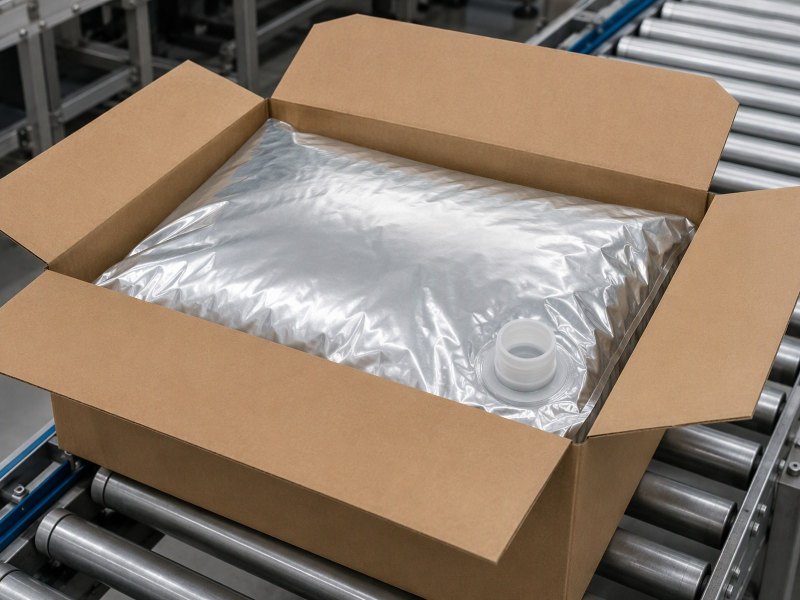
A bag-in-box liner puts the load on the box and the barrier on the film. This article covers the metal ply, the gauge, the laminate, the valve joint, the filled-box test, the fitting step and the enquiry.
What Does Aluminium Foil Do in a Bag-in-Box Liner?
A boxed liquid pack that holds shape and still loses its contents to a soft seal is the commonest liner failure. The metal ply answers it.
A bag-in-box liner needs a metal layer because the box carries the load and the liner carries the barrier. Aluminium foil adds a continuous ply that holds back vapour, oxygen and light.
The sections below follow the liner from the metal itself, through ply, gauge and laminate, to the valve, the filled box, the fitting and the enquiry.
Why does a liquid liner need a metal layer at all?
A liner has no wall of its own. It is filled through a valve and emptied in stages, so the film does a different job from a bottle.
The metal ply supplies what the box cannot, which is a barrier. The box supplies what the film cannot, which is structure. Every decision below follows from that split.
Dive deeper
A film is chosen for what it does at the filling head: it seals, it flexes, it survives a drop. Permeability is a secondary property and always a matter of degree. A liner that hangs in a box through a long draw-off sees a permanent concentration difference, wetter on the product side, drier or warmer outside, and vapour keeps moving along that gradient.
A metal ply interrupts it. Rolled aluminium foil is continuous, and a soundly handled layer leaves no through-thickness path that a gas molecule can follow. It is also opaque, which matters in a liquid: light drives oxidation in oils, citrus and dairy, and no clear film stops it.
The second reason is specific to a liner. The film is not backed by a rigid wall on every side; it hangs, folds into the corners and is drawn down as the product leaves, so it works in flex for its whole life. A ductile metal layer bends with the film instead of cracking at the crease.
That is the division of labour in one line: the corrugated case takes the stacking load and the drop, the laminate takes the barrier. Neither part does the other's job, which is why the format works at a size where a self-supporting container would be awkward.
What does the foil ply do that a plain film cannot?
A plain film can seal, flex and print. It cannot stop light, and it cannot hold a gas path closed for a liner's life.
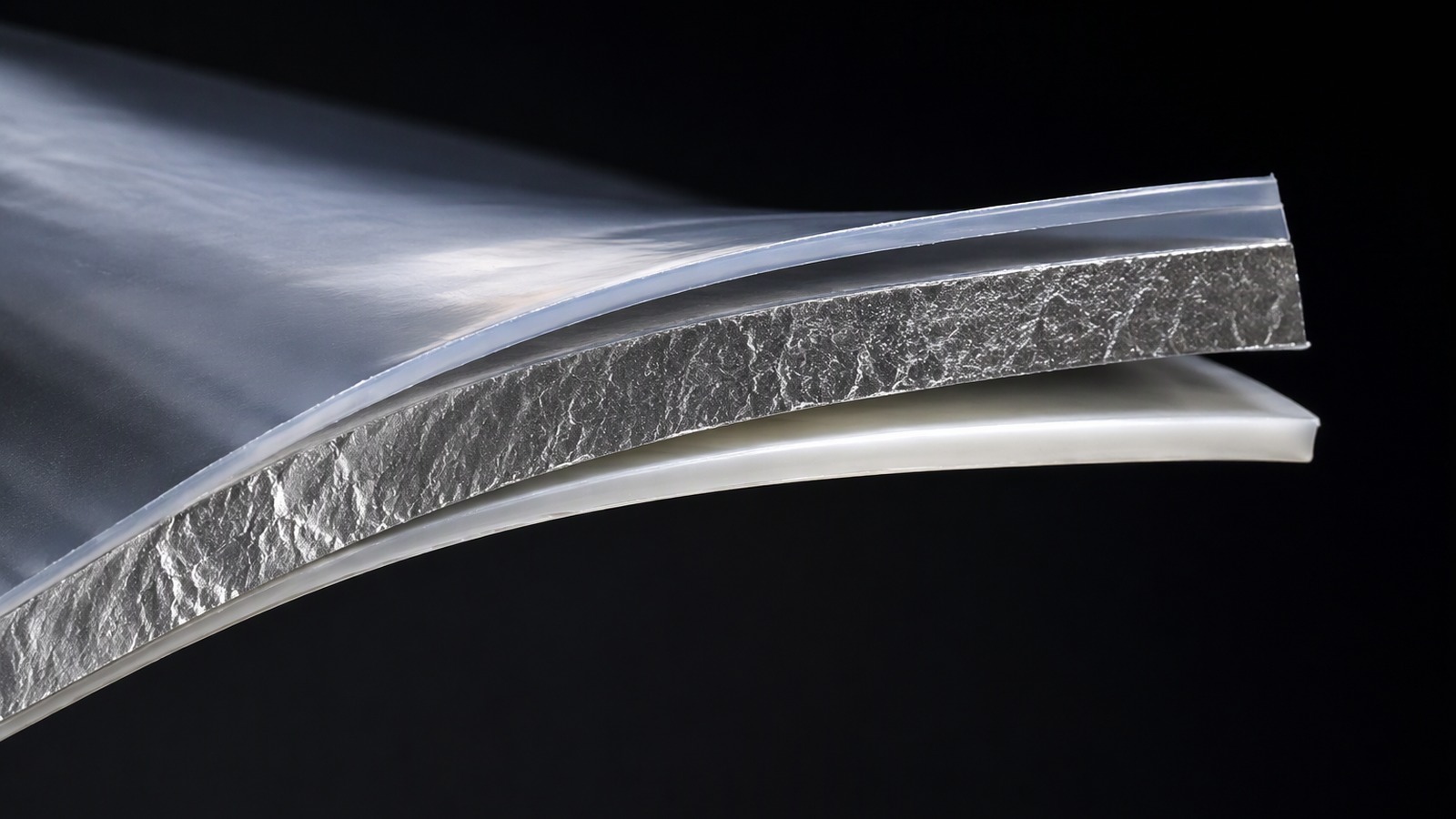
It adds the three functions a polymer lacks: an opaque light stop, a lasting closure of the vapour and gas path, and a ductile layer that flexes without cracking.
Dive deeper
Take the light first. A clear film passes visible and ultraviolet light into the product, and in an oil, a juice or a dairy liquid that light starts a chain no antioxidant fully stops. A metal ply ends it at the surface, which is why a light-sensitive liner is specified with foil rather than with a clear high-barrier film.
Then the gas path. A polymer is not a solid wall at the molecular scale; small molecules travel between the chains, and the rate rises with temperature and with flexing. Aluminium has a metallic lattice, so a continuous layer behaves as a sheet rather than a sieve, which is the difference between a barrier that holds and one that only slows the loss.
Then the mechanical side. Foil is ductile and it dead-folds, so it follows a corner crease instead of fighting it and spreads a point load wider than a stiff film would. That is also why the metal sits inside the laminate, away from abrasion and acid attack.
One more effect is easy to miss on a fast line. Metal conducts heat, so the ply evens out temperature across a sealing jaw and along the seam, which widens the processing window a co-packer has when line speed changes.
Which gauge belongs in a bag-in-box liner?
Gauge is a compromise between barrier, flex life and the laminator, chosen as a band rather than a single figure.
The ply sits in the middle of the converter range: heavy enough to keep few pinholes through repeated flexing, thin enough to laminate and fold without springback at the corners. The exact figure follows a converter trial.
Dive deeper
Gauge matters more here than in a flat pouch because of the fold. A liner is creased into a box, and the crease is where a thin metal layer most easily develops a pinhole. As gauge falls, the count of pinholes in a web rises, and the ones at a crease sit where the product presses hardest.
The opposite limit is set by the laminator and by the fold. A heavier ply resists being folded flat into a corner, springs back after the box is closed and can lift a seam already made, and once the layer is continuous, extra metal adds stiffness rather than protection.
In practice the answer is a band: an intermediate converter gauge, chosen with the converter so the crease stays sound at the corner radius the box actually has. A trial on the real box and line settles it faster than any table.
Alloy and temper narrow the band. The usual start for a strong, pinhole-resistant ply in a soft temper is 8021 aluminium foil, with 8079 much the same and 8011 or 1235 where a converter's laminate already runs well; the designations follow compositions registered by the Aluminium Association. Temper is normally O or H22 for a ply that has to drape.
Why is the liner a laminate rather than foil alone?
Foil alone cannot be sealed into a liquid-tight seam, and it cannot be joined to a valve. Polymer layers do that work.
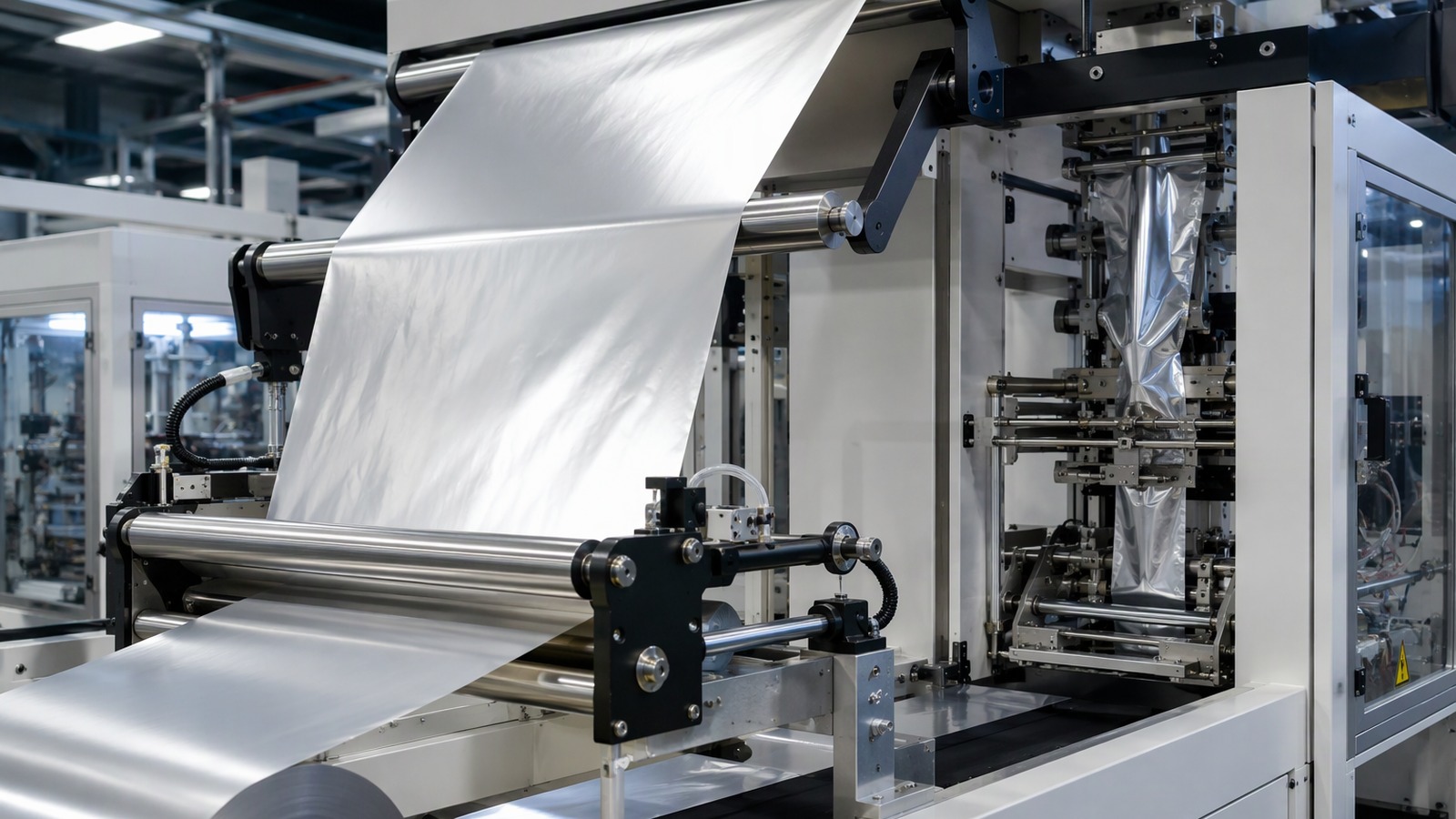
Because the foil carries the barrier and nothing else. A sealant makes the seams and the valve joint, a structural layer carries the flex load, and the foil sits between them, protected from abrasion.
Dive deeper
A metal surface does not weld to itself at a filling-line temperature, and it does not wet out into a continuous seam. A laminate solves that with a heat-sealable polymer on the product side: a plain polyethylene for an aqueous liquid, a more resistant grade where the product carries acid, alcohol or essential oil.
The foil then has to be protected. On the product side the sealant covers it, so an acidic or salty liquid never reaches the metal. On the outside a structural film, usually polyester or nylon, keeps the foil off the box wall and away from abrasion during loading. Burying the metal is what lets a ply from the packaging and container foil range, such as a plain 1060 aluminium foil where the outer film carries the strength, survive a long draw-off.
Adhesion holds the stack together. The bond has to survive flexing, the corner crease and the pull at the spout without the layers parting at a seam edge. A delaminated edge is a channel, and a channel shows up as a stained box rather than as a leak on the line.
The order of layers also sets stiffness. A structural outer film holds shape while the box is loaded, which makes fitting repeatable, and still drapes enough to follow the corner.
What happens at the valve and the spout?
The valve is the one place where the barrier is interrupted on purpose, and where a liner often leaks.
The valve is joined through the laminate to the sealant, so the joint is polymer to polymer rather than metal to metal. The foil stops short of the weld zone.
Dive deeper
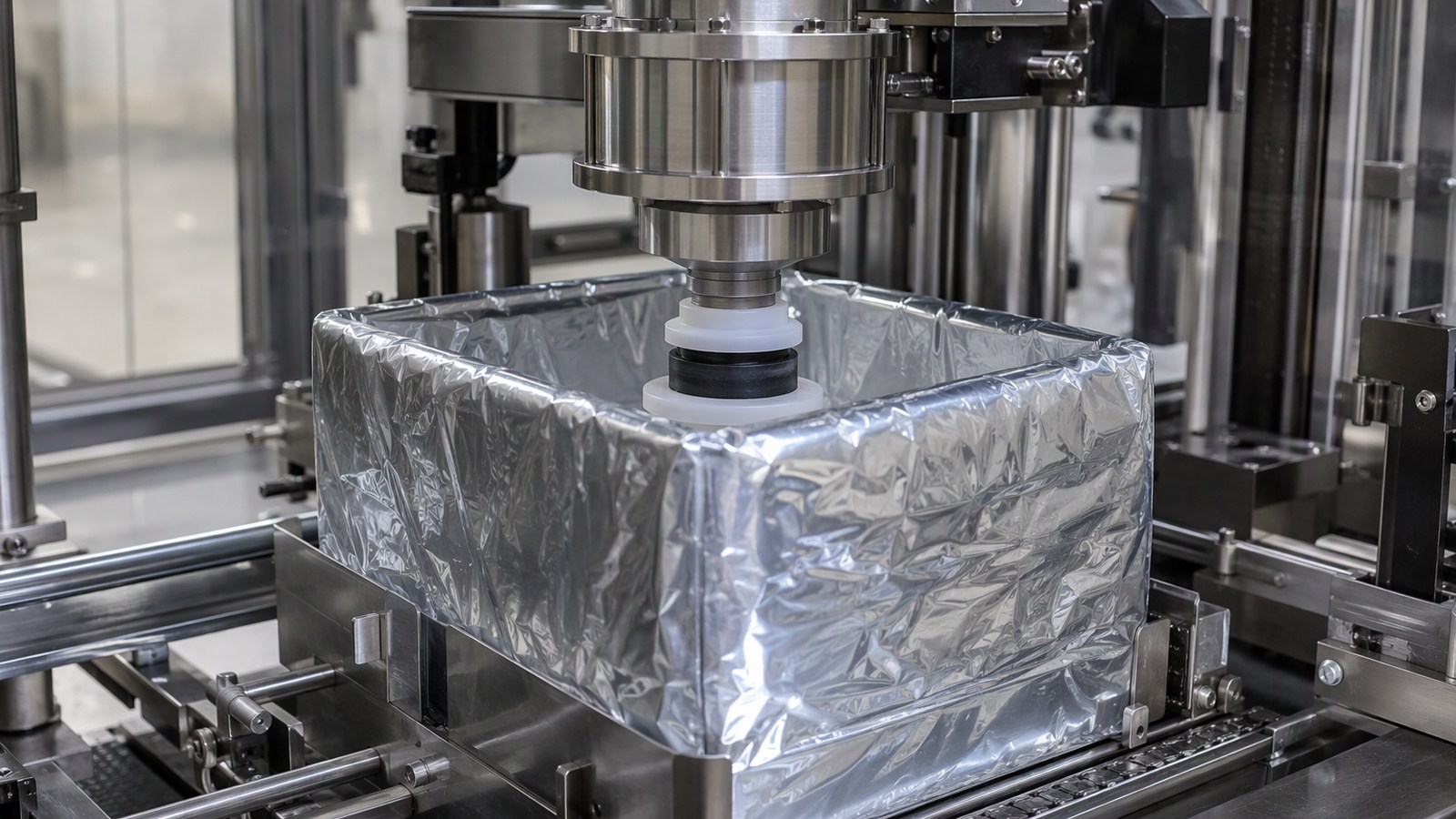
A valve is fitted by welding a plastic body into a cut in the liner. The weld is made between the valve flange and the sealant, which is why the sealant has to suit the valve material and be thick enough there to flow into the joint. The foil is not welded: it is cut back so the weld zone is polymer only.
That cut-back is the weak point. A ply ending too far from the weld leaves a ring of sealant with no metal behind it, and that ring has the least barrier and the most stress. A ply ending too close can be gripped by the tool and torn. The distance is fixed with the valve supplier, not varied between batches.
The spout also concentrates load. A filled liner hangs from the valve when it is dispensed, so the weight of the product passes through a small welded ring, and every movement of the box works that ring in peel and in shear. A backing collar spreads the load into the laminate.
Finally the closure. A cap that seals on the spout keeps the barrier closed between draws, and a cap refitted many times is a joint in its own right. The valve is specified as a system with the liner, checked on a filled box.
Why does a filled box test the liner differently from an empty one?
An empty liner is checked flat on a bench. A filled one meets a standing head of liquid, tight corner folds and a box that moves.
A filled box loads the liner three ways an empty one never does: a standing head at every seam, corner folds held tight and repeated flexing. Failures appear at folds and at the valve.
Dive deeper
The first load is pressure. A standing column of liquid pushes on the whole inner surface, and the pressure at the bottom is higher than at the top. A seam that holds when the liner is empty may weep when it is full, because the sealant is peeled rather than merely wetted, and the bottom seam and the valve see most of it.
The second load is geometry. Once filled, the film is pushed against the box walls and into the corners, and the folds are held flat by the product rather than left free to open. A crease formed during fitting becomes a permanent fold under load, and a pinhole there has a column of liquid behind it.
The third load is movement. A filled box is lifted, stacked, dropped and dragged, and each event flexes the laminate somewhere. The box carries the stacking load, which spares the liner compression but does nothing about the liquid inside. A dry bulk liner meets none of this, which is why aluminium foil for bulk bag and FIBC liners follows another logic.
So a liner is qualified on a filled box: filled through the valve, closed, handled, left standing, then inspected at the folds, the seams and the spout. A flat bench sample tells the filler very little.
How is the liner fitted so the barrier stays intact?
Fitting is where a sound liner is damaged: the film is folded, pushed into a box and clamped at a spout, often by hand.
The liner is loaded before the box is closed, aligned so the spout meets the cutout without stretching, and left with slack at the corners.
Dive deeper
The sequence matters. A liner is placed into an erected box, or the box is built around a pre-loaded liner, and in both cases the film has to reach the spout cutout without being twisted. A twist is worse than a wrinkle: it puts a permanent shear into the laminate and pulls the weld ring out of plane.
The corners need slack. Fitted tight, the first fill pulls the film off the box walls and loads the seams before the product settles. Fitted loose, the folds have somewhere to go and the seams stay in compression rather than in peel. The amount is a fitting instruction, set by the box and the fill.
Sharp edges are the other hazard. Flute ends, staple points and a rough cutout can abrade a laminate while it is pushed into place, and abrasion on the outside of the foil stays invisible until the barrier has gone. A taped cutout removes most of that risk.
Then the box has to close without pinching the film, because a flap that closes on a fold creases the foil where it will stay under load. A box that has stood in a cold store makes this harder, since the laminate stiffens; that side of the problem is covered in foil for frozen and chilled food packs.
What must an enquiry for a bag-in-box liner foil contain?
Most liner enquiries arrive as a film request. A foil mill needs the structure, the line and the joint, not only an alloy.
Send the laminate structure and where the foil sits, the alloy and temper, the width and core, the filling method, the valve type and the product family.
Dive deeper
Start with the structure. Name the layers in order, say which side faces the product and where the foil sits, and state the sealant family. A mill can then judge whether the ply you asked for is the one that will survive the crease.
Then the metal: alloy, temper, width and core diameter, 76 mm or 152 mm. 8021 and 8079 are the usual start, with 8011 and 1235 where the converter has a running structure, in O or H22 for a draping ply. Say whether the face is bright, plain or lacquered.
Then the line and the joint: how the liner is filled, whether the valve is welded in by the converter or by the filler, what the valve body is made from, and whether the box is erected around the liner or the liner dropped in.
Finish with the commercial frame. State the product family, since an acidic or fatty liquid changes the sealant choice, and the annual and per-size quantities, because liner foil is normally supplied against a minimum order of 3 MT per size. Loading is from Qingdao, Tianjin or Shanghai, and the notes published by European Aluminium or the guidance at alufoil.org make a useful cross-check.
A bag-in-box liner works because the box takes the load and the foil takes the barrier. Specify the ply, the laminate, the valve joint and the fill together.