What does an aluminium foil stiffener actually do to a panel?
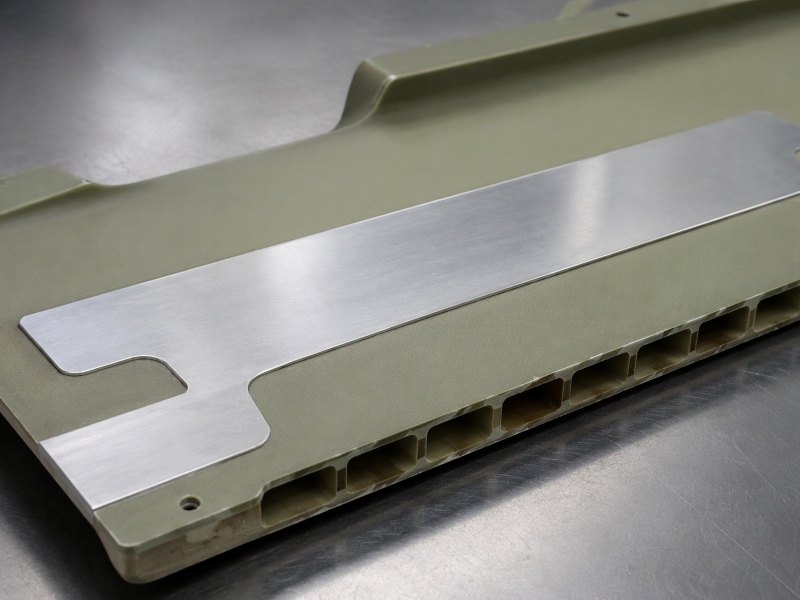
A bonded stiffener changes how a panel resists bending: it puts metal away from the neutral axis and spreads load across an overlap. Gauge, bond area, flatness and joint type decide whether the plate works.
What does an aluminium foil stiffener actually do to a panel?
A panel that flexes in service gets blamed on the gauge, so the first fix is a heavier skin, and the flexing returns.
A bonded stiffener holds a second layer of metal away from the skin, so the assembly resists bending as a deeper section rather than one thin sheet.
The eight questions below follow it from what a stiffener does to how it is ordered, and stay qualitative, because the numbers belong to the panel.
What does a bonded stiffener actually do to a panel?
A stiffener carries almost none of the working load; it changes how the panel resists bending.
It puts metal away from the middle of the panel, so a bending panel must stretch one face and compress the other instead of rotating about its centre.
Dive deeper
Picture a flat panel in bending. The face on the outside of the curve stretches, the face inside compresses, and the material near the middle barely moves. That middle zone is dead weight in bending terms: present, paid for, and doing very little. A bonded stiffener puts a second layer of metal far from that middle, so the section resisting the bend is deeper than the skin alone. The alloy has not changed; the geometry has.
A stiffener also shortens the span. A panel supported only at its edges bends across the whole distance between them, and the amount of bend rises steeply with that distance. Bond a plate across the middle and each side gets a shorter unsupported field. Depth in the section and less span to bend over are separate effects, and they add: one is bought with section depth, the other with plate spacing.
What changes most is the failure mode. A bare panel announces itself by oil-canning, drumming or a visible bow between fixings. A stiffened panel rarely bows; it tends to fail at the boundary of the stiffener, by peeling the bond at an end or by letting the unsupported skin between two plates buckle. That is why a stiffener is never simply a plate dropped in the middle of a panel.
Why use a metal plate instead of simply making the panel thicker?
Thickening the skin raises rigidity everywhere, including where nothing bends, and adds mass along the whole panel.
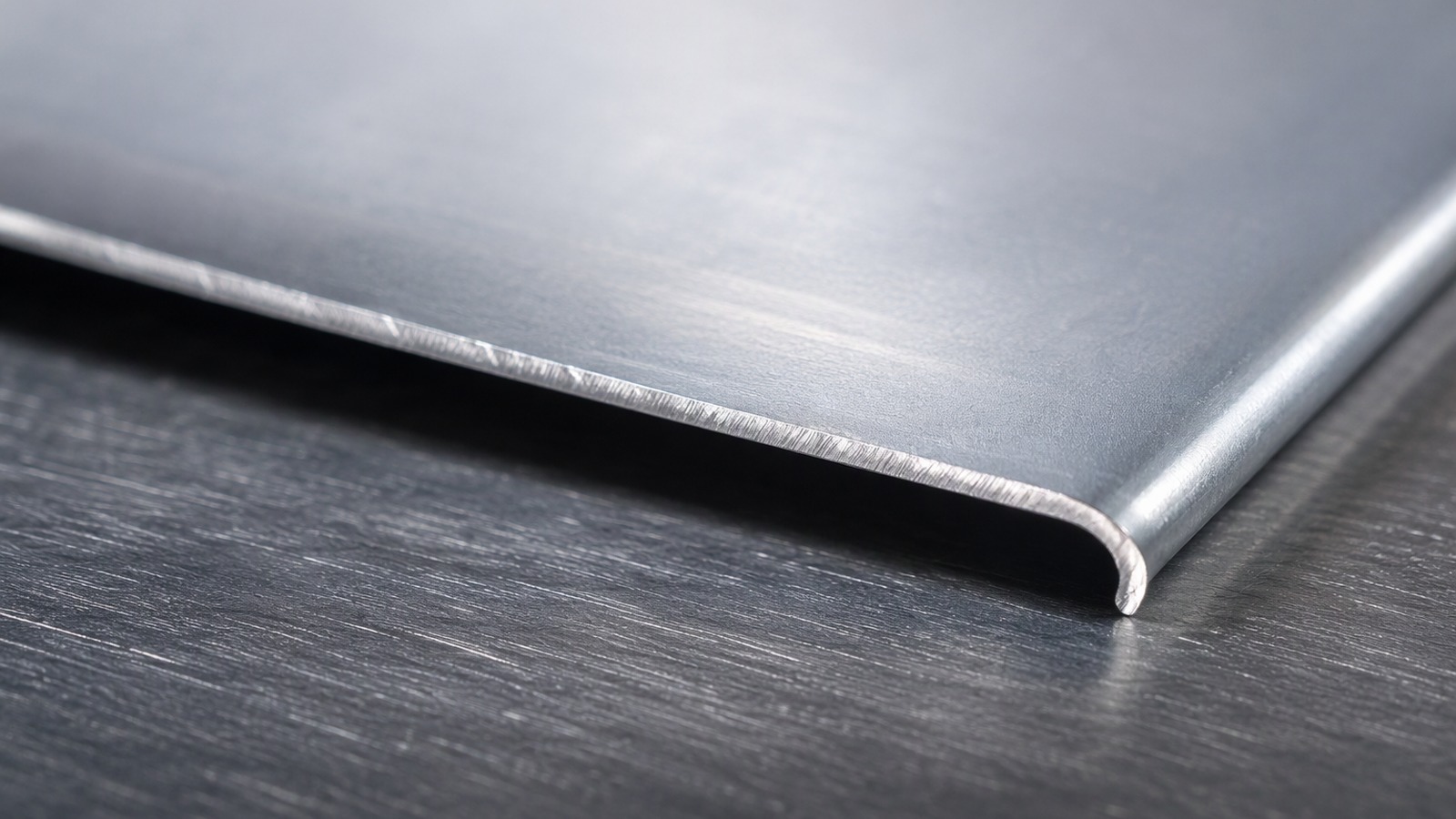
A plate puts material only where the span needs it and further from the neutral axis, so a thin skin with a bonded plate can beat a heavier skin.
Dive deeper
Thickening a skin is the simplest idea and the least efficient one. More gauge adds mass across the entire panel, including the areas that were already stiff enough because they sit near a fixing or a fold. It also does nothing about span: the panel still bends across the full distance between supports, and it still drums in the middle when that distance is large. The gain is real, but it is bought at full-panel weight.
A bonded plate is a local answer. The fabricator looks at where the panel actually moves and puts metal there. Because the plate sits on the surface, its contribution depends on its distance from the middle of the panel, and a plate on one face is already far from that middle compared with the skin it stiffens. For the same added mass that is a better return than an even increase in skin gauge.
There are practical reasons too. A thicker skin changes every downstream operation: forming force, springback, cut edge and the load on every fixing. A plate changes one area and leaves the rest of the panel untouched. It also lets a fabricator hold one skin specification across several variants and differentiate them with plates. Much of this material sits in the industrial and technical foil range, and the Aluminum Association covers the metal behind it.
Which gauge makes a stiffener and which makes a skin?
The same coil range covers both jobs, so the split is about what the part must do, not a product name.
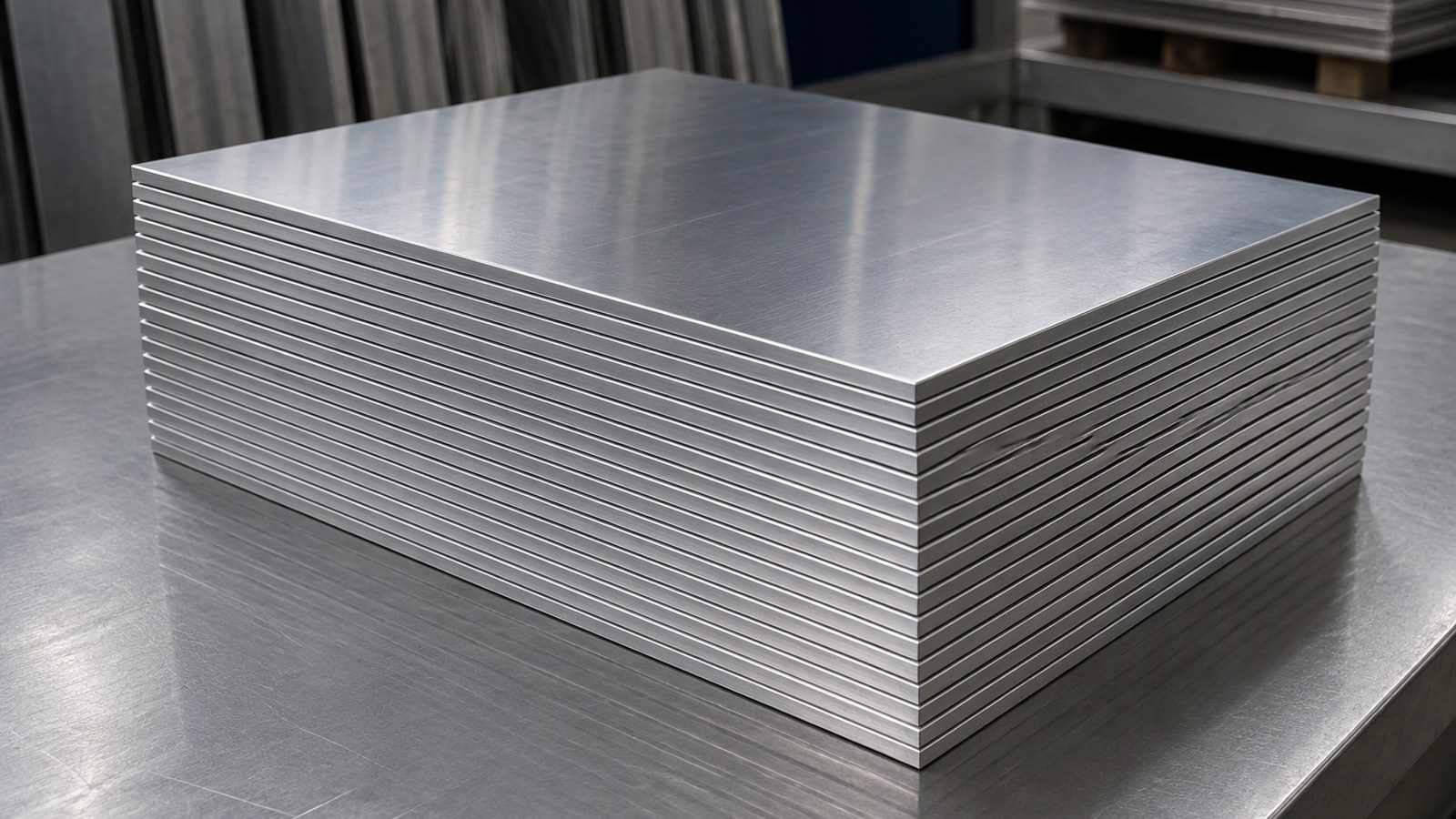
The light end is skin work; the heavy end, up to 0.20 mm, is where stiffeners are cut, and alloy and temper decide how the plate behaves.
Dive deeper
At the light end, foil is a barrier and a facing. It drapes, follows a radius, conforms to whatever is under it, and its own rigidity hardly matters because the substrate provides it. Move up the range and the behaviour changes by degrees: the web stops draping, starts to hold a set, and begins to resist handling. Somewhere in that transition the material stops being a skin and becomes a plate.
The top of the range is where stiffener work sits, because a stiffener has to arrive flat, stay flat through bonding and hold its shape while the bond sets. Below that, a plate is possible but needs support during handling and telegraphs every imperfection under it. Gauge is not a quality ranking: a light gauge used as a stiffener is the wrong tool.
Temper matters at this end as much as gauge. A soft plate conforms to a wavy panel instead of flattening it and dents at the edge of a clamp; a harder temper holds the shape it was cut in, . 3004 aluminium foil at 0.18 mm in H18 sits at the top of the range, 8021 aluminium foil at 0.1 mm in H24 covers the middle where a wall must hold shape, and 3003, 1050, 1060 or 1100 appear where forming and cost weigh more than strength.
Why does the bond area matter more than the metal?
A stiffener attached at a few points is a bracket, not a stiffener: the panel bends between the attachments.
Rigidity comes from load passing continuously from skin to plate, so bond area, not plate gauge, sets how much stiffness the panel sees.
Dive deeper
Think about how the load gets from the panel into the plate. The panel bends, its surface wants to slide relative to the plate bonded to it, and the bond resists that sliding along its length. With a continuous bond every part of the plate is dragged into the work. With a bond only at the ends, the middle of the plate does nothing and the panel bends freely between the patches.
That is why the bond area, not the plate gauge, usually decides whether the part works. A heavy plate bonded over a narrow strip behaves like a small plate with a heavy edge: the panel finds a hinge line just outside the bond. A lighter plate bonded over a wide, well-prepared area behaves like a stiffened panel. The metal is only as useful as the area through which it is connected, and the surface texture under it decides how much of that area is real.
Continuity is the other half. Interruptions matter: a gap for a cable, a hole for a fixing, an area left dry because the panel was not flat. Each one shortens the path the load can take. The ends deserve particular attention, because that is where load enters and leaves, and where peel starts if the bond is starved. Industry context on the metal sits with European Aluminium.
How does a stiffener behave when the panel is loaded?
Under load the pair does not act as one piece everywhere; skin and plate share the work unequally.
In the middle of a stiffened field the layers move together; near the ends load transfers through the bond, so shear and peel concentrate there.
Dive deeper
Load a stiffened panel and the first thing that happens is a change of shape, not a failure. The panel bows slightly, the plate bows with it, and the bond is loaded in shear along most of its length because the two layers want to slide past each other. Shear is the mode a bond handles best, which is why a well-made stiffener is a dependable part. The metal background is summarised under aluminium foil.
At the ends of the plate the picture changes. Its load has to enter and leave the panel over a short distance, so shear rises towards the end and a peel component appears wherever the panel is not perfectly flat. Peel is the mode a bonded joint handles worst, which is why stiffeners usually run past the point where the panel needs them instead of stopping at the edge of the high-load zone.
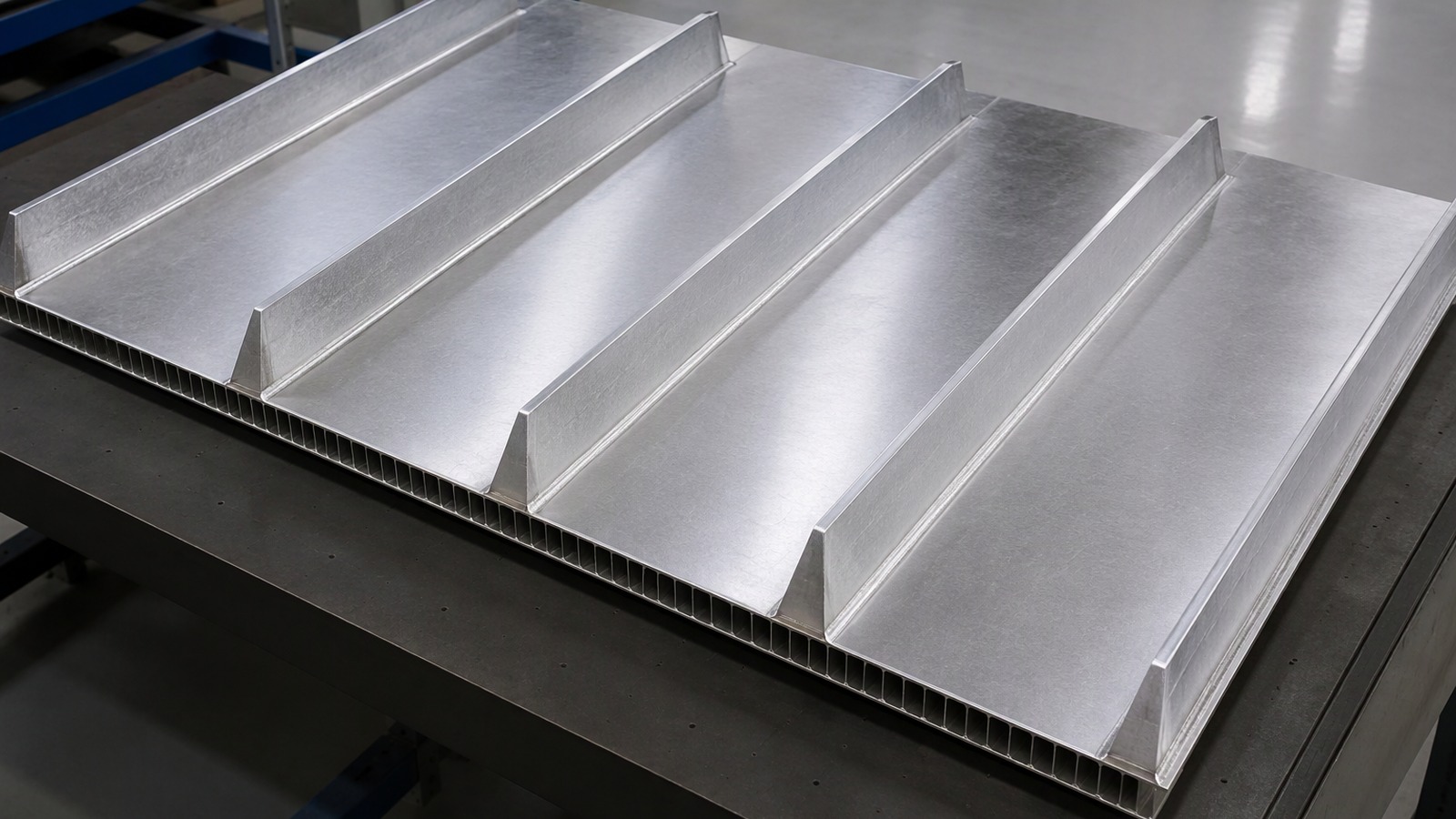
The skin between stiffeners is loaded too. It is now a small panel supported on four sides, and it can buckle or drum well before the stiffened section is in trouble. Stiffener spacing, not plate gauge, often sets the limit of the design: closer plates on a lighter gauge can carry more than one heavy plate with a wide field between them.
Why does flatness decide whether a stiffener works at all?
A stiffener cannot pull a wavy panel straight; it can only stiffen the shape the panel already has.
A bond transfers load only where the surfaces meet, so a plate bonded to a panel that is not flat carries load at the high points.
Dive deeper
Flatness matters twice, and the second time is less obvious. The first is contact: a bond needs plate and skin to meet across the intended area. A panel with a bow or a twist touches a straight plate at a few high points, the bond there is thick, and the rest of the area is starved. What looked like a full bond area behaves like a set of small pads.
The second is that a stiffener preserves what it is bonded to. If the panel is flat when the plate goes on and the bond holds, the assembly stays flat, which is why stiffening is specified for shape retention as much as for rigidity. If the panel is not flat, the plate locks the wave in: the panel reads as stiff and still looks wrong, and no amount of extra gauge takes the wave out.
That is why the plate has to arrive flat itself. Heavy foil that has been coiled, stacked or handled badly carries a set, and a plate with a set cannot flatten anything. A plate stored on edge or stacked without support takes a curve before it reaches the bonding table. At this gauge the material behaves close to sheet, so the difference between aluminium foil and aluminium sheet is worth settling first.
What changes when the stiffener is bonded rather than mechanically fixed?
A rivet joins two parts at points; a bond joins them over an area, and that changes how the stiffener behaves.
Mechanical fixings clamp at discrete points and let the panel work between them, while a bond spreads the load across the whole overlap.
Dive deeper
A mechanical fixing works by clamping. The plate is pulled against the panel at each fastener, and the panel is stiffened between fasteners only as far as friction and contact allow. The fasteners are the weak path: each one concentrates load into a small area of skin, and each hole removes material exactly where the load has to pass. Holes also give a tear or a crack somewhere to start.
A bond has no holes and no local clamp. Load is spread across the overlap, the panel surface is not perforated, and the assembly keeps a continuous outer face, which matters where the panel is a visible surface or a barrier. A bonded plate also sits lower, because no fastener head or washer stands proud of it.
The trade is in access and inspection. A bonded plate cannot be tightened later and cannot be removed without destroying the bond, so the surfaces have to be right first time and the process has to be controlled. Mechanical fixing tolerates a wider variation in surface texture and a less flat panel; a bond does not. Many assemblies use both, with the bond carrying the stiffness and a few fixings holding the plate until it sets. The foil trade body at alufoil.org follows the same split between rolled material and finished assembly.
What must an enquiry contain?
Enquiries that arrive as a gauge and an alloy are the ones answered with a question, which costs a day.
Send the panel, its support points, where it flexes, the bond shape and area, the surface preparation, the cut edge and the quantity.
Dive deeper
Start with the panel, not the foil. What is it made of, how thick is the skin, where is it supported, and what load or handling makes it flex? A panel that drums between two edges is a different problem from one that bows along a single edge, and the two take different plate layouts. A sketch with the support points marked answers more than a paragraph.
Then describe the joint: which face is bonded, how much of it, and how the surface is prepared beforehand. Say whether the plate is continuous or interrupted, and whether its ends can run past the high-load zone. State what the assembly must not do, such as no visible bow or no movement at a seal. Those are requirements a supplier can work to; "make it stiff" is not.
Finally the supply details: gauge within the foil range, alloy and temper, and whether parts come as cut plates or as coil for you to blank. Coil width can run from 100 mm to 1500 mm on a 76 mm or 152 mm core, Plate cut from the right width saves an operation. Quantity matters: 3 MT per size is the minimum order here, and loading is from Qingdao, Tianjin or Shanghai. Include the cut edge, because a heavy plate is trimmed after bonding, and why heavy gauge foil needs a different tool explains what that edge depends on.
A stiffener is geometry and bond area working together; get the flatness and the overlap right and the gauge becomes a detail you can specify with confidence.