How Is Aluminium Foil Printed Before Lamination?
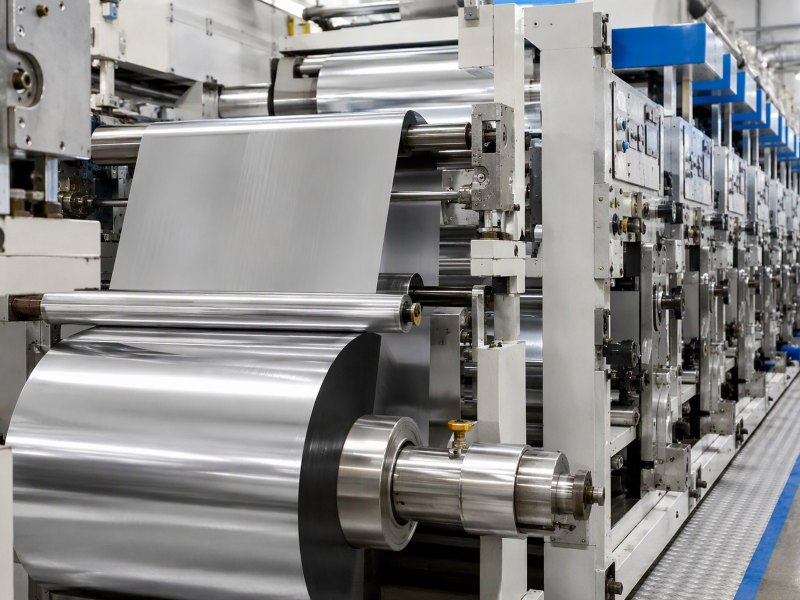
Foil is printed while it is still bare metal, then laminated over the print. That order explains the treatment step, the face choice, the register problems and why so many print faults begin at the mill rather than at the press.
How Is Aluminium Foil Printed Before Lamination?
Print ordered after lamination turns a metal problem into a finished-pack problem, and the press becomes the last place to find it.
Foil is printed before lamination so ink lands on treated bare metal, where it wets, dries and can be inspected; laminating then seals the print inside, away from the fill.
Unwind, treat, print, dry, laminate: each step resets the surface the next depends on.
Why is aluminium foil printed before it is laminated rather than after?
Print after lamination and the ink lands on a film, not metal, on a structure already built and already expensive.
Because printing first puts ink on treated foil, where adhesion, drying and inspection are controlled; laminating afterwards buries the print, so ink never meets the fill and the film wears.
Dive deeper
Lamination is a sandwich operation: two webs, an adhesive or a melt layer, heat and pressure at a nip. Once that sandwich closes, the printed face sits inside it and nothing in the pack can reach the ink. Print applied afterwards would have to bond to the outside of that sandwich, a surface chosen for sealability or slip rather than for ink reception.
Inspection is the second reason. Bare printed foil can be checked on the press against a light and a reference sample, with the web running. After lamination the print is read through a film, and film haze, adhesive striation or trapped air look like print defects even when the print is sound, so the press is adjusted for a laminator problem.
Cost is the third. A fault caught at the press wastes foil and ink; the same fault caught after lamination wastes the second web, the adhesive, the run and the slitting, and it may surface after the customer has fixed a width. Printing first keeps the decision where it is cheapest. Associations such as European Aluminium describe converting as a chain of steps: each is easier to govern while the web is single, and a laminated roll that fails has no second chance at the press.
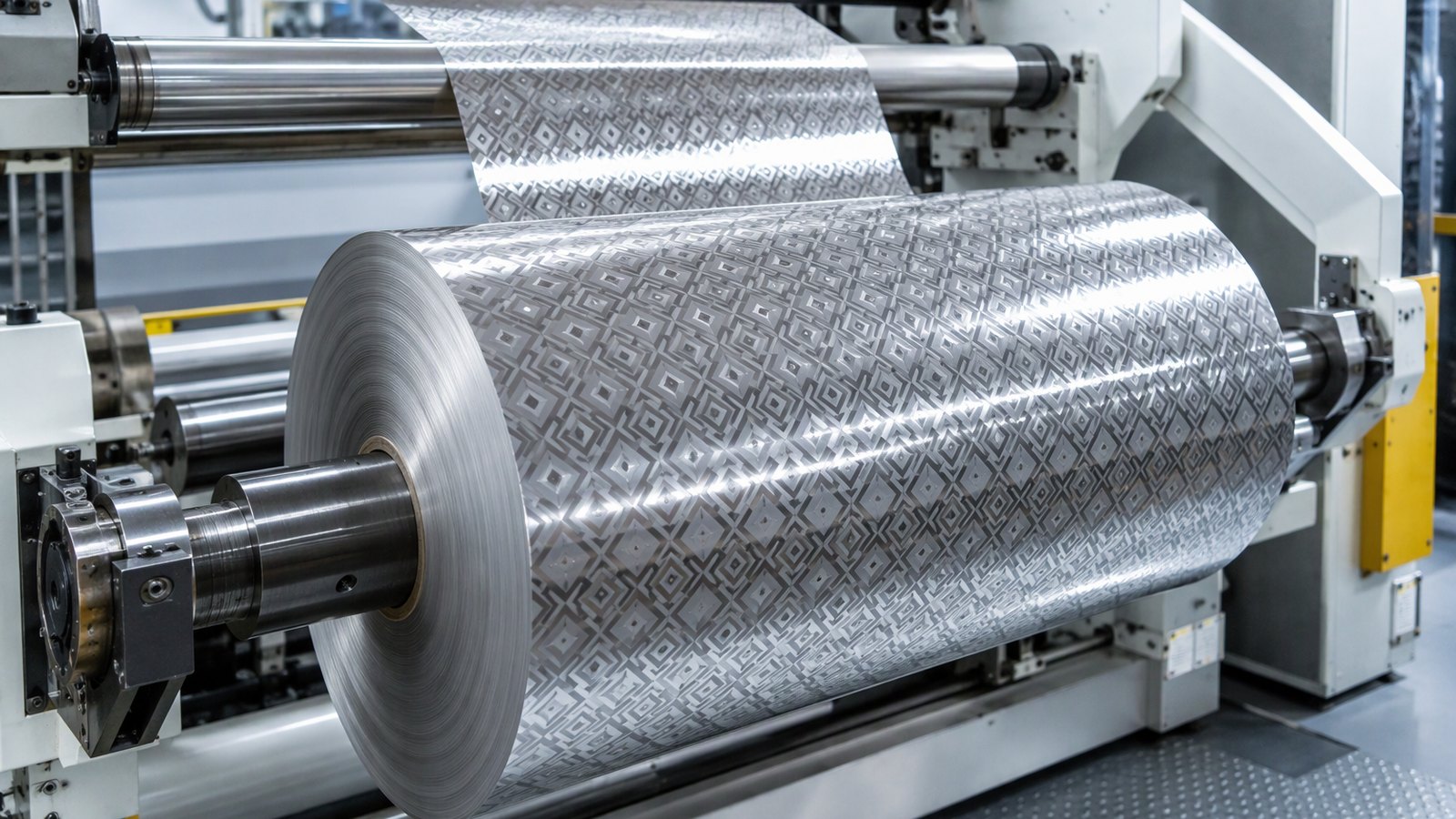
How does ink behave on a bare aluminium surface?
Metal does not absorb. Every drop of ink must wet the surface, stay where it was placed and dry by losing carrier.
Ink sits on foil as a film rather than soaking in, so it must wet a low-energy oxide, survive drying and key to the metal; where wetting fails, the film pulls back into bare patches.
Dive deeper
Aluminium is rolled with a thin oxide skin that forms within moments of exposure, and that skin is chemically stable and low in surface energy. An ink formulated for paper relies on capillary absorption into a porous web to set and to anchor. On foil there is no absorption at all, so the whole job falls to wetting and to the chemistry of the interface.
Wetting is a contest between the surface energy of the metal and the surface tension of the ink. When the ink is the higher of the two, the droplet beads, the film retracts from the edges of the image and the print shows pinholes, crawling or a mottled look. Where wetting is good, the film levels into a continuous layer and the dried ink holds a clean edge.
Drying changes as well. Solvent and water inks lose their carrier in the oven, and the resin left behind must coalesce into a coherent film on a base that cannot absorb anything; too little heat leaves a tacky film that blocks in the rewind, too much makes it brittle. Adhesion comes from keying into the fine texture left by rolling and from polar groups at the surface, which is why the treatment step matters. Background on the metal is collected by Wikipedia.
Why does the foil need a treatment before the ink will hold?
Rolling leaves a surface that resists the ink it is meant to receive: clean to the eye, low in energy, holding a film of residue.
Because untreated foil presents a low-energy oxide with rolling residues, ink cannot wet or bond reliably; a corona discharge, a flame pass or a thin primer raises that energy or adds a receptive layer.
Dive deeper
A freshly rolled coil carries more than metal. Residual rolling oil, sometimes a protective film, dust from slitting and a thin oxide all sit between the ink and the aluminium. Some of it is invisible and none of it is uniform: the edges of a wide coil can carry more residue than the centre, and a roll stored on its side can pick up contamination along one band.
Corona treatment passes the web through a discharge that oxidises the surface, attaching polar groups that water and solvent inks can bond to. The effect is real but shallow, and it fades: treated foil left standing loses part of its gain, so treatment belongs just ahead of the press rather than weeks before it. Over-treatment is its own fault, leaving a weak boundary layer that lifts away with the ink.
A primer takes the other route. Instead of changing the metal, it adds a very thin receiving layer that the ink can wet and bond to, and it can run in line with the press. Which route suits a job depends on the ink, the press and the lamination that follows, and it is a conversation with the supplier. The mechanism is set out in why foil needs corona or primer treatment.
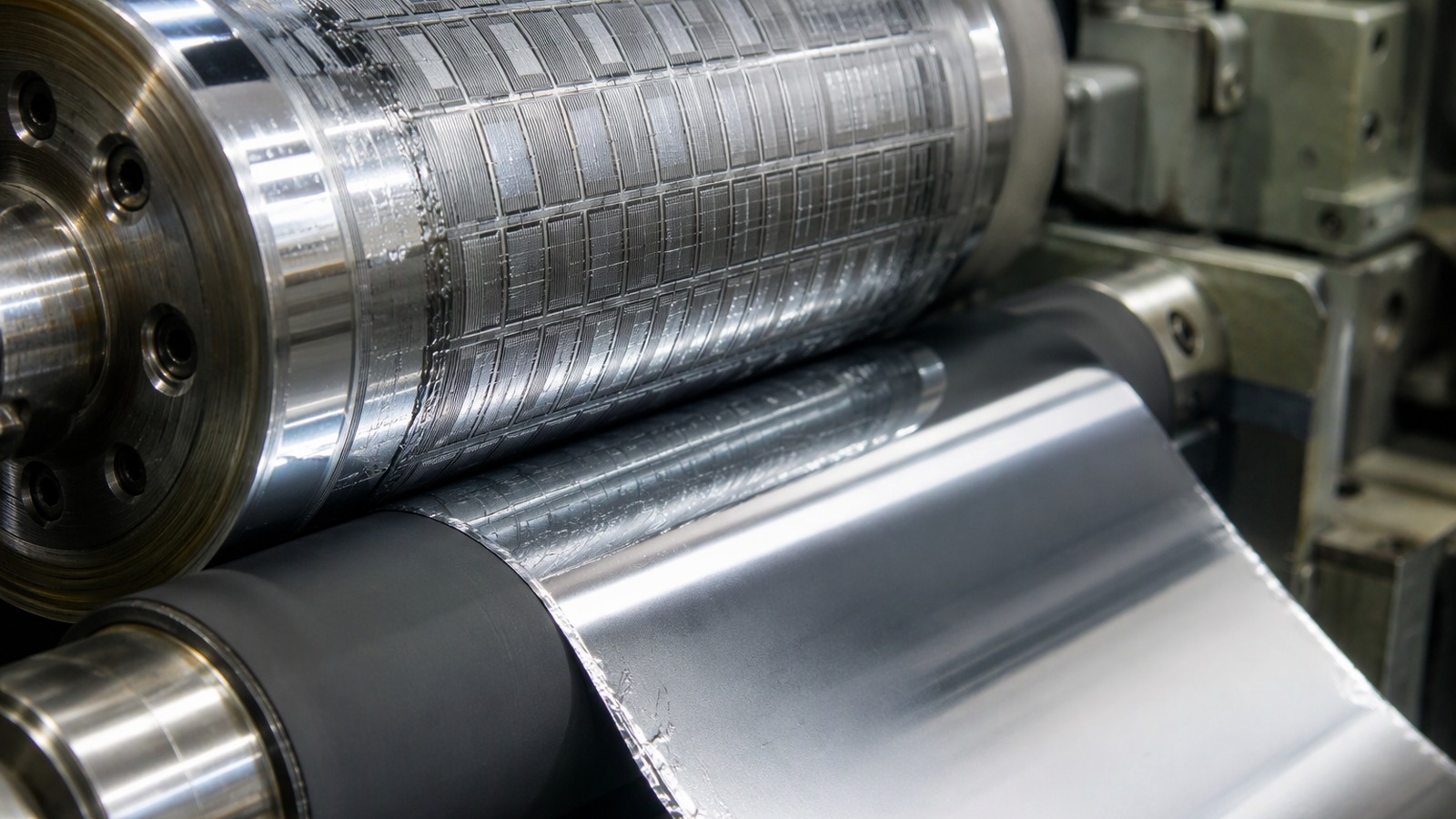
Which face of the foil carries the print?
A foil has two faces from two different rolls, and they do not behave alike. Choosing the wrong one wastes the treatment.
The print normally goes on the face buried inside the laminate, often the matte face as it leaves the mill, because it holds ink and the lamination protects it; the bright face stays free.
Dive deeper
Foil is rolled between a work roll and a backup, and the face that touches each one ends up with a different texture. One face comes away bright and reflective, the other matte and finely grained. The difference is small in gauge terms and large in printing terms: the matte face offers more texture for the ink to key into and scatters reflected light instead of showing every variation in the ink film.
Because of that, most printed packaging foil is printed on the matte face and laminated print side in. The print is then read through the foil or through the outer film, protected from the fill, the heat seal and the abrasion of the filling line. Where the print has to be visible on the outside, it goes on the face that will be outermost, and the ink then needs a protective coat or a film over it.
The practical point for a converter is orientation. If treatment is applied to one face and the roll is loaded the other way round, the press prints the untreated side and the ink fails for no obvious reason. Marking the print face on the roll, keeping the splice direction consistent and recording which face was treated turn a subtle difference into a controlled one.
Why does register slip on a foil web?
Register is alignment between print units, and foil gives it little room: the web has almost no stretch to spare.
Register slips because the web is thin, stiff and thermally active: tension differences, oven heat, drag on idlers and gauge variation change the path length, so colours arrive out of step.
Dive deeper
Every unit between two print stations adds or removes a small amount of web length. An idler with a dry bearing, a chill roll running cold, a dancer responding late or a tension zone set a little high will each stretch the web by a fraction that the next station sees as a shift. Paper absorbs some of that in its structure; foil has nothing to absorb it, so the shift goes straight into the image.
Heat is the other half. The web leaves a drying oven warmer and, depending on the ink carrier, either swollen or contracted relative to when it entered. It cools over the next few metres while still moving; if the distance between units is short the next colour is laid down before the web settles.
The cure is mechanical before it is electronic. Balanced tension zones, load cells that control rather than merely display, chill rolls that stabilise the web and a modest running tension all reduce the movement. Automatic register control can chase an error, but it works better when there is less error to chase, and it cannot straighten a web that is baggy on one edge. The incoming roll belongs in the same conversation; see the foil roll and sheet range.
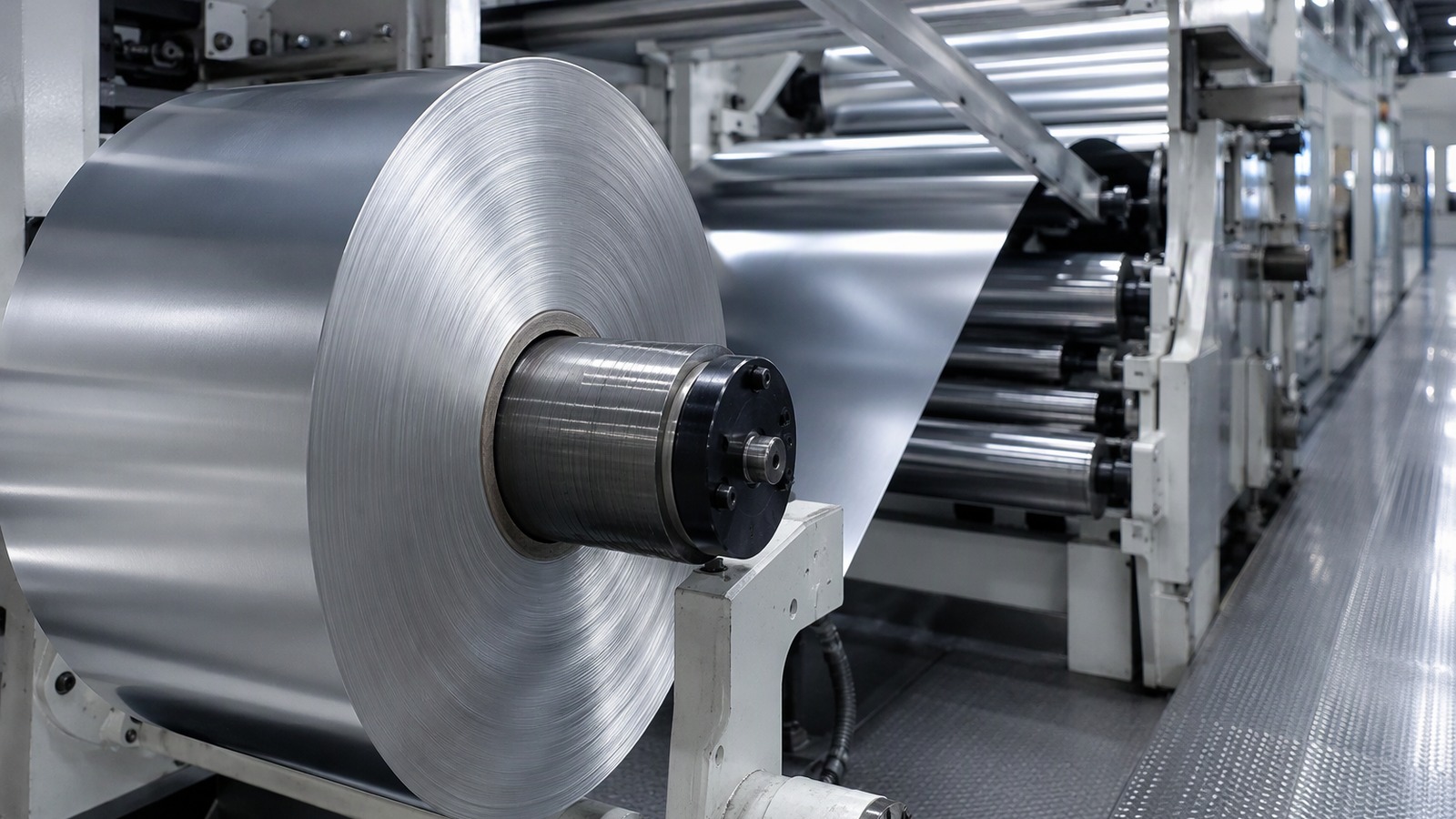
What does printing do to the web's flatness and tension?
A press is a series of nips, ovens and pulls, and each leaves a mark on a web that cannot spring back.
Printing adds and removes tension at every station, wets and dries the web and lays down an ink film, so the result can be a cockled web and a roll that no longer matches.
Dive deeper
Foil deforms permanently long before it tears. A tension high enough to keep the web flat in one zone may be enough to stretch it in the next, especially where the web is warm after an oven. The stretch is not uniform across the width: the centre and the edges cool at different rates, and a web that was flat at the unwind can reach the rewind with slack edges and a tight centre, or the reverse.
Ink adds mass and, in the oven, removes carrier. A heavy print area dries differently from a light one, so the web can develop a curl towards the printed face, and that curl persists into the rewind and shows up as a baggy roll. Static, which builds readily on a dry non-conductive web, pulls the sheet against rollers and adds drag that reads as tension variation.
The response is to taper tension through the machine and to keep the rewind soft. A printed roll wound as tightly as a mill roll will block, transfer ink and flat spot the outer layers, and the damage stays invisible until the roll is unwound at the customer. Winding tension, chill rolls and a trimmed edge decide whether the print survives the journey. Mill practice is described by the Aluminium Association.
Why does a print defect often originate upstream of the press?
The press is where a fault is seen, not always where it is made. By the time ink reaches the nip, the surface is decided.
Because the surface the ink meets was fixed at the mill and in storage: residual oil, oxide, moisture, dents, edge damage, gauge bands and baggy winding all change how the web prints.
Dive deeper
Look at the pattern before blaming the cylinder. A defect that repeats at a fixed interval along the web usually belongs to a roll or a cylinder circumference, and one that repeats across the width points to a roller, a coating or a mill condition. Random speckle is usually ink, dust or a dirty doctor blade. Periodicity is the cheapest diagnostic available, costing nothing but a length of printed web and a rule.
Gauge bands are a good example. A coil rolled with a slightly thicker band along one position prints differently there, because the ink film and the nip pressure are both affected, and the band reappears at the same position on every revolution of the unwound roll. No adjustment at the press removes it. The same is true of a baggy edge: the web wanders, treatment becomes uneven and the print fades along one side.
Storage adds its own contribution. A roll that has taken moisture at the edges, or has been stood on end and dented, will print a mark that no ink change can cure. Good converters keep a witness length from each incoming roll, print it and compare; that record separates a supplier problem from a press problem before either side spends money. The material background is summarised by Alufoil.
What must an enquiry for printed aluminium foil contain?
An enquiry giving only alloy and thickness comes back as a price for metal, not a printed roll, and the gap shows at proof stage.
An enquiry needs the structure and end use, the printed face, the print process and colour count, artwork status, alloy, temper, thickness, width, core, treatment route and quantity.
Dive deeper
Start with the pack, not the foil. What is filled, how it is sealed, whether the print sits inside the laminate or on the outside, and what the pack must survive afterwards. Those answers decide the face, the ink system and whether a protective coat is needed, and they are the questions a supplier will ask first. A drawing of the layer order beats a paragraph of description.
Then the metal, in the supplier's own units: alloy from 1050, 1060, 1100, 1235, 3003, 3004, 8011, 8021 or 8079; temper from O, H14, H16, H18, H22 or H24; thickness between 0.005 mm and 0.20 mm; width from 100 mm to 1500 mm; core 76 mm or 152 mm; minimum 3 MT per size; and a loading port such as Qingdao, Tianjin or Shanghai. Two starting points are 0.06 mm aluminium foil in 1060 and 0.1 mm aluminium foil in 8021.
Finally the print: number of colours, coverage, whether the design relies on the metal showing through, the repeat length and who supplies the cylinders. Say whether treatment happens at the mill, at the printer or in your own plant, because that decides who owns the adhesion problem. If a lacquer or heat-seal coat follows, say so at enquiry stage; lacquering and when it is needed explains why the two steps are specified together.
Print the metal while it is still bare, treat it just before the ink, and settle the face, the register and the roll width before ordering.