What causes static electricity in aluminium foil converting?
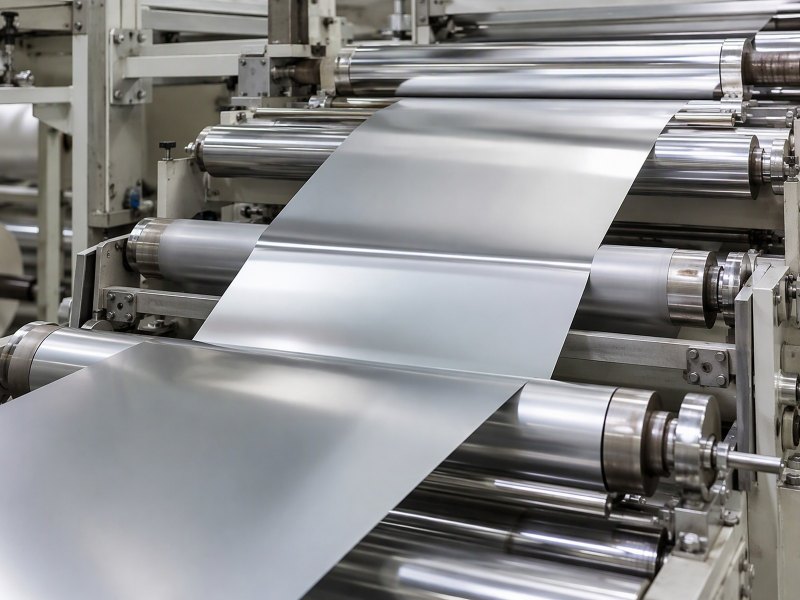
A metal web should not hold charge, yet foil lines spark, block and jam. Here is where the charge is made, why dry air and speed make it worse, and what actually removes it.
What causes static electricity in aluminium foil converting?
The line runs, the foil looks clean, then a web slaps down onto the rewind, dust clings and the slitter jams for no visible reason.
Static on a foil line comes from contact and separation, not from the metal failing to conduct: every unwind, roller and slitting cut moves charge, and a dry web at speed cannot shed it to earth fast enough.
The eight questions below follow the charge from where it is made to where it shows up, and separate what a bar can fix from what only the web path can.
Why does a metal web carry static at all when metal conducts?
Aluminium conducts, so the charge should vanish. On a running line it does not, because conduction needs a closed path and time.
A conductor only moves charge if it is connected to something. A foil web on dry rollers is often insulated from earth by the very surfaces it touches, so charge collects locally even though the metal itself conducts well.
Dive deeper
A metal conducts charge; it does not destroy it. Charge has to travel somewhere, and the route runs from the web surface into a roller, through a bearing and a frame, into earth. Break that route at any point and the web keeps whatever it has picked up.
Rollers are where the route usually breaks. Many are covered in rubber, polymer or ceramic because the covering gives grip, release and web control, and those coverings are chosen precisely because they do not conduct. The foil touches the cover, exchanges charge at the interface, and then crosses the open gap to the next roller still carrying that charge. The machine frame can be earthed; the web is not, because everything between the two is deliberately insulating.
A second effect makes it worse. Charge spreads across a conductor's surface, so a wide, thin web can carry a large charged area at a modest potential and still misbehave. A foil of 0.15 mm reads as a conductor in the hand and behaves as a charged sheet on the machine. Dwell time matters as well: a web crosses a contact point in milliseconds, long enough to share a little charge and far too short to shed all of it. For material background, see aluminium foil.
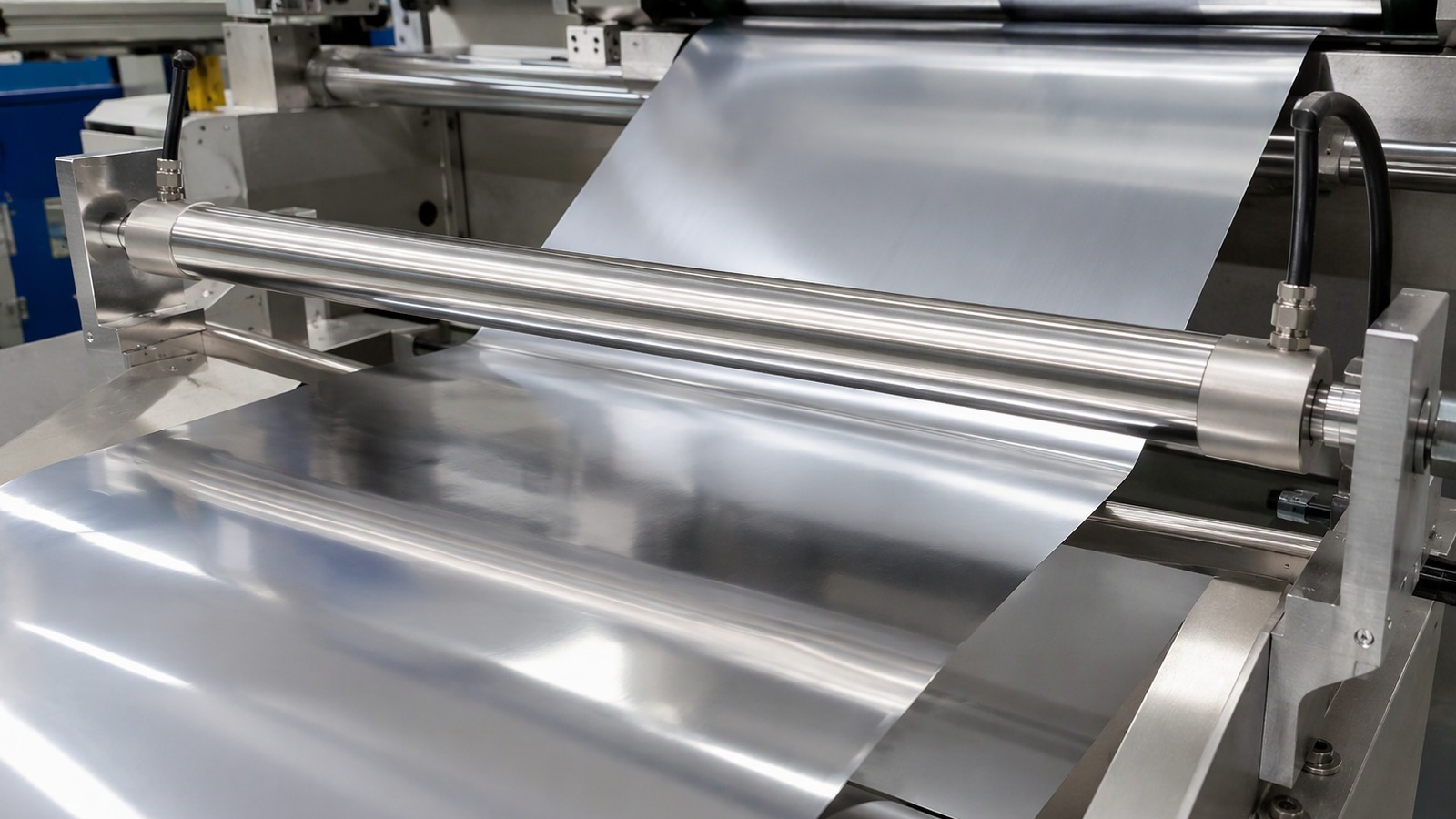
Where on a foil line is the charge actually generated?
Charge is not made evenly along a line. It is made where the web leaves a surface it had been pressed against.
Most of it comes from three places: the unwind, where wraps peel apart; a roller, where the web leaves the cover; and the slitting station, where the cut separates metal.
Dive deeper
The unwind is the largest single source on many lines. A roll is a stack of wraps pressed together, and every wrap that leaves the body is a separation of two surfaces that had been in close contact. What the outer layer loses, the departing web keeps, so the charge is already on the web before it reaches the first guide. Background on the metal and its industry sits with European Aluminium.
A roller generates charge the same way, in a smaller and more repeatable pattern. The web arrives, wraps the cover under tension, and leaves at the exit side. Contact area, wrap angle and the difference in surface behaviour between foil and cover decide how much charge is left on the web. Idler rollers that only guide the web do this too; they are not neutral just because they are not driven.
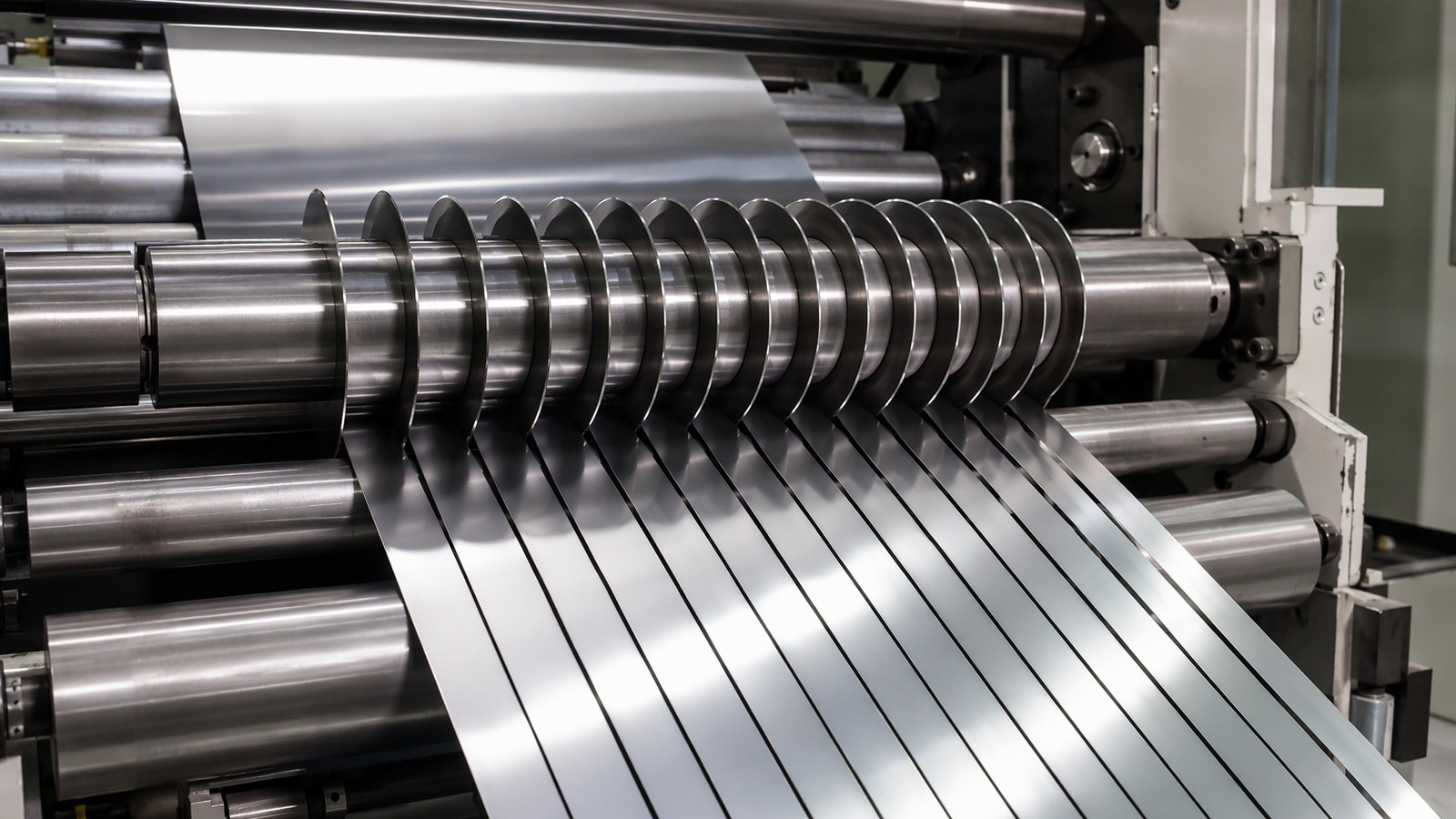
Slitting adds a third source. The cut separates metal, creates two fresh edges and throws a trim strip away at speed, so charge concentrates on the new edges and on the trim. Picture the whole line as a series of separation events adding to a running total: the same web that arrives as foil roll and sheet from the mill leaves the converter carrying the sum of them.
Why is static worse in dry air and worse at speed?
Two ordinary conditions turn a background charge into a line problem, and neither of them is a defect in the foil.
Dry air removes the thin film of moisture that lets charge leak from surfaces, and speed both generates more charge at each separation and leaves less time for any of it to escape.
Dive deeper
In most halls there is enough water in the air for surfaces to hold an invisible film, and that film is a poor but real conductor. Charge that lands on a roller cover or on the foil surface leaks through it and away. When the air dries, through cold weather, heated halls, air conditioning or a dry season, the film disappears, the leakage path disappears with it, and a line that ran quietly for months starts to crackle.
Speed works twice. A separation that happens more often per second delivers more charge per second, so the running total rises. At the same time the web spends less time in front of whatever is meant to neutralise it, and less time in contact with anything earthed. Raising the rate does not raise the charge in proportion; it also shortens the residence time available to remove that charge.
The two effects multiply rather than add, which is why the worst days are fast, dry days. A line running 1050 aluminium foil 0.15 mm at one speed can be quiet, and the same line at a higher speed difficult, with nothing else altered. How much charge a given web carries, and in what air, is a question for measurement on that line rather than for a general figure.
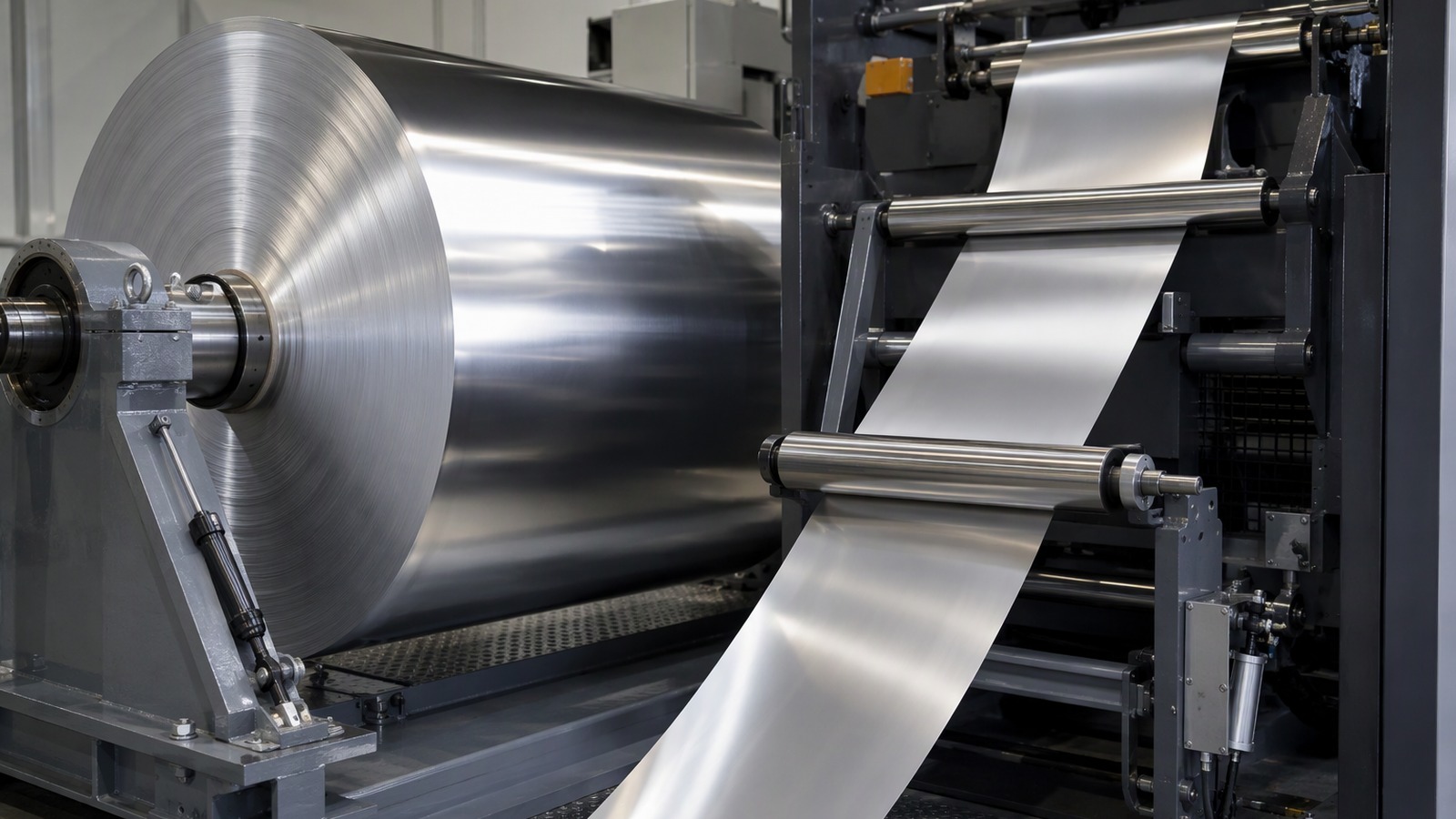
What does static actually do to a foil web on a running line?
Static damage rarely looks electrical. It looks like a web that will not track, dust that arrived from nowhere, and a join that will not sit flat.
Charged foil clings and blocks, pulls dust out of the air, sticks to guides, shocks whoever reaches for it and winds laps unevenly, so the fault usually appears well downstream of the cause.
Dive deeper
Blocking is the most common complaint. Wraps in the unwound stack cling to each other, the web will not open cleanly, and a light gauge foil can follow a roller instead of releasing from it. On a rewind the same charge pulls laps together or pushes them apart, so the roll that comes off can look tight in one place and soft in another.
A charged surface attracts particles, and a converting hall always has some: slitting dust, airborne fibres, particles from trim extraction. The foil leaves the line with a surface that was clean at the unwind. Downstream that shows as pinholes, print misses or a laminate that will not bond. Surface condition matters here, because residue changes it, and rolling oil left on the surface is a separate mechanism that can make a static problem look worse than it is.
Jams follow from the same clinging. A web that sticks to a guide can walk off its path; a slit strip that clings can mis-feed and fold. Shocks are the part operators notice, a sharp discharge when a hand comes near the web or the frame. Bodies such as the Aluminum Association describe the metal itself as unremarkable here: the behaviour belongs to the line, not to the alloy.
Why does a conductive web still need a path to ground?
Because conductivity describes how charge moves inside the metal, not how it leaves.
A ground path gives charge somewhere to go: a conductive roller, a brush, a bare frame contact or an ionising device. Without one, conductivity only spreads the charge more evenly across the web.
Dive deeper
Think of the web and the machine frame as the two plates of a capacitor. Charge on the web will not leave until something connects the two, and the connection has to be made through a surface that genuinely touches. Aluminium carries a thin natural oxide that forms within moments of exposure to air; it raises the resistance of a dry metal-to-metal contact, so a frame that looks earthed is not automatically a path for the web.
The path also has to exist along the whole web, not at one point. A web that touches an earthed roller for a few milliseconds equalises only partly, and it starts charging again the moment it leaves. Practical lines combine partial measures: dissipative roller covers in key positions, brushes or contact bars where the web can be touched without marking it, and ionising devices where no contact is possible.
The frame itself has to be earthed properly, and that is maintenance work: paint, corrosion, a bearing replaced with an insulating bush, a bonding strap removed during a rebuild. A converter who wants a stable line checks continuity from the roller surface to the building earth. Trade bodies such as the foil industry association treat this as basic line discipline rather than as a property of the metal.
What does a static bar do, and what does it not do?
A static bar is not a drain. It is a local source of ions with a working distance and a working speed.
It ionises the air in front of it so the passing web can give up or take on charge, but it acts only on the face it points at, only close up, and only while the web is in front of it.
Dive deeper
Inside the bar, a high field breaks air molecules into positive and negative ions. A charged web passing through that cloud attracts the ions it needs and leaves neutralised, or nearly so. The mechanism is local: it works on the surface facing the bar, in the air gap, while the web is inside the field.
That defines the limits. A bar cannot reach charge buried in a wound roll, because the ions never get between the layers. It cannot treat the reverse face. It cannot help a web that is recharged a metre further on by the next roller. It cannot replace an earth path, and it will not compensate for a frame that is floating. A dirty emitter or a failed supply reduces output without stopping the line, so the bar seems to fail long after it did.
Placement decides most of the result. A bar belongs after the last separation event before the point where charge causes trouble, close enough to the web to act, and clear of trim and dust. Two well-placed bars usually beat one large one, because charge is added along the path and has to be taken off along it. A bar installed at the station where the jam happens is treating a symptom that was manufactured upstream.
Why does the fix often sit upstream of the problem station?
The jam is at the slitter. The charge that caused it was made several rollers earlier and has been travelling with the web ever since.
Charge rides with the web, so neutralising it where it is made costs less than fighting it where it finally causes trouble, and it protects every roller and guide in between.
Dive deeper
A web does not stop carrying charge when it leaves the roller that charged it. The charge travels the length of the line at line speed, and everything the web touches on the way either shares it, adds to it or does nothing. By the time the web reaches the slitter, what it carries is the sum of every separation since the unwind, less whatever the bars and earthed contacts managed to take away.
That is why moving a bar from the problem station back to the unwind often changes more than adding a second bar at the problem. Upstream treatment keeps the intermediate rollers clean and the web flat, which keeps wrap angles and tracking close to design. It also removes charge before it can attract the dust that the slitter is making.
The practical rule is to walk the web path back from the fault and find the last place where the web left a surface. Whether the web is 8011 aluminium foil 0.08 mm for a container line or a heavier gauge for a technical part, the geometry of the path decides where the charge is made, and the same walk finds it. Charge made at the unwind and removed at the slitter has already marked every roller in between.
What should a converter check before blaming the foil?
Before the coil is condemned, a short list of checks on the line will usually account for the charge.
Check whether the fault follows the coil or the machine, look for insulated rollers and broken earth paths, inspect every static bar, note how dry the hall is, and review the slitting setup.
Dive deeper
Start with a swap. Run a coil from a different lot, and if the fault stays with the machine, the foil is not the variable. If it follows the coil, the difference is more likely surface condition or winder geometry than alloy, and a telescoped roll or one wound with uneven tension will produce static-like symptoms from a purely mechanical cause.
Then walk the path. Look for roller covers that are dry, glazed or recently replaced with a different compound; for bonding straps removed during maintenance; for painted or corroded frame joints; for a bar whose emitter is coated or whose supply has failed; for trim extraction that has been turned down. Note the condition of the hall air and whether the fault arrived with a change of season.
Finally, measure. Charge on a running web can be read with handheld instruments, and readings at the unwind, either side of each bar and at the slitter show where charge is made and whether treatment works. Those numbers belong to the line, which is why a supplier can describe the mechanism but cannot say what another plant will read.
Static on a foil line is a circuit problem before it is a material problem: find where charge is made, then give it a path to ground.