Why Does Aluminium Foil Facing Matter in Acoustic Laminates?
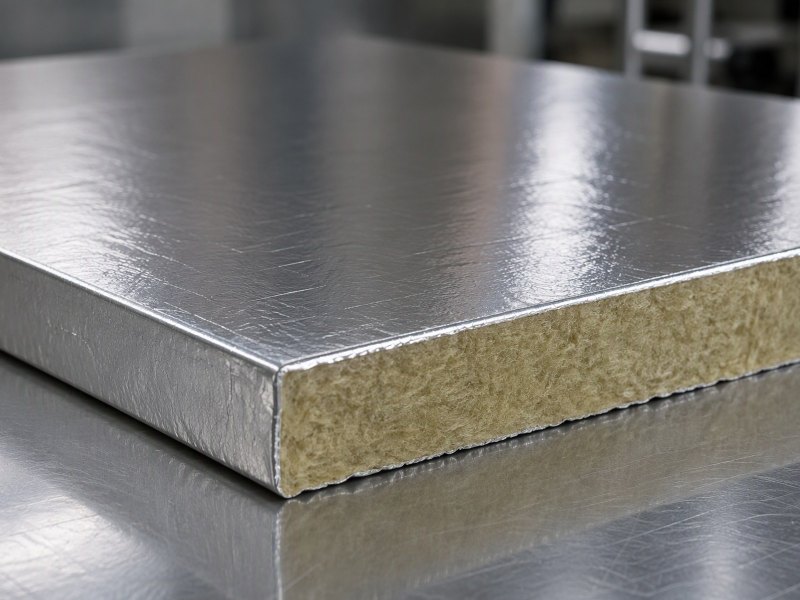
Foil facing adds mass, seals the face and carries the bond that makes an acoustic laminate work.
A foam core alone looks like a sound answer until the panel is cut, handled and fixed. Then the facing, not the foam, decides whether the promise survives.
Foil facing adds mass and a sealed skin, resists surface motion and stiffens the face, so the core can absorb without being crushed, wetted or pumped by moving air. The bond carries that benefit into the finished part.
This guide follows the facing from the unwind roll to the installed panel: why a metal ply works, what it adds to a bare core, why it is laminated rather than used alone, which gauge belongs in a facing, and what an enquiry must state.
Why does a metal ply help with sound at all?
Sound is energy arriving at a surface. A metal ply does not absorb that energy; it changes what happens to it before the core ever sees it.
A thin metal skin is heavy for its thickness, so it resists being set in motion. It turns part of the arriving energy back at the surface and spreads the rest sideways instead of letting it drive straight through.
Dive deeper
A panel is a chain of conversions. Airborne energy pushes the outer surface, the surface moves, the movement enters the core, the core turns some of it into a little heat, and what remains leaves the far face. A facing alters only the first step, but that step decides what the rest receives.
A bare core is light and soft at its face. Its outer layer is the part most easily set in motion, so energy arriving there moves it early and moves it far: motion passes inward readily and radiates back out on the return path. A metal ply bonded to that face resists that first movement, and being stiff in its own plane it cannot stretch locally the way an open surface can.
Two effects follow, and neither is absorption. Part of the arriving energy turns back at the surface, because a heavy, stiff skin is a poor match for air. The energy that does enter spreads over a wider area, so the core works through more of itself instead of being driven in one spot.
A third effect is quieter but often larger: sealing. An open structure passes air, and moving air carries energy with it. A continuous skin closes the face, so the panel stops behaving like a filter and starts behaving like a barrier with an absorbent back.
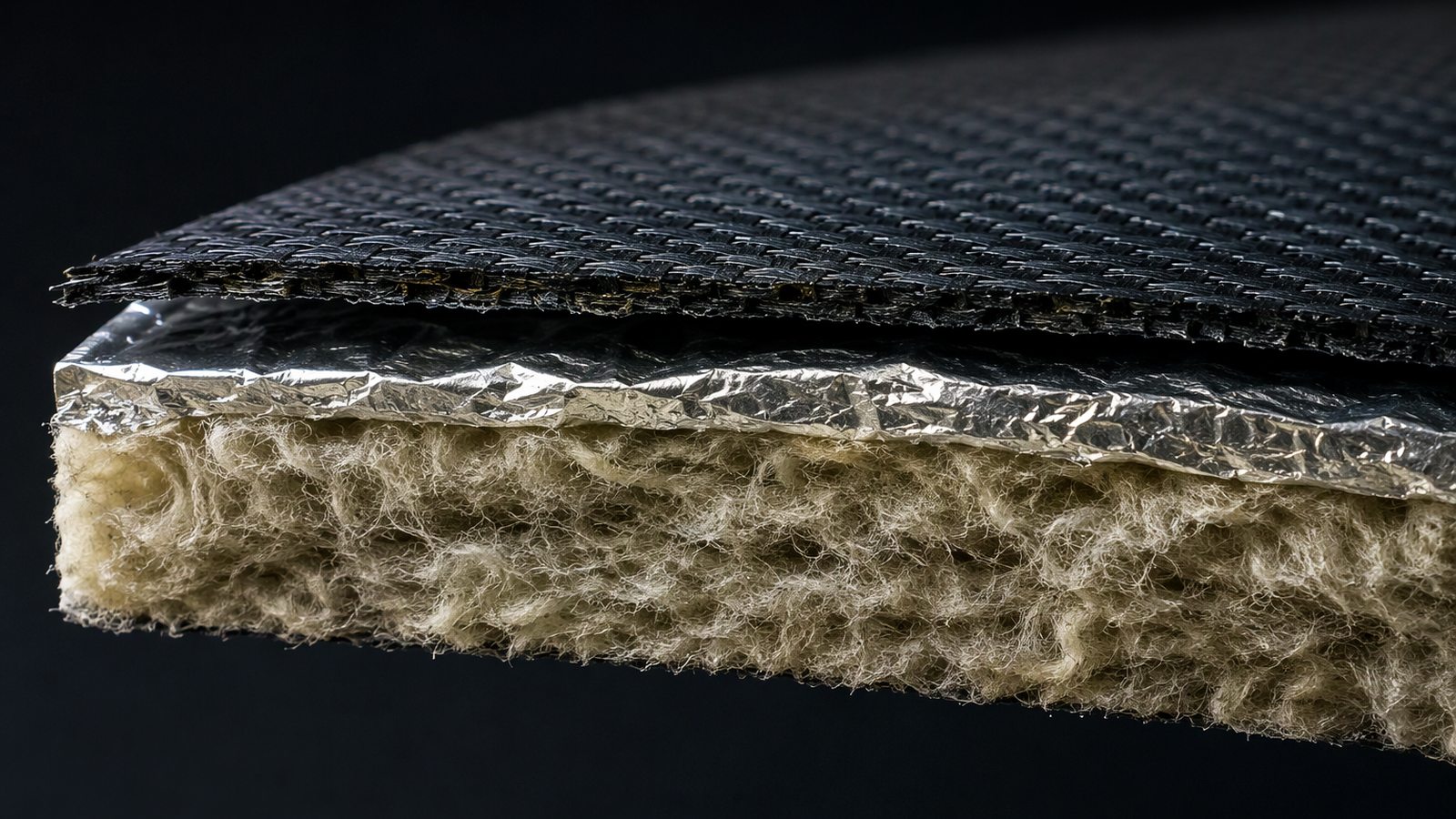
What does a foil facing do that a bare foam cannot?
Four jobs are easy to list and hard to combine in one material: keep air out, protect the surface, spread load at fixings and stay cleanable.
It closes the face, guards it from abrasion and crushing, stiffens it around fasteners and gives it a wipeable surface. The core was chosen for what happens inside, not at the surface.
Dive deeper
The first job is closing the face. Foam is mostly air by volume, and its surface is a network of openings. Air moving in and out of them carries energy with it, which is useful while the panel is intact and unhelpful once the face is compressed or damp. A foil skin closes the surface.
The second is mechanical protection. The same thin skin that resists being set in motion also resists abrasion, scuffing and the small crushing that happens whenever a panel is stacked, carried or leaned against a wall. A bruised face is a changed face: the outer layer loses the open structure that made it work.
The third is stiffness around fasteners and edges, where a soft core alone tends to tear or creep. The facing spreads the point load of a screw or clip over an area, so the core is compressed gently rather than punched. That is a structural benefit that happens to protect the acoustic one.
The fourth is cleanliness. A sealed metal face can be wiped, and in ductwork, plant rooms or appliance cavities that matters as much as the acoustic result, because a face that slowly collects dust and grease becomes a different panel. Surface texture and temper both count here.
Why is a laminate used instead of foil on its own?
Foil alone is a membrane, not an absorber. It has almost no internal loss, so whatever it does not reflect it tends to hand back.
The core supplies the loss and holds the facing at a steady distance from the structure. A laminate is a division of labour, not foil plus filler.
Dive deeper
Foil on its own is a membrane. Stretched across an opening it reflects part of the arriving energy and stops air movement through the gap, but it has very little internal loss, so what it does not reflect it tends to re-radiate.
The core supplies the loss. Its open structure converts motion into a small amount of heat, and it holds the facing at a constant distance from whatever sits behind, which lets the assembly behave as a system rather than as a drum. A laminate is a division of labour, not foil plus filler.
There is a practical reason too. A facing needs support to be bonded flat, and the core is that support. Bonding foil to a flat core in a continuous line gives an even, repeatable surface. Wrapping foil around a finished part by hand gives waves, bridges and trapped air, and each of those is a place where the facing will lift later.
Finally, a laminate can be cut, edged and fixed as one item. A converter who receives foil and core separately has to solve those problems panel by panel. Background on the material is in the reference entry on aluminium foil, and the wider industrial and technical foil range shows how facings sit beside other technical foils.
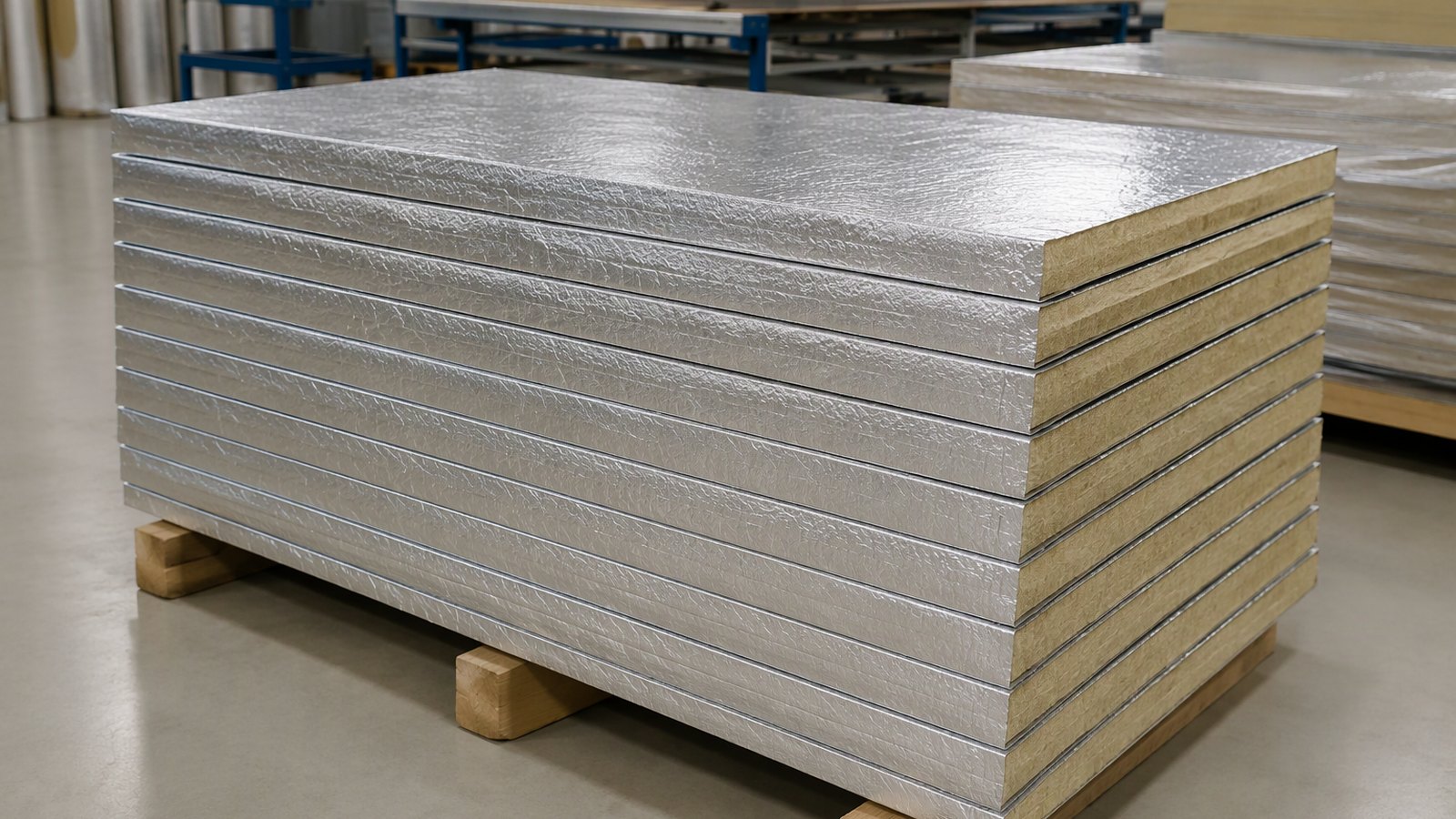
Which gauge belongs in an acoustic facing?
Gauge is a compromise between stiffness, weight, handleability and cost, so the answer is a band rather than a single figure.
Most facings sit in the middle of the foil range, supplied in roughly 0.02 mm to 0.09 mm depending on the core and the line. Soft tempers conform; firmer tempers hold a flat face.
Dive deeper
Too thin and the facing wrinkles, tears at the bond line and telegraphs every irregularity of the core. Too thick and it stops conforming and costs more than the benefit justifies. Neither failure shows up in a flat sample; both show up on the third pallet.
For most facings the working band is the middle of the foil range, supplied in 0.02 mm to 0.09 mm depending on the core texture and the bonding process. Temper matters as much as thickness: a soft temper such as O or H22 conforms over a textured core, while H18 holds a flat face and resists denting.
Alloy choice follows the same logic. 8011 and 8079 are common for facings because they combine workable strength with a fine, even surface. 3003 and 3004 bring more stiffness where the facing must span a gap or where panels are fixed at wide centres. A general-purpose facing can be 3003 aluminium foil at 0.12 mm; a lighter one over a smooth core may use 8079 aluminium foil at 0.05 mm.
Width matters as much as thickness. Facings are usually slit to the panel width, from 100 mm to 1500 mm, so the bonder does not trim in line and waste the edge. Ask for finished width plus edge allowance, and state the core diameter you can unwind, 76 mm or 152 mm.
Why does the bond between foil and core decide performance?
A facing only works while it is attached. Once the bond line separates, even locally, the metal skin stops resisting surface motion.
The facing and the core must move as one body. Coverage, continuity and adhesion at the edge decide whether that happens in service or only on the sample.
Dive deeper
A separated facing rattles, traps air and gives the panel a second path for energy that was never part of the design. The effect is rarely dramatic at first, which makes it dangerous: the panel looks right, sounds acceptable on the bench, and changes after a season of cycling and handling.
Bond strength alone is not the whole story. Coverage and continuity matter more. Adhesive applied as a full film behaves differently from adhesive applied in lines or dots, and a partial pattern leaves channels along the interface where air and moisture can travel. Those channels also let the facing flex independently of the core.
The interface is where process discipline becomes visible. Surface texture on the foil, cleanliness of the core face, adhesive weight, line speed and nip pressure all act on the same result. A change in any one can leave a bond that looks perfect on a flat offcut and fails at a panel edge. A facing that lifts at a corner is usually a bond problem, not a foil problem.
This is why gauge and bond should be specified together. A heavier facing carries more load into the bond and is less forgiving of a weak interface. A light facing asks less of the adhesive but shows every gap. Ask for the bonding method and the coverage pattern in writing, then peel a production sample.
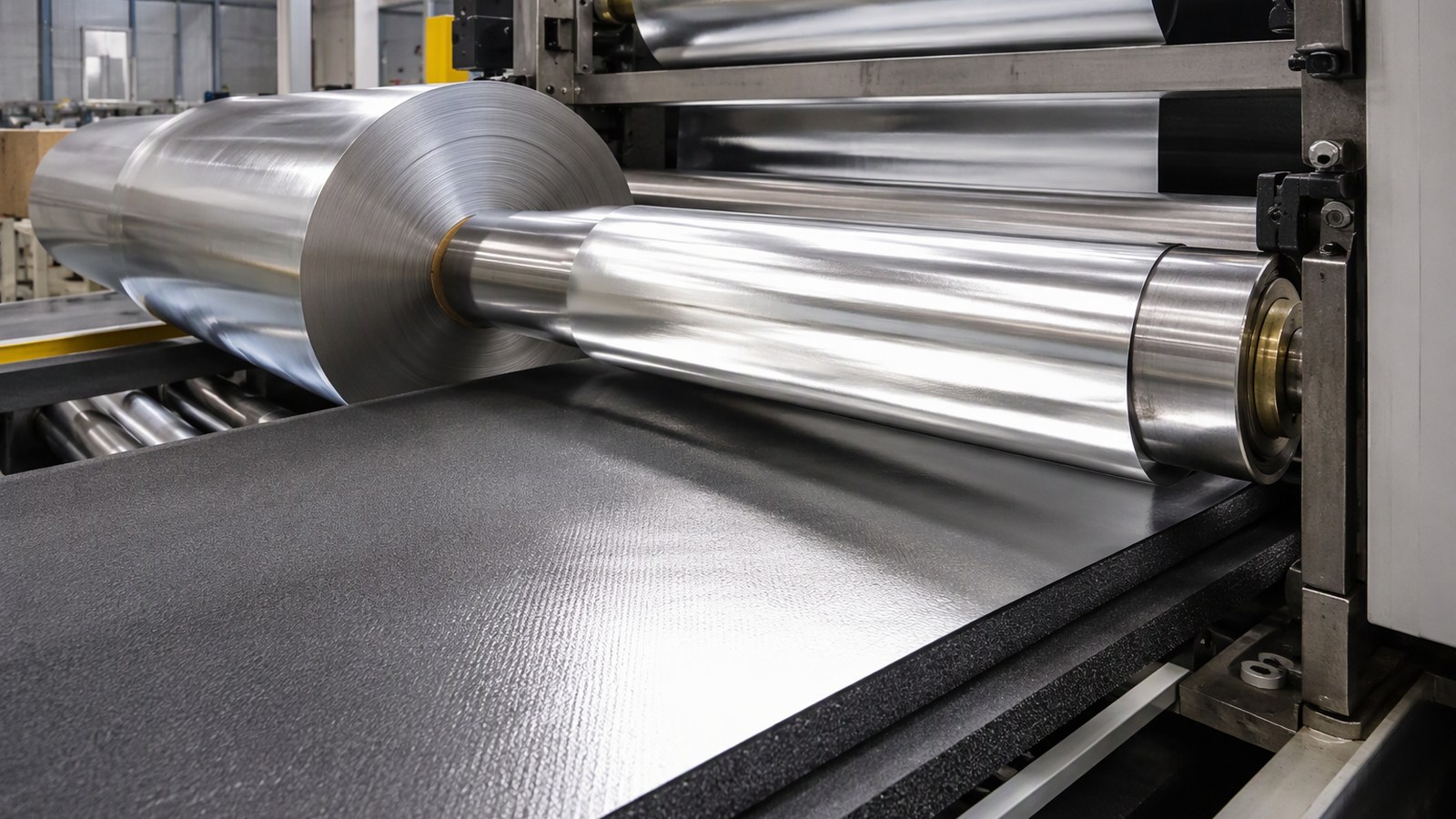
What happens at joints, edges and fixings?
A panel rarely fails in the middle. It fails where it was cut, where two panels meet, or where a screw went through it.
Those are the three places where the facing is interrupted, and an interrupted facing is a leak in the skin. Each needs a drawn detail, not an installer decision.
Dive deeper
At a cut edge the foil is only as good as its adhesion at the boundary. A clean shear cut leaves a tight edge with the facing still bonded. A dull blade drags, lifts the facing and starts a peel that runs inward as the panel is handled. Edges should be cut with a sharp tool and, where exposed, closed with a profile, a tape or a folded return.
At a joint between panels, the two facings do not touch unless something makes them. A gap of a few millimetres is a line where air moves and where the panels move independently, so the seal is broken exactly where the surface is least supported. A cover strip, a mastic bead or an overlap restores continuity.
At a fixing, a fastener passes through the facing, the core and into the structure, compressing the core around itself. That compression is a hard spot in a soft field, and it is where the facing creases and eventually cracks. A washer spreads the load, a resilient sleeve separates fixing from facing, and spacing should follow the stiffness of the facing.
Notes published by the foil industry on handling and joining are a reasonable starting point, while the actual detail still has to be drawn for the panel in hand.
How does a panel work as acoustic treatment and vapour barrier at once?
The two duties pull in opposite directions. An acoustic face wants to be open enough to admit energy; a vapour barrier wants to be closed.
A foil facing satisfies both by putting the closed layer on the outside and leaving the open structure behind it. Position and sealing decide whether that works.
Dive deeper
A foil facing resolves the conflict by separating the functions through depth: the metal skin closes the surface, and the core behind it stays open. The panel then resists moisture at the face it presents to the room while still absorbing energy that reaches the core through that face.
Position decides the outcome. On the warm side of an assembly, a continuous skin keeps moisture out of the core, and a dry core keeps the behaviour it was chosen for. On the cold side, the same skin can trap moisture that entered elsewhere, so the facing has to sit where condensation is not expected.
Sealing is the weak link in almost every installation. A facing with taped joints and a sealed perimeter is a barrier; the same facing with one open edge is a funnel, and the core will find that edge. Where the panel meets a wall, a duct or a frame, the facing should be carried into the seal, and every penetration sealed around its fastener.
There is a thermal side benefit that should not be oversold. A bright face reflects radiant energy, but reflection is not insulation, and the core is doing the work the facing only protects. Published material from the aluminium industry describes how the metal behaves in these layers.
What must an enquiry contain?
An enquiry that says only acoustic foil will produce a quotation for something, but probably not for the part you are building.
Describe the build, the foil, the commercial frame and the failure you are trying to avoid. A supplier can only choose alloy, temper, gauge and width from what you state.
Dive deeper
Start with the build. State what the core is, how the facing is applied, whether the panel is flat board or a formed part, and which face carries the foil.
Then the foil: the alloy if you have one, the temper, the thickness range you can run, the width, and whether the surface should be bright, matte or textured for bonding. Say whether the foil is to be lacquered, because that changes what the bonding line must do to it.
Then the commercial frame: quantity per size, with 3 MT per size as the usual minimum, the core diameter you can unwind, 76 mm or 152 mm, the packing you expect, such as eye to sky or eye to wall on a wooden pallet with a moisture barrier wrap, and the port, Qingdao, Tianjin or Shanghai.
Finally, say what the panel has to survive: handling, cleaning, humidity, the fixing pattern and the failure you have seen before. A supplier who knows the failure can suggest a gauge and a bond instead of guessing. Specifying foil for duct insulation and foil for automotive heat shields cover neighbouring duties, and general industry data on aluminium helps you check the grades offered.
The facing is the part of the laminate that meets the world. Get the gauge, the bond and the edges right, and the core can do its work.