Why Does an Aluminium Heat Shield Fail at the Edge First?
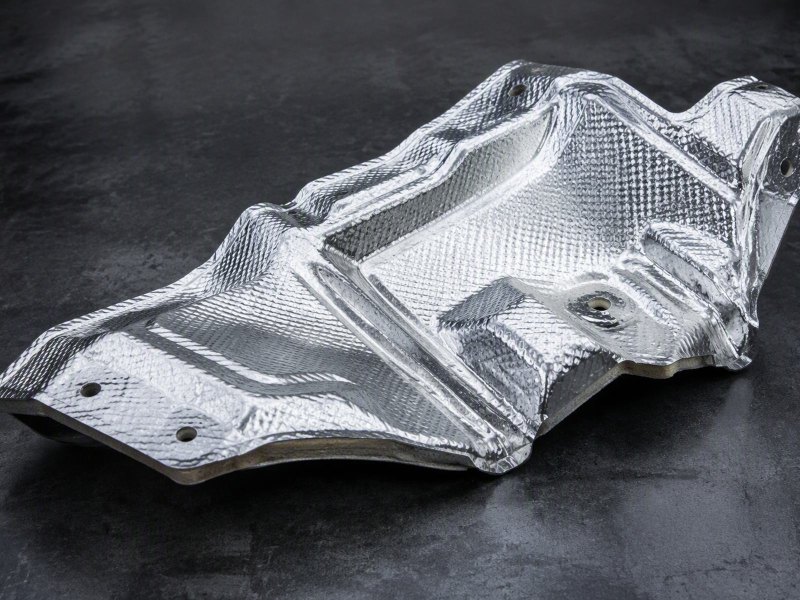
How the foil ply, the mat core and the formed edge work together in an automotive heat shield, and why road salt, vibration and stone impact decide how long the part lasts.
A heat shield rarely fails in the middle. It fails at a trimmed edge, a fastener hole or a crease, where the foil ply was already overworked.
The foil is the reflective, heat-facing ply of a laminate; the mat behind it does the blocking. A shield endures when foil, core and forming are specified as one part.
Below, the part stays in view: a formed shield under a vehicle, wetted by salt, shaken by the road and struck by stones, not a flat coupon.
Why Is a Heat Shield a Laminate Rather Than a Solid Sheet?
A solid sheet conducts heat along itself and re-radiates it from the far side; a laminate can separate reflection, blocking and forming into different layers.
Because one material cannot reflect at the hot face, slow conducted heat and still be pressed into shape, the shield is built as foil, bonding layer and core.
Dive deeper
A formed shield normally begins as a sandwich. The foil ply sits on the side that faces the hot component, a bonding layer holds it to a fibre or mat core, and a second facing often closes the cold side for handling and appearance. Each layer is chosen for one duty.
The foil side is deliberately thin. Its work is to present a continuous bright surface to the heat source and to keep the core clean and dry; it does not carry load and does not insulate by thickness. That is why the ply comes from the lower part of the 0.005 mm to 0.20 mm range, where a 1100 aluminium foil in O or H22 temper is a common starting point.
Inside a brazed exchanger, foil for heat exchanger fin stock becomes part of the core and survives a furnace cycle; a shield foil is laminated and never sees a braze. Jacketing foil faces weather on a plant pipe, whereas here the mat blocks the heat. Bonded as one assembly, gauge, temper, surface and core behave predictably through pressing and trimming; chosen separately, the part is re-engineered on the line. The range sits under industrial and technical foil, but the choice belongs to the formed part.
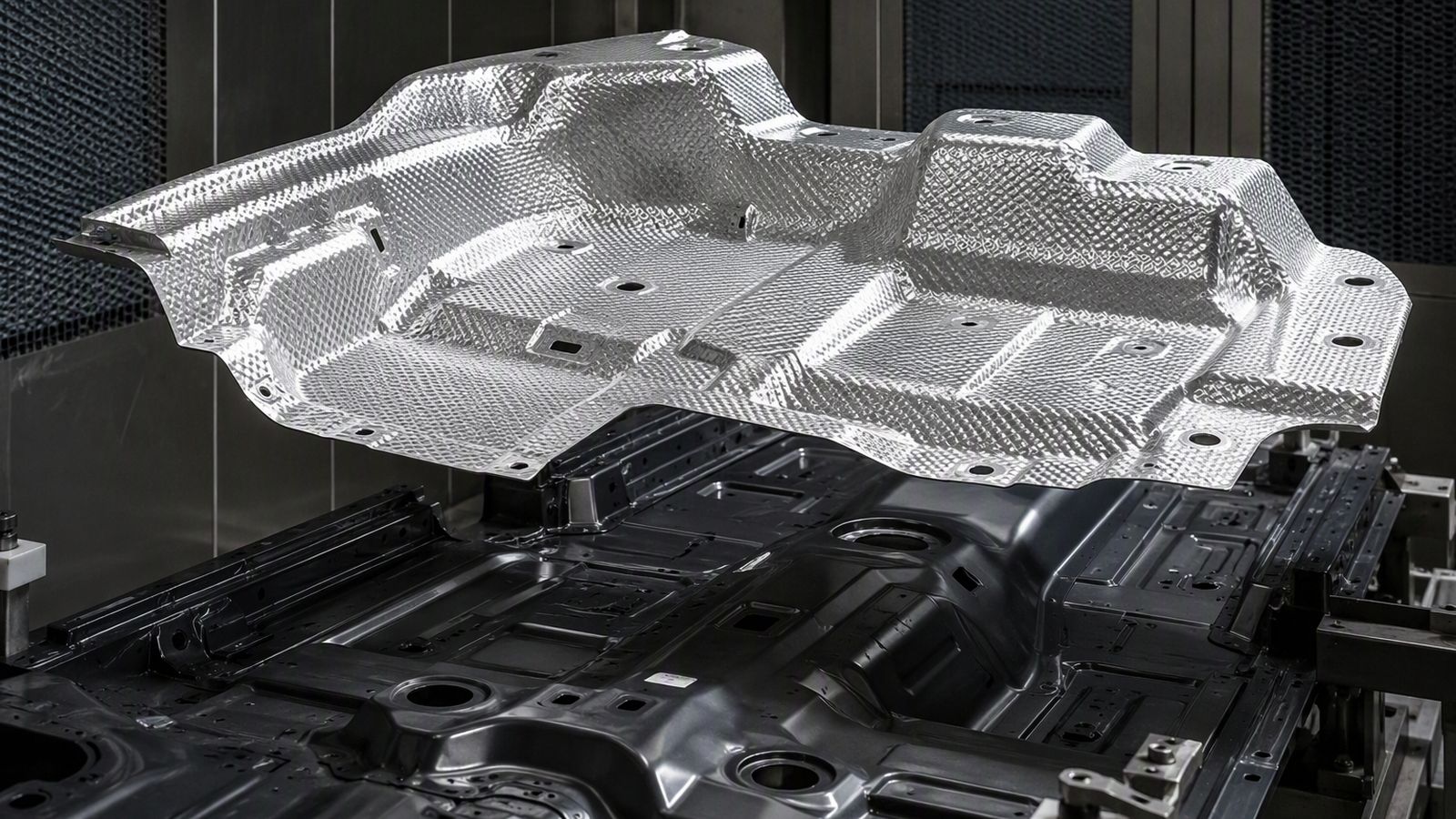
Why Do the Bright Foil Face and the Mat Core Do Two Different Jobs?
One surface handles radiant heat arriving in a straight line; the mat handles heat that has already entered the laminate.
The bright face sends radiant heat back toward its source. The mat slows what still passes and damps the panel. Remove either one and the shield keeps its shape but loses its job.
Dive deeper
Radiant heat travels without a medium, so the surface in its path decides how much continues. A bright aluminium face returns a large share of what arrives, and that depends on the surface staying clean and uniform, not on the foil being thick. The mat works differently: it is porous, it holds still air in small cells, and it breaks the path along which heat would conduct from the hot face to the cold one.
Neither mechanism replaces the other. A mat alone lets radiant heat load its outer skin, which then re-radiates toward the floor pan. A foil alone passes heat by contact at every fastener and re-radiates from its cold side. Extra foil thickness buys stiffness, not reflection; extra mat thickness buys blocking, and holds water if the edge stays open.
Surface condition is a specification item, not a cosmetic one. Mill finish, brightness, oil residue, oxidation from storage and handling marks change what the hot face does, and they change what the bonding layer can grip. Ask the supplier what the delivered surface will be and how it is protected in transit; the general behaviour of the material is described in public references such as aluminium foil, but the surface you receive is a commercial decision.
Why Does a Dented or Creased Shield Lose More Than It Looks Like It Should?
A crease is a permanent fold in a thin ply. It changes the gap the part was formed to keep and starts a crack that appears later.
A dent closes the air gap the mat relies on and work-hardens the foil along the fold. The loss looks local, but the crack that follows does not stay local.
Dive deeper
A shield works because of the space it holds. The formed shape keeps the mat at a distance from the hot component and keeps the cold side away from the panel it protects; that gap is design, not a by-product of the drawing. A dent reduces the gap locally, a crease does the same while folding the foil back on itself, and the part still fits and still fastens, which is why the damage passes inspection.
Mechanically, a fold is worse than a dent. Bending a thin foil beyond its elastic limit work-hardens it, and a hardened fold has less ductility left for the vibration that follows. The crease becomes the place where a fatigue crack starts, and a thin foil backed by the core lets that crack travel far before it shows.
The practical answer is allowance, built in before the tool is cut. Forming radii, clearance around fasteners, packing between parts and handling rules in assembly all protect the gap. Where a drawing forces a tight bend, a softer temper such as O or H22 and a gauge from the upper part of the workable range give the ply room to bend without folding. How much room is needed belongs to the customer's part validation.
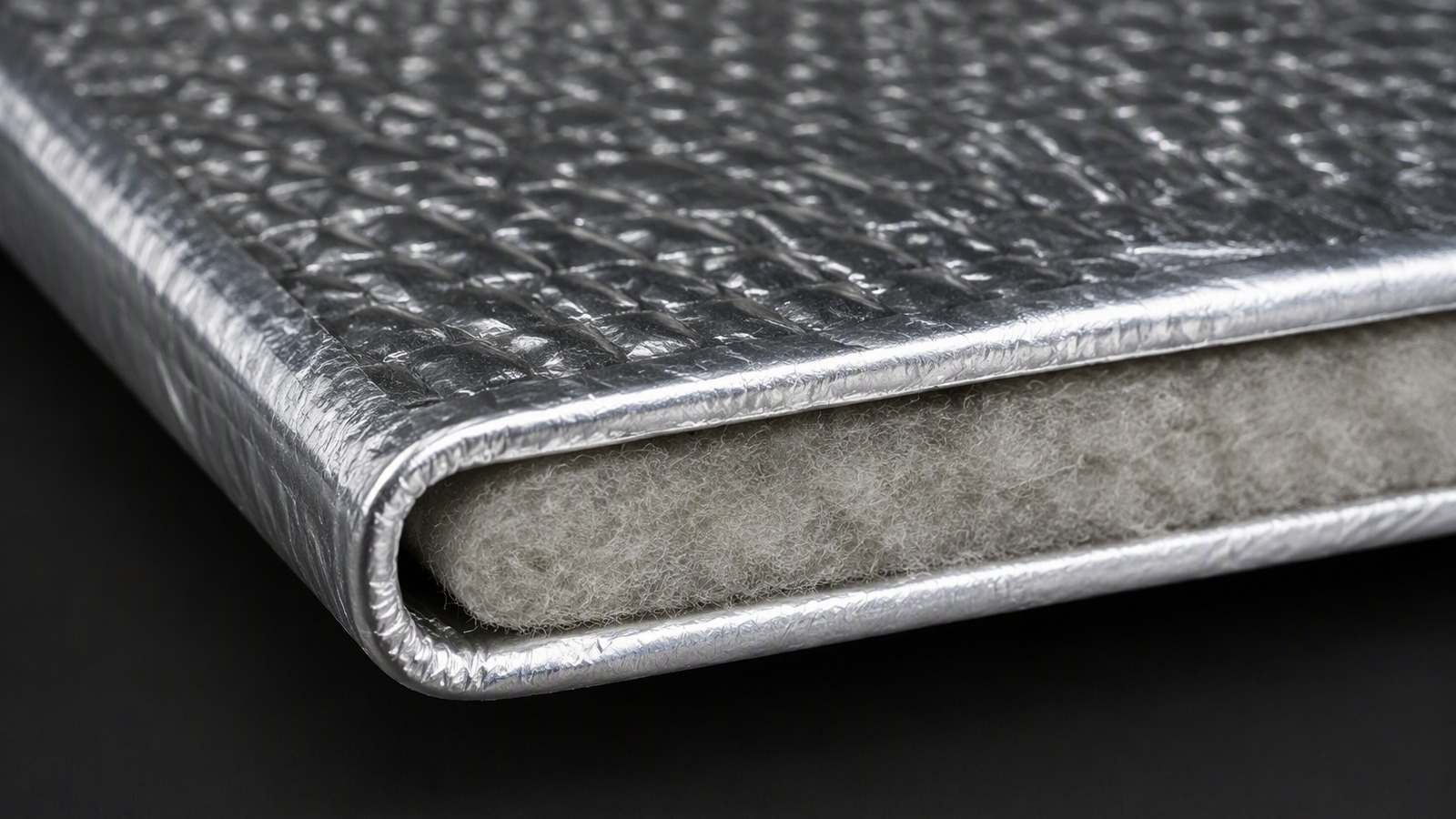
Why Must the Foil Survive Forming, Trimming and Fastening Without Cracking at the Edge?
Every shield is stretched, cut and pierced after lamination, and the trimmed edge and the fastener hole are where the foil has least support.
Forming thins the ply, trimming leaves an edge with no core behind it, and fastening concentrates load. Ductile temper and a clean cut decide whether the part survives the line.
Dive deeper
Forming is where the foil first shows what it is made of. A shallow draw asks little, but corners, tight radii and deep pockets stretch the metal unevenly, and the foil thins where the mat compresses least. A temper chosen for stiffness, such as H14 or H16, holds a shape and resists drumming, yet it has less elongation for the corners. A softer O or H22 grade flows into the same corner with fewer splits.
Trimming and piercing come next, and both create an edge with no core behind it. A sheared edge carries a burr and a zone of deformed metal; a poorly set tool leaves micro-cracks that open later under vibration. A fastener hole is the same story in a circle: a stress raiser by geometry, in a thin section held only by its bond.
Fastening then loads what the edge left behind. Rivets, clips and studs press the laminate locally, and every fastener is also a galvanic junction when it is steel against aluminium. Keep the fastening zone away from the highly formed area, specify an aluminium foil roll whose temper suits the real forming route, and let the customer confirm the joint on the assembled part rather than on a flat sample.
Why Is Corrosion From Road Salt and Condensation the Real Ageing Mechanism?
A shield lives wet, salty and warm, then cold. The chemistry at the foil surface, more than the heat, decides how long the part lasts.
Salt held in the mat and condensation trapped behind the foil keep an electrolyte against the metal. Ageing is a corrosion story, and a bare face at the underside loses first.
Dive deeper
Road salt does not need to be sprayed directly at a shield to get to it. Spray thrown up by the wheels lands on the underside, wicks into the open edge of the mat, and stays there because a shield sits in a sheltered cavity where air movement is poor and drying is slow. The mat behaves as a reservoir, holding the salt solution against the foil.
Condensation adds the other half. A shield is warmed by the component it faces and cooled by road air, so it cycles constantly, and moisture condenses on the cold face or inside the laminate when the dew point moves. Water collects at the lowest point and at the edge, exactly where the foil is cut and the bond ends.
This is why an unprotected foil face is a poor choice at the underside of a vehicle. Alloy selection helps, and grades such as 3003, 3004, 8011 or 8021 are often preferred over a plain 1100 where the environment is wet and salty, but alloy alone does not close an open edge. A protective finish, a sealed or folded edge, drainage in the formed shape and a design without pockets all address the mechanism, and how much protection is enough belongs to the customer's part validation.
Why Do Vibration and Stone Impact Matter More Than Steady Heat?
Steady heat is a condition the part is designed around; vibration and stones are events, and events start cracks that steady heat alone rarely does.
Vibration loads fasteners and folded edges through a huge number of small cycles. Stone strikes load a small area at speed. Both attack the foil where it is least supported.
Dive deeper
A thin formed shield is a diaphragm. It is stiff enough to hold its shape and light enough to be driven by everything the road sends upward, so it flexes between its fastening points and drums against the air around it. The mat does more than block heat: its mass and internal friction damp that movement, which is why a shield with a well bonded core is quieter and longer lived.
Fatigue is the consequence. A stress well below the level that would break the foil once still starts a crack after enough reversals, and the crack begins where geometry concentrates strain: a hole, a cut edge, a tight radius, the boundary of a crease. A shield can pass a static check and still fail in service.
Stone impact adds a different load. A strike puts force into a small area, denting the foil, crushing the mat behind it and thinning the metal at the rim of the dent. The damage is rarely a hole on the first hit; it is a dent with a hardened rim and locally unsupported foil, which is precisely the condition fatigue needs. Bodies such as The Aluminum Association describe the material, but the resistance of one shield is established on the customer's part.
Why Must the Shield Maker and the Foil Supplier Agree Gauge, Temper and Surface Together?
Gauge, temper and surface interact. Change one and the other two move, and a foil that meets a data sheet can still fail in the press.
The supplier controls what leaves the mill; the maker controls what happens in the tool. Agreeing all three before the coil is ordered is cheaper than finding the mismatch in a try-out.
Dive deeper
Gauge sets the forming window. A heavier ply resists thinning at corners and holds a flatter panel, but it also resists the bend and springs back more, so the tool has to be built for it. A lighter ply forms more easily and follows the mat, yet has less metal to give at a radius.
Temper moves with gauge, and surface moves with both. A harder temper keeps flatness and resists handling damage but narrows the forming window; a softer temper widens it and asks for more care in trimming. Surface is the variable most often left to chance: brightness affects the hot face, surface texture and oil affect the adhesive, and oxidation from storage affects both. A bonding layer that grips a freshly rolled surface may struggle on one that has sat in humid air.
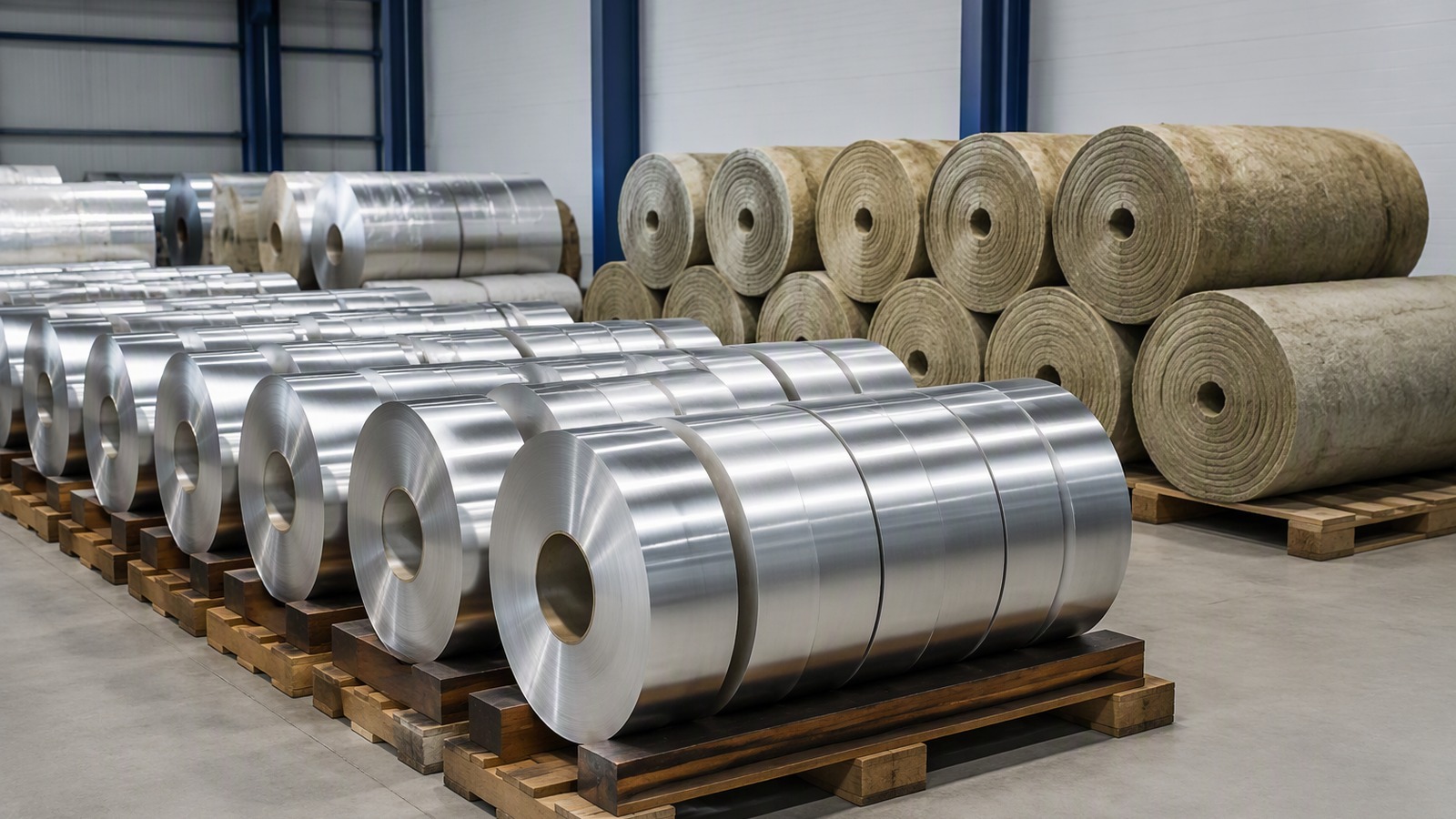
Commercially, the three belong in one conversation. Width from 100 mm to 1500 mm and core of 76 mm or 152 mm have to suit the laminating line, and a minimum order of 3 MT per size is easier to plan when gauge and temper are fixed early. Bodies such as European Aluminium and ALFED publish general guidance, but the agreement that matters is between converter and shield maker, written down before the first coil is rolled.
What Should a Converter State in an Enquiry for Heat Shield Foil?
An enquiry that names only an alloy and a thickness leaves the supplier guessing about the part, and guessing is how the wrong coil gets shipped.
State alloy and temper, gauge inside the listed range, width, core, the forming route, the bonding method, the environment the part sees and the annual volume in MT.
Dive deeper
Start with the part, not the metal. A deeply drawn, pierced and multiply fastened shield asks more of the foil than a flat panel with two clips. Give the blank size, the draw depth, the tightest radius, the number and position of holes and the fastener type, because each decides whether a soft temper will do or a harder one is needed for stiffness.
Then describe the process. Say whether the foil is laminated with adhesive, bonded to a mat or simply trapped at the folded edge. Add the environment the finished part sees, in plain terms, such as salt spray from the road, standing condensation, stone strike and continuous vibration, and say who validates the part. The supplier guarantees the coil and the converter the laminate; the customer validates the shield on the vehicle.
Finally, the commercial frame. State the alloy and temper you want, or ask for a recommendation with the reason behind it; give width, core, coil or sheet form, the annual quantity in MT and the port you prefer among Qingdao, Tianjin and Shanghai.
Keep the enquiry to one part and one page, because a single clear sheet with real dimensions gets a specific answer faster than a folder of general requirements and superseded drawings for the same shield.
A heat shield is a laminate judged at its edges. Agree gauge, temper and surface with the foil supplier, then let the customer own the validation.