How Is Aluminium Foil Used in Suspended Ceiling and Roof Liner Panels?
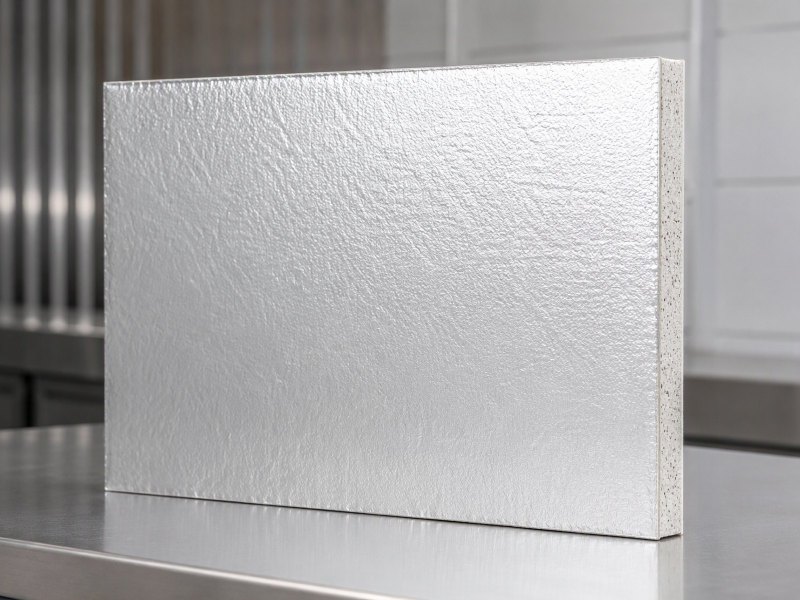
Where the foil sits, what the facing does, and why edge detail decides whether it survives.
A foil facing lifts at one corner, or reads patchy under site lighting, and the panel was sold simply as foil-faced. Nobody agreed what that face had to do.
The foil is a laminated facing on a mineral or gypsum core, not the structural skin. It reflects radiant heat back into the room, closes the core face against dust and loose fibre, and gives a clean, evenly reflective surface.
Once that is clear the questions become specific: which face carries the foil, what it must do, how the panel is fixed, and what happens at the joints of a roof liner.
Where Does the Foil Actually Sit Inside a Ceiling Panel?
Not on the outside, and not carrying the load. Its position in the build-up decides what it can and cannot be asked to do.
It sits as a laminated facing on one face of the core, usually the back, and sometimes on both. The core carries the panel; the foil covers it.
Dive deeper
A ceiling panel is a sandwich only in the loosest sense. The core, whether mineral fibre, gypsum or a cementitious board, provides stiffness, mass and most of the acoustic behaviour. The foil is a facing bonded to one face of that core, not a sheet stretched over the finished panel.
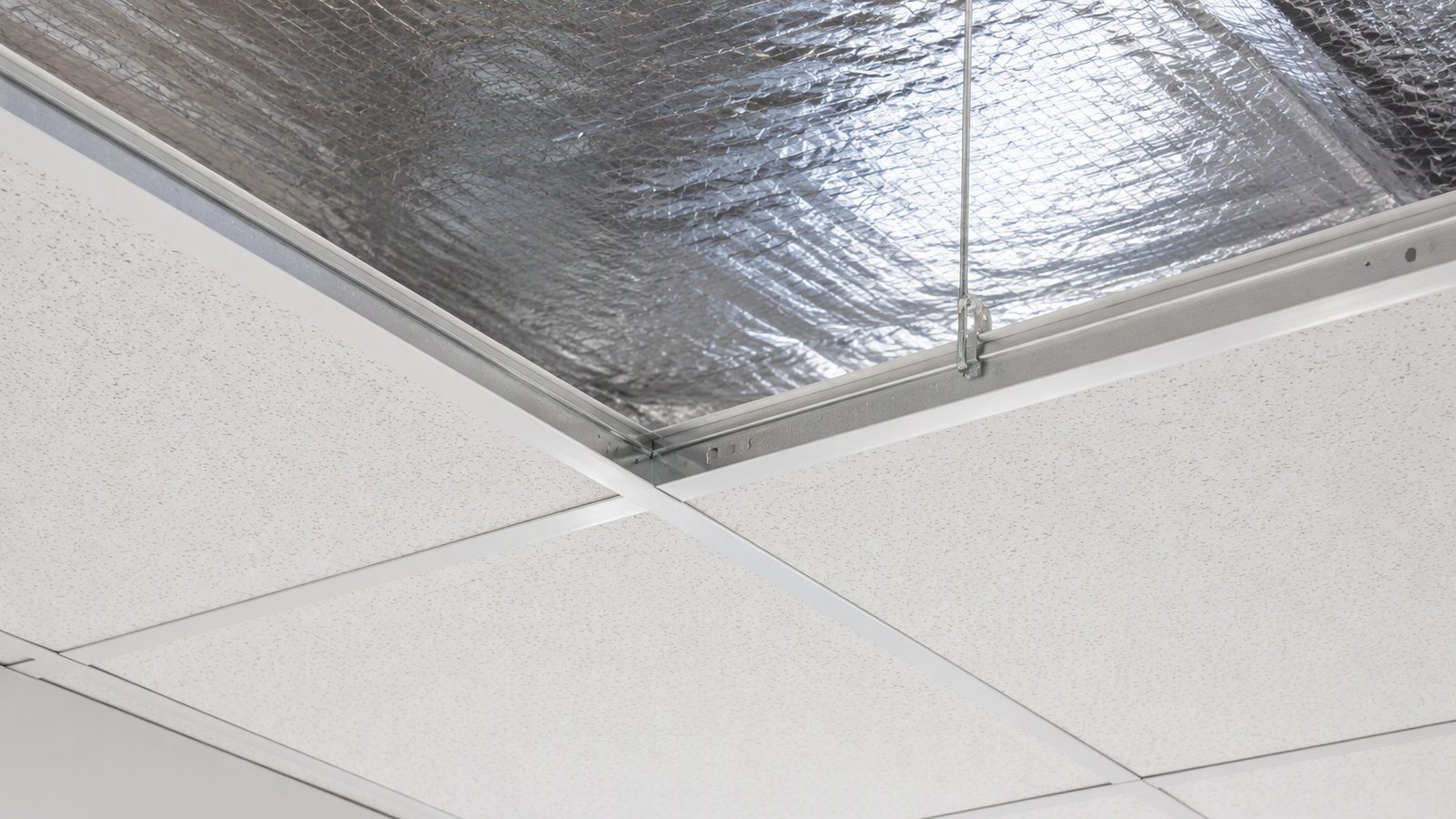
In most lay-in panels the foil sits on the back, the side nobody sees once the panel rests in the grid. That side faces the plenum, where dust gathers and warm moist air can reach a cold surface. The visible side is painted or finished with a decorative laminate, and is handled more roughly because people touch it.
Position matters because the two faces see different conditions. A back facing works in still, dusty air and must stay bonded through handling. A visible facing must survive cleaning, contact and light. Where foil sits on both faces the two layers usually differ, because the front has to look consistent across a whole ceiling.
The description of aluminium foil as a thin rolled sheet is accurate but incomplete here. In a panel the foil is never a free sheet. It arrives bonded to a carrier, or is bonded during panel manufacture, and that assembly, rather than the foil alone, has to survive handling, cutting and installation.
What Does the Facing Do That the Core Cannot Do on Its Own?
A mineral core is a good absorber and a poor reflector. It also sheds fibre at a cut edge. The facing covers both weaknesses at once.
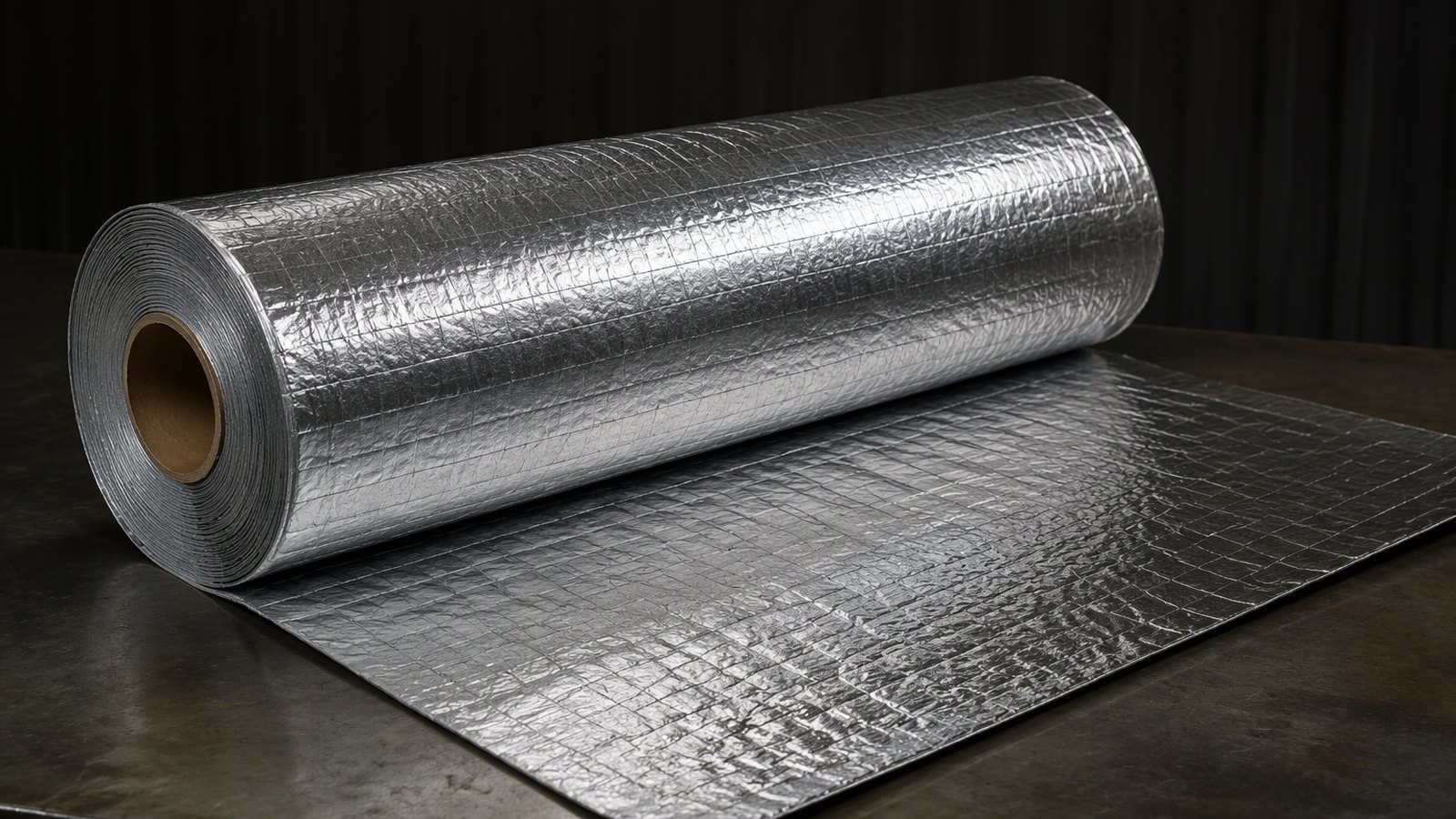
The facing reflects radiant heat toward the room, closes the core surface so it does not shed dust, and presents a flat, clean plane that lighting can read evenly.
Dive deeper
Three jobs, and they are separate. The first is radiant rather than conductive. A ceiling surface exchanges heat with the room largely by radiation, and a low-emissivity metallic surface sends much of that radiation back instead of absorbing it. The effect depends on the surface staying bright and clean, which is why a scuffed facing behaves differently from the office sample.
The second job is containment. Mineral fibre and gypsum cores both release material at a cut edge, and a bare core face in a plenum slowly deposits dust on everything above it. A bonded facing closes that face. It is not a seal in the engineering sense, but it stops the visible shedding that contractors notice on a return visit.
The third job is appearance. A ceiling is a large, evenly lit surface, and the eye is good at finding a patch that reflects differently from its neighbours. A foil facing gives a consistent base for a coating, and on exposed industrial ceilings the bare foil becomes the finished look. The aluminium industry association European Aluminium describes the metal's reflectivity and workability in general terms.
None of this requires a thick foil. It requires the facing to be continuous, well bonded and consistent from panel to panel, a manufacturing question rather than a metallurgical one.
Why Is the Foil Laminated to a Core Instead of Being Used Bare?
Bare foil of this gauge has almost no stiffness. Handled as a free sheet it creases, and a crease in a reflective surface never comes out.
Lamination gives the foil a carrier, an adhesive layer and a flat substrate. The assembly can be cut, lifted and dropped into a grid without the foil wrinkling away from the core.
Dive deeper
Think about a free foil sheet on a site. It is picked up at a corner, so it bends. It is laid on a stack, so it takes the texture underneath. It is cut against a straightedge, so the edge curls. Every mark shows under raking light, and a ceiling is always seen under raking light.
Bonding to the core removes all of it. The core is flat and stiff, so the foil cannot bend on its own. The adhesive holds the foil in tension across the face, which keeps small wrinkles from forming. The edge can then be folded or wrapped to protect the foil.
The adhesive matters as much as the foil. A facing that is barely tacked passes on the pallet and fails later, when the bond creeps at a warm edge. Ask for a bond that survives the panel's own handling. Foil for this work is often ordered in a soft temper such as 1050 aluminium foil at 0.12 mm, where the metal conforms to the core instead of fighting it.
Laminating also beats coating. A coating applied to a core is thin, and its reflectivity depends on the coating rather than the metal. A foil facing carries the metal's own surface, so appearance is set by the foil ordered, which is easier to specify and reorder.
When Should the Facing Be Perforated or Embossed?
Perforation and embossing are acoustic and optical decisions. Getting them wrong costs absorption, or makes a ceiling look uneven.
A perforated facing lets sound reach the absorbing core. A solid facing is chosen where the ceiling must be cleanable or visually closed.
Dive deeper
A perforated facing works by getting out of the way. The core behind it absorbs sound, but only if sound can reach the core. Holes, slots or a needled pattern open a path, and the open area, hole size and cavity behind the panel set how much sound is absorbed. The foil still closes the face between the holes.
Embossing does something different. A lightly embossed surface breaks up the specular reflection that makes a large flat ceiling look like a sheet of mirror. Under downlights a flat foil face shows every slight variation in flatness, and panels appear to belong to different ceilings. Texture scatters the light and hides fingerprints.
Where absorption is not required, a solid facing is usually better. It cleans easily, presents an unbroken surface, and in a plant room nobody judges reverberation. The mistake is ordering perforation for appearance in a hall specified for absorption. The build-up of acoustic insulation laminates is a separate subject, but the logic repeats: a layer only works if the path to it is open.
Perforation pattern is a specification item of its own. Two facings with the same open area but different hole size behave differently, and a pattern that looks right on a sample board can read as a moire effect across a ceiling. Judge samples from the floor, not at arm's length.
How Is the Panel Fixed, and Why Does the Edge Detail Decide?
Most panels are laid into a grid, and the edge is where the facing is most likely to be damaged before anyone looks up.
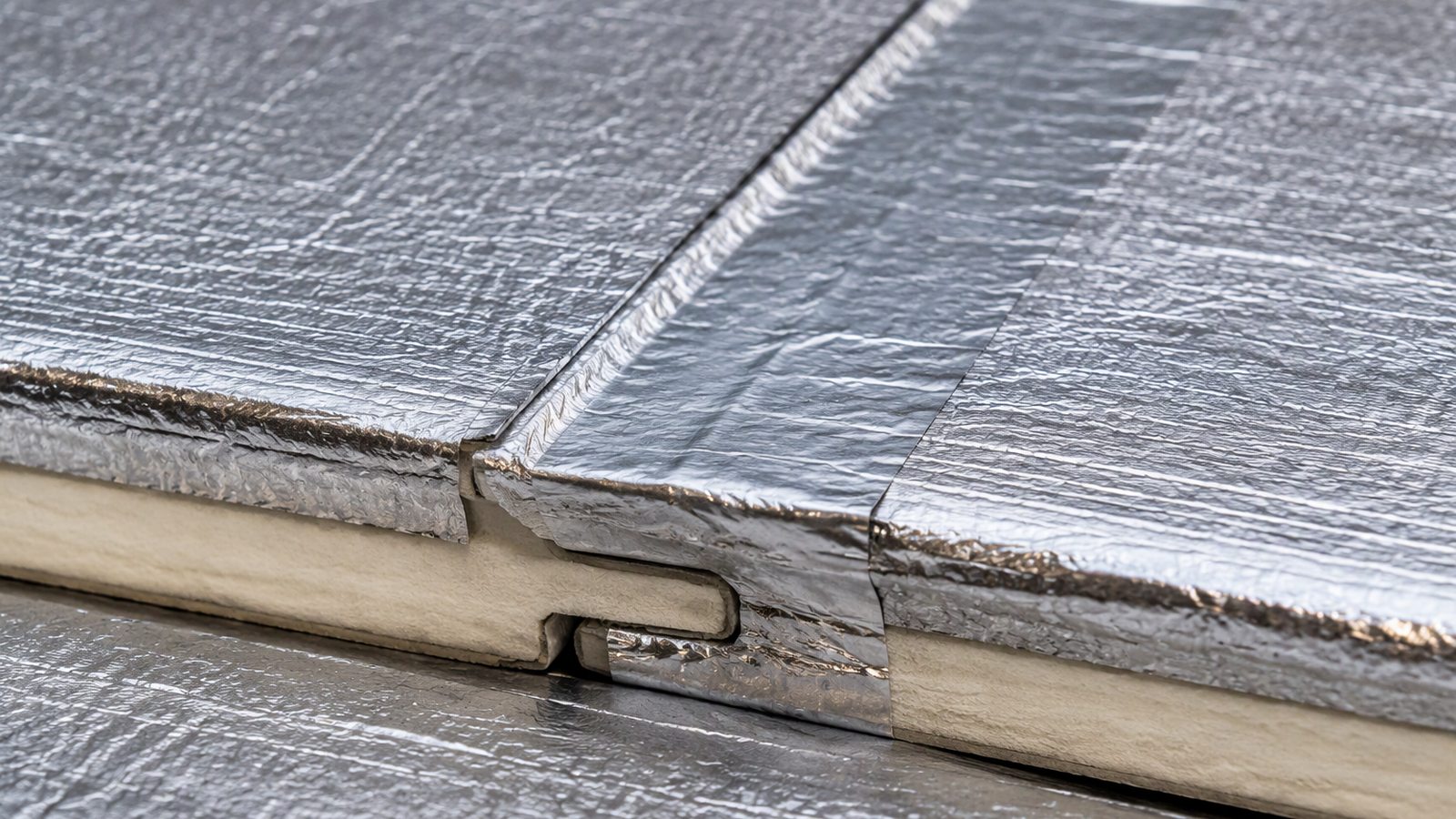
A square edge sits on the grid flange, a tegular edge drops below it, a liner panel is fixed directly. Each edge decides how much foil is protected.
Dive deeper
In a lay-in system the panel rests on the flange of a T-bar grid under its own weight. Nothing clamps it, so every panel is lifted, tilted and dropped into place by hand, often several times before the ceiling is closed. The edge that touches the grid is the edge that gets dragged.
If the facing is wrapped around that edge and bonded on the back, the foil is protected by the fold. A tegular panel hangs below the grid, so its edge is visible from the room, and the corner becomes the weak point: a fold that puckers there will lift later.
Liner panels are fixed with screws or clips to a rail or to purlins, and here the risk moves to the fastener. A screw driven through a foil facing pulls the foil into the hole and can tear it back along the thread. Washered fasteners and a pilot hole reduce that, and over-driving crushes a facing visible from below.
Site cutting is the other half. A panel cut to fit a perimeter loses its factory edge, and with it the protection that edge gave. Cut edges should be treated as exposed core, sealed or covered. Here a ceiling panel and a roof liner part company, because foil bonded into roofing and waterproofing membranes is judged by different rules.
Why Does a Roof Liner Panel Ask Something Different of the Foil?
A roof liner is a large flat underside with a hot deck above it and often moist air below. Flatness and sealing matter more than in a ceiling.
The liner faces a wide uninterrupted plane, a warm cavity behind, and the risk of condensation on its own cold inner face. The foil must stay flat and stay sealed.
Dive deeper
Scale changes everything. A ceiling is broken up by a grid every panel, so small deviations are contained. A roof liner runs as a continuous plane, and a plane is unforgiving: a slight difference in tension between two panels, or a facing that stretched on the roll, shows as a visible band.
The thermal situation is inverted too. In a ceiling the warm side is usually the room and the plenum is cooler. Under a roof the deck above can be hot while the space below stays cool, and the liner is the surface that cool air reaches. A metallic facing is a radiant barrier in the helpful direction, and also the coldest surface.
A liner spans between supports and carries its own weight plus whatever is fixed to it, and the foil contributes nothing to that. Flatness over a long run comes from the core and edge profile. The Aluminum Association sets out how the metal is classified and temper-designated, the vocabulary a liner specification needs.
Finally, a liner is seen from below at a shallow angle, in a space with high-level lighting or roof glazing. A joint that is slightly open reads as a dark line, and a facing that has rippled reads as a wave. Both are seen once the scaffold comes down.
How Do Condensation and Trapped Moisture Attack an Unsealed Facing?
Water does not need a hole. It needs a path, and the joint between two panels is usually the easiest path in the assembly.
Vapour reaches the cold foil, condenses, and runs back along the facing to the joint. Once water sits behind bonded foil, the bond is the part that fails.
Dive deeper
A foil facing does not breathe, but a panel is not a sealed envelope. Panels meet at joints, at perimeters, at penetrations and at the head of a wall, and each junction is a place where vapour can pass the facing and reach the cold surface behind it. The facing may be perfect and the assembly still wet.
Once water is behind the foil it has nowhere to go. It sits between foil and core, and works on the adhesive from the back. The symptoms arrive in a familiar order: a dull patch, then a slight ripple, then a lifting edge, then a panel where the facing peels away in a sheet.
There is a second mechanism. Moisture in a mineral or cementitious core is alkaline, and an unprotected aluminium surface in contact with alkaline moisture can corrode, leaving a dark stain that shows through a light coating. That is one reason facing foil often carries a thin protective treatment on the bonded side.
The remedies belong to the assembly rather than to the foil. Joints should be closed with a compatible sealant or gasket, perimeters sealed rather than left open, and the void above a liner ventilated or kept dry. A panel maker controls the bond and the edge; the rest belongs to the detailer.
What Should Be Written Down So Maker and Supplier Mean the Same Thing?
Foil is ordered with a few words and delivered against a much longer reality. The gap between the two is where facing complaints begin.
Write down alloy and temper, thickness within the supplied range, width, core diameter, which face is bonded, surface treatment, and how bond and edge are checked.
Dive deeper
A purchase description that says only foil-faced is not a specification. It does not say which alloy, temper or surface, or what the foil has to do. Each side then chooses something reasonable, and the two do not match on the ceiling.
Start with the metal. Alloys such as 1050, 1100, 8011 and 3004 behave differently in a laminate: softer tempers conform to a core and show fewer creases, harder tempers resist handling better. Thickness within the 0.005 to 0.20 mm range follows the bond and the handling, not a performance figure. A 3004 aluminium foil at 0.03 mm and a soft 1050 at a heavier gauge are not interchangeable.
Then describe the surface. Mill finish, a protective treatment, a wash primer, or a lacquer are different products, and the specification should say which is which. If the facing will be perforated, state pattern and open area in the terms your line uses.
Then describe the checks: how adhesion is assessed and on what sample, how the edge is inspected, how rolls are joined. State the commercial frame: MOQ 3 MT per size, shipment from Qingdao, Tianjin or Shanghai. The industrial and technical foil range groups these grades, and the alufoil.org pages maintained by the foil industry give background on production.
The foil is a facing, not a structure. Specify what the facing must do, protect the edge, seal the joint, and the panel will behave as the drawing intended.