How Do You Specify Aluminium Foil for Duct Insulation Facing?

A specification-decision guide for HVAC contractors, insulation laminators and foil buyers: how to fix alloy, temper, thickness, width, core and surface condition for duct and pipe facing, and why the gauge has to survive site handling.
Specifying foil for duct and pipe insulation facing looks simple until a thin gauge tears on site and the whole lamination fails inspection.
The direct answer: name the alloy, temper, thickness in millimetres, width, core diameter and surface condition, then add packing and ports. For a laminated facing, thickness is usually the deciding parameter, because the foil must survive handling, wrapping and site abrasion without pinholes or tears.
Below, each decision is framed as its own question, so a buyer, a laminator and an HVAC contractor can read one specification and reach one conclusion. The scope is deliberately narrow: Aluminium foil - Wikipedia describes the material in general, while this guide deals only with foil used as the facing of duct and pipe insulation.
Why does the gauge have to survive site handling?
Gauge is not only a cost line; it is the property that decides whether the facing still looks intact after unwinding, wrapping, stacking and abrasion.
A facing foil is handled many times before it is finally fixed. A slightly thicker gauge resists tearing, pinholes and wrinkling, so a specification should choose the thinnest gauge that still survives the whole chain from lamination to commissioning.
Dive deeper. A facing is not installed once; it is handled repeatedly. At the laminator the foil is unwound, coated with adhesive, combined with a scrim, a woven layer or a bubble layer, and re-rolled. It is then slit, wrapped, palletised, shipped and unloaded. On site it is carried up ladders, unrolled across duct runs, cut with knives, folded around elbows, brushed by hands and tools, and taped at every joint. Every one of those steps is a chance for a tear, a pinhole or a wrinkle. A wrinkle is not only cosmetic: trapped air under a facing can lift an adhesive, and a pinhole can let vapour through a system that was meant to be sealed.
The handling chain, in order
The chain usually runs like this: unwinding at the laminator, adhesive coating, lamination to the substrate, slitting to width, packing, transport, storage, unrolling on site, cutting, forming around the duct or pipe, and finally taping and sealing. Thin foil performs well at the start of that chain and poorly at the end. A specification therefore has to be written for the end of the chain, not for the laboratory.
Why one grade survives and another fails
Aluminium foil for facings is supplied in thicknesses from 0.005 mm to 0.20 mm, and the choice inside that range matters far more than the name of the alloy. A very light gauge can puncture when a worker drags a duct across a pallet, whereas a heavier gauge simply dents. The alloy and temper set the strength, but the gauge sets the margin. Practical documents therefore state a nominal thickness with a tolerance, and they state it in millimetres, because mixing gauges and millimetres is a common source of error. Alloy and temper designations follow the conventions maintained by ASTM Committee B07 on Light Metals and Alloys, so a specification that cites the standard family is easier for a mill to interpret than a loose verbal description.
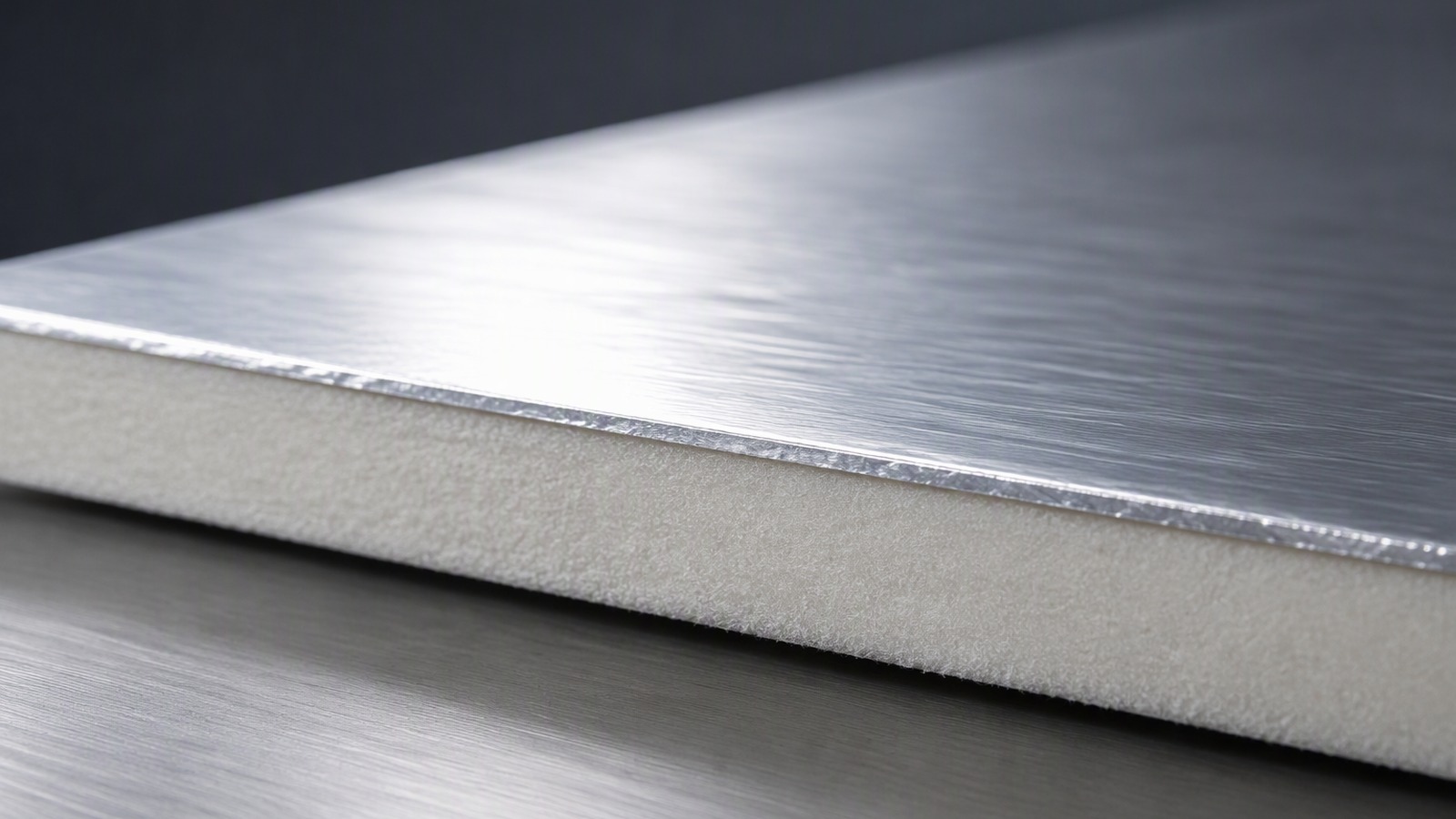
Which temper should a duct and pipe facing use?
Temper decides how the foil behaves when it is bent, folded and pressed around a duct or a pipe.
Soft tempers such as O conform easily to curves and corners, while the harder H tempers hold shape and resist damage. A facing is usually supplied in O, H14, H16, H18, H22 or H24, and the choice should follow the forming the facing will see.
Dive deeper. Temper is a statement about how much the metal has been work-hardened. In the O condition the foil is fully annealed and dead soft, so it drapes over a duct and folds without springing back. That is convenient for hand work, but soft foil also marks easily and can stretch. The H tempers, H14, H16, H18, H22 and H24, are progressively harder and hold their shape better, which helps on straight runs and on machine-laminated panels where the foil must stay flat. H22 and H24 are common where some stiffness is wanted without losing all of the ability to form.
Soft, half-hard or hard
Think of it as a trade: softer foil forms better, harder foil protects better. For a hand-applied wrap over irregular ducts, a soft temper is often the safer choice because it conforms without lifting. For a flat laminated panel that will be cut and handled in sheets, a half-hard temper keeps the surface flatter and reduces the chance of a crease. The important point for a specification is that temper is not decoration; it changes the way the product behaves on the line and on site.
How temper and gauge work together
Temper and gauge are read together. A hard, thin foil can be brittle, while a soft, thick foil can be heavy to handle. That is why temper grades deserve their own explanation rather than a single word in a table; a fuller account of how they are produced and what they mean for forming is given in aluminium foil temper grades explained. When you write the specification, state the temper explicitly and avoid vague words such as "flexible", because flexibility is the result of temper, gauge and alloy together. The main aluminium industry association in Europe, European Aluminium, publishes material on the sector, but the practical naming conventions are the ones a mill already uses on its own datasheets.
How wide should the facing foil be?
Width controls how many slits a coil yields and how much edge trim is lost on the lamination line.
Facing foil is available in widths from 100 mm to 1500 mm. The right width is the one that matches the laminator line and the finished panel with the least trim, so the specification should state the width and the slit tolerance.
Dive deeper. Width is an economic decision before it is a technical one. A laminator buys a mother coil and slits it into the widths the line needs. If the requested width leaves an awkward remainder, trim loss rises and cost rises with it, even though the foil itself has not changed. A specification that states a width the mill can produce in one clean slit pattern is easier to quote and easier to repeat.
Match the width to the line
The width should be chosen from the finished facing width plus the edge trim the line expects. It is normal to state a target width and a tolerance, and to say whether edges are slit or sheared. A clean slit edge helps the adhesive coat evenly and reduces the risk of a burr that later catches on rollers. When several panel widths are produced from one coil, the specification can list the slit pattern rather than only a single figure. A generic description such as industrial aluminium foil is a starting point, but a workable specification always narrows it to one width per size.
Why width tolerances matter
A width that drifts from coil to coil forces the line operator to re-set guides, and a re-set is a source of scrap and delay. Stating the width and the tolerance keeps the product repeatable. Because width and thickness are quoted together, the specification should present them as a pair for each size, so that nobody reads a thickness from one column and a width from another.
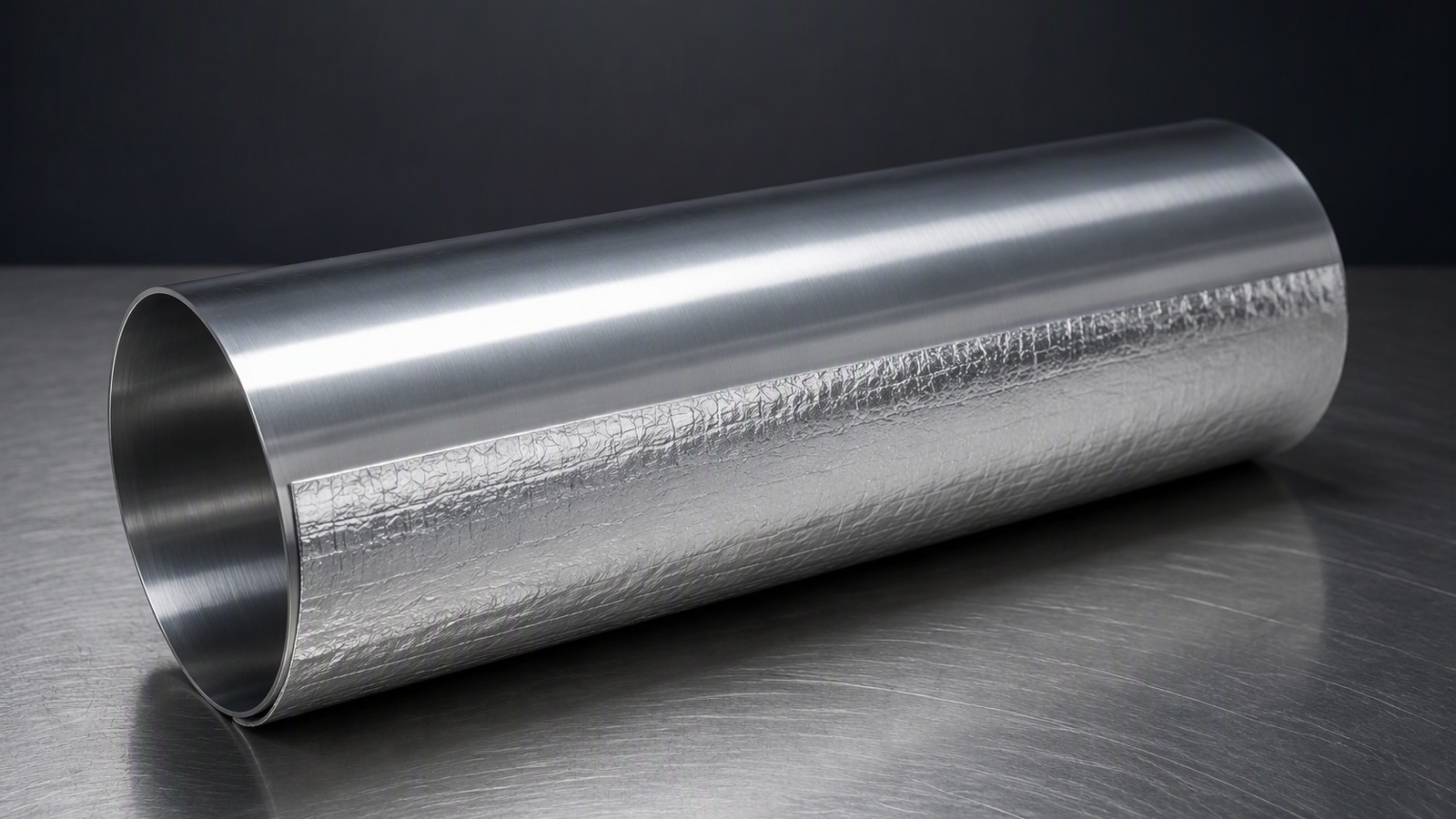
Which core diameter should the specification name?
The core is the part of the coil that the line actually lifts, so it decides how the foil unwinds.
Cores are commonly 76 mm or 152 mm. The 76 mm core suits lighter coils and manual handling, while the 152 mm core suits heavier coils and machine unwinding, so the choice should follow the handling equipment.
Dive deeper. A core that is too small for the coil weight can crush or deform, and a core that does not fit the unwind mandrel simply cannot be run. That is why core diameter belongs in the specification next to the coil weight and the handling method. It is also why the orientation of the coil matters: foil can be supplied eye to sky or eye to wall on a wooden pallet, with a moisture barrier wrap, and each orientation suits a different lift and feed arrangement.
Handling equipment decides the core
If the line lifts coils with a shaft through the centre, the core must match the shaft. If coils are lifted from the outside, the core still matters because it defines how the coil sits and how it is unwound. For a facing operation that runs at speed, a larger core can reduce the tension spikes that occur when a small core turns quickly. For a manual operation, a smaller core keeps the coil light enough to move without lifting gear. In both cases the specification should name the core, the coil weight range and the packing orientation, so that supplier and line agree before the coil is made.
Packing as part of the core decision
Packing and core are one decision, not two. A coil that is packed eye to wall behaves differently on a pallet from one packed eye to sky, and the moisture barrier wrap that protects the foil also affects how it is opened and staged. A related product used in other forming lines, aluminium foil for heat exchangers, is often specified with the same attention to core and packing, because the same lift and feed questions apply. The habit is worth copying: write the core, the coil weight and the packing direction as a single line in the specification.
What surface condition should the specification require?
Surface condition is what the adhesive actually bonds to, so a clean, uniform surface is not a cosmetic preference.
The specification should require a clean, dry, oil-free surface, free from oxidation, rolled-in dirt, scratches and edge burrs, with a surface that accepts the chosen adhesive. Pinholes and holes should be limited and defined.
Dive deeper. A laminator adhesive does not bond to the alloy; it bonds to whatever is on the surface. Oil from rolling, dust from storage, light oxidation or a fingerprint film can all reduce the bond and cause a facing to lift later. That is why surface condition belongs in the written specification and not only in a verbal understanding between buyer and supplier.
Cleaning and wetting
Foil that leaves a rolling mill can carry a thin film of rolling oil, and a specification can state that the surface is supplied clean and dry. The same line can require that the surface wets evenly, because an adhesive that beads on an oily spot will not hold there. It is enough to require a uniform, dry surface with no visible oil or stain; the point is to make the requirement explicit rather than assumed.
Defects that matter and defects that do not
Not every mark matters. A light handling mark on a facing that will be hidden may be acceptable, while a deep scratch on a visible surface is not. A specification should separate the two: what is visible and what is structural. Pinholes deserve a clear statement, because a foil meant to act as a vapour barrier should not be full of them. Edge burrs deserve attention as well, because a burr can catch on a roller and start a tear. As with gauge, the rule is to write the requirement in numbers and words a mill can check, rather than to rely on adjectives.
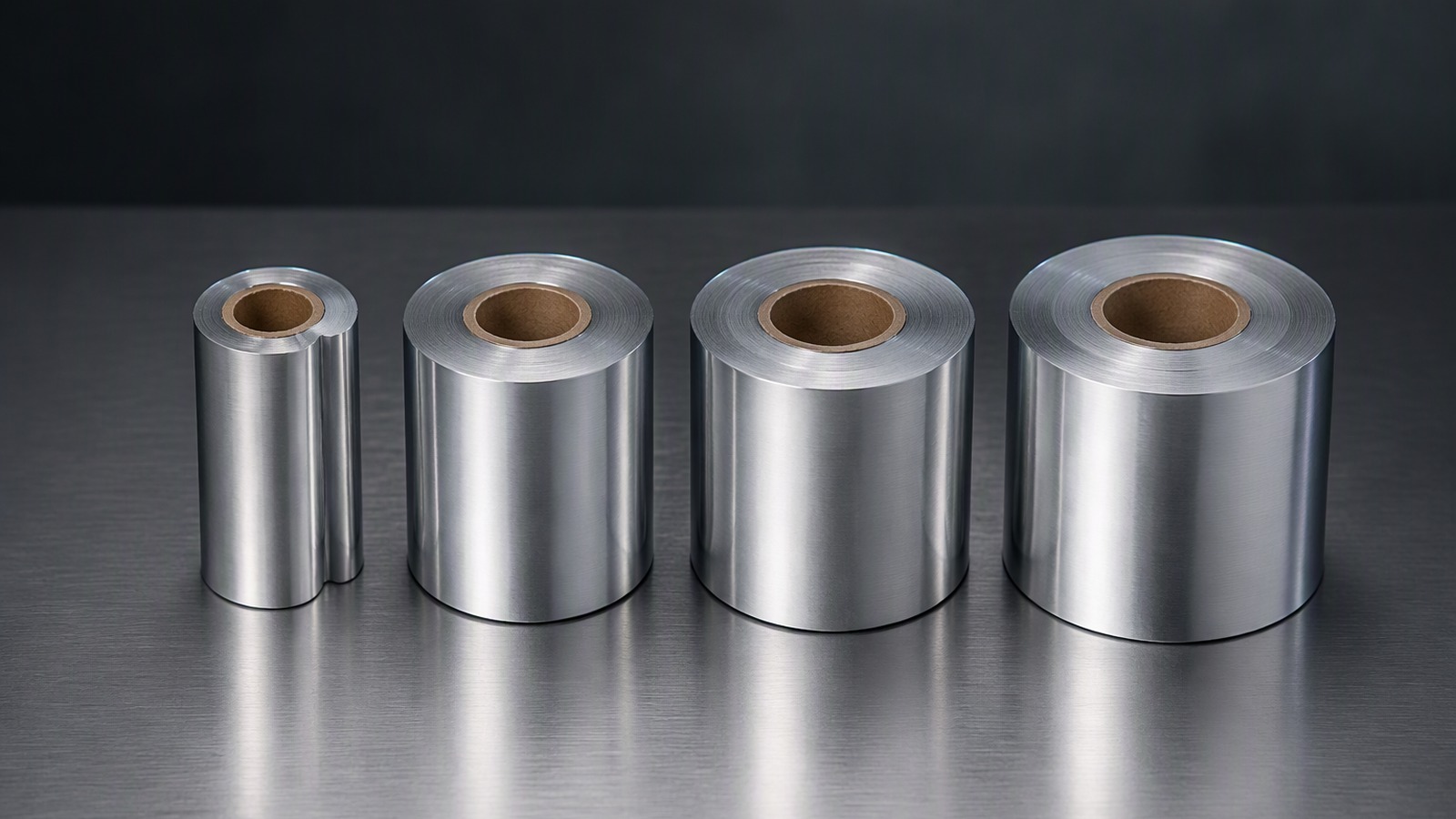
How do you turn these decisions into one written specification?
A specification is only useful if a mill can quote it and a line can check it without asking questions.
Put the alloy, temper, thickness, width, core and surface condition into one line per size, then add the commercial terms: a quantity, the packing and the named ports.
Dive deeper. The commercial terms are as much a part of the specification as the technical ones, because they tell the mill and the buyer what they are agreeing to. A quantity threshold keeps a mill run economic, and a stated packing keeps the handling predictable. When these lines are present, the document stops being a wish list and becomes an order.
A working line for each size
A usable line for one size reads, in effect: alloy, temper, thickness in millimetres, width in millimetres, core diameter, coil weight, surface condition, a minimum order quantity of 3 MT per size, packing eye to sky or eye to wall on a wooden pallet with a moisture barrier wrap, and the named port, such as Qingdao, Tianjin or Shanghai. Alloy 1050 or 1060, temper O or H14, a thickness of 0.1 mm and a width of 1200 mm is a typical opening line. The alloy and temper come from the standard families, the thickness is supplied in millimetres, and the width is stated with a tolerance.
What to leave to the mill
A good specification fixes what the line will check and leaves the rest to the mill. It does not need to describe every internal step; it needs to state the properties the buyer and the line depend on. For facings, those properties are the six decisions in this article: alloy, temper, thickness, width, core and surface condition, with packing and port as the closing lines. Buyers who want a starting point can review the wider industrial and technical foil range, and a single-size example such as 1050 aluminium foil 0.1 mm shows how one line is built. In North America, duct construction practice is often described with reference to SMACNA, and a specification that speaks the same language as the trade is easier to accept. The final test is simple: if the document can be quoted unchanged and checked on the line without a phone call, it is finished.
A good facing specification fixes alloy, temper, thickness, width, core and surface condition, then lets site handling, not price alone, confirm the gauge.