Why Does Aluminium Foil Formability Depend on Elongation?

Elongation sets how far foil stretches before it tears. It decides if two alloys form alike.
Why Does Aluminium Foil Formability Depend on Elongation?
A part runs for months inside its window, then a new alloy arrives and every corner splits. The drawing never changed; the metal did.
Formability follows elongation because forming only works while the metal can still stretch. Elongation sets how much stretch is available before a crack starts.
That sounds simple until two suppliers send data sheets that look identical. The rest of this article takes elongation apart piece by piece, then puts it back together as a purchasing decision.
What Does Elongation Actually Describe?
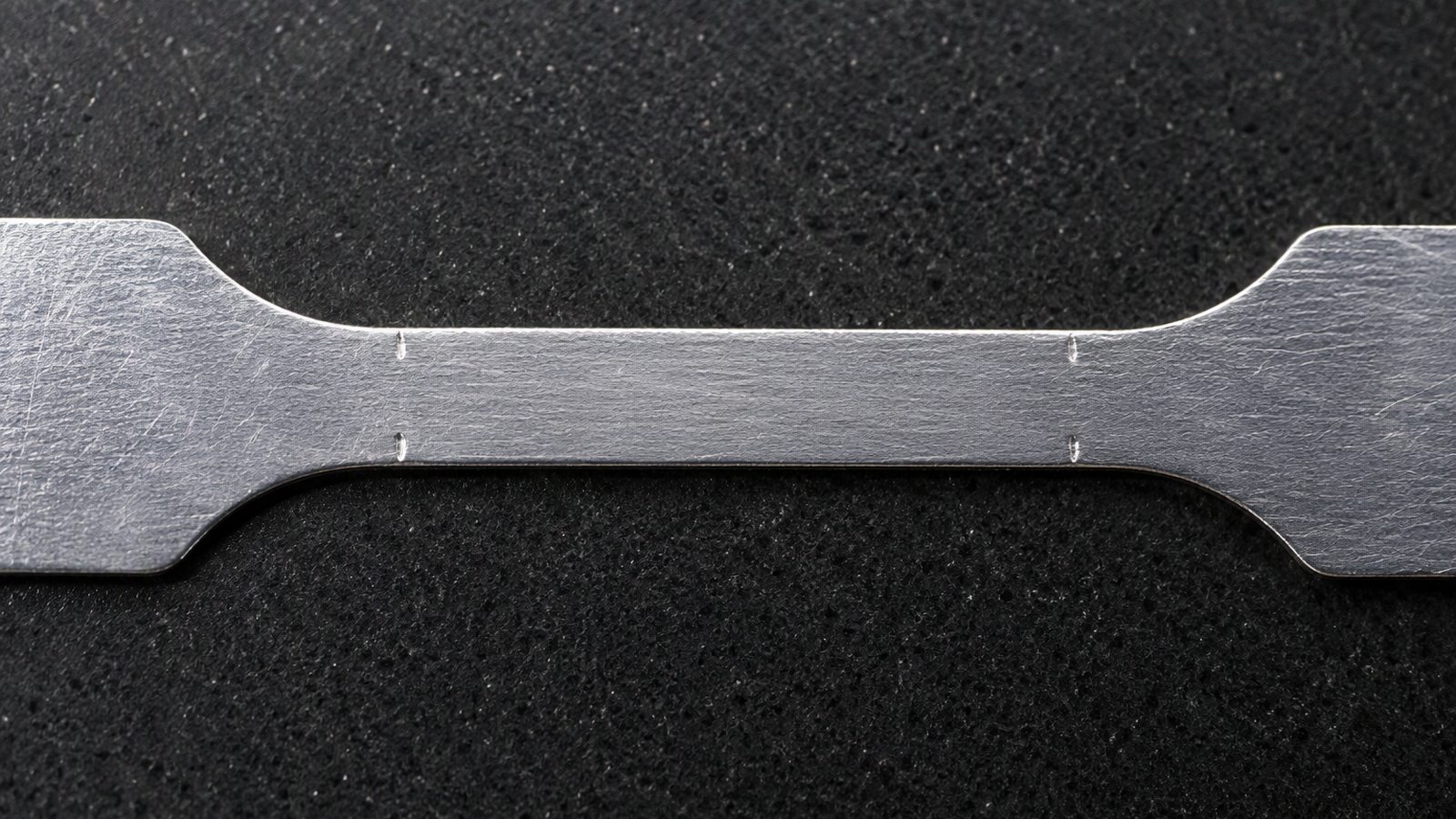
It is not a hardness reading and not a strength figure. It describes travel: how far a strip can be pulled before it comes apart.
Elongation is the permanent stretch a strip accepts before it separates. It measures tolerance for being pulled, not the force needed to pull it.
Dive deeper
Two properties sit side by side on every data sheet and are read as though they were one. Strength says how much force is needed before the metal stops springing back. Elongation says how much further it can then be pulled before a crack opens. A strip can be strong and still generous, or soft and surprisingly brittle. Confusing the two sits behind many wrong alloy choices: the stronger strip is assumed to be the tougher one, when strength and remaining stretch are separate questions.
Read elongation as a budget rather than a grade. It is reported once for the whole strip, but it is spent in small places. A forming tool never pulls a blank evenly; it concentrates work where the shape turns, where a web is narrow, where an edge is unsupported. The reported value says how much travel the metal can offer in total. It does not say how that travel will be shared across the part, and the sharing decides survival.
One more caution. Elongation is recorded on a flat strip pulled one way, while a formed part pulls in several directions and wraps around curves. A generous flat value is a good sign, not a promise. The encyclopaedic overview of aluminium foil is a fair reminder of how little metal sits in the wall of a thin part.
Why Is Every Forming Operation Really a Local Stretch?
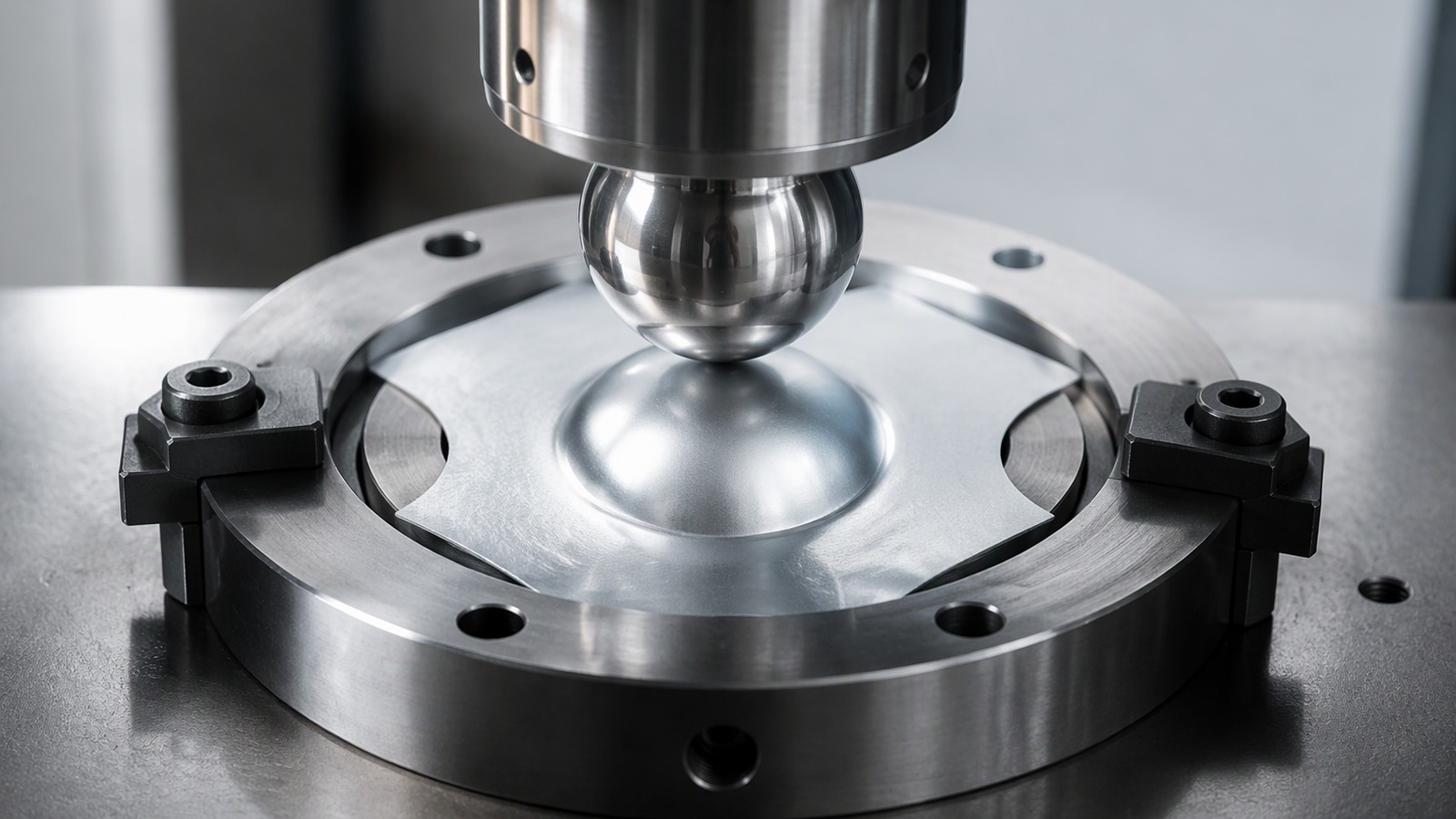
A press does not stretch the whole blank. It stretches the small area that must become a corner, a wall or a rim.
Forming concentrates strain. A part fails where the local demand passes the local supply, even when the blank as a whole still has stretch to spare.
Dive deeper
Picture a shallow tray. The flat base barely changes; it is carried inward almost intact. The corner, by contrast, has to become a curve from a flat patch of metal, and the rim has to grow as material is pulled over the die. Almost all of the useful deformation happens in a small fraction of the surface. That is why a blank can measure generously on a data sheet and still split at one corner: the average is comfortable, the peak is not.
The metal does not distribute the work by choice. It moves where friction lets it move. Every contact with a tool resists sliding, and that resistance rises once the sheet is pressed against a surface. Material near a corner is held back by the surrounding field, so the corner is asked to thin instead of borrowing metal from its neighbours. The demand is concentrated, the supply cannot travel, and the difference is paid in wall thickness.
Shorten the distance the metal must travel, soften a transition, add material at the corner, open a pocket so the field can feed it, and the same coil forms. That is why suppliers quote 8021 aluminium foil in 0.03 mm for jobs needing both strength and a working corner: alloy and tool are chosen as a pair.
Why Do Two Alloys That Look Identical on Paper Form Differently?
Two sheets can match on every declared line and behave differently under the same tool. The difference is usually in how the stretch is delivered.
Chemistry, grain structure and processing history decide how evenly a metal shares out its stretch. Matching declared values can still hide different distributions.
Dive deeper
A data sheet is a summary of limits, and limits are blunt instruments. Two strips of the same gauge can carry different amounts of alloying elements within the permitted range, and those elements change how the metal hardens as it deforms. A strip that hardens quickly stiffens the corner early in the stroke and pushes demand into neighbouring metal; one that hardens slowly keeps flowing where it is pulled.
Grain structure matters as much and is invisible on a quotation. Rolling leaves grains elongated in the rolling direction, so a strip is rarely equally willing in every direction. A corner pulling across the grain is working a different metal from one pulling along it. Softening can even the structure out, or leave a mixed grain size that deforms unevenly, with coarse patches thinning first. Two coils of one alloy and temper can therefore split in different places on the same die.
Processing history sits behind both. A different pass schedule, a different reduction before softening, a different cooling rate after casting, and the metal arrives with a different internal structure while every declared figure still matches. The website of the European aluminium industry shows how broad that landscape is, from remelt to finished strip. The foil roll and sheet range on this site shows how differently the same metal can be presented. When two quotes look identical, ask what route produced each strip.
How Does Temper Change What the Metal Will Do Before It Cracks?
Temper is the state the strip is delivered in, and it decides how much of the available stretch has already been spent.
A harder temper leaves less room before a crack. Softening restores stretch but costs stiffness, so the part and the tool decide which state fits.
Dive deeper
The same alloy can arrive in states that behave nothing alike. In the softened state the metal has been allowed to recover, so its structure is relaxed and it keeps deforming long after a harder strip would have stopped. In the cold worked states the strip carries stored distortion from rolling; it is stiffer and stronger, and part of its ability to stretch is spent before your tool touches it. The designation system that labels those states is set out in what the temper designations mean, worth reading before specifying one.
Temper can therefore decide a job on its own. A tool set up for a soft strip will often split a harder one at the same corner, with the same blank and pressure, because the harder strip reaches its limit earlier. Adding force does not help: it raises demand everywhere at once and the corner still fails first.
There is a trade in the other direction, and buyers feel it. Softening for formability gives away stiffness, so a part that must stay flat or hold a shape may need the harder state and a redesigned corner. Intermediate states exist for exactly that reason: enough cold work to keep the part crisp, enough remaining stretch to survive the tool. State temper on the enquiry, and state what the part must do afterwards.
Why Does Gauge Change the Outcome on a Thin Web?
Reduce gauge and you reduce the amount of metal available to feed a stretch. Thin foil has less to give, and it gives it faster.
A thinner web has fewer thicknesses of metal to draw from, so the same shape asks a larger share of what is there. Gauge and elongation must be read together.
Dive deeper
Formability is often discussed as if it belonged to the alloy alone, but the same alloy at two gauges is two forming problems. A thin web has less metal in the wall to redistribute, so any local demand consumes a larger fraction of what is present. Stretch that a thicker strip absorbs by thinning a little over a wide area must be taken, in a thin strip, from a narrow band that thins quickly and tears. A tool comfortable on heavier foil can fail at once when the part moves to a lighter gauge.
Gauge also changes how the strip behaves against the tool. Thinner metal bends more easily, buckles more easily and is far more sensitive to clearance and to any mismatch between punch and die. It wrinkles where a heavier strip would resist, and a wrinkle pressed flat becomes a fold, then a crack.
Tolerance makes it harder still. A gauge sitting at the low end of its band behaves like a lighter gauge everywhere, including at the corner that was already marginal. When comparing samples, read sample and production coil at the same nominal gauge and temper. 1060 aluminium foil in 0.1 mm for a shallow drawn lid is a different proposition from a much thinner web of the same alloy. The North American aluminium industry website shows how widely foil is applied across markets.
Why Does Forming Usually Fail at the Edge First?
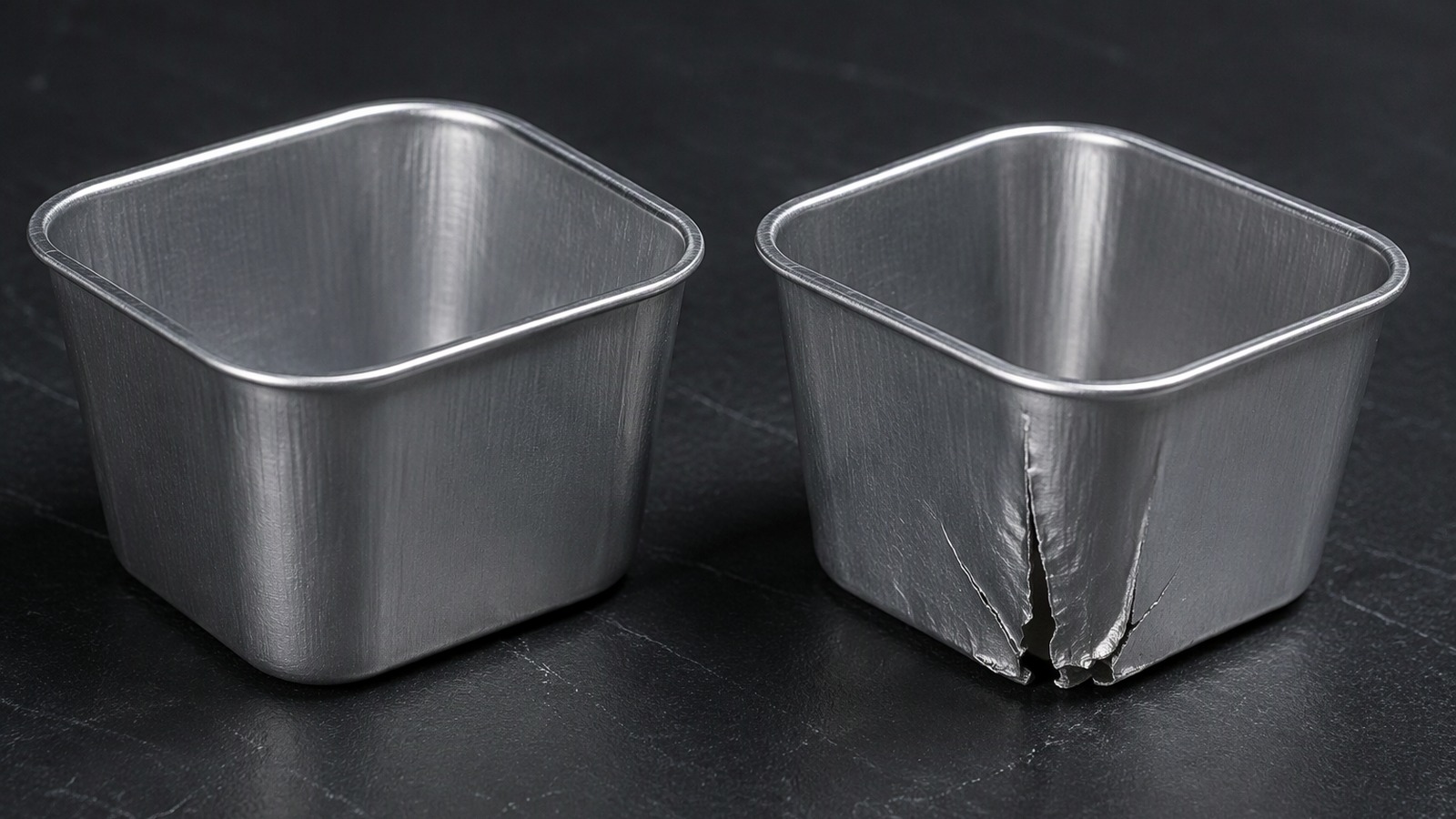
Look at a split part and the crack almost always starts at a trimmed edge, not in the middle of the field.
A cut edge carries small defects and no support, so it reaches its limit before the surrounding metal does. Edge quality is part of formability.
Dive deeper
A trimmed edge is the least protected part of any blank. Slitting shears the metal rather than cutting it cleanly, leaving a burr on one side and a zone of distorted, work hardened material along the cut. That zone has been deformed once already, so it starts the forming stroke with part of its stretch spent. Add the tiny tears and steps a shear leaves behind, and the edge behaves like a row of starter notches waiting to open.
The edge is also unsupported. In the middle of the blank, metal on all sides holds the thinning region back and feeds it; at the edge there is nothing on one side, so material pulls away and demand rises exactly where supply is weakest. Splits appear at the trim line of a corner, or along a flange edge, rather than in a wall that was doing more work overall.
Edge condition varies more than buyers expect, and between coils carrying the same description. A worn slitter, a different knife overlap, a coil re-slitted narrower, handling damage from a badly set roll, all change how the edge behaves in a press. Before changing alloy to cure a corner crack, look at the edge. The aluminium foil producers website is a useful orientation to how foil is converted after rolling.
How Does Bend Radius Relate to What the Metal Can Take?
A tight radius asks the outer surface to travel further than a generous one. The metal answers with a crack or with a fold.
The tighter the radius relative to thickness, the more the outer surface must stretch. Radius is the demand; elongation is the supply that has to cover it.
Dive deeper
Bending is the simplest forming operation and the clearest demonstration of what elongation means. When a strip is bent, the inside of the bend shortens and the outside lengthens. The outer surface is stretched along the length of the bend, and the tighter the radius, the shorter the arc over which that stretch is spread. A generous bend asks for a little stretch over a long arc; a tight one asks for a lot over a short arc.
This gives a tool setter a way to think without numbers. If a bend splits on the outside, the outer surface ran out of stretch before the bend was complete. The remedies follow: open the radius, reduce the thickness being turned, choose a temper with more remaining stretch, or arrange the bend so the outer surface does not stretch across the grain.
The same logic explains why a radius that works in one temper fails in another, and why a radius accepted on a sample fails in production when grain direction changes. It also explains why bending and drawing are related problems: both ask a local region to extend beyond its original length, and both are limited by the same reserve. The question of why the wall thins in a deep draw follows from the same accounting, seen from inside the part.
Why Do Lubrication and Tool Condition Change the Result When Elongation Does Not?
Change the lubricant and the same coil starts splitting. Nothing about the metal changed, yet the outcome did.
Friction decides how much of the stretch the tool takes out of the metal locally. Lubrication and tool condition move the demand; elongation only sets the supply.
Dive deeper
A forming tool transfers force through contact, and contact is never frictionless. Where the lubricant film is thin or broken, the metal grips the tool and stops sliding, so the region just beyond the grip must supply all of the movement. A dry corner behaves like a much smaller corner: the same stroke, concentrated into less metal, which is why a job can run well in the morning and split after a long shift.
Tool condition works the same way. A polished die entry lets metal slide and spreads demand; a scored entry grips and concentrates it.
This is where most alloy comparisons go wrong. A buyer hears about corner cracks, moves to a softer alloy, and the cracks stop, so the alloy is blamed. In reality the softer alloy simply had spare stretch to absorb demand that tool and lubricant had inflated. A cleaner die entry or a better film would have done the same at a fraction of the cost.
Where the buyer should place the decision
Use elongation as a screening property, not a promise. Ask for the value at the gauge and temper actually quoted, because a figure borrowed from another state describes a strip you will not receive. Compare like with like: same alloy family, same temper, same gauge. Then ask what the forming route does to the metal, and whether the supplier has seen the part.
Elongation is the stretch budget that a forming tool spends. Read it at the quoted gauge and temper, and check the corner before blaming the alloy.