Where Does Aluminium Foil Sit Inside an Appliance?
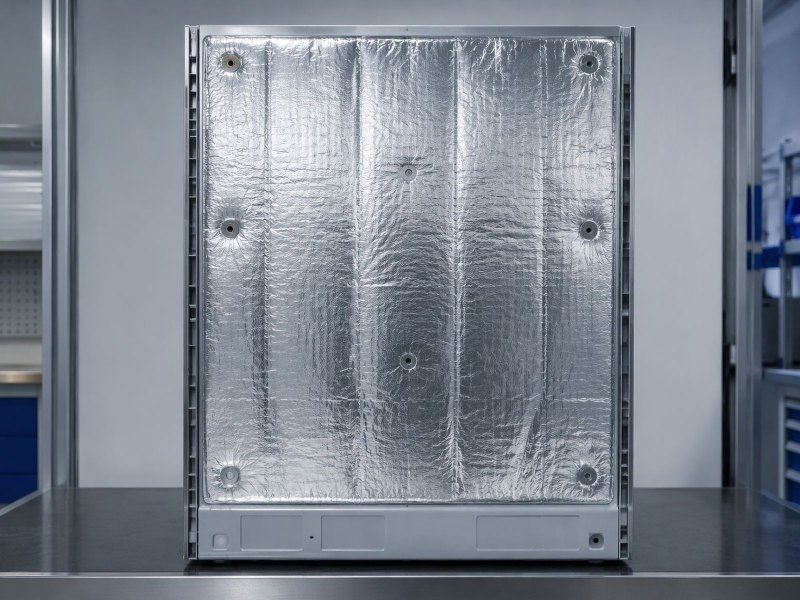
Where foil sits in an appliance, which gauge suits a facing, and why the bond decides its life.
A facing that looks perfect on the lamination line can fail inside the cabinet. Moisture reaches the cut edge, the bond lifts, and the reflective layer stops working.
Foil sits on the outward face of the insulation around the cavity: bonded to a blanket, board or foam core, looking into the air gap behind the cabinet skin, edges folded, taped or trapped under panels.
The sections below follow that facing from the drawing to the end of a service life: where it sits, why it is there, how it is specified, how it is bonded, and what finally decides whether it survives.
Where does the foil actually sit inside an appliance?
The position is easy to describe badly. Foil is not a liner for the food space; it is part of the shell around it.
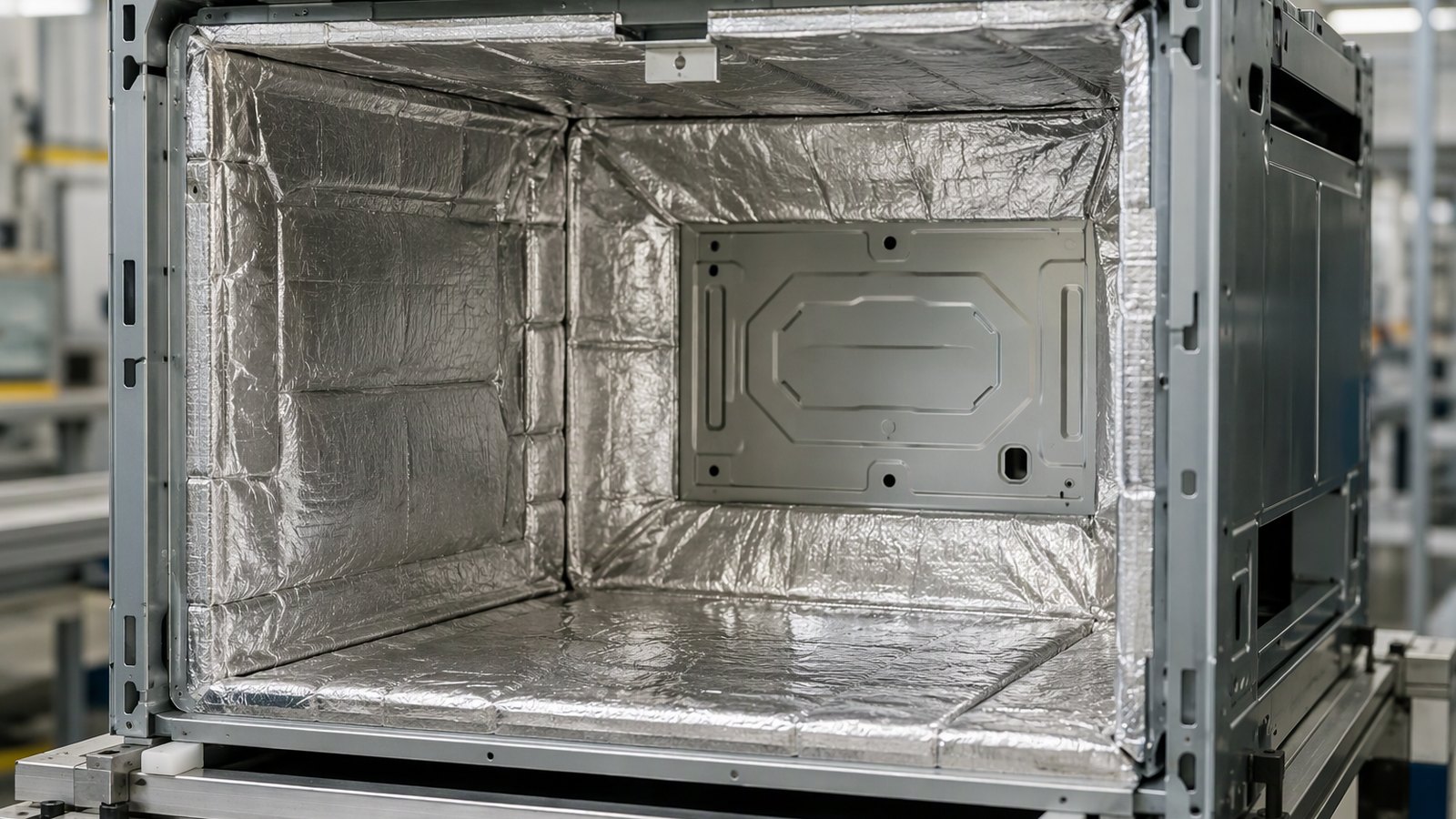
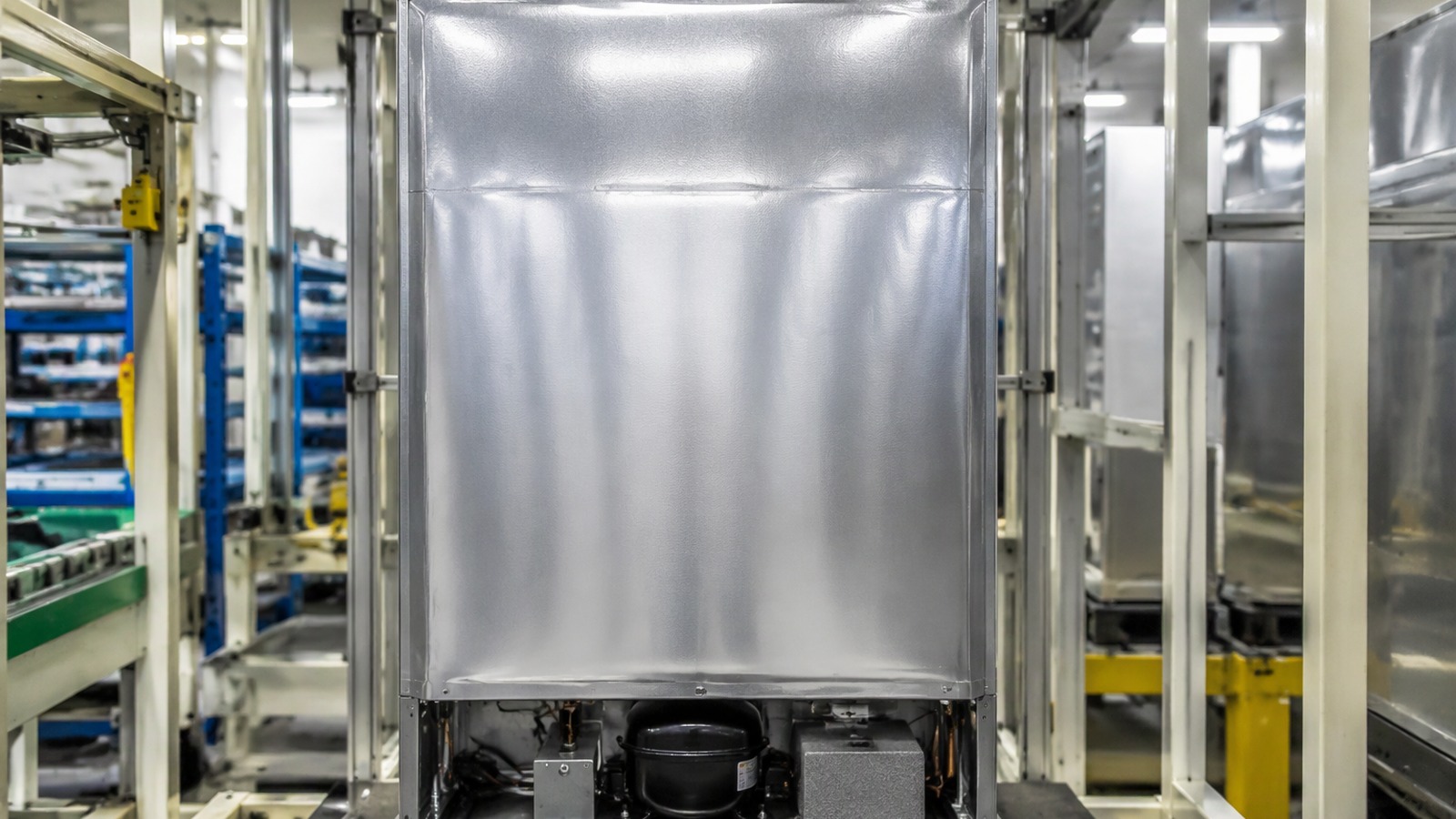
In a refrigerator it wraps the cavity and closes the machine compartment. In an oven it sits behind the outer wrapper, away from the cooking space. In a dishwasher or a washer it follows a tub or a drum.
Dive deeper
Three positions, one duty
In a refrigerator the facing appears twice: on the blanket that wraps the liner, and on the panel that closes the machine compartment. In an oven it sits behind the outer wrapper on a mineral or fibre core. In a dishwasher or a washer it follows a tub or a drum, or shields the electronics bay.
The shapes differ; the duty does not. The foil faces a gap, the core faces the cavity, and the two are laminated into one sheet before either is fitted. In every one of those positions the foil is the outer skin, never the surface that touches food, dishes or laundry.
Back panels are a separate case
A back panel facing is usually a flat laminate cut to the panel outline, with the foil directed into the machine compartment rather than into the room. Where the outer side is painted or powder coated, the foil is hidden completely.
That changes what a customer sees, not what the laminate must survive: flexing during fitting, a trimmed edge, a screw driven through it, and moist air with no easy way out. Read the drawing before choosing a gauge, because a flat sheet in a photograph is often a fold and a compression zone in the assembly.
Why does an appliance need a reflective layer at all?
The core blocks heat; the foil manages what crosses the gap without touching anything. Two different jobs, stacked in one sheet.
A bare fibre, foam or mineral surface absorbs and re-radiates strongly. A foil face reflects most of that exchange back, so the same core is allowed to do more of its own work.
Dive deeper
What the foil is doing
Heat crosses a closed gap in more than one way. Some moves through the air, some travels by conduction through whatever bridges the gap, and some is exchanged as radiation between two surfaces that face each other. Cores are good at interrupting the first two and much less good at the third, so the face of the core is where the radiant part still has to be dealt with.
A foil face changes the surface. Bare metal reflects most of the radiant exchange back towards where it came from and absorbs very little, so the facing acts as a low-emissivity screen rather than as an insulator in its own right. The core still does the blocking; the foil decides how much of the radiant part gets through.
The duty nobody specifies
The same layer keeps the core clean and dry. A foil face stops dust, grease and lint from loading the surface of a blanket, and it slows the moisture that migrates through a cabinet over years of service. Neither duty appears on a drawing, and both disappear once the foil is perforated, split or left unbonded.
Background on the metal, including how thin strip is rolled and handled, is collected in the entry on aluminium foil.
Which gauge belongs in an appliance facing?
Gauge is chosen by the handling the facing must survive, not by the barrier it must provide. Thinner is not automatically better.
Thin gauges from the lower part of a 0.005–0.20 mm range suit facings that must drape. Gauges near 0.08 mm and 0.20 mm suit flat panels, folded edges and fixings.
Dive deeper
Thin where the facing must follow a shape
On a blanket folded around a cavity, the facing is asked to bend, crease and drape. Thin gauges from the lower part of a 0.005 mm to 0.20 mm range do that best: they conform to the core, fold at a corner without cracking, and add very little stiffness to a soft laminate.
1050 aluminium foil in 0.08 mm sits above the thinnest part of that band and is often used where a facing has to hold a crease rather than drape over a curve. Go thinner than the handling allows and the web tears at the slitter, wrinkles in the nip, and shows every crease as a bright line.
Heavier where the facing is a panel
A flat back panel laminate is a different problem. It is cut to outline, drilled, screwed and sometimes folded, and the foil has to survive all of that without puncturing. 3003 aluminium foil for appliance facings brings manganese into the alloy, which raises strength, and a 0.20 mm gauge gives an edge that resists tearing close to a fixing. Where a panel is folded, that fold line is where a thin gauge gives up first.
Between those ends the choice is settled by one question: does the facing have to follow the core, or the core the facing?
Why is the facing laminated rather than used bare?
Bare foil would be cheaper and would fail. It has no body, no fixing point and no way to stay where it was put.
Lamination turns a fragile web into a handleable sheet. The core supplies body and holds the foil flat, the adhesive keeps the two together, and the composite can be cut, folded and fixed like any panel.
Dive deeper
What a bare web cannot do
Handled on its own, a thin foil has no shape worth the name, no stiffness across the width and no way to be fixed. It tears at a staple, creases under a washer, and will not stay flat across a panel long enough to be assembled. A laminate solves those problems at once.
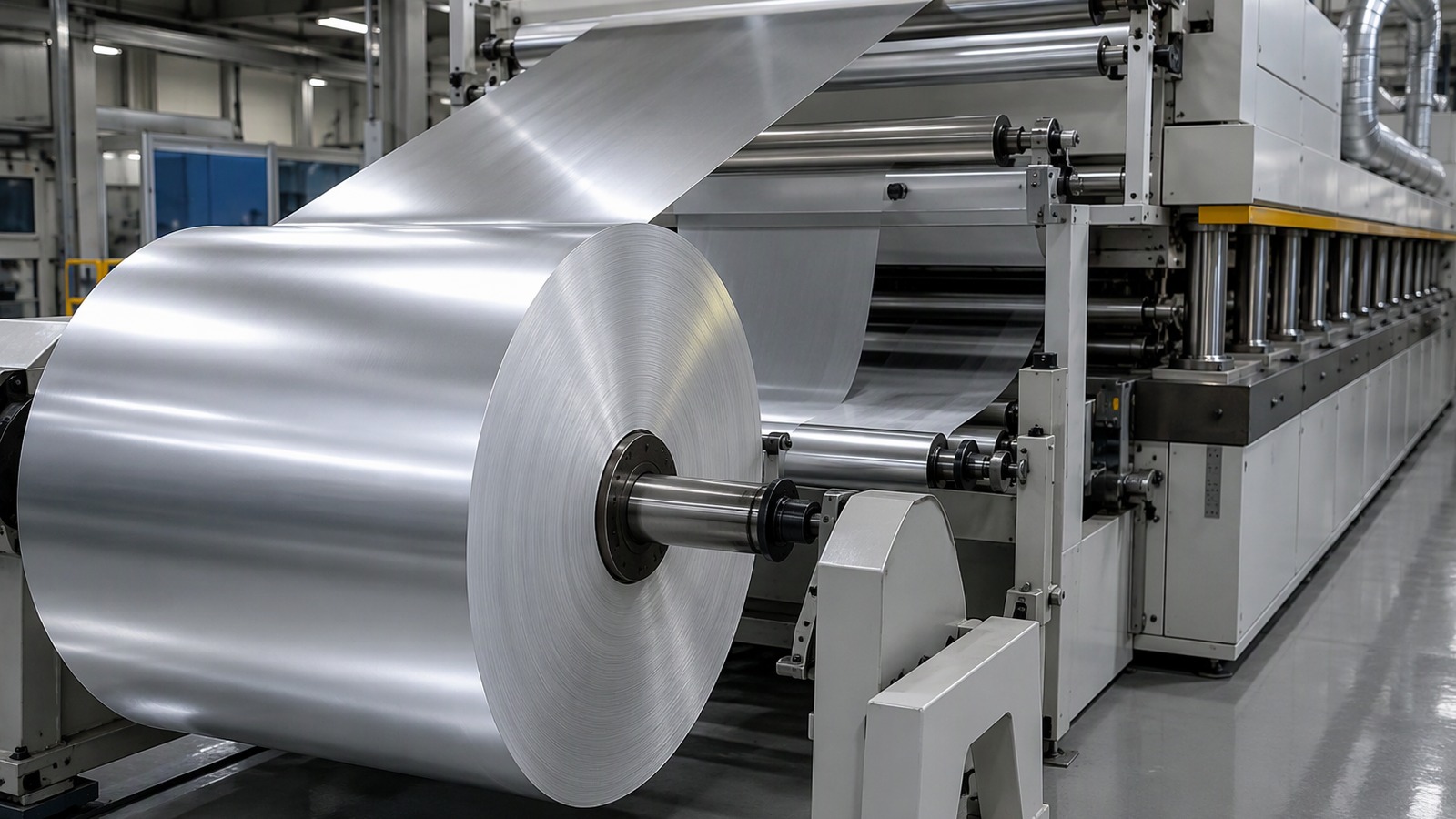
There is a manufacturing reason too. A converter can bond foil to a blanket, a foam, a nonwoven or a mineral board on one line, lacquer or print the exposed face, slit to the width the builder wants, and deliver a roll that feeds an existing cutting table. No appliance assembly has to change.
A system, not a skin
Once laminated, the foil is no longer a separate material. Its performance depends on the core it is bonded to, the adhesive between them and the way the composite is cut. That is why the same foil can be excellent in one laminate and disappointing in another, and why a specification naming only alloy and gauge is incomplete. The industrial and technical foil range is organised around that idea.
Anyone who specifies facings for construction panels will recognise the logic. The difference is in the way foil facings are specified for building panels, where the panel is large, flat and exposed rather than small, folded and hidden.
What does the bond have to do with performance?
A laminate is only reflective where it is still attached. Once the foil lifts, the space behind it becomes a trap rather than a barrier.
The bond must survive shear during slitting, peel at trimmed edges and repeated flexing during fitting. An adhesive chosen for a flat board behaves differently on a soft blanket.
Dive deeper
Where bonds fail first
A laminated facing rarely fails in the middle. It fails where stress concentrates: at a trimmed edge, along a fold, around a cut-out, or wherever the composite bends tighter than the core wants to. On a soft blanket the foil and the core move differently under load, and the adhesive has to absorb that without letting go.
That is why bond selection follows the core, not the foil. A construction adhesive that grips a mineral board wets out badly on a needled blanket. A soft laminating adhesive that suits a blanket will creep on a board that is screwed down and flexed in service.
What to ask a converter
Ask how the bond is checked, not only which adhesive is used. A peel test at the trimmed edge, an inspection of the bond line after a fold, and a sample held under warm, humid conditions for a period agreed with the converter will say more than a data sheet. Ask too what happens at the slit edge.
One further point belongs in the conversation. A bond is a joint between two surfaces, so the surface treatment of the foil and the surface of the core have to be discussed together; the foil industry body Alufoil publishes general notes on surfaces and converting that help frame the questions.
How do cut-outs, fixings and seams affect the barrier?
Every hole is a decision. A facing is judged at its cut-outs, not across its middle.
Cut-outs expose the core, fixings puncture the foil, and seams create laps that must run the right way and be sealed. The barrier is only as continuous as its least careful detail.
Dive deeper
Cut-outs
Every cut-out is a place where the core is exposed and the foil stops. A pipe pass-through, a cable route, a hinge pocket or a fixing slot all interrupt the reflective surface and leave a raw edge that moisture can reach. Whether the foil is turned in and bonded back decides whether that matters.
A clean, sharp cut is not a luxury here. A ragged edge on a thin facing tears further every time the part is handled, and the tear runs under the foil rather than through it, so it stays invisible until the patch lifts.
Fixings and seams
A screw through a laminate is a puncture, a compression zone and a capillary in one. Washers spread load but do not seal, and a fixing driven too close to an edge tears the foil even when the core holds. The gap behind a fixing is a small channel, and water uses it. Settle fixing positions before the gauge is chosen.
Where two sheets meet, the lap must run in the direction that sheds water rather than traps it, with foil face over foil face. In a panel built to reduce noise, a break in the facing changes the behaviour of an acoustic laminate as much as it changes the barrier.
Why does condensation decide whether the facing lasts?
Water finds the one place a laminate cannot protect: the raw edge.
Where moist air reaches the core, the foil can stay bright while the bond behind it fails. Condensation, more often than heat, is what ends an appliance facing.
Dive deeper
Where the water comes from
An appliance is a wet environment even when it looks dry. A refrigerator cabinet meets condensate on the cold side and humid room air on the warm side. A dishwasher meets steam at every cycle and standing water in the sump. Laundry equipment meets damp lint and spilled detergent.
None of that has to reach the cavity to matter. It only has to reach the cut edge of a facing, where the core is open and the bond line is exposed. The pattern is familiar to anyone who has stripped a failed panel: the outer face looks untouched, and the core is damp within a short distance of every edge.
Why the foil survives
Aluminium in a domestic environment usually develops a thin, stable oxide layer and then largely stops reacting. That is why a foil face can stay bright for years while the laminate behind it fails: the metal is not the weak part of the system, the interface is. Once water travels along the bond line, the foil lifts in patches.
Notes on how the metal behaves in service are published by European Aluminium, the industry body for the sector in Europe. The design answer is to keep water away from the edge rather than to rely on the foil to resist it: turn or tape the edge, and hold the raw edge out of any collection zone.
What must an enquiry contain?
A quotation is only as good as the drawing behind it. Most of the information that decides the answer never reaches the supplier.
Send the alloy and temper, the gauge and width, the core material and its form, the bond type, the cut-out and fixing layout, the packing and the port. Without those, a price is a guess.
Dive deeper
The drawing and the data
An enquiry that says only that foil-faced insulation is needed will produce a price for something, but probably not for the part in hand. What a converter needs is the position in the appliance, the core material and its form, the face that must stay reflective, and the way the part is fitted. It also helps to say what the facing must not do, and where it must not be cut or compressed.
What to put in the message
State the alloy and temper if they are fixed, or describe the duty if they are not. Give the gauge and width, the core diameter the line accepts from 76 mm or 152 mm, and the form the foil should arrive in: roll or sheet, faced on one side or both. Add the packing, the port you prefer from Qingdao, Tianjin or Shanghai, and the quantity against a 3 MT per size minimum.
Then add the two things usually missing: a sample of the core the foil will be bonded to, and a photograph of the failure you are trying to avoid. Guidance from the Aluminium Association helps with terminology, but nothing replaces the core in the converter's hands.
An appliance facing is a laminate first and a reflective surface second. Specify the position, the core, the bond and the edges, and the foil keeps its job.