Why Does Bakery Packaging Need Aluminium Foil at All?
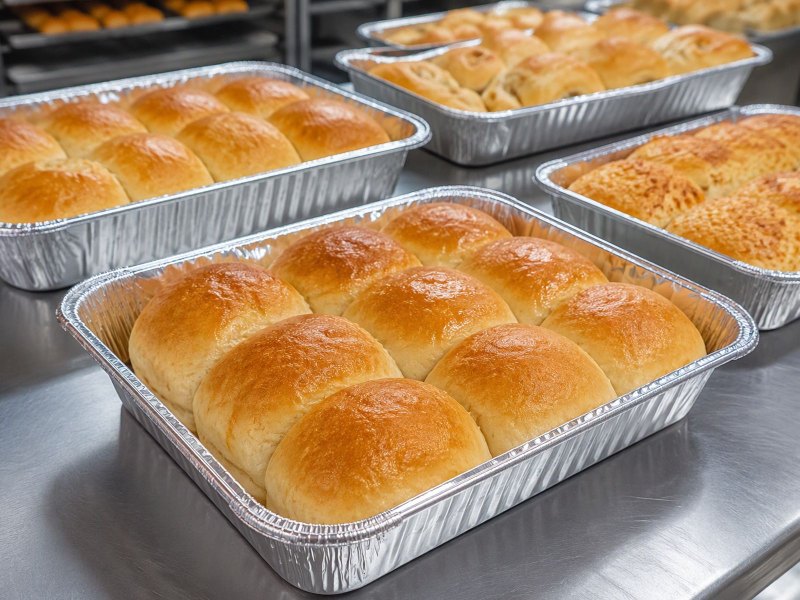
A working guide for bakery packaging converters, bake-off operations and industrial bakeries: why a metal layer sits in a bread pack, what it does for the crust, how a pressed tray differs from a wrap, and what an enquiry has to state.
Paper wraps bread every day, and film keeps it soft. Neither holds a crust back from a warm cabinet, and neither keeps a filled tray rigid on a trolley.
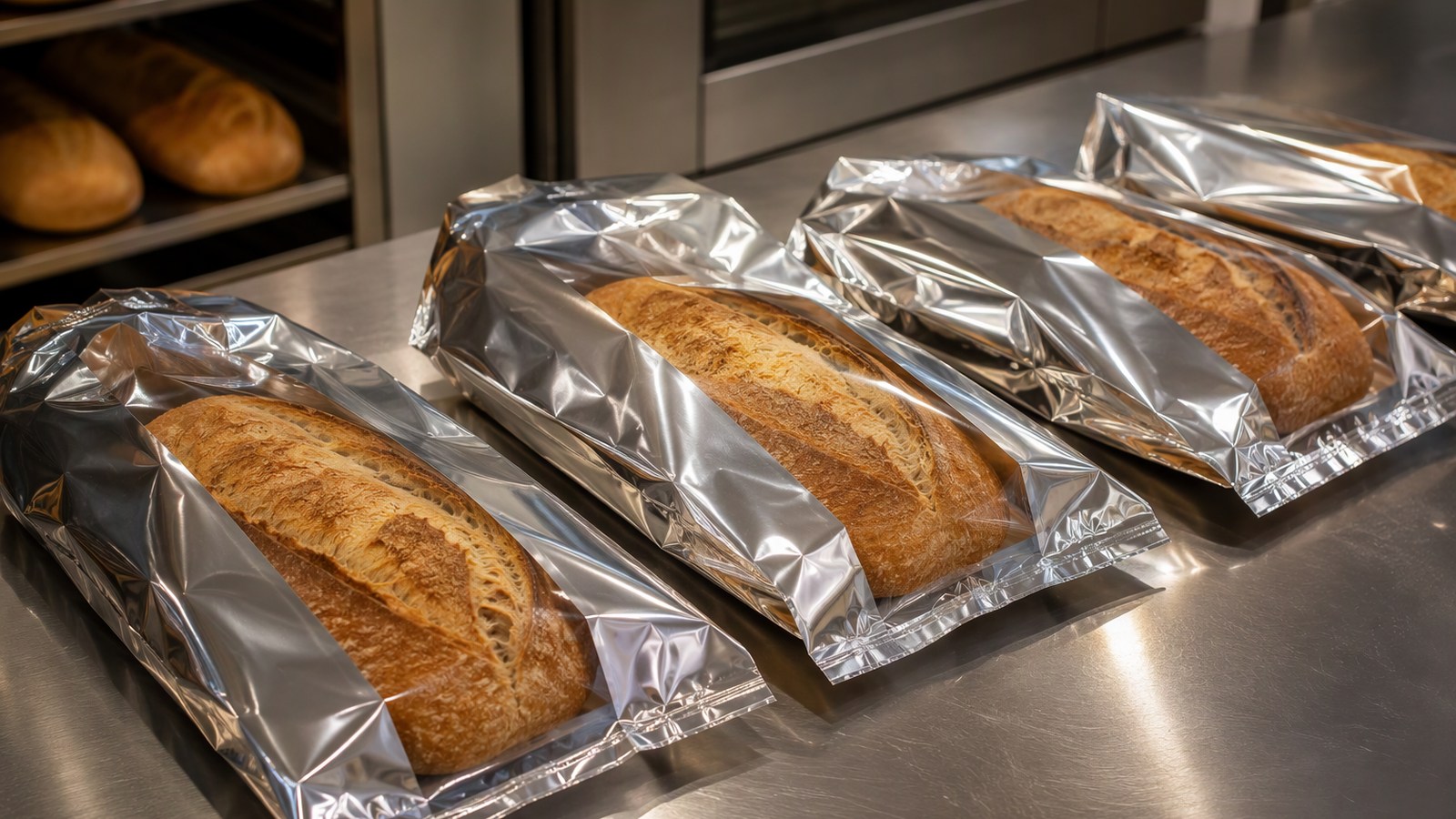
A foil layer is a metal ply inside the pack, not a wrapper instead of paper. It stops vapour, spreads heat, blocks fat and holds a pressed shape, while the paper or film around it prints and seals.
That sounds simple until a crust goes leathery in a holding cabinet or a tray corner cracks on the press. The questions below are the ones converters, bake-off teams and buyers argue about most.
Why Does Bakery Packaging Use a Metal Layer When Paper and Film Already Exist?
Paper breathes and film seals. Both are cheap, both are familiar, so a metal ply has to earn the space it takes in the structure.
Because neither paper nor film is both a vapour stop and a heat spreader. Foil blocks vapour and fat, spreads heat and keeps a pressed shape while the pack is warm.
Dive deeper
Paper is a mat of fibres, and the gaps between them are the point of it. Air and steam cross the sheet, so a loaf wrapped in paper does not sweat in the bag, and the sheet stays calm when the room changes. That same openness is why paper cannot hold a crust: whatever the bread gives off leaves through the sheet, and whatever the room holds arrives the same way.
Film behaves in the opposite way. A sealed film bag stops the exchange almost completely, which is what a soft crumb needs, but the vapour it traps has nowhere to go. Put that bag in a warm cabinet and it collapses onto the surface, a film of condensation forms inside, and the crust softens against it within the hour.
Metal is the only ply that does neither. Solid aluminium has no absorption path, so vapour crosses it only at a pinhole, a crease or a cut edge. It reflects radiant heat instead of soaking it up, it conducts heat sideways so a pack has no hot spot, and it dead-folds, so a tray or a folded wrap stays where it was put. The material itself is described in the public literature on the metal.
What Does a Foil Layer Do for a Crust That Paper Cannot Do?
A crust is a dry, brittle layer sitting on a wet crumb. Almost everything that ruins it is water moving in the wrong direction.
It keeps the crust's own steam off the surface. Foil blocks the vapour path and reflects radiant heat, so the crust dries rather than rehydrates and stays crisp instead of turning leathery.
Dive deeper
A crust is a thin, glassy layer holding very little water, pressed against a crumb that is full of it. Water moves from the wet side to the dry side, so the crumb pushes moisture outward. If that moisture can leave, the crust stays crisp. If it is trapped at the surface, the crust takes the water back and turns soft, then leathery. Both outcomes are decided at the surface itself.
Paper lets that moisture leave, which is why a paper bag holds a crust for a short while, but paper also lets the room in. On a humid morning the same sheet carries water inward, and the crust softens from outside. Foil closes that two-way door: vapour stays in the crumb, and the reflective face turns heat away from the surface.
What foil cannot do is rescue a crust that was already wet when it was packed, or dry one sealed in its own headspace. A tight foil pack holds the crumb's moisture, and if the pack then cools, that vapour condenses on the coldest surface, which is usually the crust. That is why a bakery foil is often a laminate with a paper or film face, and why structure matters more than gauge.
Which Gauge Suits a Pressed Bakery Tray, and Why Does the Tray Differ From a Wrap?
A tray is formed, filled, stacked and carried. A wrap is folded once around a loaf and torn off. Both are the same metal, asked to do different work.
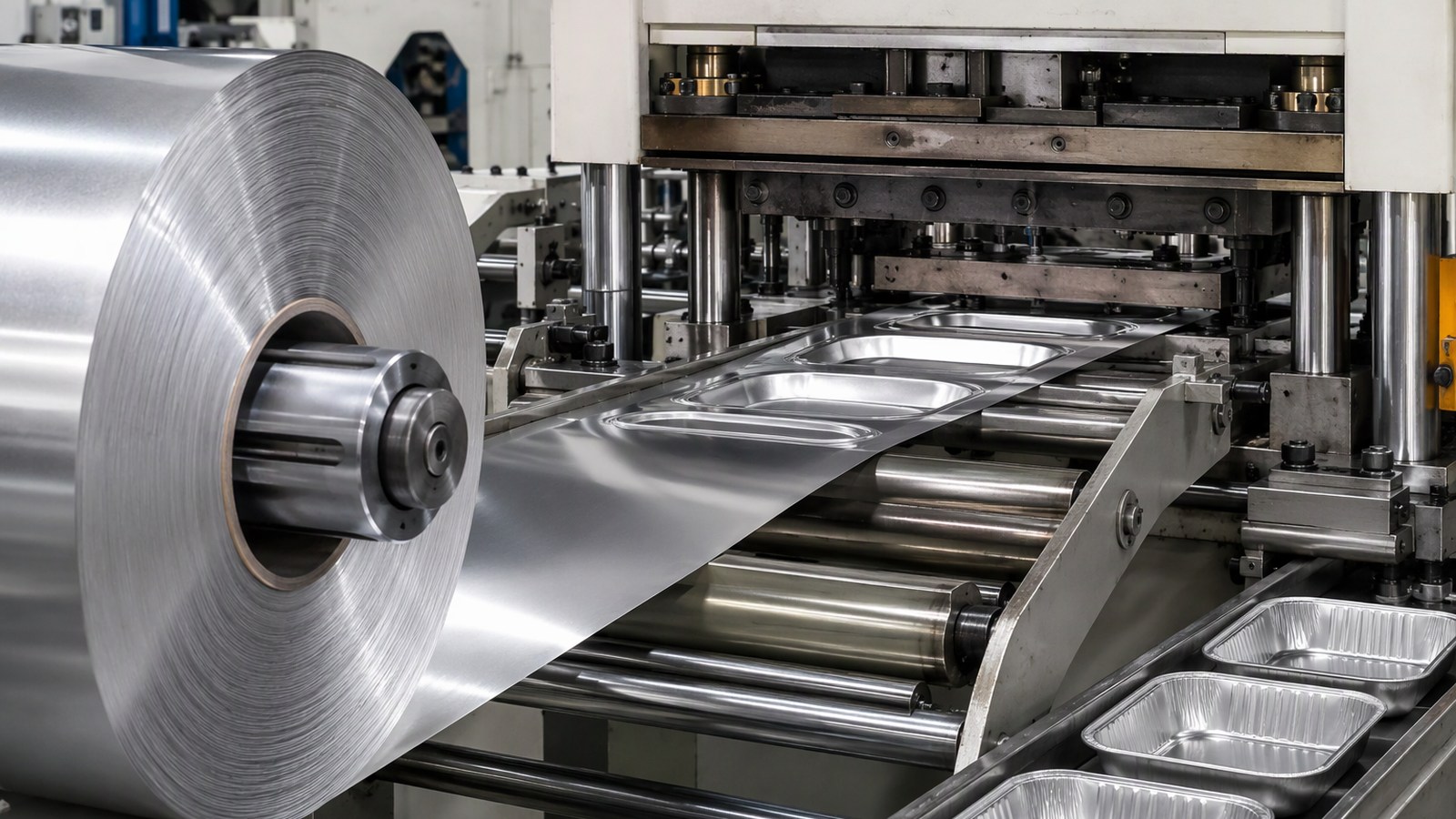
Pressed trays sit mid-range, in a temper stiff enough to hold a rim. Wraps run lighter and softer, because they must fold flat, stay folded and laminate easily.
Dive deeper
A tray has to survive forming before it has to survive anything else. The blank is drawn into a cavity, the corners take the strain, and the wall thins as it stretches. Too thin a blank tears at the corner or leaves a wall that flexes when the tray is lifted. Alloys such as 8011, 3003 and 3004 are common for pressed containers, in tempers from O through H14, H16 and H18 depending on the stiffness the formed tray needs.
A wrap is a different problem. It is folded by hand or by a simple machine, creased against a loaf edge, and expected to stay creased. That calls for a soft temper, O or H22, and a lighter gauge, because a stiff sheet springs back off the fold and will not lie down at the corner. Alloys 1235, 8079 and 8021 are typical here, usually laminated to paper so the pack can be printed.
Both are supplied in the same declared span, 0.005 mm to 0.20 mm, but they sit at different points in it, and the number has to be agreed with the forming tool rather than copied from another bakery. Two converter grades on our own pages are 8021 aluminium foil at 0.06 mm and 1060 aluminium foil at 0.08 mm.
Why Is a Tray Pressed With a Rim Rather Than a Straight Wall?
A straight wall is the shortest path from blank to tray, and it is the wrong shape for anything that has to be carried, stacked or closed.
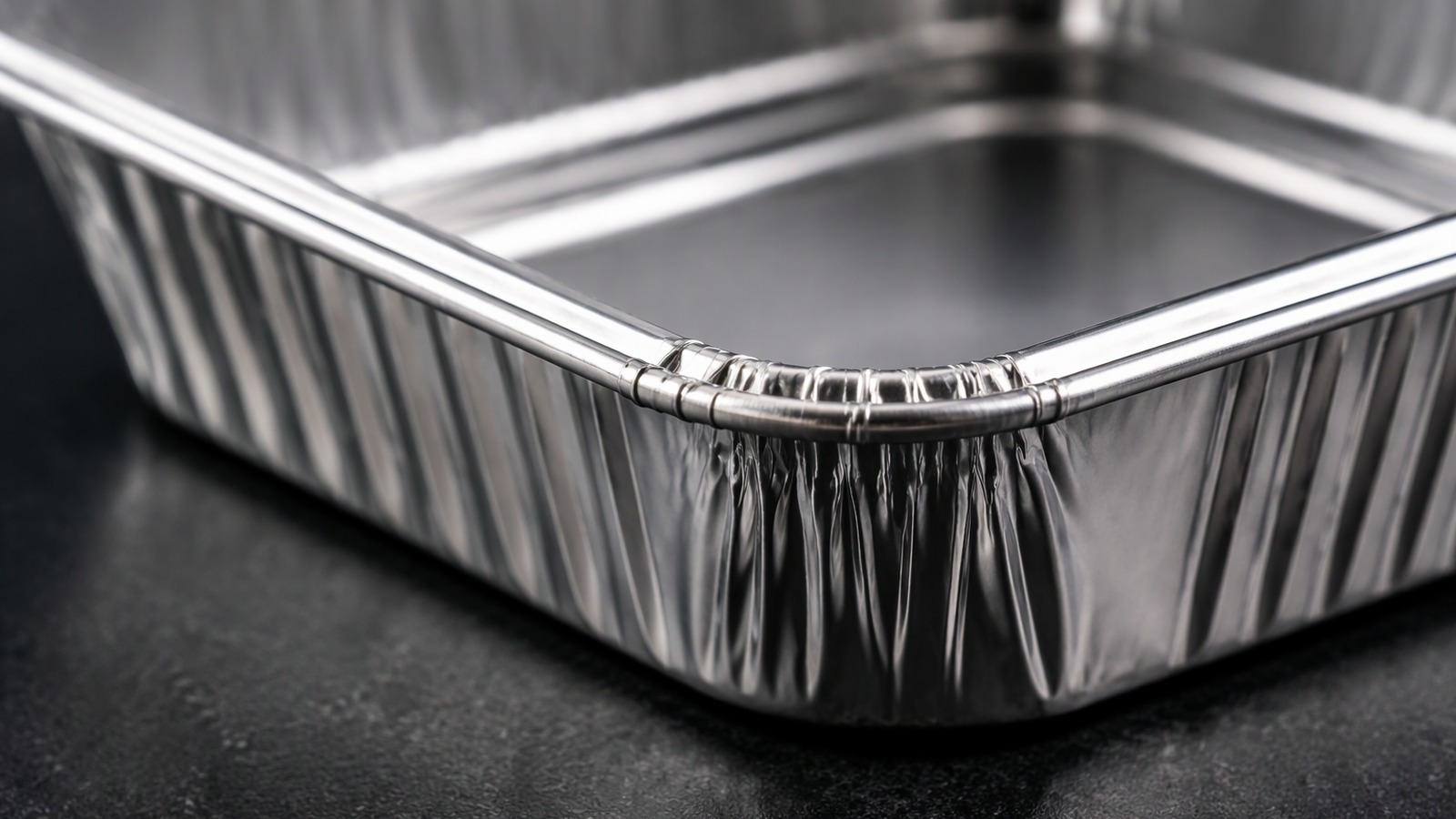
The rim is the handle, the stacking feature and the stiffener at once. It also takes up metal that would otherwise pile into the corner, where a crack would leak.
Dive deeper
Forming a tray means moving metal, not stretching it evenly. The blank has more material around the edge than the cavity can absorb, and that surplus has to go somewhere. A rim gives the press a controlled place to take it, folding the surplus into a band that work-hardens as it forms and stiffens the wall. A straight wall leaves the surplus at the corner, where the metal bunches and thins.
The rim also does the handling work. Fingers go under it, a trolley slot holds it, a lid lands on it, and a nested stack rests on it. Remove the rim and the load moves into the wall, which bows under a full tray and jams the stack. The rim is not decoration added after forming; it is what makes the tray a handling unit rather than a shallow dish.
Rim geometry is where a converter and a toolmaker have to agree. The width, the radius at the top of the wall, whether the edge is folded or curled, and how square the corners are all change how the tray behaves in a press and in a stack. Bodies that study how aluminium is rolled and formed, such as the European aluminium industry association, describe that trade between formability and stiffness.
How Does the Foil Behave While the Pack Sits in a Warm Holding Cabinet?
Warm air is not the problem. Warm air around a sealed pack is, because the pack becomes a small climate of its own.
Metal reaches the cabinet's air temperature quickly, spreads it evenly and does not soften. The risk shifts to the seal, the lid and the trapped vapour, not the tray wall.
Dive deeper
Aluminium conducts heat well and carries little heat for its thickness, so a foil tray follows the cabinet air closely instead of lagging behind it. That is usually an advantage: the pack holds one temperature rather than a hot base and a cool top, and there is no cold spot where condensation would collect. It also picks up heat from the shelf it stands on, and a thin wall carries that heat through the pack rather than holding it at the base.
What the metal does not do is soften. A film pouch or a thin thermoformed lid relaxes as it warms and sags into the headspace. Foil keeps the shape it was pressed into. The thing to watch is the laminate, because a foil bonded to paper can curl when the two faces expand differently, and a curled rim will not seat in a trolley slot.
The other behaviour is a cycle rather than a state. A pack that is warmed and then allowed to cool passes a point where its headspace can no longer hold the vapour it carries, and that vapour condenses on the coolest surface. Metal is a good place for that, because it is smooth and the water forms a film. The converting side is covered by the foil converting industry organisation.
Why Is Grease Resistance a Separate Question From Moisture?
Fat and water travel by different routes. A structure that stops one can pass the other, and a bakery product usually contains both.
Fat wicks along fibres and creeps through pinholes; water crosses as vapour and needs only a path. Foil blocks both by being solid metal, so folds and cut edges decide which gets through first.
Dive deeper
On a fibre sheet, fat is the harder traveller. It wicks along the fibres by capillary action, so a buttered or oiled surface shows a translucent patch that grows outward from the contact point, and the sheet loses its look long before it loses its strength. A denser, tighter sheet slows the wicking, and a coating can stop it, but both remain porous structures with edges that fat can find.
Water behaves differently depending on its state. Liquid water needs an actual opening, and a sound foil has none. Water vapour needs only a continuous path through the material, and a metal has no such path, which is why a foil layer is such an effective vapour stop. The weakness of foil is not its face but its discontinuities: a crease, a pinhole, a cut edge at the rim.
That is why the two questions have to be asked separately. A tray that holds fat perfectly at the base can still pass vapour at a crease in the corner, and a wrap that blocks vapour can wick fat along its paper face to the outside. Alloy choice feeds into this, because formability decides whether a seam closes cleanly. Our note on aluminium foil container alloys sets out how 8011, 3003 and 3004 behave.
What Changes When the Same Tray Is Lidded Instead of Left Open?
An open tray dries and cools. A lidded tray holds both, and the pack turns into a closed volume with its own vapour balance.
Lidding makes the tray a closed system: the headspace saturates, the crust softens against the lid, and the lid and its seal become the weakest part of the pack.
Dive deeper
The tray does not change; the climate inside it does. An open tray exchanges freely with the cabinet, so the surface dries and the crust firms, which is what an open bake-off display is for. Close the same tray with a lid and the vapour the crumb gives off has nowhere to go. The headspace reaches saturation, the surface stops drying, and the crust softens against the lid.
The mechanics change as well. Once lidded, the pack is handled as a box: it is stacked, and the load passes through the lid and the rim rather than through the product. A lid that is dished will rock on the rim, a rim that is not flat will leave a gap, and a wall that flexes lets the lid lift at a corner. A lidded tray is a separate programme, not an open tray with a lid added.
The purpose of the pack decides the rest. A pack filled warm and lidded at once traps far more vapour than one cooled first, and a pack meant to be reheated later has to tolerate a second warm cycle. Cold-chain packs meet a related but different set of demands, as our note on aluminium foil for frozen and chilled food packs explains.
What Must an Enquiry for Bakery Foil Contain?
Most first enquiries describe a bakery and stop there. A quotation needs a specification, and the specification starts with the pack, not the metal.
State the product, the pack format, tray or wrap, the alloy, temper, thickness and width, the core, and the quantity per size. Add how the pack is closed and how it is held.
Dive deeper
Start with the pack. A sketch or a sample of the tray, with the rim width, the depth, the corner radius and the number of cavities, tells a supplier more than a paragraph. For a wrap, state the loaf size and whether the sheet is folded by hand or by machine.
Then the metal. Alloy and temper, thickness and width, core diameter and quantity per size decide a rolling programme. Our span is 0.005 mm to 0.20 mm thick and 100 mm to 1500 mm wide, on 76 mm or 152 mm cores, minimum 3 MT per size, from Qingdao, Tianjin or Shanghai. Tempers run from O through H14, H16, H18, H22 and H24.
Finally, say how the roll will be used. A converter running a press wants a width for the blank and a temper for the draw; a bakery wrapping by hand wants a width for the bench and a soft temper. If the foil goes into a laminate, say what it is bonded to. The family is on our aluminium foil for packaging and containers page, and the aluminium association is a useful reference.
Foil earns its place where paper and film fail: the vapour path and the warm hold. Specify the pack first, then alloy, gauge and width.