What is a bottle capsule, and why does it use aluminium foil?

A bottle capsule is the foil sleeve that covers the neck and closure of a wine or spirits bottle. This guide explains why foil is chosen over a plastic sleeve at the premium end, how capsules are formed, and what a buyer must state in an enquiry.
What is a bottle capsule, and why does it use aluminium foil?
A capsule that creases, dulls or will not release costs a premium bottle the impression it was made for.
A bottle capsule is the foil sleeve that covers the neck and closure of a wine or spirits bottle. Foil holds a sharp crease, carries colour well, and tears in a clean line, so the premium end prefers it to plastic.
The eight questions below follow the capsule from coil to bottling line, then to the enquiry.
What exactly is a bottle capsule?
The word covers several shapes, and the shape decides what the foil has to do.
A capsule is the sleeve that covers the neck and the closure of a wine or spirits bottle. It may be a plain sleeve, a shell with a closed top, or a shaped cap. It protects the closure, carries colour and signals quality.
Dive deeper
Start with geometry, because every later decision follows from it. A capsule has a top, a shoulder that turns over the lip of the bottle, and a skirt that runs down the neck. The skirt may be straight, flared or stepped, and its height is fixed early.
A capsule may be a plain sleeve the bottler shapes in place, or a formed shell whose top is already closed. Many designs carry a tear strip or a perforated band so the capsule opens in one movement. Others are simply cut long enough to tear by hand.
What the capsule covers matters as much as what it shows. Underneath sits the closure, whether a natural or technical cork, a synthetic stopper or a screwcap shell. The capsule wraps the joint between closure and bottle, keeps dust off the top, and holds a tamper-evident band where the design calls for one.
Then there is the visual job. On a shelf the capsule is often the first coloured surface a buyer sees, and it carries the house colour more often than a printed message. That is why it is judged on shade and sheen long before anyone reads the label. The aluminium foil beneath is the starting point for every one of those decisions.

Why is foil used instead of a plastic sleeve at the premium end?
A plastic sleeve can cost less, yet on a premium bottle it reads and behaves differently.
Aluminium foil takes and holds a sharp crease, accepts lacquer with depth of colour, and tears along a controlled line. A plastic sleeve springs back, shows its seam, and looks lighter than the glass.
Dive deeper
The first difference is memory. Foil deforms and stays where it is pressed, so a capsule shaped over a neck keeps the profile the tooling gave it. A plastic sleeve relaxes back and often shows a soft shoulder where the design wanted a crisp one.
The second is the seam. A foil capsule can be formed as one continuous shell, so the eye travels round the neck without meeting a join. A sleeved plastic tube usually has a weld, and on a dark colour a highlight will find it.
The third is colour. Foil takes a lacquer on a bright base, so a deep shade gains depth and a metallic finish gains life. Plastic is pigmented through or printed, and tends to look flatter beside glass.
The fourth is opening. Foil tears along a scored or perforated line and leaves a neat edge, which suits a capsule opened in front of a customer. Plastic stretches before it tears, and the torn edge is ragged.
None of this makes foil right everywhere. Where cost per unit decides a project, a plastic sleeve may still be chosen. The point is narrower: at the premium end, foil usually earns its place. Buyers can start from the aluminium foil for packaging range.
How is a capsule formed, and what does that demand of the foil?
Forming is short, fast and unforgiving, and it exposes every weakness in a coil.
Foil is lacquered, slit, then shaped into a shell by deep drawing, spinning or rolling over a mandrel. Forming demands even thickness, clean edges, a stable temper and a surface that will not crack.
Dive deeper
The forming route decides what the foil must survive. In deep drawing, a blank is pressed into a die and the wall is pulled thin as the shell deepens, so the metal has to stretch evenly without thinning into a pinhole at the shoulder.
In spinning, a disc is pressed against a rotating mandrel and the metal flows outward under a roller. Spinning rewards a temper that work-hardens predictably, because the metal is worked several times in one pass.
Rolling over a mandrel is the gentlest route. A lacquered sleeve is slipped over the neck and shaped by rollers or brushes, and here the foil must be flat and hold a crease rather than stretch.
Every route punishes the same faults. Thickness variation makes a shell draw unevenly on one side. A burr becomes a tear. A hard temper cracks at the shoulder while a very soft one wrinkles. Waviness shows as shells with oval tops, and pinholes open under strain.
Temper is therefore chosen with the tool, not from a catalogue. Soft tempers form easily, H14 to H18 give stiffness and a crisper edge, and H22 or H24 sit between. That is why the specification is agreed with the customer's forming equipment. Grades such as 8011 aluminium foil are a common starting point.
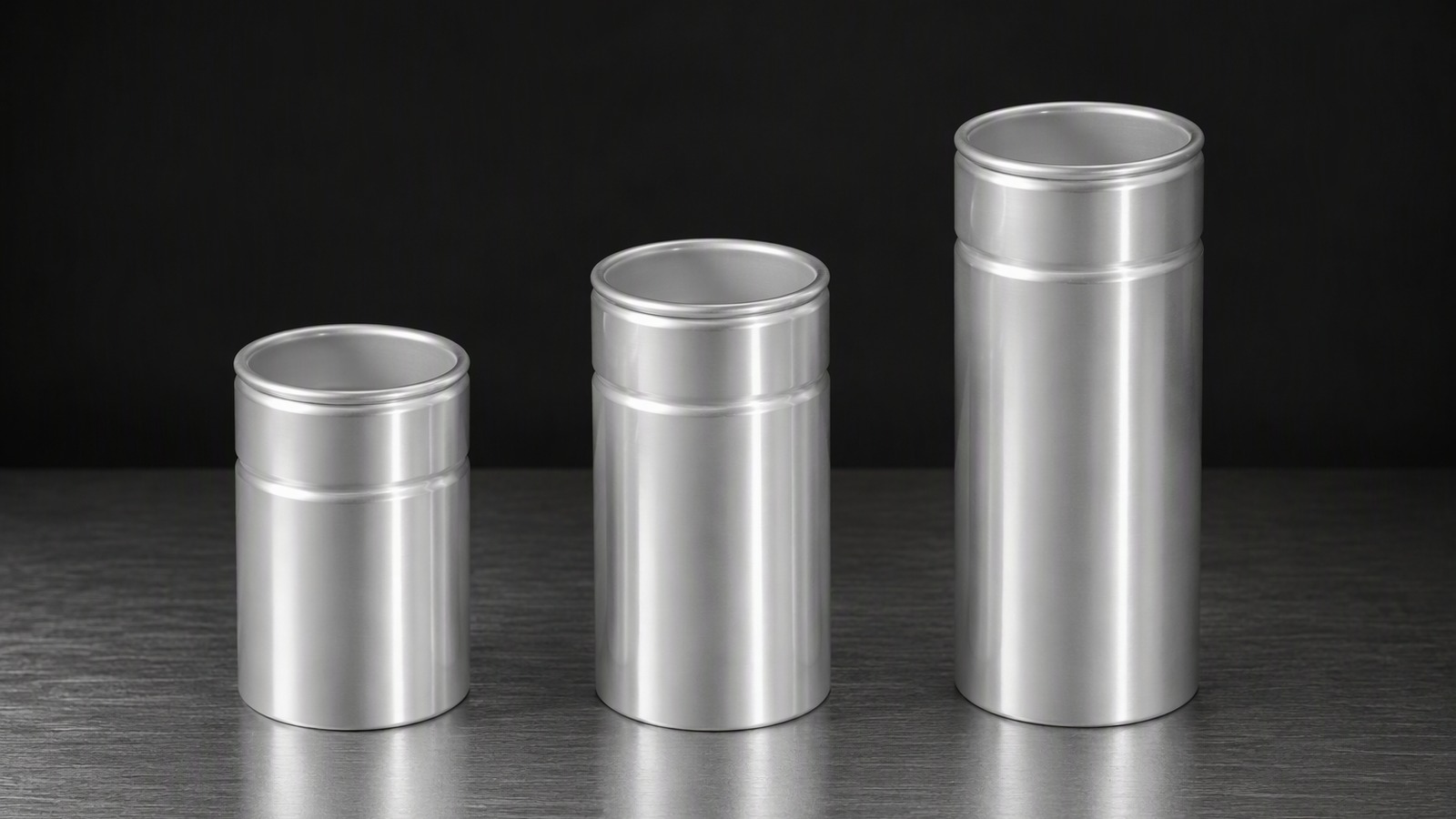
Why do lacquer and colour matter more here than gauge?
Two capsules can use similar foil and still look a grade apart, because the coating decides.
The lacquer carries the colour, the gloss and the resistance to handling, and hides small surface marks. Gauge sets how a capsule feels and forms; the coating sets how it looks, and colour control matters more.
Dive deeper
A capsule is bought by eye before it is bought by measurement. The colour has to match the previous delivery, the label and the carton, and it has to match under bar lighting as well as under the lights of a bottling hall. Two coils a few micrometres apart look identical under that test, and a shade that drifts shows on a shelf first.
That is why the coating system carries the risk. A lacquer film has to wet the foil evenly, cure to a consistent gloss, and stay flexible enough to follow the shoulder without crazing. Too thin reads patchy on a bright base. Too thick can crack at a tight radius or block in the tool.
Colour is also where small gauge differences disappear. A buyer handling two capsules may feel a difference in stiffness, but the eye records shade, gloss and the evenness of the film. Stiffness can be adjusted with temper; colour drift cannot be corrected after coating.
Decoration follows the same logic, which is why how aluminium foil is lacquered is settled before the foil is ordered. A matte or raised area catches light and shows any variation in film weight. For background on the trade, the European Aluminium Foil Association publishes material on foil converting.
How does the closure interact with the capsule?
The capsule is not decoration applied afterwards; it shares the same few millimetres as the closure.
The capsule wraps closure and neck together, so its inner diameter, skirt length and tear line must suit the closure type and the bottle finish. One that grips too hard slows the line; one that grips loosely spins.
Dive deeper
The capsule and the closure meet over a short distance, and that distance is where most handling problems begin. The capsule must cover the joint without interfering with the seal the closure makes against the bottle, and without pressing on a part designed to move.
Different closures behave differently. A natural cork compresses and recovers, so a capsule over it must allow for a small change in diameter. A synthetic stopper is stiffer and returns less. A screwcap brings a hard, threaded shell, and the capsule must sit over it without jamming the thread or hiding the band that shows the bottle has been opened.
The bottle finish matters as much as the closure. Neck diameters vary slightly between moulds and between glass suppliers, and a capsule that fits one mould tightly may spin on another. That is why a capsule is usually specified against a measured neck, not a nominal one.
On the line, the capsule must also survive the operation that puts it on. One that grips too early will not seat; one that grips too late will sit high and leave a ring of neck showing. Both faults surface as rejects, and both usually trace back to the fit between capsule, closure and bottle rather than to the foil.
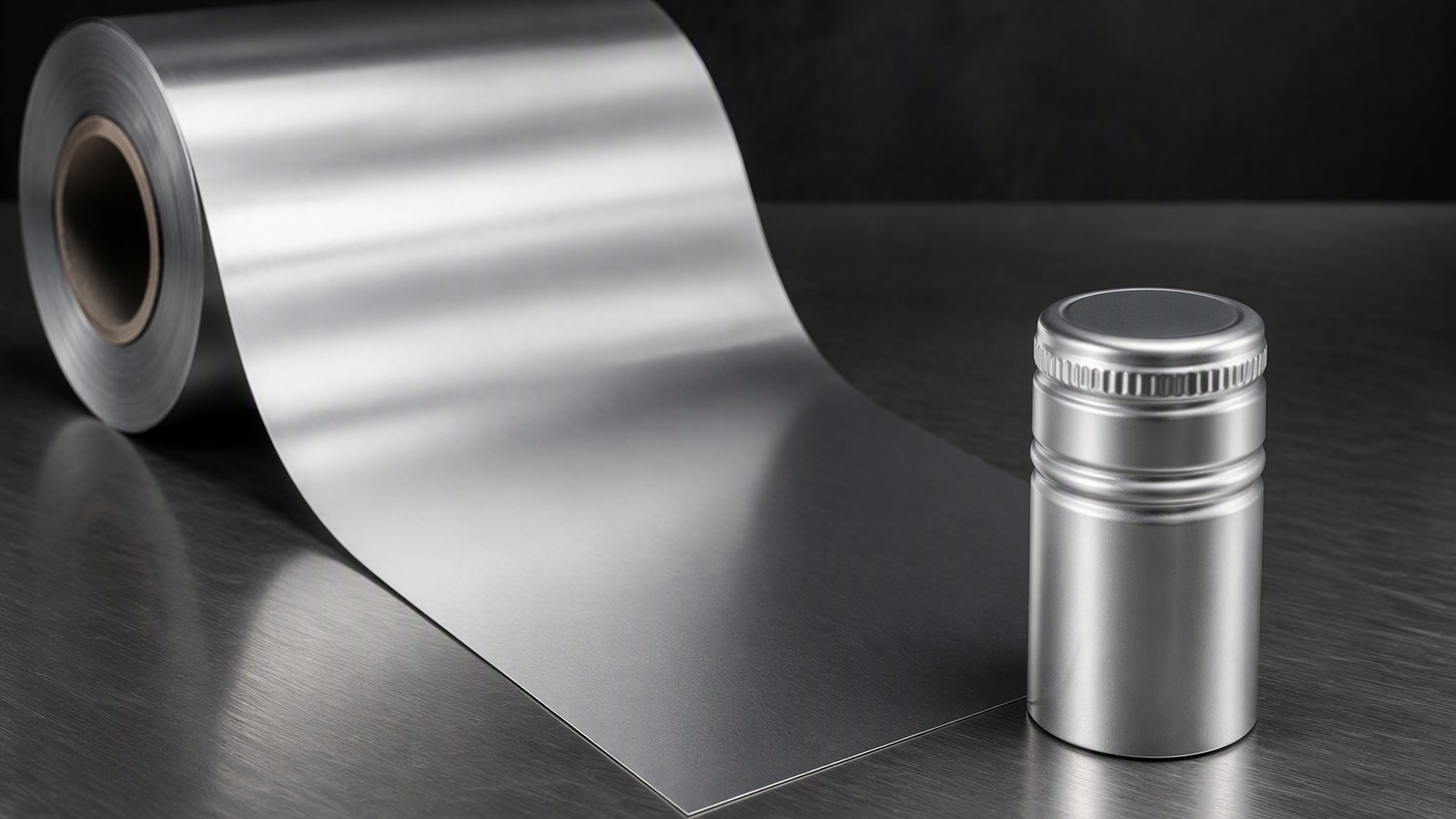
Why does the foil surface decide how a capsule looks and handles?
A coil can meet its thickness target and still spoil a run, because surface is where faults show.
Pinholes, streaks, roll marks and edge damage all show through a lacquer or a bright finish. A clean surface, a flat wind and straight slit edges let the coater lay an even film and the tool pull the foil.
Dive deeper
Surface is the part of a specification that is hardest to write down and easiest to see. A coil can sit inside its thickness tolerance and still fail, because a streak or a roll mark shows through a thin lacquer as a line running its length.
Pinholes deserve their own mention. A pinhole is a tiny perforation in the foil, and under a bright or metallic lacquer it reads as a dark dot. On a plain capsule a cluster looks like a dirty patch, and no amount of coating hides it.
Winding and slitting decide how the coil behaves in the coater. A soft or uneven wind makes the foil pull unevenly, so coating weight varies across the web. A burr on a slit edge transfers to the next lap, and a wavy edge makes the web wander off centre.
Cleanliness matters for the same reason. Dust, oil and slitter debris trapped under a lacquer become visible defects, and a capsule is inspected under light that shows every one of them.
The practical answer is to describe the finish wanted and the forming route, then let the mill match surface quality to them. A bright finish, a matte lacquer and an embossed foil surface each tolerate different levels of variation.
Which foil specifications belong in the discussion?
Alloy, temper and thickness are chosen with the forming tool, not before it.
Capsules are usually discussed in the 1050, 1060, 1100, 1235, 8011, 8021 and 8079 alloys, in tempers from soft O through H14, H16, H18, H22 and H24. Thickness and width are fixed with the customer's forming equipment inside the 0.005-0.20 mm range.
Dive deeper
The alloy list for capsules is short and familiar. 1050, 1060 and 1100 are the plain 1xxx-series grades that lacquer well and form predictably. 1235 is chosen for a brighter, more reflective surface. 8011, 8021 and 8079 are the workhorse packaging alloys, and 3003 or 3004 add strength.
Temper follows the forming route. Soft O tempers form easily and crease well. H14, H16 and H18 give stiffness and a crisper edge. H22 and H24 are the intermediate tempers that suit designs needing some of both, and the choice is usually made on a trial tool.
Dimensions are where buyers most often over-specify. Our foil is rolled from 0.005 mm to 0.20 mm and slit from 100 mm to 1500 mm, on 76 mm or 152 mm cores, so the range covers most capsule tools. The exact combination is agreed with the customer's forming equipment.
Commercial terms are simple. Minimum order quantity is 3 MT per size, and loading is from Qingdao, Tianjin or Shanghai. Because a programme runs several widths, state every size in one enquiry so the tonnage can be grouped. The packaging and container foil range shows how these grades sit together, and bodies such as European Aluminium and the Aluminium Association publish general material.
What must a buyer state in an enquiry?
Most slow enquiries are not difficult; they are simply missing the details that decide the answer.
State the capsule type and dimensions, the closure and bottle finish, the forming method, the lacquer and colour target, the alloy and temper if already fixed, the width and core, and the quantity per size.
Dive deeper
An enquiry that answers the questions below can be quoted without a round of emails. Start with the part: the capsule type, the skirt height, the diameter at the top and at the neck, and whether the top is closed or open.
Then the closure and the bottle. State the closure type, the bottle finish and the measured neck diameter, and say whether the capsule is applied by hand or on an automatic line. If a tear strip is needed, say where it sits.
Next the appearance. Give the colour reference, the gloss level, whether the finish is bright, matte or embossed, and whether the outside is printed. If the capsule carries a decoration, say which surface it goes on.
Then the foil. If alloy and temper are already fixed by an existing tool, say so. If not, describe the forming route and let the mill propose. Width, core diameter and the number of sizes belong here too.
Finally the commercial frame: quantity per size, destination port and any packing requirement. With those, a supplier can answer on foil alone, without guessing at the part.
A capsule lives on foil surface and coating control: describe the bottle, the closure and the tool, and the foil follows.