Aluminium Foil for Pet Food Trays and Pouches: Which Pack Fits?
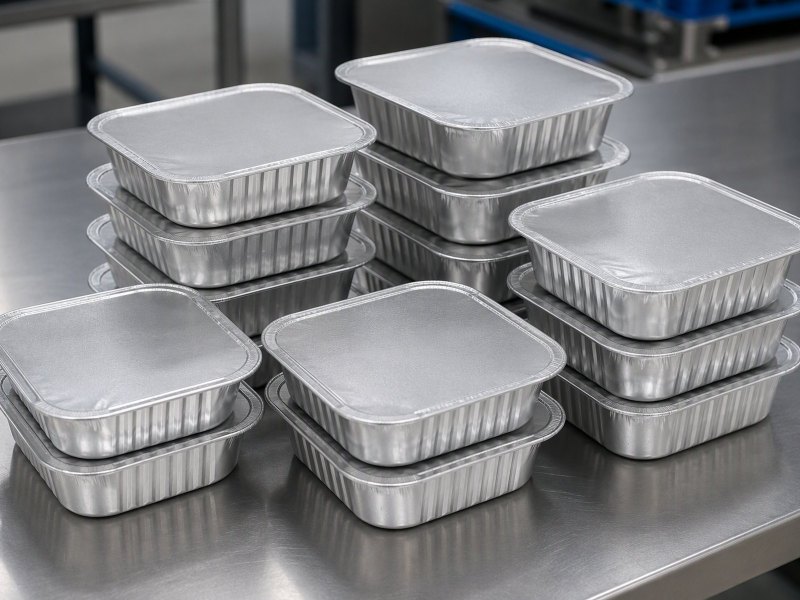
Pet food foil has to hold fat and odour, not just moisture. This article covers the tray-versus-pouch decision, the gauge for a large formed tray, where a lidded tray and a sealed pouch each fail, and what an enquiry should contain.
Aluminium Foil for Pet Food Trays and Pouches: Which Pack Fits?
A pet food pack that passes a moisture test can still fail in the warehouse and in the kitchen. Fat, odour and tray depth decide the outcome.
Pet food needs a foil layer that holds back fat and odour as well as moisture. Large trays take a heavier gauge in a soft temper, and pouches take a thin barrier foil inside a laminate. The format decides gauge and failure point.
The sections below follow a buyer's order: product, pack, tool, filling line, enquiry.
Why does pet food packaging ask more of a foil layer than human dry food does?
Dry human food is mostly a moisture question, and a thin continuous foil answers it well.
Pet food adds a fat phase that lies against the foil face and finds every weak point in a seal, a fold or a cut edge.
Dive deeper
Dry human food is mostly a moisture question. A biscuit or a flake is stable because it is dry, and the pack only has to hold vapour back, keep aroma in and stay stiff enough for a pallet. A thin continuous layer of aluminium foil does that well.
Pet food rarely offers that simplicity. Kibble usually carries a fat coating applied after forming, and that fat lies on every piece, pressed against the inner face of the pack. A semi-moist product adds free liquid that migrates, so the pack must act as a barrier and survive contact with a lipid phase.
Three things raise the demand. The product is often packed warm, so volatile fat fractions reach the inner face while the sealant is still soft. The pack is heavier for the same shelf space, and it is opened and closed many times, which flexes the foil until it hardens and cracks.
Where a dry-food specification stops short
A dry-food specification usually stops at vapour transmission and seal strength. Neither figure describes what happens when hot fat wets a seal land, creeps along a channel and sets there. That is why a pet food pack can meet a dry-food style specification and still show stained board or soft seals. Bodies such as European Aluminium describe the material; pack design sets line behaviour.
What do fat and oil do to a pack that a moisture barrier alone will not stop?
Fat does not travel as vapour. It wets, wicks and softens, so it defeats a pack that was only ever tested for water vapour.
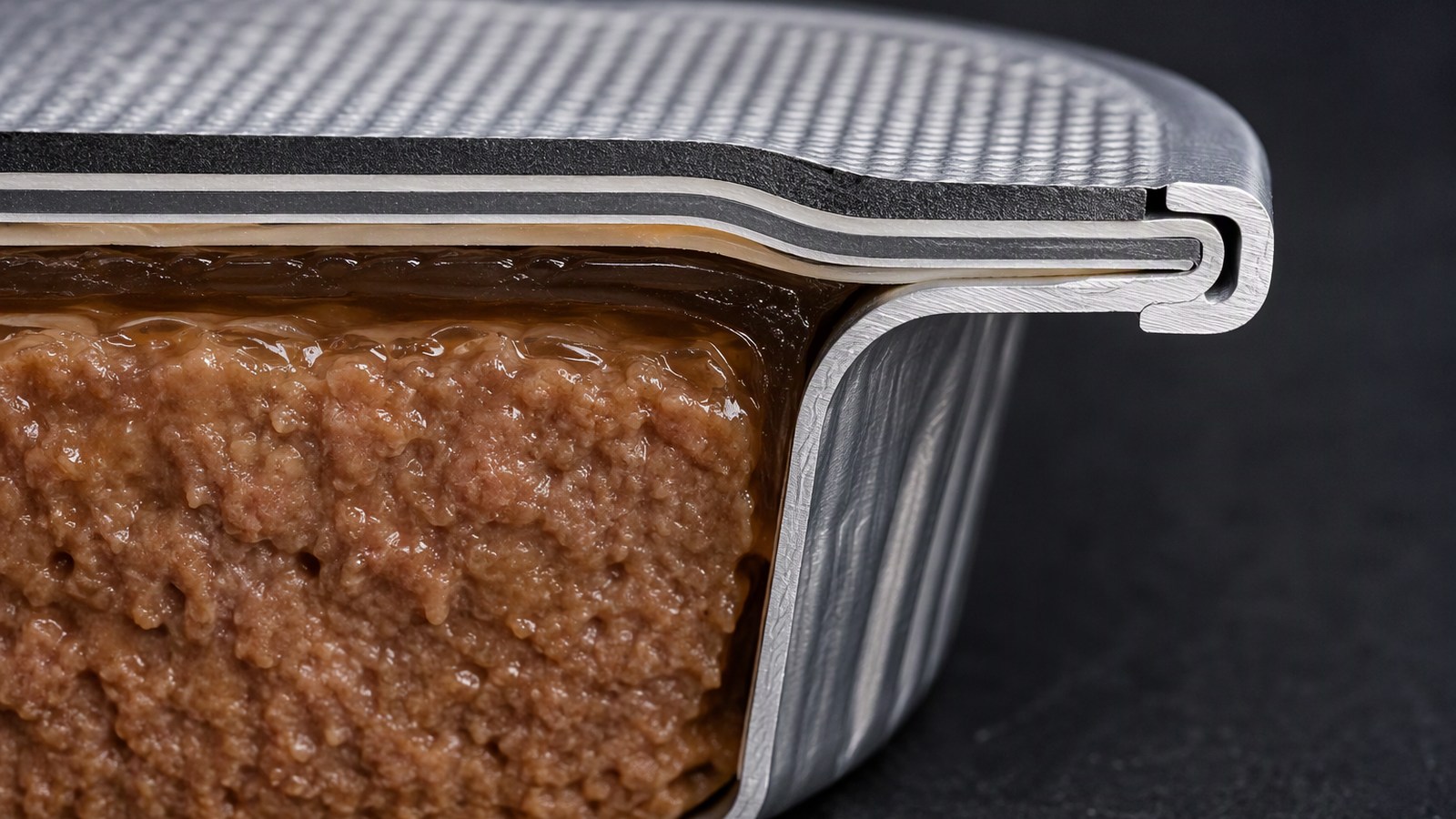
Oil creeps along seal channels, softens adhesive layers and stains the board behind the foil. A moisture barrier measures none of this.
Dive deeper
A moisture barrier is a statement about water molecules crossing a film. Fat moves by a different route: it wets a surface, spreads along it by capillary action, and dissolves into the polymer it touches. Where vapour is stopped by continuous metal, oil goes around it through the seal, the cut edge and any adhesive that is not lipid resistant.
The seal is the usual path. A seal is made by softening a sealant and pressing two surfaces together. If product fat is present in the seal land at that moment, the faces do not fully wet each other, and the joint is weaker than one made on a clean land. The weakness is invisible until a channel opens under load.
Adhesives are the second path. A laminating adhesive that performs well against water can soften when a fatty phase reaches it from the pack edge, and once the bond softens the layers move against each other. The foil is intact, the print is intact, and the pack has lost the structure that held the seal flat.
Why lipid contact is specified separately
Rancidity is a third issue, and it belongs to the product rather than the pack. Fat oxidises when oxygen reaches it, and oxidation runs faster where fat is spread thin over a large surface. A pack that admits air at each opening accelerates that.
Why is a tray used for some pet food formats and a pouch for others?
The format follows the product and the filling line far more than it follows the brand image.
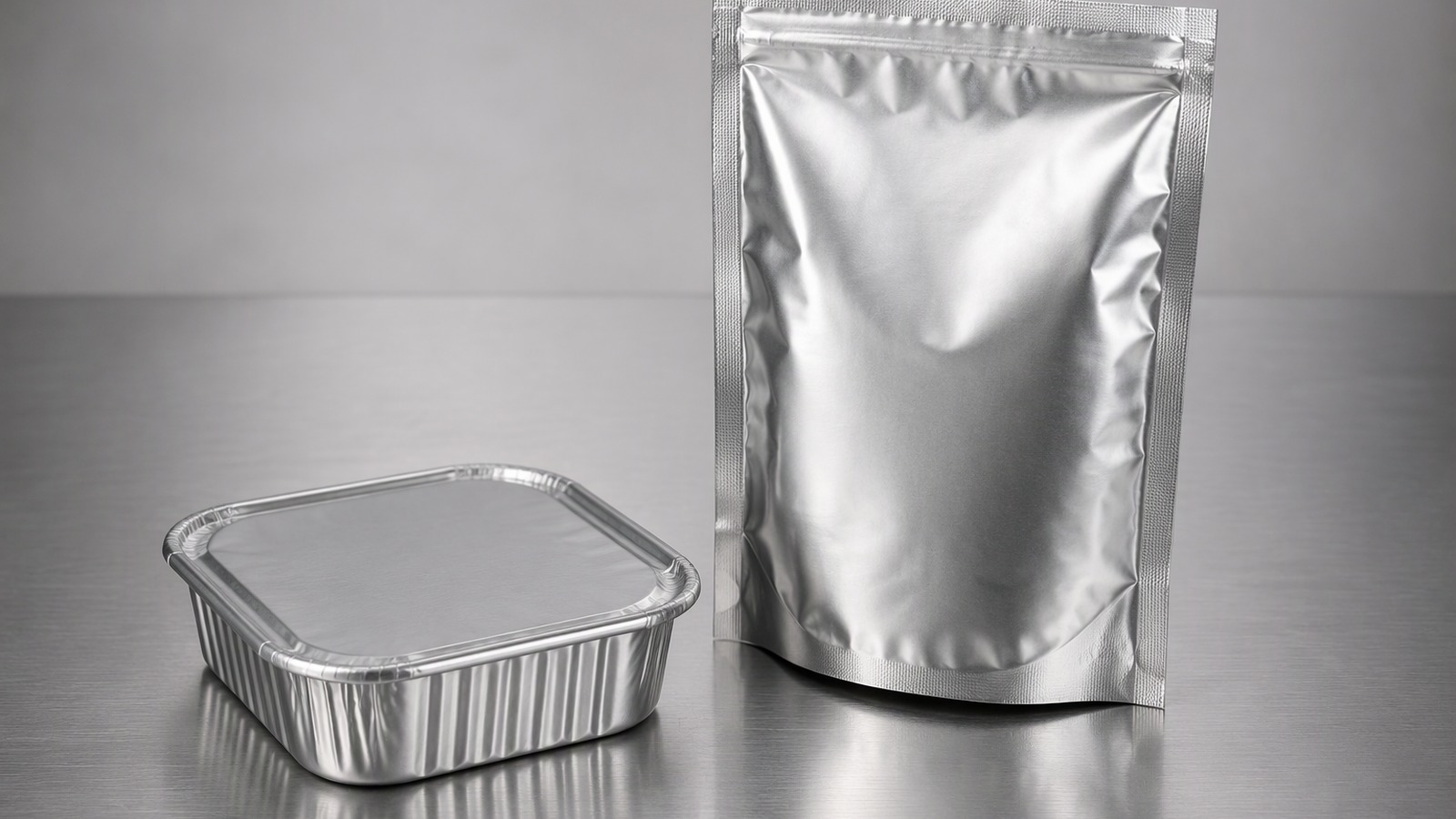
A tray gives a rigid wall, a flat seal ring and a pack that stands and stacks. A pouch gives a light sealed volume and fills on different equipment.
Dive deeper
A tray is chosen when the product needs a wall. A loaf, a terrine, a chunk in gravy or a pressed block all want to be held while they set, and lifted out or eaten from the pack. The formed tray carries that load: the wall stands on a shelf, the base sits on a platen, and the rim gives the lid a surface to seal to.
A pouch is chosen when volume matters more than shape. It is made from a flat laminate, so material is used only as a skin, and a stack of empty pouches takes a fraction of the space of empty trays. Tray bodies and lids sit together in the packaging and container foil range for that reason.
The filling route decides as much as the product does. Trays are filled from above and lidded on a platen, which suits viscous or piece-bearing products. Pouches are formed, filled and sealed on a vertical or horizontal line, which suits free-flowing pieces and smaller portions. Switching format usually means a new filling line.
Distribution narrows the choice
Distribution settles the rest. A tray holds its shape in a chilled or frozen case and can be stacked while the contents are soft. A pouch conforms, so it survives rough handling but presents badly once crushed. Buyers shipping foil for frozen and chilled food packs often find the pouch wins on cube alone.
Which gauge suits a large formed pet food tray?
A large tray is a draw problem before it is a barrier problem, and gauge is the first lever a buyer has.
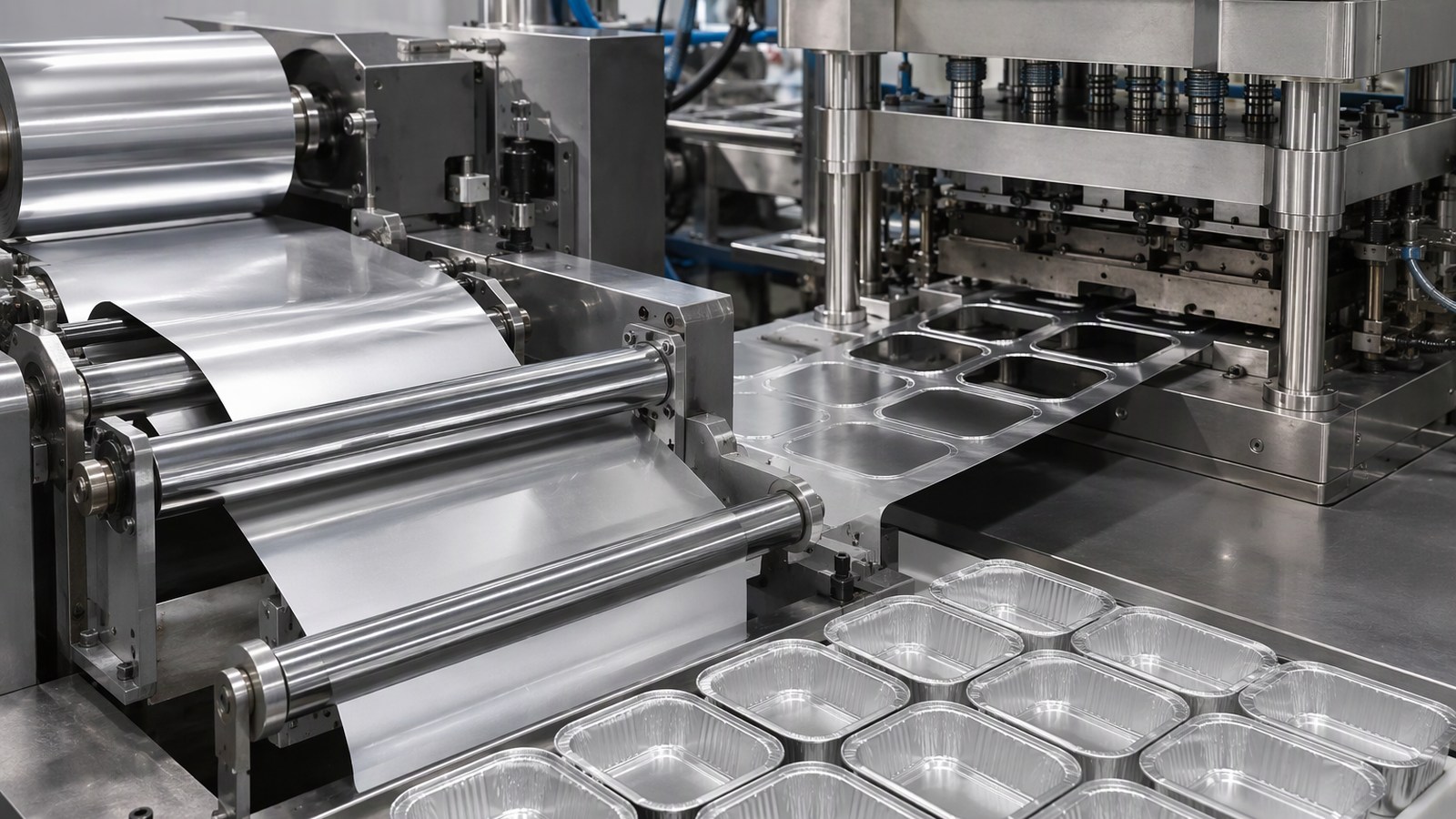
Large formed pet food trays are commonly run in 8011 at 0.08 mm in O temper, moving heavier where the draw is deep or the stack is tall.
Dive deeper
Gauge on a large tray is set by the draw, not by the product. When a blank is pulled into a cavity, the metal thins at the corners and along the wall, and how much it thins depends on the ratio of depth to width. A gauge that suits a shallow plate can thin below a usable wall on a deep tray.
8011 at 0.08 mm in O temper is the common starting point, and it is the gauge detailed on the aluminium foil for pet food trays page. The alloy is a packaging grade, the soft temper leaves ductility for a deep cavity and a rolled rim, and the wall stands up in the hand when the tray is full of product.
Heavier stock enters when the geometry demands it. A very deep draw, a tray carried by one corner, or a stack several high in a case can justify 0.10 mm or more, and 0.15 mm aluminium foil in a plain grade is used where a part is drawn deeply and then has to stay where it was put.
Reading gauge against cost
The trade is metal cost against the cost of a pack that fails, and the alloy and temper for formed containers decides which side a tray lands on. Thickness must also hold across the width, because stock that varies draws unevenly and leaves a rim that is not flat.
Why do a lidded tray and a sealed pouch fail in different places?
A tray and a pouch are closed by different geometry, so they leak at different features of the same pack.
A tray fails at the flange: wrinkles, product in the seal land, rims that are not flat. A pouch fails at end seals, gusset corners and flexed lines.
Dive deeper
On a tray, the seal is a ring. The lid is pressed onto a flat flange, and the joint depends on that flange being flat, clean and wide enough. A wrinkle at a corner forms a channel that no pressure will close, and product on the land holds the sealant apart.
On a pouch, the seal is a set of lines. Two end seals and a back seam close the pack, and the corners where those lines meet are the hardest places to seal, because the material is folded and the thickness doubles. The foil converters association side of the trade calls corner leaks a handling issue.
Flex is the other difference. A pouch is designed to move, so the foil inside it flexes every time the pack is picked up, dropped or cased. Foil flexed repeatedly along one line hardens and then cracks, starting at a fold or a seal edge. A tray does not flex that way, so its seal ring fails instead.
How inspection follows the geometry
Inspection follows the geometry. A tray is checked at the flange for width, continuity, wrinkles and product in the seal. A pouch is checked at the seals and corners, and by opening a sample to look at the bond. A test that suits one format says little about the other.
How does the foil behave when the pack is processed after filling?
Heat after closing turns a finished pack into a pressure vessel for a short time, and the foil goes with it.
The pack expands as the contents warm, the lid or pouch domes, and on cooling it pulls back. That cycle loads every seal in the direction it resists least.
Dive deeper
When a closed pack is warmed after filling, the contents expand and any air inside expands more. A lidded tray domes its lid and the seal ring takes the load in peel. A pouch balloons, its end seals take the load in shear, and the gusset unfolds. Neither movement is damage in itself if the seal was designed for it.
The return is the harder half. As the pack cools, the contents contract, vapour condenses and the internal volume falls. The lid or the film is drawn inward, and the same seals are loaded in the opposite direction. A seal that held under pressure can fail under that reverse pull.
The foil itself behaves predictably. It expands and contracts with the pack, it does not absorb the product, and it does not change state. What changes is its condition: foil flexed by the dome and the return is slightly harder along the fold lines.
What this asks of temper and gauge
Temper and gauge therefore have to suit the cycle, not only the forming step. A soft temper that forms a deep tray easily will flex further under pressure, and a heavier gauge resists the dome but loads the seal more when it pulls back. Both effects are weighed against a known closing route.
Why is odour containment a separate requirement from barrier?
A pack can be a perfect moisture barrier and still be smelled from the far end of a warehouse aisle.
Odour travels through seals, cut edges and sealant films that absorb aroma and release it later.
Dive deeper
Barrier is usually discussed as a rate: how much of a substance crosses a given area over time. Odour is discussed as a threshold. The human nose detects some volatile compounds at extraordinarily low concentrations, so a leak that is irrelevant to moisture pick-up can be obvious beside a pallet.
The foil is not the weak point. A continuous metal layer stops aroma molecules as effectively as it stops water. The paths around it are the problem: a seal channel, a cut edge where the laminate is exposed, and the sealant film, which can absorb aroma and release it from the outside face.
The second direction matters as much as the first. A pet food pack sits beside other products, and a sealant that absorbs odour from the surroundings carries it into the pack. Board, labels and cartons absorb odour too and hold it. Odour is therefore specified as containment, not transmission.
Where control actually sits
Practical control comes from the structure, not the metal. A sealant chosen for low sorption, an adhesive that does not carry aroma, a seal continuous around the perimeter, and a cut edge kept away from the product all reduce the effect. Guidance from the aluminium industry association covers the material side; a packed sample settles the rest.
What must an enquiry contain?
An enquiry that names only an alloy and a thickness leaves the supplier guessing at the pack around it.
Send the pack format and drawing, how the product behaves, the filling and closing route, whether the pack is heated after closing, the width and core you can run, and the quantity.
Dive deeper
Start with the pack, not the metal. A tray drawing with the cavity depth, the rim width and the corner radius tells a supplier more than a gauge does, because the draw ratio sets the gauge. For a pouch, the laminate structure, the finished size and the seal positions do the same job.
Describe the product by behaviour rather than by recipe. Does it carry free fat or a coating, is it liquid or set, does it contain pieces that could puncture, and is it filled warm or cold. These answers decide the sealant, the adhesive and the gauge. A packed sample beats a page of description.
Describe the line. How the pack is filled, how it is closed, whether it is heated after closing, how it is cooled, and how it is cased and stacked. Each step loads the pack, and a supplier who knows them can suggest a temper that survives the sequence, not only the press.
The commercial frame
Finish with the commercial frame: alloy and temper, thickness, the width the line can run within the 100 to 1500 mm range, the core diameter, 76 mm or 152 mm, the quantity in metric tonnes, and the port, Qingdao, Tianjin or Shanghai. A minimum order of 3 MT per size applies to each slit size.
Pet food asks foil to hold fat, odour and shape, not just moisture. Match gauge to format, then say how the pack is filled and handled.