What Is Buckle in Aluminium Foil and How Does It Differ from Waviness?
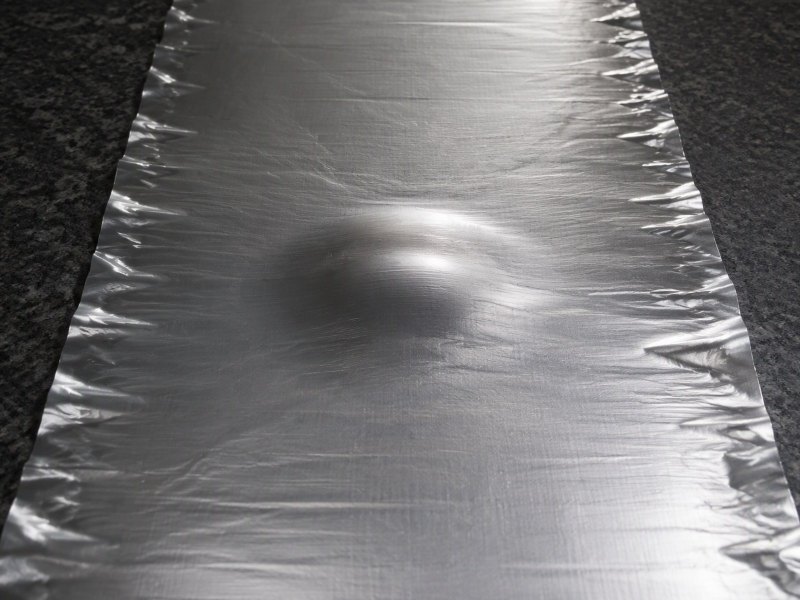
Buckle is one local pocket of extra length; waviness is a repeating wave. Why it matters.
What Is Buckle in Aluminium Foil and How Does It Differ from Waviness?
A coil that will not run flat stops a line. The bench says waves, the winder says buckle, and the wrong name sends the fix the wrong way.
Buckle is a local pocket of excess length lifted out of the web plane. Waviness is a repeating wave along an edge or across the width. A buckle cannot pass a roller nip; a shallow wave often can, which is why the two are handled differently.
Both faults arrive as a surface that is not flat, and both get described by whoever found them rather than by what they are. Sorting them starts with shape, then position, then the first roller.
What Is Buckle in Aluminium Foil?
Buckle is a raised area with no tear and no change of gauge: a pocket of excess length with nowhere to go, so it lifts out of the plane.
It is local. One patch carries more material than the path it must travel, and the surplus rises as a pocket with a soft crown and sloping shoulders.
Dive deeper
Buckle is a length fault, not a thickness fault. The gauge across a raised patch is the same as the gauge beside it, so a micrometer finds nothing and a thickness report can be clean while the coil refuses to run. What has changed is the amount of material in one band of web relative to the distance that band must travel. If a narrow strip is slightly longer than its neighbours, the surplus has nowhere to go but out of the plane.
The result is a pocket with a defined boundary, sloping shoulders and a soft crown. It can sit near an edge, in the middle, or in a band that reappears at the same position on every wrap. Pulling harder does not remove it: tension narrows the pocket while leaving the material in place. Nor does time, because the extra length survives winding, transport and storage and comes back on the unwind.
Bench descriptions call it a bag, a pocket or a loose area, and it is often confused with slack winding. Position separates them. Slack moves and fades as tension changes, while a buckle keeps its boundary and its distance from the edge. Mark it, unroll a few metres, roll back, and the mark returns to the same band of web.
What Is Waviness, and Why Is It Different?
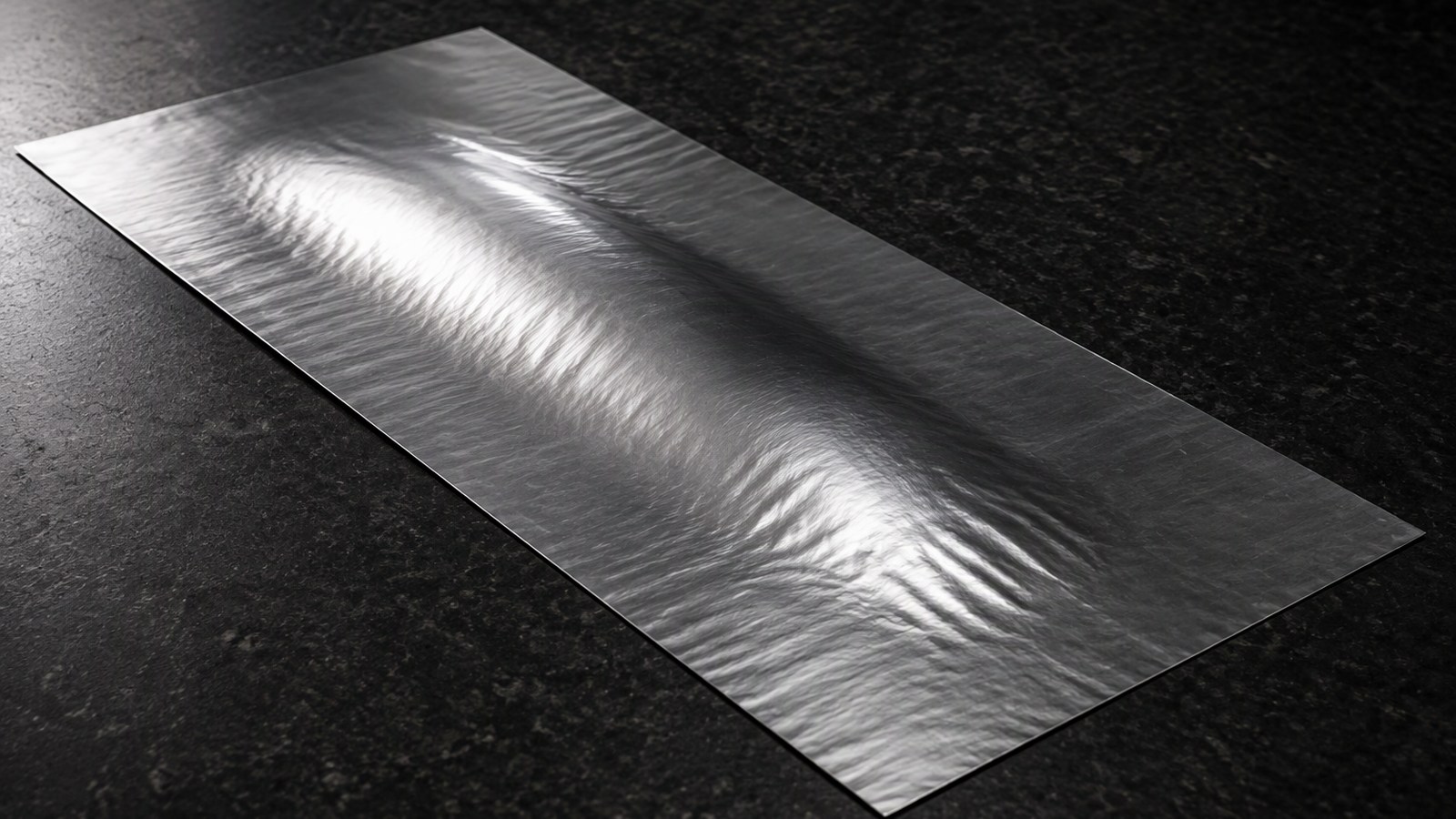
Waviness is a repeating rise and fall: the web undulates along an edge or in bands across the width, with a regular rhythm instead of one pocket.
It is distributed. Many gentle alternations share the surplus length, so no single area stands proud. Edge waves run down one side, centre waves between tight edges.
Dive deeper
Where buckle concentrates surplus length in one place, waviness spreads it. A wavy web also has too much material, but the excess is distributed across many small waves rather than trapped in one pocket. That single difference explains how the two are seen and how they answer to tension.
Position gives the first useful classification. An edge wave runs along one side and fades towards the middle, pointing to a length difference between edge and centre. A centre wave lifts between two tight edges, pointing the other way. A wave repeating evenly across the full width suggests something with a regular pitch in the roll stack.
Amplitude and pitch describe severity without naming a number. A wave barely visible in raking light behaves differently from one that casts a shadow, and a short, tight series differs from a long, lazy undulation of the same height. Two coils can hold the same nominal surplus and run quite differently.
Waviness also answers to tension in a way buckle does not: a distributed wave can be pulled part of the way flat and then run acceptably. That is why a bench alone can condemn a coil a converter would run, and why gauge crown across the width deserves a look when waves appear in the middle.
Why Do They Behave Differently on a Machine?
Laid on a bench, both faults lift in the same way. The difference appears when the web meets a roller, and that is where the two part company.
A wave flattens through a nip because its excess is spread over many gentle slopes. A buckle arrives at the nip as one pocket and cannot.
Dive deeper
A roller nip is a length equaliser. It takes the web between two surfaces and asks every part of the width to travel the same distance at the same speed. Distributed waves are pressed out over the contact arc and the web leaves flat. A pocket arrives as a lump, gets trapped between the surfaces and folds, because the nip has no way to spread its material sideways.
That is the practical difference between a fault a converter lives with and a fault that stops a line. A wave is a nuisance at the unwind and often invisible after the first idler. A buckle becomes a crease, and a crease becomes a reject, so the same nominal flatness problem produces two entirely different conversations about the coil.
The behaviour also shows downstream. A wave tends to return a little way after the roller, because the length is still there and the web relaxes; a buckle either leaves a crease that stays or persists the full length of the run. Watching a metre past the last roller tells you which one you have. Speed adds the last clue: a wave may misbehave only on fast runs, while a buckle misbehaves at every speed. The aluminium foil entry on Wikipedia covers the material and its rolling history for anyone new to the product.
How Are Buckle and Waviness Created in Rolling?
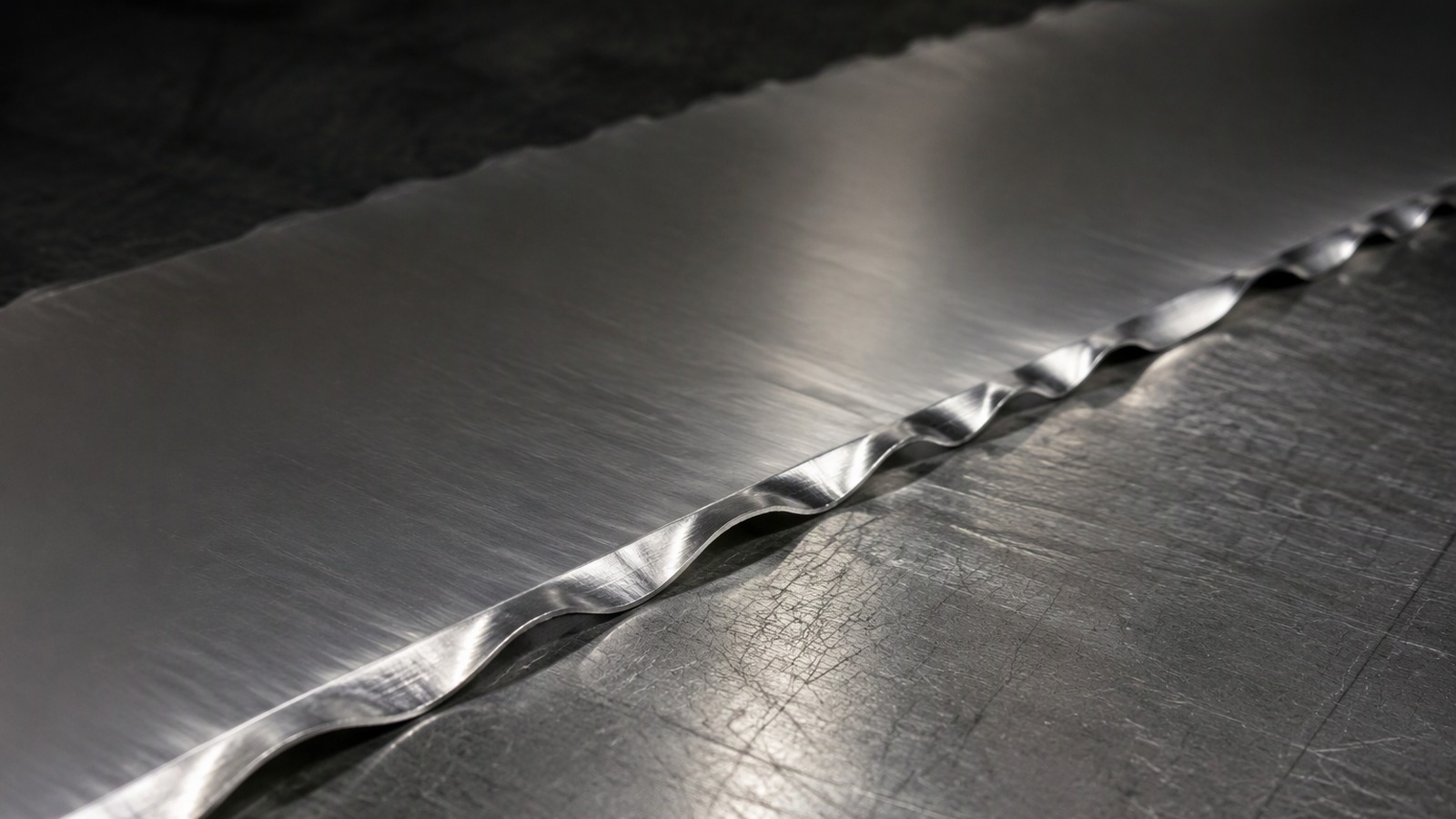
Both begin as uneven reduction. Some part of the strip leaves the roll gap longer than its neighbours, and the surplus shows the moment tension is released.
A local variation in gap, thermal shape, lubricant film or incoming gauge gives a local length difference. A broader, smoothly varying profile gives waviness.
Dive deeper
Rolling sets length. The strip leaves the gap at a speed that depends on how much it was reduced, so any part of the width reduced differently leaves at a different speed and with a different length. Foil is thin enough that a small gap difference across the width becomes a real length difference, and the material keeps that memory through annealing and winding.
Local causes give local faults. A high spot on a roll, a mark repeating once per revolution, a patch of thicker incoming strip or a thermal bump all lengthen one band and leave the rest alone. The pocket then sits at the same position relative to the centreline for the whole coil. The same band is long in every wrap, so the fault is predictable rather than random, which is why it can often be traced to something fixed in the mill.
Distributed causes give distributed faults. A roll slightly warm at the edges, a crown profile that does not match the load or an uneven coolant spray produces a smooth length gradient, and the strip answers with waves. Annealing does not remove either fault: it softens the strip and can make a mild wave easier to pull flat, but it cannot take length out of the material.
How Does Winding Create, Bury or Hide Flatness Faults?
Winding can make a fault, carry it or cover it. Tension that varies across the width builds length differences wrap by wrap, and outer layers press a fault flat.
A coil can hold a real buckle under tight wraps and look sound outside. It appears when the outer layers come off.
Dive deeper
Tension is applied across a width but is rarely uniform. If one band is wound tighter than its neighbours it is stretched further, and the difference accumulates with every wrap, so the coil holds a built-in length difference. The strip has not changed, but the coil now behaves as if one band of it were longer, and the unwind proves it. A fault can therefore appear on a converter's unwind in a coil accepted at the producing end.
Winding also hides what is already there. Tight wraps press a pocket down and hold it flat, and the outside of the coil looks sound. The fault declares itself some way into the unwind, when the tension comes off the outer layers. By then the coil is open and the argument is about ownership.
This is why a coil can sit inside a width tolerance and still buckle. Width is measured across the coil, edge to edge, and says nothing about length along the web. A coil can be exactly the ordered width and still hold a band longer than its neighbours, so flatness protection needs a flatness clause. Rewind material such as 8011 aluminium foil in 0.18 mm is often where this starts. The Aluminum Association is the trade body for the aluminium industry in the United States.
Why Does Slitting Hide or Expose Buckle and Waviness?
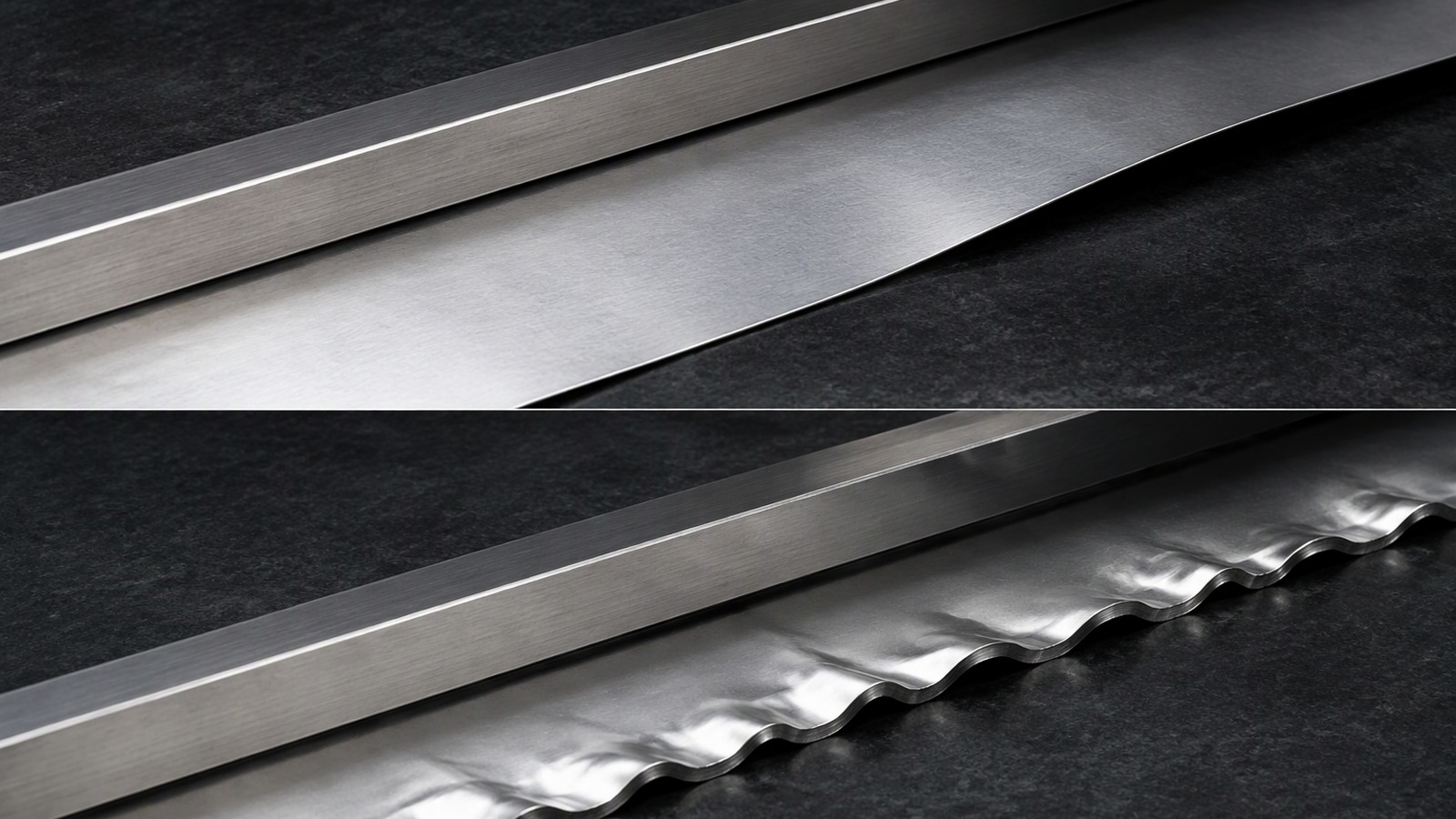
Slitting cuts a master coil into narrower coils, and the knife lines decide which faults each daughter coil inherits and which are trimmed away.
A wave at the master's edge can leave with the trim; a buckle mid-width stays. One wide wave can become several narrow ones.
Dive deeper
A master coil carries a map of length differences across its width, and slitting redraws the boundaries. If the knives cut inside a wavy edge, the wave goes into the trim and the daughter coil can be flat across its new width. That is a real improvement, and it explains why a wide coil sometimes runs badly while the narrow coils cut from it run well.
The opposite happens just as often. If a wave sits mid-width and a knife line runs through it, every daughter coil carries a share, so one fault becomes several. A pocket at the centre of a master can be split between two slit coils, each showing a lifted edge at the cut line where the pocket was severed.
Slitting also changes how a fault presents. A wide, gentle wave divided into narrow coils becomes, in each coil, a comparatively steep edge wave, because the same surplus now sits in a much narrower width. The cause has not changed but the appearance has, and staff who see only the slit coils look for a fault in the slitter when the shape was inherited. Narrow material such as 8021 aluminium foil in 0.03 mm has the least room to distribute surplus. The European Aluminium Foil Association represents foil producers and converters.
Where Does Camber Fit Next to Buckle and Waviness?
Camber is a different geometry altogether: the web bows sideways as it runs, so the two edges are not parallel to the direction of travel.
It is a bow in the plane, measured along the length, not a lift out of it. A cambered web steers; a buckled or wavy web lifts.
Dive deeper
Buckle and waviness are out-of-plane faults: the web leaves the flat surface it should occupy. Camber stays in the plane. The strip is flat, but the whole web curves to one side over its length, so the centreline wanders and the edges follow it. Nothing lifts, and a sheet laid on a bench can look perfect while the coil will not track.
That changes the symptom. A cambered web steers: it drifts to one side of the line, loads one edge of the guide and can telescope on the winder. A buckled or wavy web lifts, flutters, folds or wrinkles at a nip. The operator's complaint is the first clue and is more reliable than any description of the surface, because the two faults behave differently at the guiding system.
Camber is generated differently too. It comes from a length difference between the two edges, held consistently along the coil, rather than from a local pocket or a repeating profile. That is why it is measured against a straight reference along the length while buckle is found by looking at a patch. The three often overlap, and a cambered web pulled hard against a guide can develop a wave on the loaded edge. The geometry belongs with camber along the length, a separate subject from the faults described here. The European Aluminium association covers the wider industry.
How Should You Inspect, and What Goes in the Specification?
Inspection has to happen twice: on the coil as received, and on the running web, because some faults appear only under tension and speed.
On the coil, look for a raised patch that keeps its position. On the run, watch where the web leaves each roller. In the specification, name the fault and the test.
Dive deeper
On the coil as received
Start with the outer wraps under raking light, then unwind several layers and repeat. A buckle is a patch that holds its position relative to the edge and does not move when the wrap is loosened. A wave is a rhythm along one edge, and it changes with tension.
On the running web
Watch the web between the unwind and the first nip, then a short distance past each roller. A wave that disappears after the first idler is distributed shape; a pocket that persists or leaves a crease is a buckle. Note the speed at which the symptom appears.
In the specification
Write the fault name and the method. State that the coil is to be free from buckle, defined as a local raised area of excess length that does not lie flat under normal running tension, and free from waviness beyond an agreed limit at a stated tension. Name who assesses it and what happens if it is found.
A specification that says only that the foil must be flat leaves the dispute open. Buyers ordering through a packaging and container foil range should also say what the foil will run on, because a fault invisible on a simple rewind can be fatal on a line with several nips.
Buckle is a pocket of extra length, waviness a distributed ripple, camber a sideways bow. Name the shape and the test, and a flatness argument becomes a specification.