How Does Water Staining Form on Aluminium Foil Rolls?
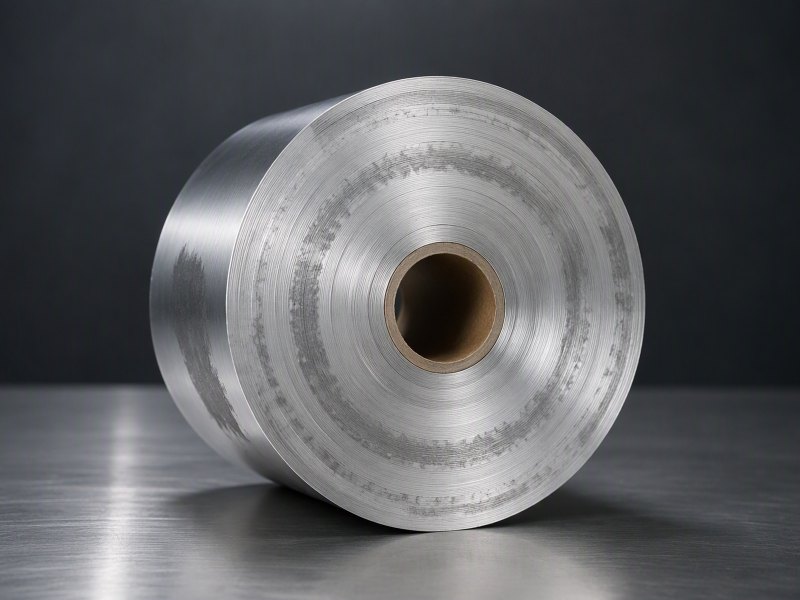
Water staining on aluminium foil comes from moisture trapped in the roll. Learn how storage, packing, moisture barrier wrap and sea freight keep foil bright for importers and converters.
Moisture trapped between tightly wound foil layers can leave dark marks that buyers reject at goods-in. Understanding the mechanism helps importers and converters stop the problem before shipment.
Water staining is the dark, cloudy surface marking that appears where moisture and condensation sit against aluminium foil inside a roll long enough to react with the metal surface, and it is prevented by keeping rolls dry, wrapped in a moisture barrier and stored in stable, ventilated conditions.
Water staining on aluminium foil is one of the most common quality complaints in foil importing, so this article explains the chemistry, the warehouse conditions that trigger it, and the packing and handling rules that keep foil bright from the mill to the buyer's unloading bay.
What Causes Water Staining on Aluminium Foil?
Water staining is a corrosion-like surface reaction, not a dirt mark. It happens when moisture sits against bare or lightly protected foil for days.
Water staining is caused by moisture and condensation forming inside a roll, mainly from temperature swings during storage, transport or sea freight, that leaves a thin film of water on the foil surface long enough to dull and darken it.
Dive deeper
Aluminium foil is reactive at the surface. The moment it meets air, a thin and invisible oxide layer forms and shields the metal underneath. That native oxide is normally stable, but it is not waterproof. When water rests on the surface for hours or days, the oxide can slowly hydrate and change, and the altered surface scatters light differently. Buyers then see what they call water staining: dark, mottled or cloudy patches instead of a uniform, reflective finish.
The water does not have to be visible. In a tightly wound roll, most of the free moisture sits at the edges and in the gaps between laps, and it usually arrives from three sources. The first is condensation, when warm and humid air reaches metal that is cooler than the surroundings and the vapour turns to liquid on the surface. The second is residual moisture carried into the packing before it is sealed. The third is liquid water that reaches the roll through a damaged or poorly sealed wrap during handling and transport.
Because the laps are pressed together, even a very thin film stays in contact with the surface for a long time and cannot evaporate. That long contact time is why staining is often worse in the middle of a roll than on a single sheet, and why it frequently appears as bands that follow the winding pattern. The mechanism is essentially the same as the general behaviour of the material described in Aluminium foil - Wikipedia, and it applies to the foil used across flexible packaging, lidding, household and technical converting.
How Does Water Staining Form Inside a Roll?
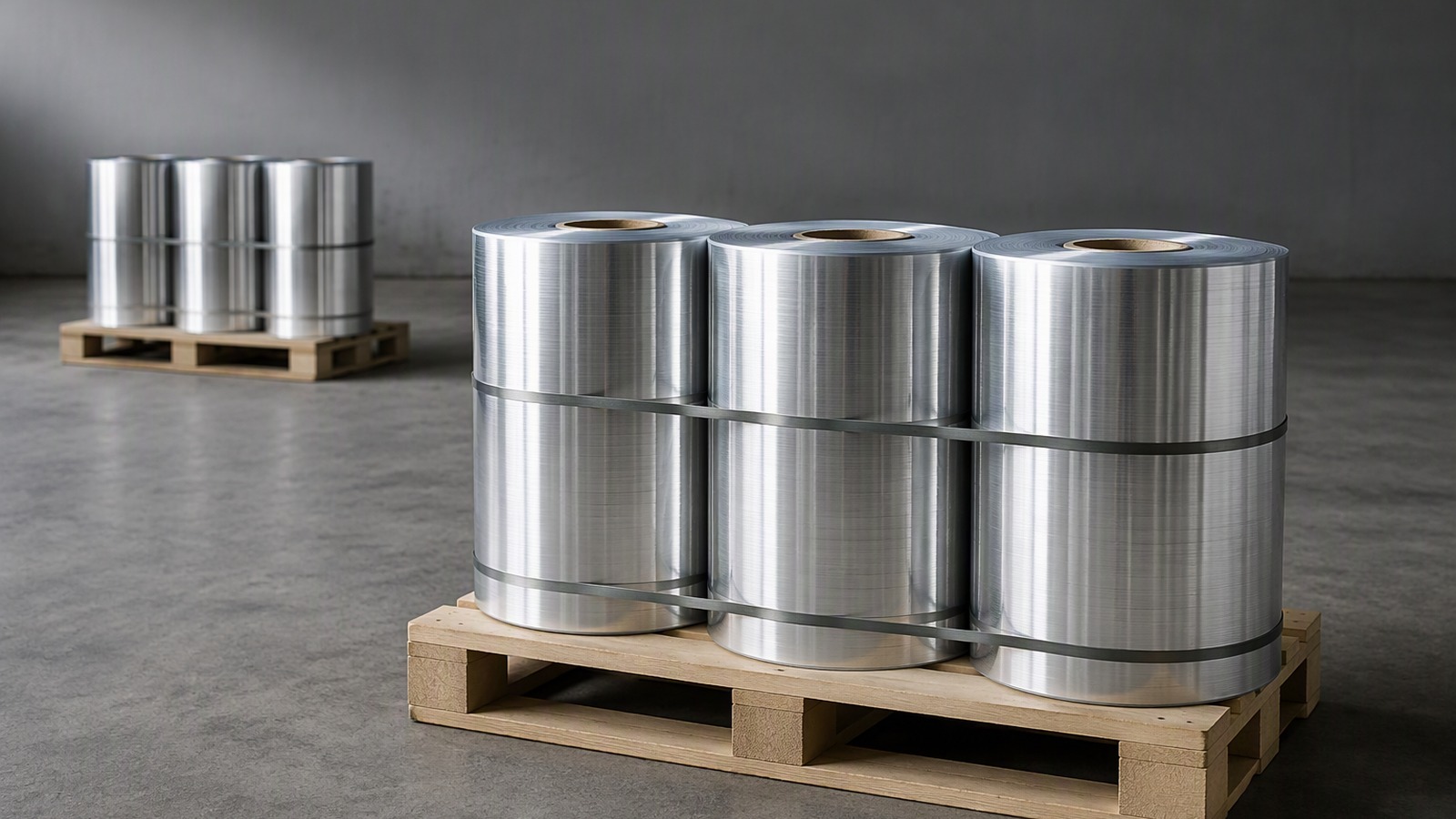
Staining forms where the winding tension is tightest, because trapped moisture there has nowhere to go. The position of the water, not its volume, decides the damage.
Inside a roll, moisture collects at the edges and between laps, where it cannot drain. The capillary gap between layers holds a thin film in contact with the foil for a long time, so the surface slowly darkens along the winding lines.
Dive deeper
Formation starts at the surfaces that stay wet the longest. Water enters a roll mainly at the two edges, where the cut faces are exposed, and it travels inward by capillary action through the tiny gaps between laps. Once inside, the water cannot drain or dry, so the surface chemistry keeps changing for as long as the moisture remains.
The winding pattern decides where the marks appear. Foil is wound under tension, so the layers touch closely and hold a thin film against the metal. Marks therefore tend to follow the winding direction and to concentrate near the core and mid-roll, away from the edges that can sometimes dry faster. A larger roll diameter stores more laps and more trapped air, so heavier rolls can hold moisture for longer before anyone notices. Cores of 76 mm and 152 mm both leave a hollow centre where damp air can circulate, especially if the roll is stored eye to sky.
Temperature lag explains much of the risk. Metal takes time to reach the temperature of the room around it, so a roll that has been cold overnight will still be cold when the warehouse warms up in the morning. The warm air around it cools on contact, drops below its dew point and leaves condensation on the surface and on the packing. Repeated cycles slowly build the damage. Soft alloys behave the same way at the surface, so water stains on aluminium foil rolls of any temper follow similar rules whatever the grade, and the same logic applies to light-gauge material used in packaging and technical converting.
How Do Storage and Warehouse Conditions Cause Water Staining?
Most staining is born in storage, not in transit. A cold roll moved into warm, humid air will sweat long before anyone opens the packing.
Large day-to-night temperature swings, high relative humidity and poor ventilation are the main triggers. When a cool roll meets warm, damp air, condensation forms on the metal, and repeated cycles keep the surface wet.
Dive deeper
Warehouse conditions decide how often a roll sweats. The critical measure is not the average temperature but the dew point of the air relative to the temperature of the metal. When a cold roll meets air whose dew point is above the metal temperature, condensation is almost certain, and it forms first on edges, cores and any bare metal left by a damaged wrap.
The worst pattern is a large daily swing. A warehouse that is cold at night and warm and humid by midday forces the metal through repeated condensation cycles. Poor ventilation makes it worse, because still, damp air lingers around the pallets instead of being carried away. Rolls stored near open doors, loading docks or leaky roofs face the same problem in a more concentrated form.
Basic storage discipline removes most of the risk. Keep rolls on pallets and never directly on concrete, because a cold floor conducts heat away and keeps the metal cool. Leave space between stacks for air to move, and keep the store closed and, where possible, stable in temperature. Rotate stock so older rolls ship first, and inspect wrap before it leaves the store. The measurement principles that underpin dew point, temperature and humidity monitoring are set out by the National Institute of Standards and Technology, and applying them with simple data loggers turns storage from guesswork into a controlled process. Simple loggers left with the load record the temperature and humidity history, so a buyer can see whether a roll stayed dry from factory to warehouse. Where the climate cannot be controlled, the packing has to compensate for it.
How Does Packing and Moisture Barrier Wrap Prevent Water Staining?
Packing is the last line of defence against moisture. A good barrier keeps humid air away from the metal for the whole journey.
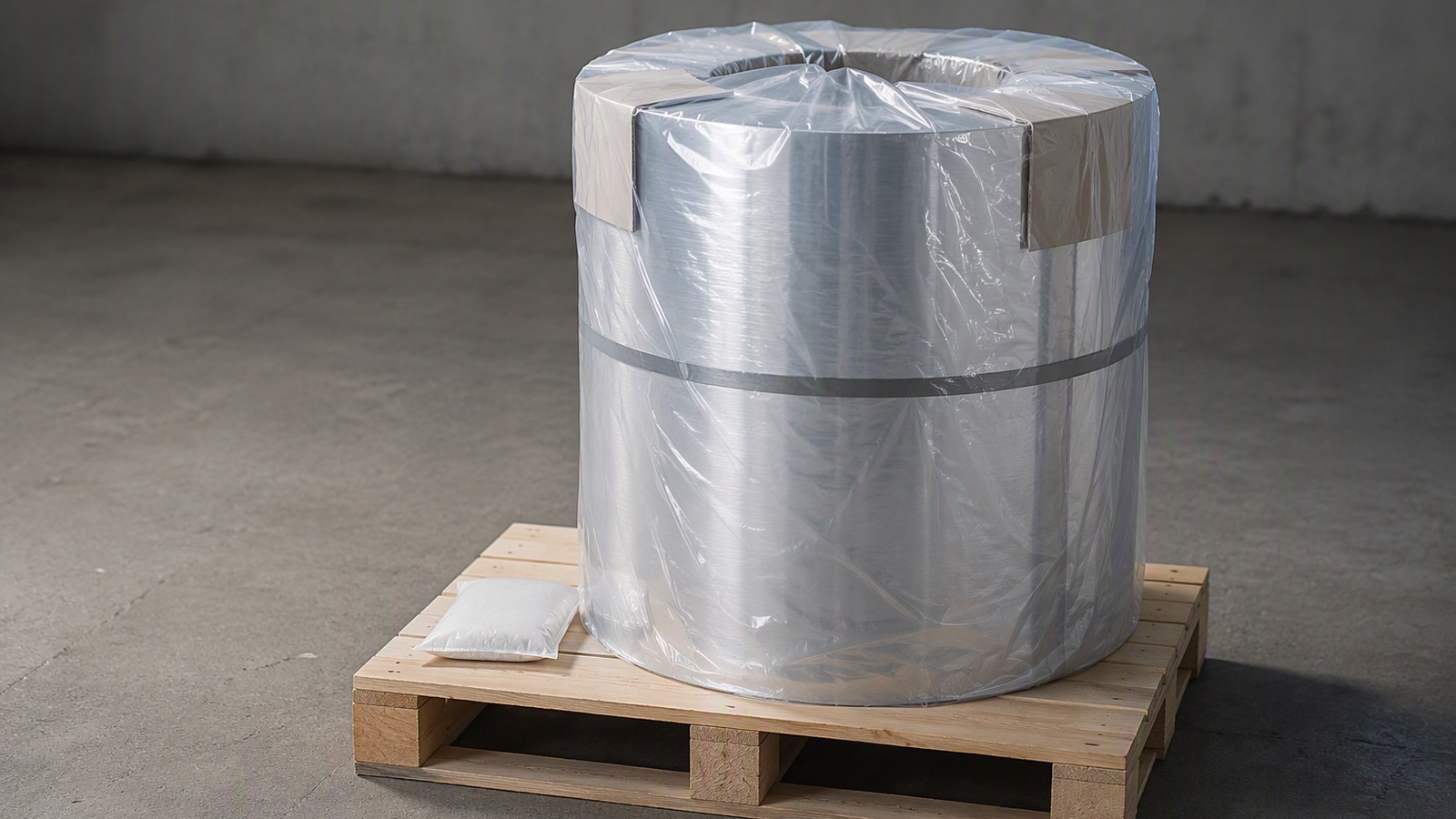
A moisture barrier wrap seals the roll from humid air, while desiccants absorb any vapour already trapped inside. Together with a wooden pallet that keeps the roll off the floor, packing controls the micro-climate around the metal.
Dive deeper
Packing creates a small, dry pocket around the roll. A moisture barrier wrap blocks humid air from reaching the metal, and the pallet keeps the base of the roll away from damp floors. Together they hold the micro-climate steady even when the air outside changes.
The wrap is the primary barrier. A sealed moisture barrier film keeps outside humidity out, and any vapour already trapped inside is managed with desiccant where the journey is long or the climate severe. Corner boards and edge protection stop the wrap from being cut, because a single puncture lets humid air straight to the metal. Rolls are usually supplied in eye to sky or eye to wall orientation on a wooden pallet, and that choice changes how the packing protects the cut edges.
Orientation matters. In eye to sky, the roll stands on its cut edge, so the wrap seals a smaller exposed face but any water on top can run toward the core. In eye to wall, the roll lies on its curved surface, which spreads the load and shields the edges, but the packing must resist crushing along the length. Whichever orientation is specified, the aim is the same: keep the wrap intact, keep the pallet dry and keep the roll off the ground. For a wider view of the grades used in these applications, see industrial and technical foil, and for wider industry context, European Aluminium explains why consistent material handling matters across the sector.
How Should Rolls Be Handled and Stored to Avoid Staining?
Handling and storage practice decides whether a well-packed roll stays bright. Small routines, repeated every shift, matter more than any single measure.
Keep rolls on pallets, never on bare floors, store them eye to sky or eye to wall as specified, avoid dragging them, and move them slowly between climates so condensation has time to settle.
Dive deeper
Handling damage is often the first step toward staining. A torn wrap, a dented edge or a roll left on a wet floor gives moisture an entry point that no packing can defend after the fact.
Move rolls with the right equipment, avoid dragging or dropping them, and never roll them across a wet surface. Store them on dry pallets, keep the wrap sealed, and let a cold roll reach room temperature before the packing is opened, so condensation forms on the outside of the wrap rather than on the metal.
The habits that protect foil are simple but they must be consistent. Train forklift operators to lift from below with forks that do not touch the wrap, and to set rolls down gently. Inspect every roll at goods-in and again before dispatch, and reject or rewrap anything with a broken seal. Keep a short acclimatisation window between a cold container and a warm store, so temperature equalises gradually and the metal is not shocked by a sudden change.
Documentation supports all of this. Recording storage temperature, humidity and handling dates turns a vague complaint into a traceable event, and it links directly to how thickness and yield are managed in production. Buyers who understand foil thickness tolerance and yield are better placed to judge whether a surface mark is a real defect or a shipping artefact, and to give clear feedback to the mill. Good records also protect the converter when a claim arises, because they show exactly how the roll was stored and moved after arrival.
How Does Sea Freight Increase Water Staining Risk?
A container crossing the equator can swing from cold nights to hot, humid days. That cycle is the hardest test a foil roll will face.
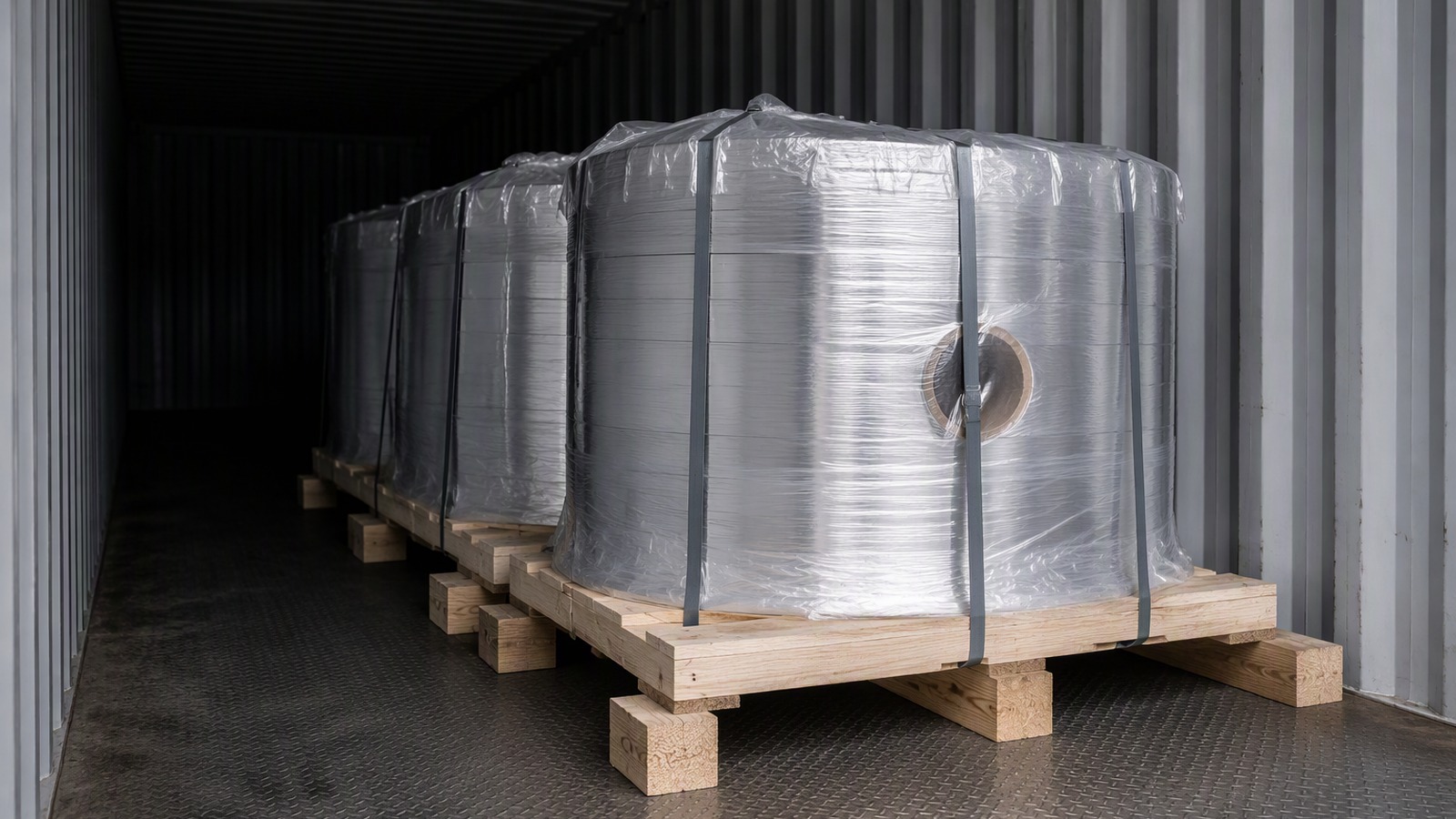
Inside a sealed container, moisture that evaporates from the pallet or floor can condense on cooler foil surfaces. Long voyages and multiple climate zones increase the number of wet-dry cycles, so freight packing must be robust.
Dive deeper
A container is a closed, unventilated box that can cross several climate zones. Moisture released inside it has nowhere to go, and the metal is often the coolest surface available.
During a long voyage, pallets, dunnage and residual moisture release vapour that condenses on cooler foil and on the container walls. Repeated warm days and cool nights build many wet-dry cycles, so freight packing must resist moisture far longer than a warehouse does.
Container rain and container sweat are the visible result. Loading practice reduces them. Use dry, heat-treated pallets, add container desiccants for long or humid routes, line the container where appropriate, and secure the load so rolls cannot shift and tear their wrap. Roll wrapping and lashing should leave the barrier intact at every corner.
Ports and routing add another layer of risk. Cargo loaded at Qingdao, Tianjin or Shanghai may wait on a hot quay before sailing, then pass through humid tropics and cool nights at sea. Each stage changes the temperature of the metal and the air around it. Understanding why container loading matters for foil importers helps buyers specify packing that matches the route, and for general industry guidance on handling and storing aluminium products, the Aluminium Federation is a useful reference. When rolls arrive, inspect the wrap and the cut edges first, because that is where staining shows before it spreads.
Water staining is preventable when moisture, temperature and packing are managed together. Dry rolls, sound barrier wrap and careful handling keep aluminium foil bright from mill to unloading bay.