How Should Aluminium Foil Rolls Be Stored and Handled?
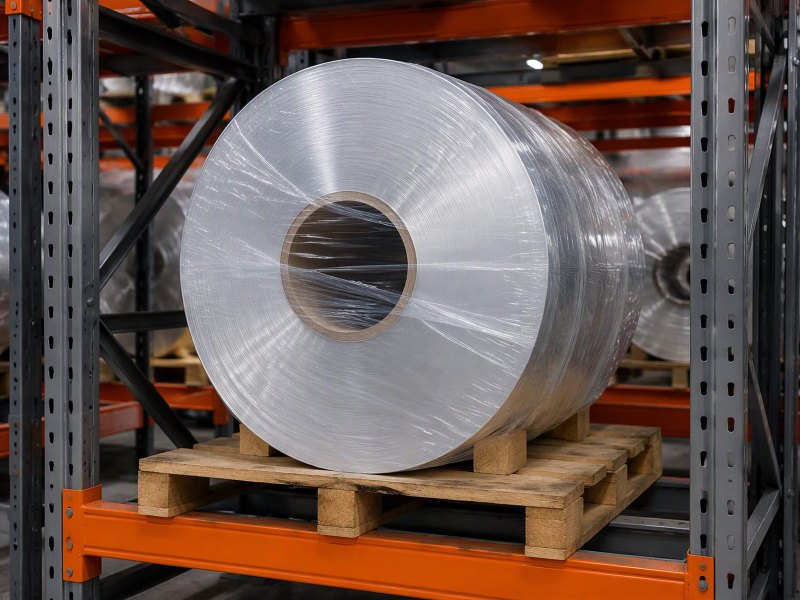
A roll that passed inspection can still be ruined on the rack. How condensation, stacking, orientation, FIFO, clamp handling and part-used rolls decide whether sound foil stays sound.
A roll can pass every check at the dock and still be scrapped months later, ruined by nothing more than the way it was kept.
Sound foil stays sound when the wrap stays closed, the roll keeps its shape, handling touches the pallet rather than the metal, and the oldest stock moves first. Storage is a process, not a place.
The sections below follow a roll through the warehouse: the air around it, the rack under it, the forks that lift it, and the records that decide when it leaves.
Why can a roll that passed inspection still be ruined in storage?
Inspection samples a roll at one moment and largely from the outside. Storage acts on the whole roll for as long as it sits there.
Acceptance confirms the condition on the day of receipt. Moisture, load and handling keep working afterwards, and their effects usually appear at the converting line rather than at the dock.
Dive deeper
Inspection is a sample, and a narrow one. A roll is judged by its visible wrap, its edge and the laps exposed at the head. Everything inside the coil, between laps that winding tension has pressed together, is neither visible nor sampleable without destroying the roll. That is not a weakness in the arrival check, which is covered separately in the guide to checking foil on arrival; it is the nature of a wound product.
Storage works precisely on that hidden interior, and it works slowly. Moisture migrates through a fold in the wrap. Load settles into the bottom of the coil. A clamp leaves a mark that only appears when the roll is mounted on a shaft. None of this produces an incident report, because no single moment looks like an event.
The consequence surfaces much later, at the line, as a stain that prints through, an edge that will not track, or a roll that unwinds with tension rising and falling. The general background on aluminium foil explains why the surface dominates: foil is a thin gauge metal with an enormous surface area for its mass, so most damage is surface damage, and the surface is exactly what storage controls.
How does condensation form inside a wrapped roll?
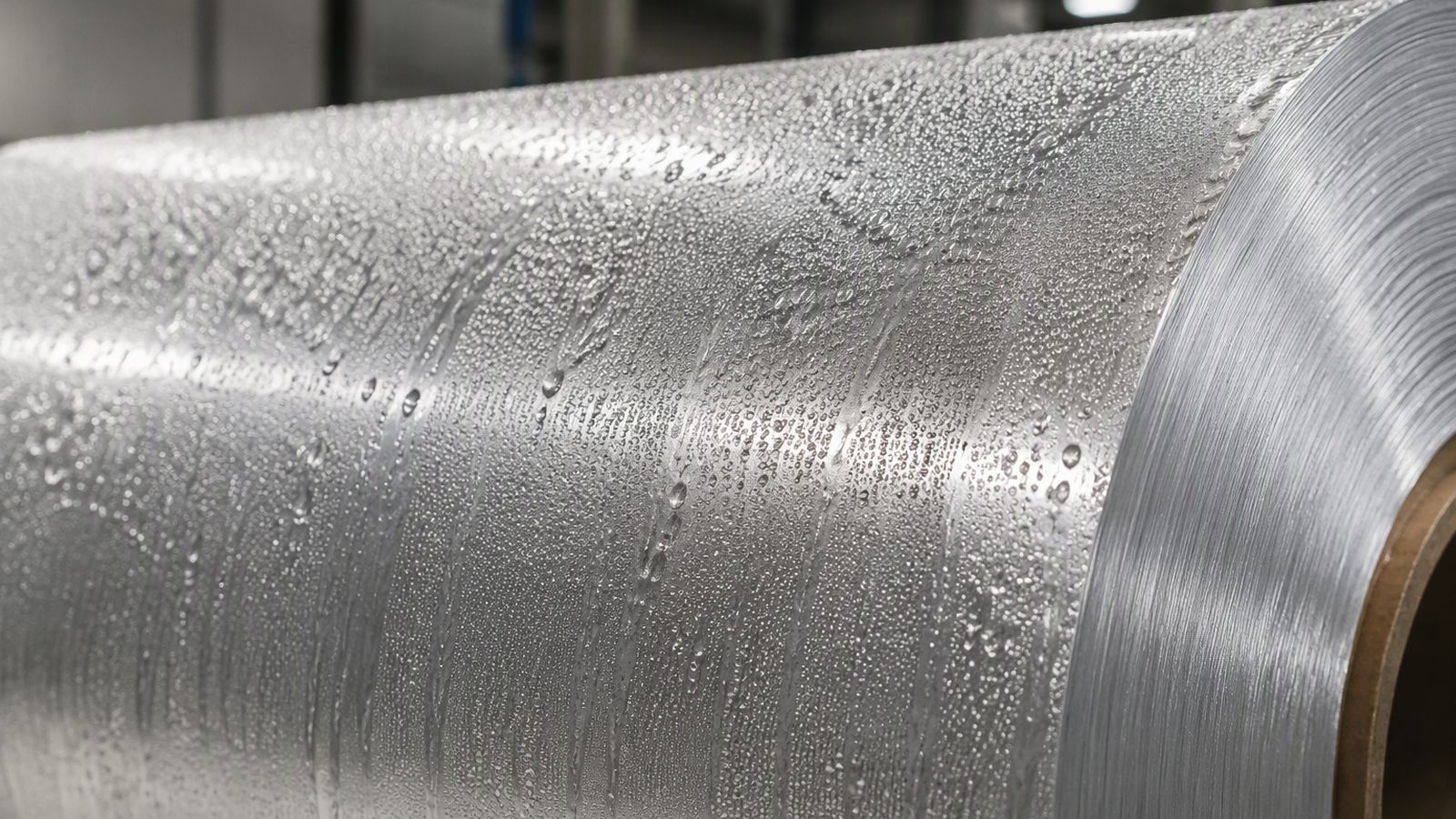
A cold roll carried into a warm room behaves like a cold glass. The difference is a long, narrow gap between laps that can hold the water.
Air trapped inside the wrap carries moisture. When the metal is colder than the room around it, that moisture condenses on the foil, and the wrap keeps it there instead of letting it escape.
Dive deeper
A wrapped roll is not sealed like a tin. The wrap is folded and taped around a shape with two open ends at the core, and the folds move as it expands and contracts. In practice it breathes: air is exchanged continuously, and the core ends are the easiest route in and out.
Temperature cycling does the rest. A warehouse warm by day and cold at night, or a roll arriving on a cold vehicle and wheeled straight into a heated hall, puts the metal below the dew point of the air around it. Moisture then condenses on the coldest surface available, which is the foil, and the wrap holds that water against the metal instead of letting air carry it away.
The water does not sit in one place. It gathers in the gap between laps and creeps along the wound surface while the roll stays cold or the air stays humid. That marking, and how it is avoided, is covered in preventing water staining on aluminium foil. The practical answer is equalisation rather than speed: let a cold roll reach room temperature while it is still wrapped. How long that takes depends on the roll, the wrap and the building, so it belongs in the site procedure.
What does stacking do to a roll’s roundness?
A roll is a hollow cylinder carrying its own weight through a thin wall of laps. Stack it and the load arrives as a line, not a surface.
Weight concentrated on one contact line flattens the coil where it is touched. The roll comes out of the stack oval rather than round, and no later handling puts the shape back.
Dive deeper
Roundness is a geometric property, and geometry is the one thing handling cannot repair. Stack rolls on their curved surface and each presses on the one below along a narrow contact band. The bottom roll carries everything above it, the wall of laps is thin, so the band deflects, and the roll stays slightly flattened. Engineers call it ovality.
Ovality is not cosmetic. An oval roll leaves a shaft, unwinds unevenly, and pulls the web with tension that rises and falls once per revolution. Tracking drift, wrinkles and register error look like machine faults until somebody measures the roll.
Racking repeats it: a roll resting on two beams is supported at two lines, and if the beams are spaced for a narrower size, a wider roll bridges them with its weight hanging in the middle. Rolls stored on their ends under load press into the edge of the laps, the least supported part of the package. There is no universal figure for how much may be stacked, and offering one would be unwise: the safe load depends on alloy and temper, on coil wall thickness, pallet, rack and floor, so it belongs to the material supplier and the site procedure. The European Aluminium association publishes general material that is useful when that figure is agreed.
Should a roll stay on its pallet, on its side, or on its axis?
The pallet is the handling interface, and the orientation is the storage decision. Both should be settled before the roll is put away, not improvised at the rack.
Keep the roll on the pallet it arrived on, and choose the orientation that matches how it will next be moved. A pallet spreads load, protects the edge and keeps the wrap off the floor.
Dive deeper
Two orientations are in common use. Standing a roll on its end puts the axis vertical, so it occupies a small footprint and can be approached from any side, which suits a clamp truck in a narrow aisle. Laying a roll on its curved surface puts the axis horizontal, which suits a shaft-mounted unwind, a crane with a roll grab, and any case where the roll will be pushed rather than lifted.
What matters is that the choice is made once and written down, because mixing orientations in one bay is how rolls get dragged. A roll stored on its end and then pulled sideways by a clamp has been asked to do two incompatible things.
The pallet earns its place for three reasons. It spreads load over a footprint instead of a contact line. It keeps the bottom of the wrap clear of the floor, where water, dust and traffic live. And it gives the fork somewhere to go that is not the metal. A roll taken off its pallet to save height has traded a little space for a lot of risk. Widths from 100 to 1500 mm on 76 mm or 152 mm cores need pallets of different lengths, so a stock of aluminium foil rolls in several sizes should carry a pallet matched to each width.
Why should the oldest roll be used first?
Every roll in the warehouse is ageing, and the oldest one has been ageing longest while being handled most.
First in, first out is not bookkeeping tidiness. It limits the time a roll spends exposed to moisture, load and handling, and it stops stock disappearing to the back of a rack.
Dive deeper
Age matters because several slow processes run at once. The surface of the foil is never perfectly inert; it carries a thin oxide that keeps growing, and in a humid store the growth is uneven and shows as a colour difference rather than a measurable loss. The wrap ages too: folds stiffen, tape loses grip, and a cover that was tight at receipt becomes a loose sheet that lets dust and moisture in.
The oldest roll is therefore usually the most exposed one, which is the practical argument for rotation, and it is also the roll most likely to be forgotten. A rack loaded and picked from the front slowly buries its first pallet, and one day that pallet is found with a wrap that no longer protects anything. One address per roll, front-load and back-pick, is what keeps the queue real.
Age is not a countdown. There is no single interval after which foil becomes unusable, and a figure presented as one would mislead, since the rate depends on the wrap, the building, the season and the alloy. What a plant needs is a review point agreed with the material supplier and written into the site procedure, plus a physical check of any roll that reaches it. The Aluminium Federation publishes general material that is useful when that conversation starts.
What damage do forks and clamps do at the edge?
The edge of a roll is the only place where every lap is exposed at once. It is also where forks arrive first.
Tines strike and puncture, clamps squeeze and slip. The result is a burred or crushed edge that will not track, and it is usually found at the line rather than at the rack.
Dive deeper
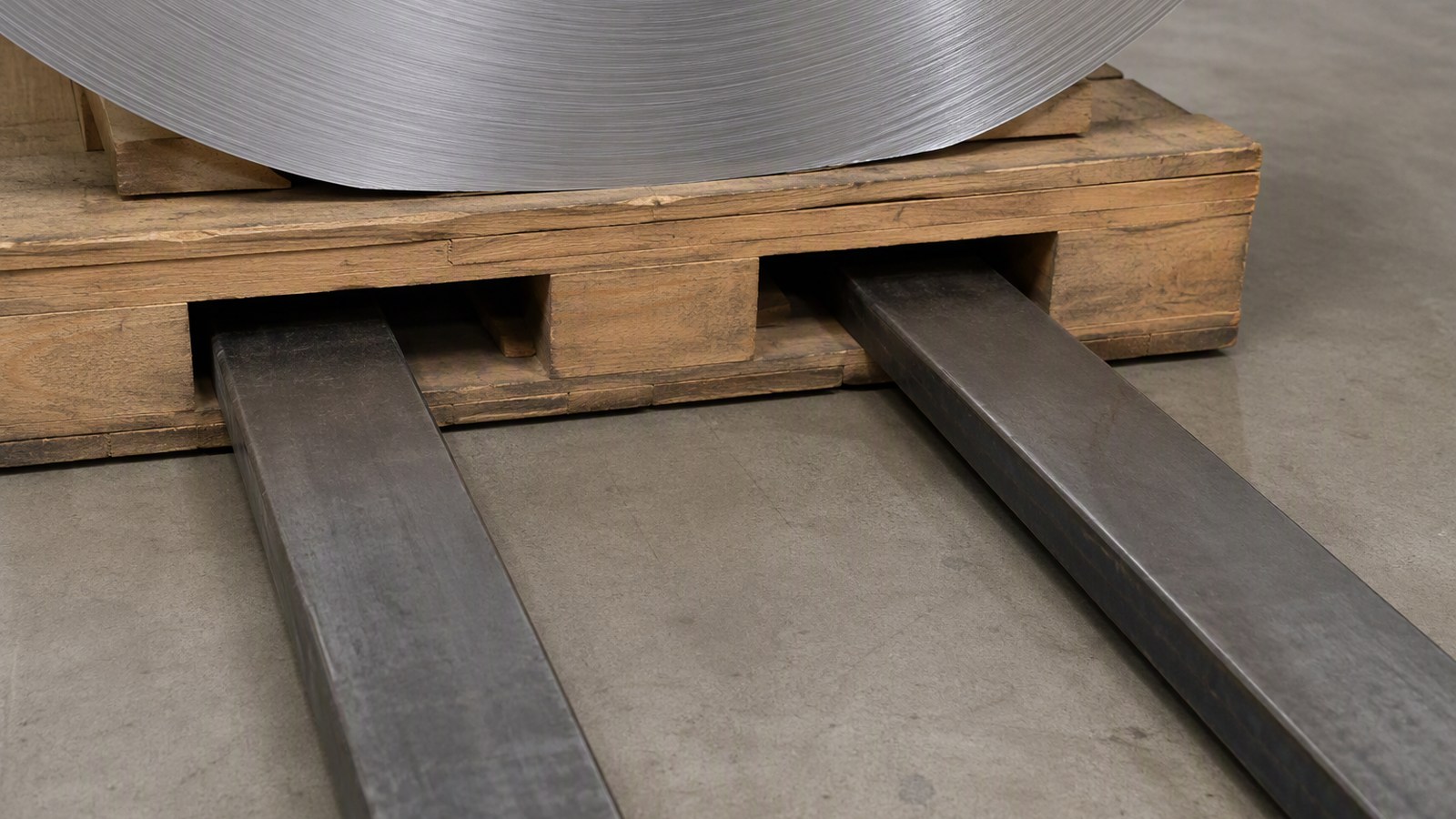
A fork tine is a steel wedge moving at walking pace towards a soft, thin-walled cylinder. If it enters under the pallet, nothing touches the foil. If the pallet is missing, or the tine too long, or the driver hurried, the tine meets the wrap and then the edge. A puncture is small but becomes large: the opening lets air in and out with every temperature cycle.
Clamps cause a different pattern. A clamp grips the curved surface and relies on friction, so the force must be high enough to hold the weight, and that force is applied to the laps. A roll clamped near its edge is squeezed where the wall has least support, leaving a scuffed surface and a flattened band where the pads sat.
The edge is unforgiving because trimming cannot repair it: removing a damaged edge means removing laps, and on a roll ordered for a specific width that may be the end of it for the intended job. Move the pallet wherever a pallet exists; where it does not, support the roll along its length rather than at a point. Where a clamp is the only option, grip the body rather than the edge. A coil of 1060 aluminium foil at 0.02 mm deserves the same care.
What should be done with a partly used roll?
A part-used roll is the most vulnerable item in the warehouse, because its protection has already been opened once.
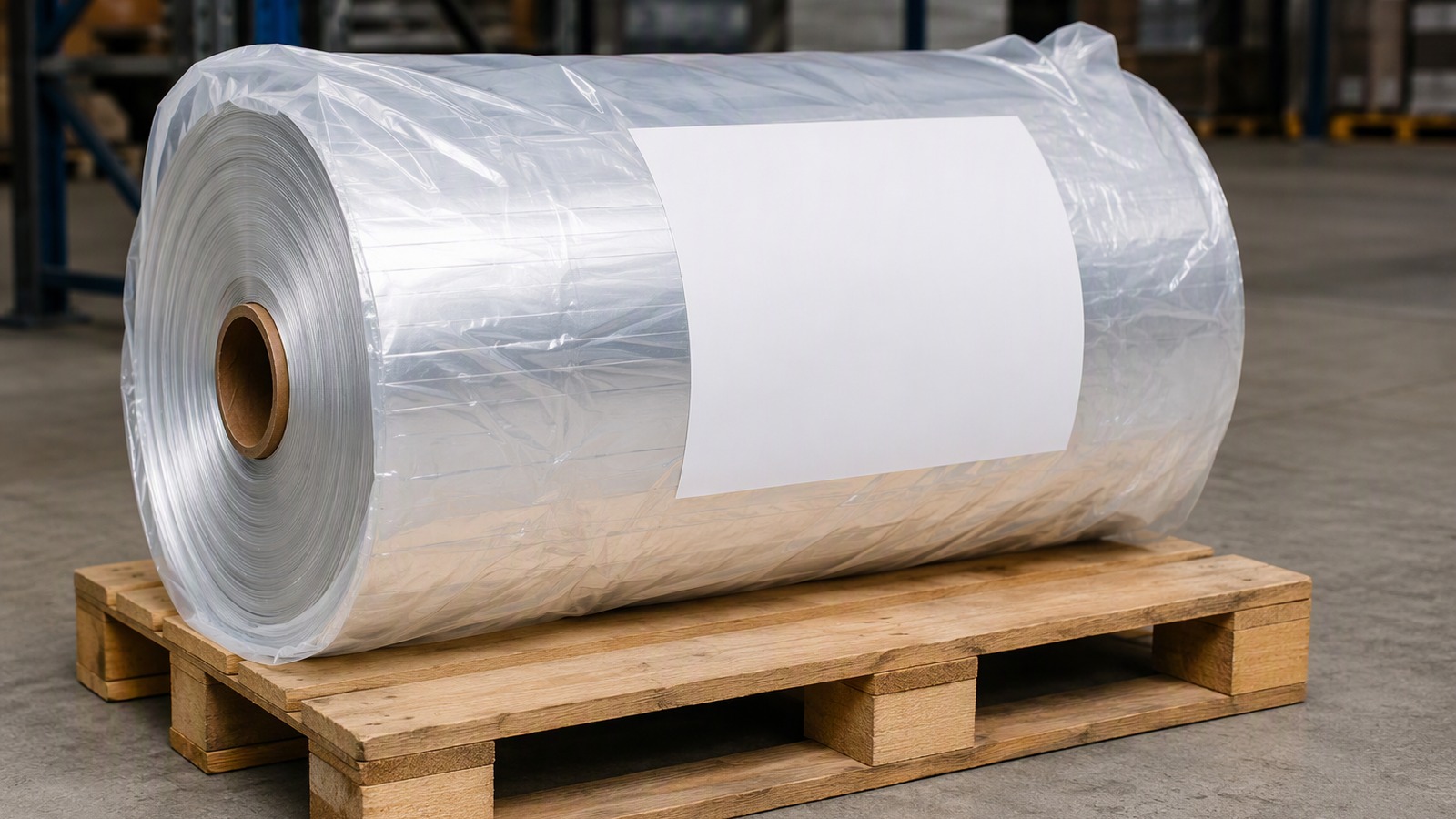
Rewrap it before it leaves the line, restore its support, label it with its identity and remaining quantity, and return it to a defined position rather than to a corner.
Dive deeper
The moment a roll is unwrapped, the balance changes. The wrap that kept moisture out is gone, the outer laps are exposed, and the roll has usually been mounted, so it has been handled more in one shift than in its whole previous life. If it goes back to the rack as it is, the next person will see an open roll and treat the opening as normal.
The sequence that works is short. Rewrap at the end of the run, while the roll is still on the machine and still supported, rather than after it has been carried across the plant. Restore the end protection, because the open core is the main route for air exchange. Restrain the loose laps so the roll cannot telescope in the rack. Label it so identity, alloy, temper, size and remaining quantity travel with it, then put it at the front of the picking queue.
If the wrap cannot be restored properly, the roll should be flagged and used at the next opportunity rather than stored indefinitely, and marked as a return rather than new stock. There is also a discipline about the floor: a part-used roll left standing on concrete overnight, without a pallet, has picked up everything the floor holds.
What should a stock controller record?
If it is not recorded, it cannot be prevented twice. The record is what turns good storage from a habit into a system.
Record the roll’s identity, its location and orientation, every movement, and the condition of its wrap at issue and at return. Then review the exceptions, not the totals.
Dive deeper
Identity first: alloy, temper, thickness, width, core size, gross and net weight, and the roll number that ties the item to the arrival record. Those fields stay in Latin characters and digits in every language. Then position: a location naming bay, rack level and slot beats one naming the aisle. Orientation belongs in the record, since a roll found on its side after being stored on its end has been moved.
Movement and condition carry the prevention. Every move should record the equipment used and who used it, so a pattern of edge damage can be traced to a shift or a truck rather than to bad luck. Wrap condition at issue and at return should be written in plain words, with the date the roll went into service.
Finally, the exceptions. A roll that was dropped, clamped badly, splashed, or found with a torn wrap is the only real evidence a plant gets, and it is worth more than a page of totals. Recording it turns a storage policy into something that can be checked and defended. The Aluminium Association and the range of foil roll and sheet formats point the same way: the more items tracked, the more specific the record must be.
Storage does not damage foil quickly; it damages it quietly. Keep the wrap closed, the shape supported and the oldest roll moving, and accepted material stays accepted.