What Is a Rolling Pass Schedule for Aluminium Foil?
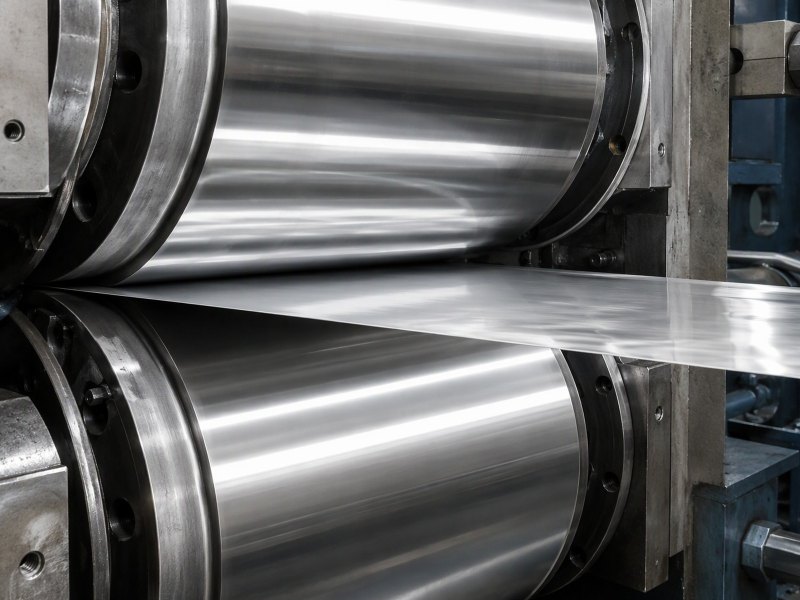
Why two identical coils behave differently: the rolling pass schedule behind them.
Two coils of the same alloy and gauge can arrive with different flatness, temper and pinholes, and the reason is rarely in the paperwork.
A rolling pass schedule is the ordered sequence of thickness reductions that turns a heavy input into foil, with the anneals between them. The sequence, not a single setting, decides temper, flatness and continuity.
Buyers meet the schedule as behaviour: a roll that runs flat on one line and cups on another, a gauge that drifts midway, pinholes that move between lots. What follows traces that sequence to the coil.
What Is a Rolling Pass Schedule, and How Does a Heavy Input Become a Thin Web?
A schedule is a plan, not a setting. It decides how much thickness each pass removes, in what order, and where the metal softens.
It is the ordered sequence of reductions that takes a thick input down to foil, plus the anneals and roll changes between them. Each pass removes a share; the sequence produces the web.
Dive deeper
Foil does not begin as foil. The input is a coil of cast or hot-rolled aluminium, millimetres thick, with its own history. Between that coil and a delivered roll of 0.005 mm to 0.20 mm material sits a written plan: entry and exit gauge for every pass, the tension to hold, where the coil is annealed, and where the work rolls are changed.
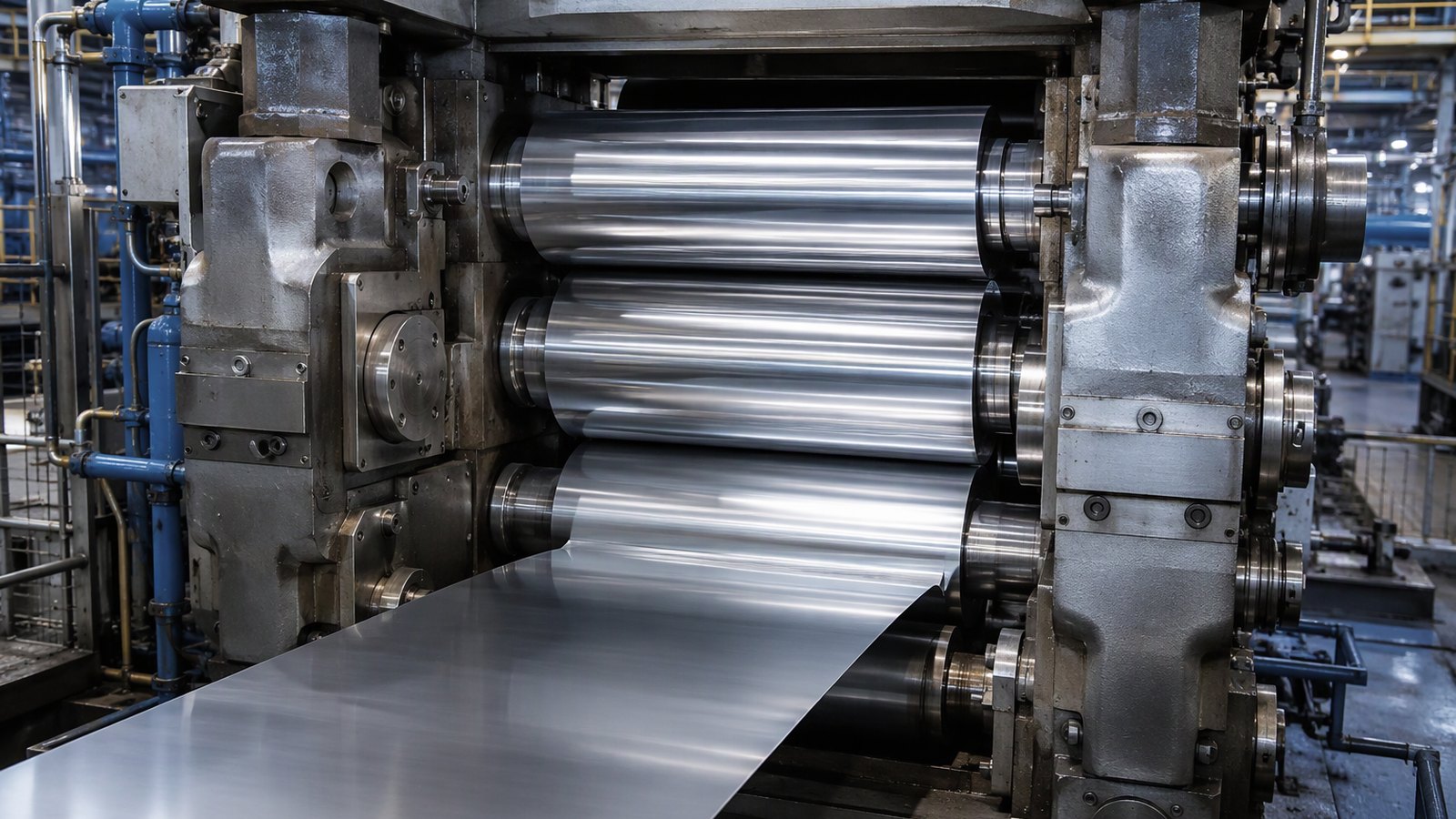
The plan is built around the stand that will run it. A reversing mill sends the web back and forth through the same pair of rolls, closing the gap a little on each return, so one stand can carry a long series of reductions. The planner starts from the incoming gauge and works forward, deciding how much to take at each step and where the metal must soften before it takes more.
Nothing in that table is arbitrary. Each line compromises between what the stand can deliver and what the finished coil must do. A sequence that leaves room for correction yields small, even variation; one written to move metal quickly leaves errors that later passes inherit and sometimes amplify.
Schedules also differ by product family, since household foil, container stock and aluminium foil rolls and sheet for converters ask different work of the last passes, and are planned separately.
Why Can Aluminium Foil Not Be Rolled to Gauge in a Single Pass?
One pass can only remove so much before the mill runs out of force, the web loses shape, or the rolls flatten.
Because the load needed to thin metal rises steeply as the web thins, while the rolls can only carry so much. Past that point they flatten, the crown stops transferring, and the web comes out wavy or split.
Dive deeper
The geometry works against the mill. As the web thins, the arc over which the rolls touch it shortens, so each unit of roll force buys less reduction. The force needed to take a given amount out of a thin web is far higher than for the same share of a thick one, and a stand has limits on separating force, torque and power.
Roll flattening is the second obstacle. The rolls are elastic, and a heavy load presses them flat where they meet the strip, widening the contact and blunting the edge meant to cut into the metal. Pushing harder does not produce a thinner web; it produces uneven thickness with a rolled-in pattern.
The metal resists as well. Every reduction distorts the crystal structure and multiplies defects inside the grains, so it grows harder and demands more force next time. A single heroic pass would have to overcome that hardening in one step, at the moment the geometry is least favourable.
Then there is what the strip does after it leaves the gap. A thin web under high tension wrinkles, cracks at the edges or tears at an inclusion, so tension, shape and temperature must stay inside a workable window at every stage. Aluminium foil as a rolled product covers the material side.
What Happens to the Metal Between Passes?
Between passes the metal is not resting. It is harder, warmer and slightly different from the metal that entered the gap a moment earlier.
Each reduction distorts the crystal structure and multiplies defects, so the metal work-hardens and resists the next pass. Anneals soften it again, and the pattern of hard and soft steps becomes much of your temper.
Dive deeper
Work hardening is the cost of thinning. Slip planes inside each grain slide past one another, and the defects they leave crowd together and block further movement. The metal becomes stronger and less ductile: harder metal needs more force, cracks at the edges and carries stress that surfaces later as shape.
Annealing is how the sequence escapes that corner. Heat lets the distorted structure rearrange, defects annihilate and new grains grow where the old were overloaded, so the metal comes back soft enough to roll again. Where the anneal sits has consequences: softening at one point rather than another gives a different product.
This is why temper is partly a record of the schedule. Temper O means the metal was taken through its softening step and left there. H14, H16 or H18 means the coil was rolled after the last anneal and stopped at a chosen point, so the hardening reflects how much reduction followed the heat. H22 or H24 sits between: softened, then worked back. How annealing sets foil temper follows the metallurgy; the schedule decides where the heat falls.
A coil does not cool evenly either, and how it is stored after an anneal affects how the softening spreads through the wrap, so two coils with the same designation can differ in stiffness.
Why Do the Last Passes Look Different from the First Ones?
At the thin end the mill no longer fights thickness. It fights shape, friction and a web barely able to support itself.
Early passes remove bulk and set width and profile. Late passes barely change thickness; they set flatness, surface texture and continuity, and the web is often rolled as a doubled pack to survive the load.
Dive deeper
The first passes are about volume. There is plenty of metal, the stand can take a substantial bite, and the priorities are to bring the coil down, keep the width true and set a profile later passes refine. Errors here are large but correctable, because reductions remain in hand.
By the final passes the priorities invert. Little thickness is left and almost no room to correct anything. What the last passes set is shape: whether the web lies flat, whether it is tight in the centre or the edges, whether it will cup when slit and rewound. They also set surface texture on both faces.
This is where the pack comes in. Near the thin end, two layers are often fed through the gap together. The doubled web behaves like a thicker, stiffer material: it carries tension without wrinkling, supports itself between the rolls and resists tearing where a defect would end a sheet. The layers protect each other's inner faces, so one side comes out bright and the other matte.
The cost is that a pack has its own failure modes. The layers must stay aligned, separate cleanly afterwards, and any mark between them is pressed into both surfaces. The schedule decides when doubling starts, and that shapes the surface and the pinholes of everything delivered.
How Does the Schedule Shape Gauge Consistency, Flatness and Pinholes?
Gauge variation along a coil is rarely one bad pass. It is usually a sequence that never settled, or a correction applied too late.
The schedule sets how much reduction each pass takes and how much room the mill has to correct errors. A balanced sequence leaves small deviations; a rushed one leaves shape later passes cannot remove.
Dive deeper
Thickness errors accumulate according to where they are introduced. A heavy entry coil with variation along its length carries that variation forward, and each pass scales it down without erasing it. The schedule controls how many chances the mill has to flatten the error out, and how much reduction stays in reserve for a correction.
Thermal effects belong to the same story. Rolling heats the rolls unevenly across the barrel, so the working gap changes shape as a campaign continues. A schedule that orders coils and lets the stand settle delivers a more consistent profile than one treating every coil as the first. Buyers see it as a coil that measures well early and drifts later.
Pinholes are the third fingerprint. A pinhole is a break in continuity, and continuity depends on how the last reductions treat an already thin web. Inclusions can be strung into a line of holes, a roll mark can press through, a local over-reduction can split the sheet. A defect introduced early may close in later passes; the same defect at the end stays open. Doubling changes the arithmetic again.
Gauge consistency, flatness and continuity are therefore not separate themes but three readings of one sequence. European Aluminium publishes industry-level material on how rolled products are made and used.

Why Is a Heavy Gauge Not Just a Thin Gauge with Fewer Passes?
A buyer may assume a heavier foil is a thinner one with less rolling. The two are produced differently and behave differently.
Heavier foil often arrives work-hardened from a shorter sequence, while the thinnest material needs softer metal and a much more delicate end. Flatness, surface and handling needs diverge long before the final gauge.
Dive deeper
Thickness changes what the metal can do to itself. A sheet at the heavy end is stiff enough to be handled, slit and formed; a web near the thin end needs support from tension, a pack, or both. It changes which reductions are possible, how much tension can be applied and what the rolls may imprint.
Temper availability differs too. Some designations are practical at heavier gauges and awkward at the thinnest, because the hardening that produces them also makes a thin web brittle. A buyer specifying one temper across gauges may find one end comes from a different sequence, with a different surface and flatness, though the label looks familiar.
The economics differ as well. Thin foil consumes more rolling effort for the same weight of metal, more roll changes and more careful handling, which is why one alloy at two gauges is not one product bought by weight. Treating it as one is how buyers compare offers that are not comparable.
That is also why thick foil is served by tooling designed for it rather than by scaling a thin-foil line. Why heavy gauge foil needs a different tool explains the hardware. From the buyer's chair, specify by function: gauge, temper, the flatness the line needs and the surface the next process expects.
What Can a Buyer See from a Certificate, and What Stays Hidden?
A certificate reports what was measured on a sample. It cannot report the path the metal took before that sample was cut.
A certificate typically shows alloy, temper, gauge and mechanical results for a sample. It says nothing about how many reductions were used, where the anneals sat or how the final passes were run.
Dive deeper
What the document does well is confirm identity. Alloy, temper, nominal gauge and the mill's own test results tell a buyer the coil is the material ordered and that it fell inside the limits the supplier works to. That is worth checking against the purchase order, because a mismatched temper code is easy to miss.
What it cannot do is describe the sequence. Two coils can share alloy, temper and gauge while coming from different entry stock, with anneals at different points and a different thin end. Their certificates may look identical and their behaviour on a line may not. A certificate is a snapshot, not a history.
Sampling is the second limit. A test piece comes from a defined position, and a coil is long. Variation along the length, across the width and between the faces is only partly represented, so a coil that passes on the sample can drift near the end of the wrap, where a converter notices it.
The practical answer is to use the certificate as a beginning and build your own record: gauge checks at more than one point, notes on where a coil sat in the run, and the coil identity kept with what you made. The Aluminum Association is a reasonable place to read around rolled product terminology.
What Should a Buyer Ask When Gauge Behaves Unexpectedly?
When a coil measures within limits but runs badly, the useful questions are about the sequence, not the number on the label.
Ask where the gauge was measured, whether the coil came from the same sequence as the last good one, what temper was rolled in, and whether the last passes ran as a pack.
Dive deeper
Start with the measurement. Gauge read at the edge and gauge read at mid-width are not the same number on a crowned coil, and a reading from a slack outer wrap says little about the body of the roll. Ask where the check was taken, on which face and after how much unwinding. Many disputes dissolve here.
Next, ask about continuity of supply. A coil from the same sequence, entry stock and campaign as the last good delivery differs from one off another run. If behaviour changed when the source changed, the sequence is the first suspect, and the supplier can say whether anything moved.
Then ask about temper and the thin end. Was the coil rolled to a strain-hardened temper or partly annealed, and were the last passes run as a single sheet or a pack? Those answers set the surface and flatness to expect, and whether the coil can hold what your line needs.
Finally, make the question answerable. Describe what happened: where on the width the wrinkle appeared, where in the wrap the gauge moved. Then check the gauges you may need, 8079 aluminium foil 0.1 mm and 1100 aluminium foil 0.18 mm, and ask which sequence each comes from. The European Aluminium Foil Association sets out how foil products are classified.
The schedule is the part of a coil nobody photographs. It decides how the metal got to its gauge and how it behaves on your line.