What Is Gauge Crown in an Aluminium Foil Roll?
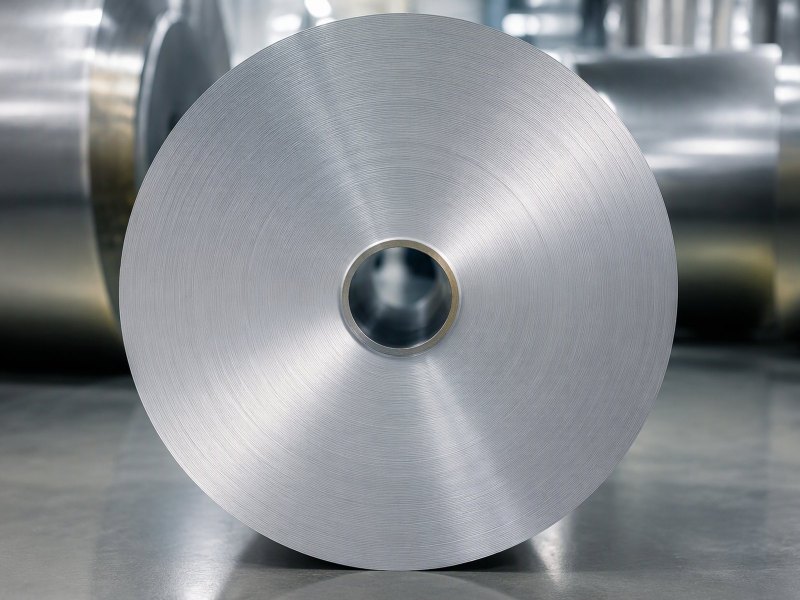
Crown is a width-wise profile, not a spot defect. How it disturbs slitting and rewinding.
A roll can pass every single-point gauge check you make and still run badly. The problem often sits across the width, not in one spot.
Gauge crown is a gradual difference in thickness between the centre of the web and its two edges. The foil is a little heavier in the middle, so the across-width profile is not flat.
The definition is easy. What matters on the floor is where the shape comes from and why it surfaces as a running problem mid-shift.
What exactly is gauge crown in a foil web?
Crown is often mistaken for a thick patch. It is a slope rather than a step, and that difference changes how you look for it.
Crown is a smooth side-to-side variation in gauge: heavier near the centre of the web, lighter toward each trim edge, with the change spread over the full width.
Dive deeper
Slope, not step
Slice a roll and look at the strip edge-on and the thickness would not read the same at the centre as at the two trim edges. It would fall away gradually toward both sides. That gentle fall, held consistently along the whole length, is the crown.
Because the change is spread across the entire width, no single reading looks wrong. A gauge taken at one point gives you the local figure and says nothing about the trend, which is why a coil can be accepted on spot checks and still arrive crowned.
A property of the whole web
A step, a thick band or a bump is a local fault: it occupies a short distance and shows up when you walk a gauge along the web. Crown has no borders of its own. It rides with the material everywhere and only becomes visible when one position is compared with another.
Two rolls can share the same average gauge and behave quite differently, because an average says nothing about distribution. One may be nearly level from selvedge to selvedge, the other may hold much of its metal in the middle. Both figures look alike; only one runs quietly. That is why it helps to treat gauge crown across the foil roll as a property of the whole web, never of a single square cut from it.
Where does crown come from in the rolling mill?
Crown is not added on purpose at the end of the line. It is left behind by the way metal is reduced between two work rolls.
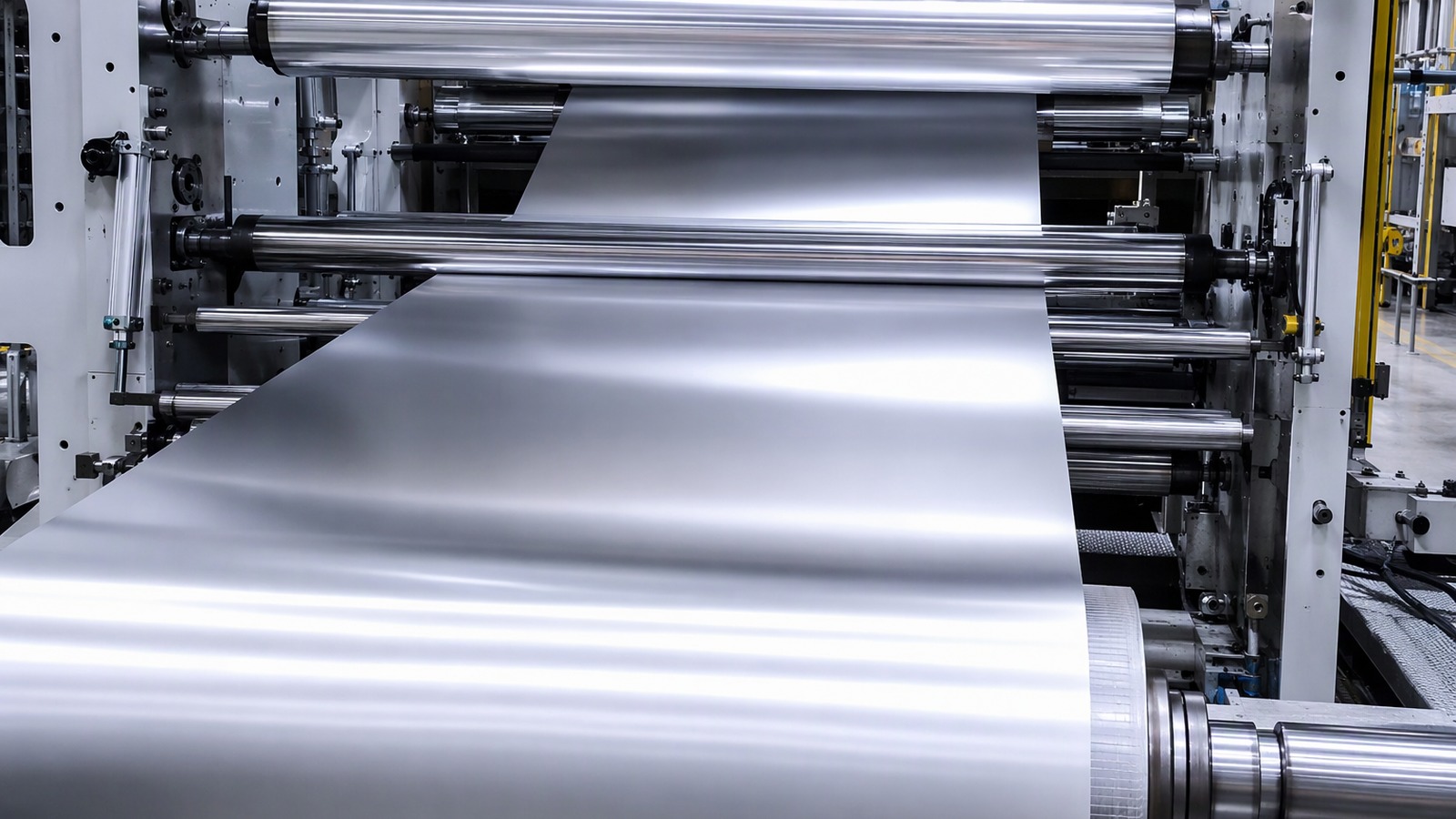
Rolling squeezes the strip between work rolls that bend under load. The gap is never perfectly parallel, so centre and edges are reduced by slightly different amounts.
Dive deeper
Deflection under load
Separating force pushes the work rolls apart, and they bend most in the middle of the barrel, where the load has least support. Grinding a deliberate curve into the roll body, and holding its thermal profile steady, are the usual ways of compensating. The gap is meant to deliver an even pass, but the balance is delicate.
Any shift in that balance writes itself across the width. More reduction in the centre thins the middle, less reduction leaves it heavy, and a mismatch between the two sides tilts the profile. Crown is therefore a normal consequence of a loaded rolling gap.
Inherited through the passes
A foil coil is not rolled in a single pass. The profile set early is carried down through successive reductions, and later passes can correct it only within limits. Once the coil reaches its final gauge, the shape across the width is largely locked in, and no downstream step will take it out.
This is why the question is never whether crown exists. Every rolled web carries some. The useful question is whether the profile held in a particular coil suits the width you intend to slit and the process that follows. General background on the metal itself sits in the reference material on aluminium foil.
Why does crown show up as a running problem instead of a spot defect?
If crown were a spot, incoming inspection would catch it. Instead it hides until the material is under tension in a running machine.
Crown only becomes a defect when the whole width is engaged at once: under tension, in a nip, or against a rewind drum. Then uneven gauge turns into uneven length and uneven tension.
Dive deeper
Equal gauge, unequal length
Metal of different thickness needs a different length to make the same number of wraps. A crowned web, pulled flat, is effectively longer down the middle than at the edges. Nothing shows on a stationary roll face, but the moment tension is applied the centre and the edges start to disagree about how much material there should be.
That disagreement cannot be pulled out of the web. Tension is applied across the full width, so the heavy centre takes more load and the light edges take less; the web reacts by going slack at the edges or by lifting into a shallow wave. Both are running symptoms, not marks you can point at.
Visible only in motion
This is the practical sting. A crown complaint usually arrives as a description of behaviour rather than a measurement: tracking that drifts, wrinkles that form on one side, a roll that looks tight in the middle, a coating weight that varies from lane to lane.
Because the symptom appears downstream, the profile itself is rarely suspected first. Operators change tension, adjust guides, slow the line. Some of that helps for a while, which is exactly what makes crown so persistent and so easy to blame on something else. The next coil from the same pallet then behaves the same way.
How does crown affect slitting and rewinding?
On a slitter, a crowned coil is asked to do something it cannot: deliver identical lanes from material that is not identical across its width.
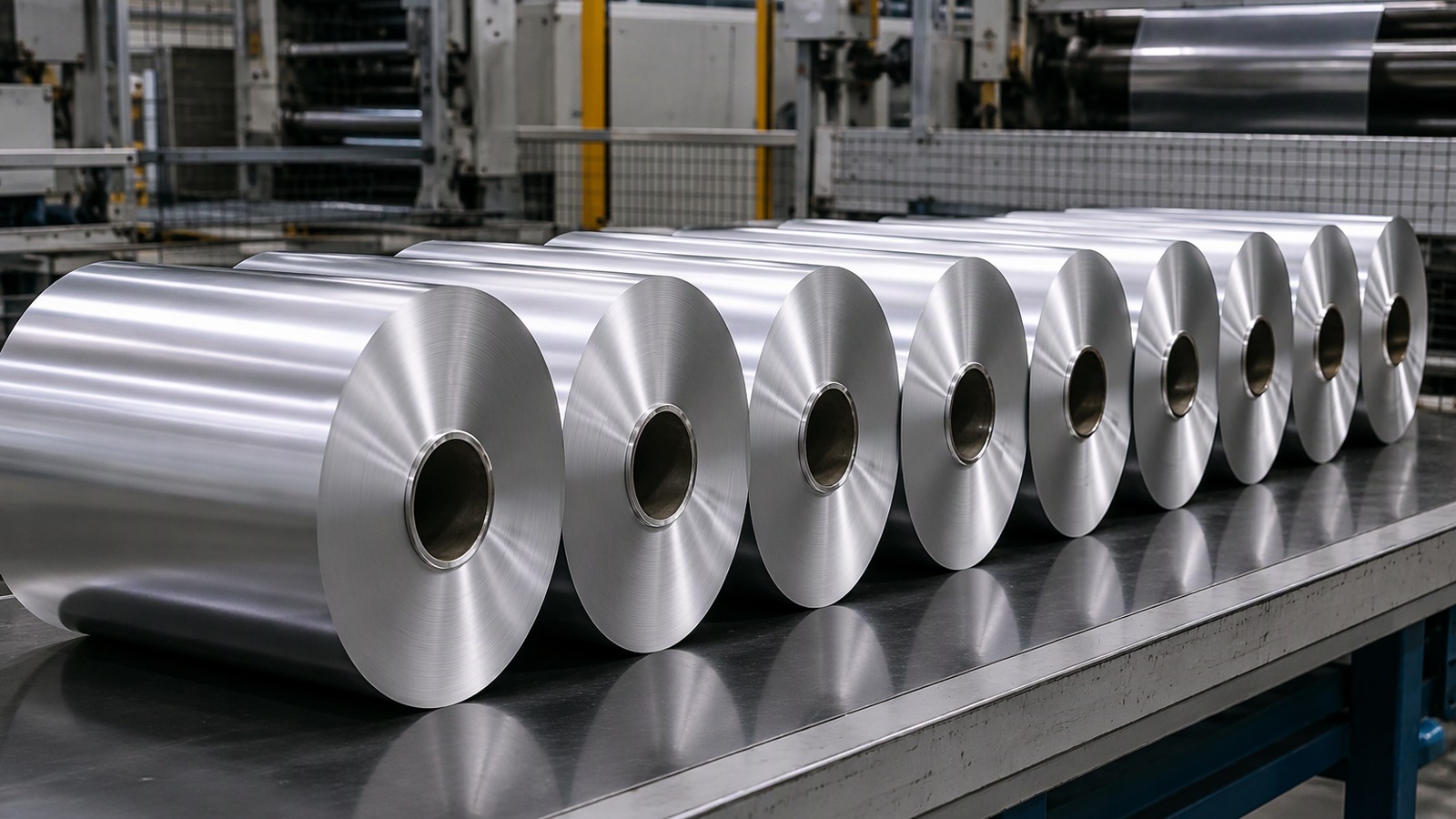
Lanes cut from different positions carry different gauge and different length. They wind at different hardness, so the finished slit rolls behave individually rather than as a matched set.
Dive deeper
Uneven lanes, uneven build
When a crowned master is slit into several lanes, the lane from the middle is heavier and slightly longer than the edge lanes. Wound at a common tension, the middle lanes build harder and the edge lanes build softer. The difference may be small per wrap and still be obvious by the time a roll is full.
Operators see it as a build that tightens toward the core, or as a set of rolls where only the outer ones feel right. Adjusting tension to satisfy one lane often makes the others worse, because the cause sits in the material rather than in the machine setting.
Trim, dust and stoppages
A profile that is not level also loads the trim. Slitting cleanly depends on the knife meeting metal of consistent gauge; where the gauge is heavier the cut needs more force, and edge quality can drift between lanes and along the run.
On heavier work the same profile is present in every slit roll you send out, so one master coil can spread the effect across a whole order. Where the lane widths matter as much as the gauge, the 3003 aluminium foil we supply can be specified at the width you need, so the geometry is settled before the coil is cut.
Why does a heavier gauge show crown more plainly?
Crown is present in thin foil too. It simply has less room to declare itself in a light gauge, where other effects dominate.
In a heavier gauge the absolute difference between centre and edge is larger and the web is stiffer, so the profile resists being pulled flat and shows as waves, tracking error and build variation.
Dive deeper
Stiffness works against you
A web resists bending far more strongly as it gets thicker, and that stiffness works against any attempt to flatten a crowned section under tension. Thin foil can be stretched enough to hide a modest profile; heavier material carries the shape into the machine and pushes back against the tension that is meant to control it.
Heavier gauges are also often slit into narrower lanes for structural or semi-structural work, where a small gauge difference across a narrow width becomes a large proportion of the lane it sits in. The same profile that would be tolerable on a wide light web is concentrated into strips that feel it at once.
Uses that punish a profile
Applications that demand flatness are usually the ones asking for heavier foil: stiffeners, formed parts, lids that must sit level, laminates that cannot tolerate a wave. Those processes compare the whole surface at once, so the profile is exposed rather than averaged away.
Practical experience with 1100 aluminium foil in the heavier part of our range shows the pattern clearly: the coil is judged by how it behaves in the press or on the line, and the profile is what the machine reacts to first. It is also why how to choose a gauge that suits your lanes deserves more care than a single reading.
How can a converter check for crown without a lab?
You do not need instruments to find the trend. You need a way to make the whole width disagree visibly, and then to read that disagreement.
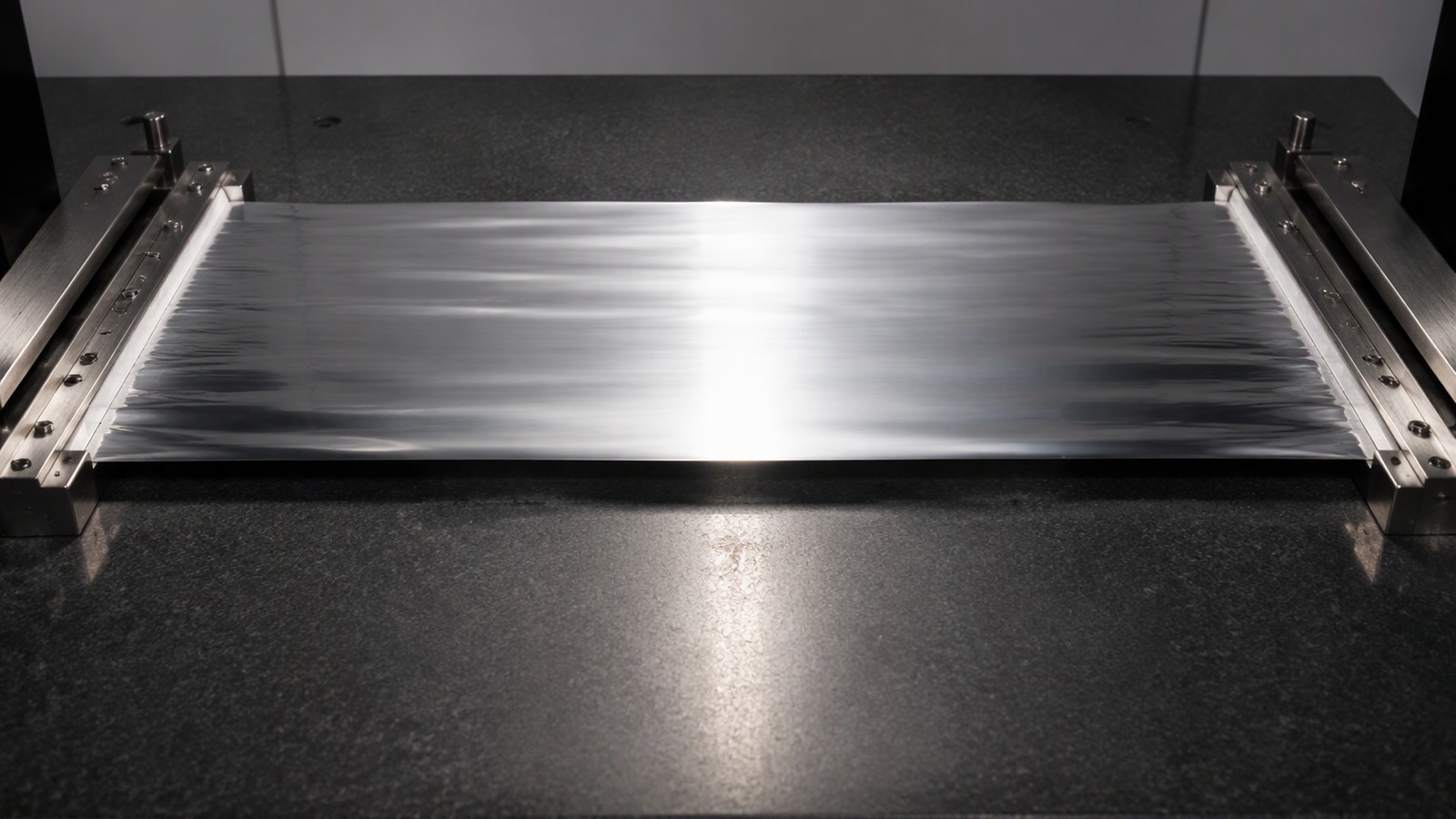
Tension a sample across a bench, unwind a few wraps under load, and watch where the web lifts. A crowned web lifts at the edges while the centre stays tight, or the reverse if the profile is inverted.
Dive deeper
The bench test
Cut a length from the outer wraps, hold it at both ends and pull it gently flat. A level web lies quiet. A crowned one shows slack bands near one or both edges, or a shallow wave that travels when you press the centre. Mark the edges, turn the sample over and repeat; the picture should follow the material.
Repeat at several points along the coil rather than at one. A profile that changes from the outside to the inside of the roll tells you something about how the coil was built, which a single sample will never reveal. Write down exactly what you see, in the order you see it, and keep the sample.
Read the run, then confirm
The line itself is the best detector. Note where lanes go slack on the slitter, which side wrinkles, and whether the effect grows as the roll diameter increases. Then compare with a second coil from the same delivery: if the behaviour follows the coil, the profile is the likely cause.
Keep the observation factual: which lane, which side, what tension, what diameter. That record is what makes a conversation with a supplier productive, and general reading such as the aluminium industry in North America gives useful framing for the question you are about to ask.
Why is crown not the same thing as thickness tolerance?
Tolerance asks whether a reading falls inside a limit. Crown asks how the readings are arranged relative to each other.
Thickness tolerance is a single-point judgement against a limit. Crown is the shape of the distribution across the width, and a coil can be fully within tolerance while still being crowned.
Dive deeper
One describes a point, the other a pattern
Tolerance is a promise about individual readings: each one, taken the agreed way, should fall inside a band. Crown is a description of the band's internal structure. A web can sit comfortably inside its limits at the centre and at both edges and still slope steadily from one to the other.
So the paperwork and a crown complaint are not in conflict. Both can be true at once. Confusing them leads buyers to reject a coil for the wrong reason, or to accept one that meets the letter of the limit and cannot be run.
Where yield enters
Tolerance also drives yield, because a limit set tight forces more trimming and more rejection. That arithmetic is a separate subject, set out in aluminium foil thickness tolerance and yield. Crown sits beside it: it changes how the material behaves rather than how much of it is usable.
Both figures can look healthy while the coil still refuses to run, and that is the case most often missed on the floor. The practical consequence is that a conversation about crown needs different evidence from a conversation about tolerance: one needs readings at agreed points, the other needs across-width behaviour on a running line, with the lane pattern and the coil references attached.
What must an enquiry about crown contain?
A short, specific enquiry gets a useful answer. A general complaint about wavy foil usually gets a general reply.
State the alloy and temper, the width you slit, the finished lane widths, the process downstream, and the exact behaviour you observe, with the coil references involved.
Dive deeper
The facts that change the answer
Give the alloy and temper you are running, the master width and the lane pattern you cut. Add the downstream process, because a profile tolerated in one step is rejected in another. Say whether the effect appears on every coil or only some, and whether it grows as the roll builds.
Describe the behaviour in machine terms: which lane goes slack, which side wrinkles, at what tension and at what diameter. If you have a bench observation, describe it the same way. A photograph of a wave on a running web says more than adjectives.
What to ask for
Ask how the across-width profile is handled for the width you order, and whether the coil can be supplied to suit your lane pattern. Where flatness matters, say so at enquiry stage rather than at claim stage; the foil supply chain works far better when the requirement is stated before the coil is rolled.
Our own range runs from 0.005 to 0.20 mm in widths of 100 to 1500 mm, with a 3 MT minimum per size, and enquiries are answered against your lane pattern rather than against a generic width. For market framing when comparing suppliers, the foil converting sector is worth reading, but the wording that decides the outcome is the wording about profile.
Crown is a width-wise profile, not a spot fault. Ask for the profile that suits your lanes, and judge the coil by how it runs.