Aluminium Foil as Heat-Exchanger Fin Stock: What Should Buyers Know?
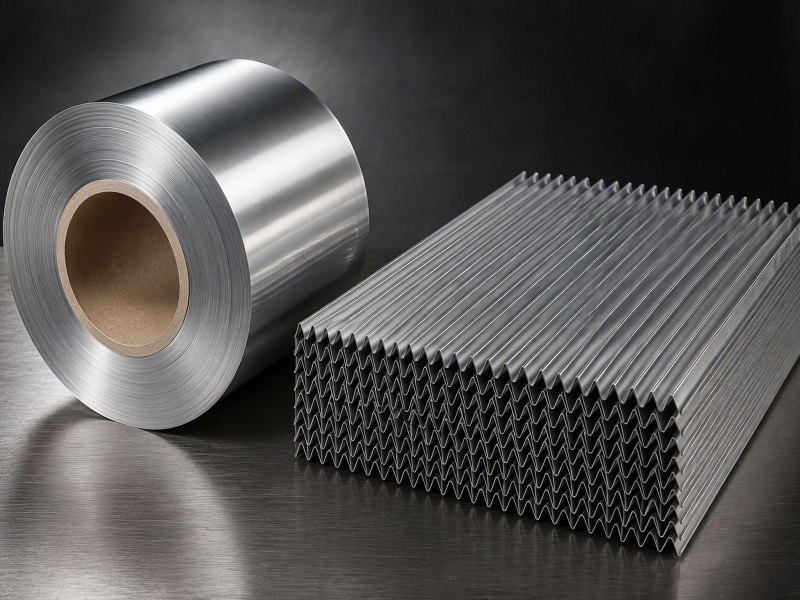
Aluminium foil as heat-exchanger fin stock: what the fin does, why alloy and temper matter more than thickness, why flatness and edge drive the finning line, and what a buyer should state in an enquiry.
A finning line stops for reasons that rarely start on the line. The incoming foil decides whether the line runs at all.
Fin stock is thin aluminium foil, usually in tempers such as O, H14, H16, H18, H22 or H24 and alloys such as 1050, 1060, 1100, 1235, 3003, 3004, 8011, 8021 or 8079, folded into fins. Alloy, temper, flatness, surface and slit edge decide performance.
This article follows the foil from coil to folded fin pack and explains what an enquiry must say so the material fits the line.
What does a fin actually do inside a heat exchanger?
Inside a heat exchanger the fin is not decoration. It decides how much of the tube's heat meets the passing air.
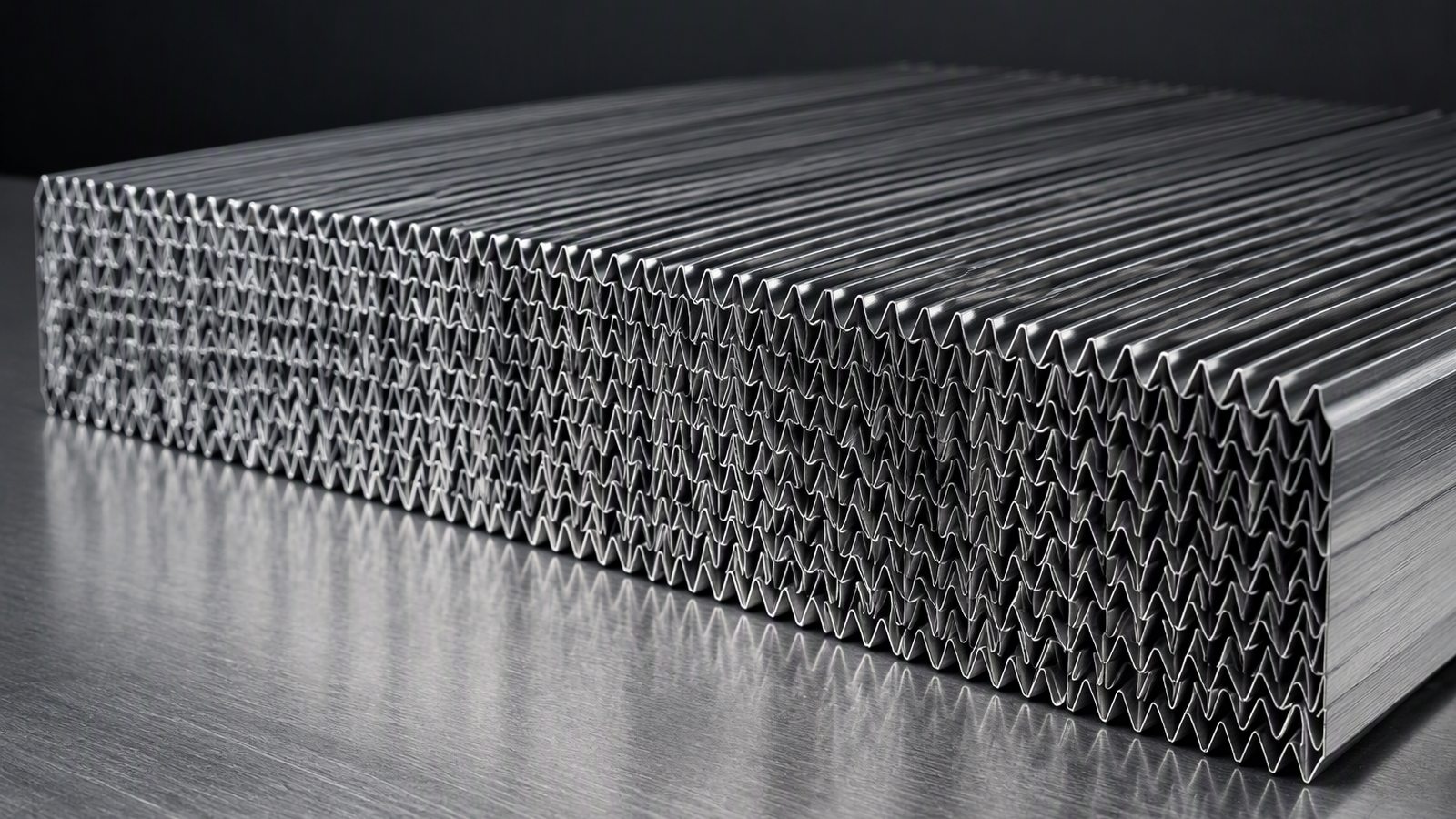
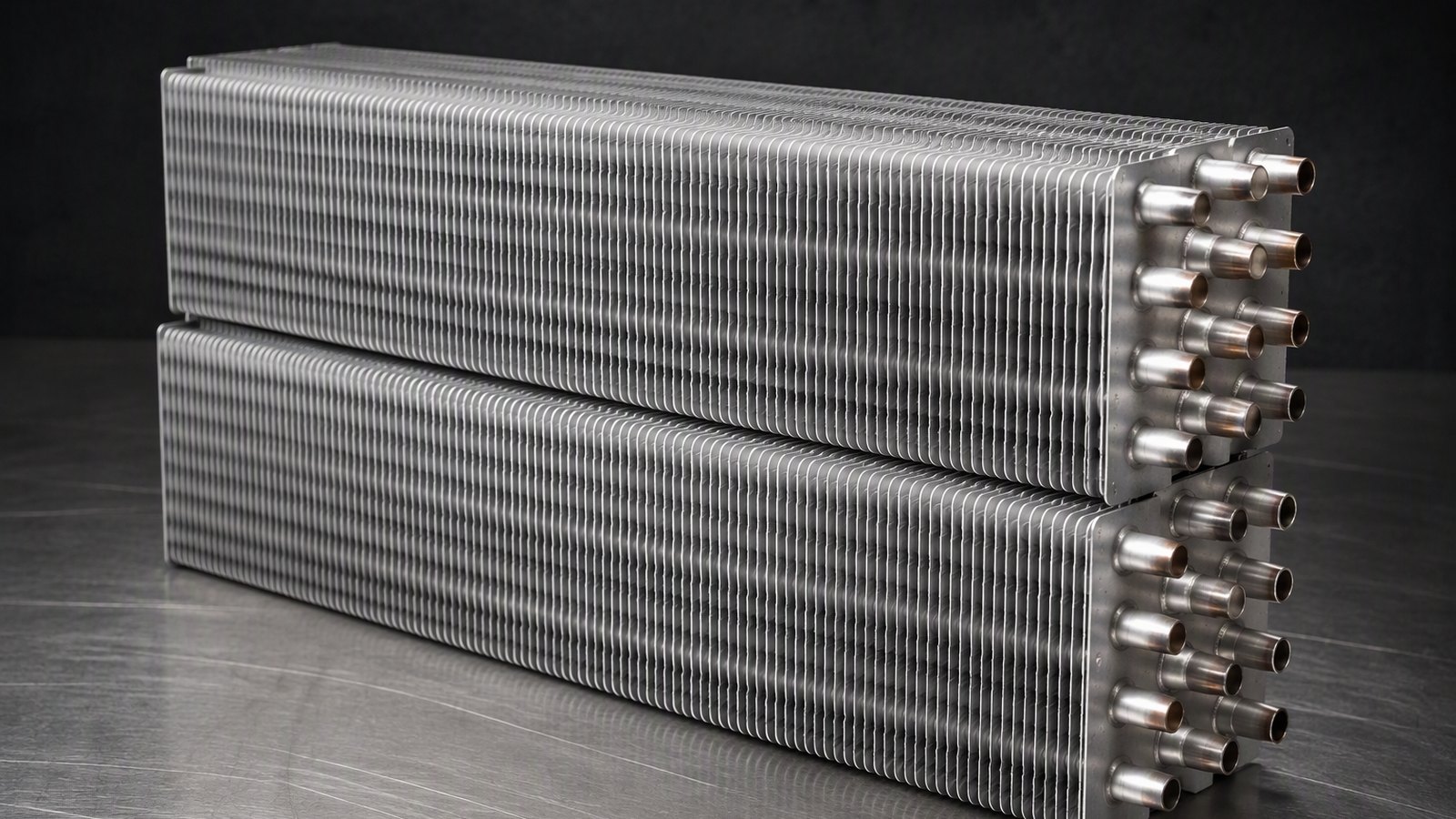
A fin extends the air-side surface of a tube, so more heat moves between the fluid inside and the air outside. The foil is folded into a profile and bonded to the tube or header.
Dive deeper
A heat exchanger moves heat between two fluids, and one of those fluids is usually air. Air is a poor conductor of heat, so the surface that touches air has to be large. The tube alone cannot offer enough of that surface. The fin is the answer: it is a thin sheet folded into a repeating profile that multiplies the air-side area many times over, while staying light enough that its own weight does not dominate the assembly.
Because the fin is thin, it also responds quickly to changes in the air stream, and its geometry sets the balance between heat movement and pressure drop across the coil. A fin pack that is too tight may raise resistance to airflow; one that is too open may leave heat behind. This balance is a design choice, and the foil that the designer selects has to make that geometry possible at line speed.
The fin is also a structural member of the coil. In many coils the fins, tubes and header form one bonded body, and the fins help hold that body together. If the foil is uneven, the pack does not stack cleanly, the heart of the coil distorts, and the finished coil may not fit the housing it was designed for. For background, see aluminium foil and the work of European Aluminium.
Why is fin stock specified by alloy and temper, not thickness alone?
Thickness says how much metal is there. It says nothing about how that metal folds, bonds and behaves under heat.
Alloy sets strength, formability and brazing behaviour, while temper sets stiffness and how the foil folds. Two coils of equal thickness can run very differently on one line.
Dive deeper
Alloys such as 1050, 1060, 1100, 1235, 3003, 3004, 8011, 8021 and 8079 are common in fin stock, and the choice changes how the foil behaves at each stage. The 1xxx grades are essentially pure aluminium and are prized for formability and for moving heat readily. The 3xxx grades add manganese, which supports strength, while the 8xxx grades bring their own balance of properties for demanding coil designs.
Temper matters just as much. Soft O temper folds easily but can sag or mark; the work-hardened H14, H16, H18, H22 and H24 tempers trade some formability for stiffness and spring. A finning line set for a stiffer temper may tear a soft one, and a line set for a soft temper may crush a stiff one. That is why the same nominal thickness can succeed in one temper and fail in another, and why a grade that suits one coil family may fit another poorly.
For a fuller picture of which grade fits which duty, see aluminium foil for heat exchangers. The safe approach is to agree alloy and temper with the supplier against the fin profile and the joining process, and to keep that combination fixed from order to order.
Why must the foil stay flat and burr-free when folded into fins?
A fin is a folded shape held to a tight rhythm. Any wave, twist or burr in the flat foil travels into that rhythm.
Flatness keeps fin height and spacing even across a wide pack, and a clean edge stops burrs from cutting or blocking. If either slips, the folded pack turns uneven.
Dive deeper
Flatness is usually described as the freedom of the strip from waves, buckles and twist. When the foil is fed into a finning machine, it passes through a set of rolls that form the louvre and the fold. Residual flatness faults are not smoothed away; they are multiplied, because the forming rolls repeat the same bend along the whole coil. A light wave becomes a leaning fin, and a strong buckle becomes a collapsed section.
Edge quality is equally important. Slitting produces two new edges, and those edges carry any burr created by the knives. A burr is a thin ridge of metal pushed out at the cut. On a finning line a burr can catch on a guide, lift the foil, or shower fine particles into the pack. Those particles can later interfere with bonding and with the airflow surface.
Because flatness and burr are set at rolling and slitting, they are rarely fixable at the customer's plant, so the material that arrives has to be right. Those faults are far easier to prevent at the mill than to correct once the coil has been cut. For wider technical context, look at our industrial and technical foil range, and agree flatness and edge requirements with the supplier.
How does surface condition affect brazing or coating?
The surface of the foil is not just a skin. It is the layer that must accept flux, filler or coating and form a sound joint.
A uniform, clean surface lets flux, filler or coating wet the foil evenly, so the bonded pack acts as one body. Oil, oxides or dust leave weak zones.
Dive deeper
Brazing, in its simplest sense, joins parts by melting a filler metal that flows into the gap between them while the parent metal stays solid. For that flow to happen, the surfaces involved have to be clean and chemically ready. Residual rolling oil, loose oxide, fingerprints or dust can stop the filler from wetting the foil, leaving a gap that looks bonded but is not.
Surface condition also shapes coatings. When a coil is coated for corrosion protection or for a decorative finish, the coating has to bond to the foil. A surface with uneven oxide, patches of oil or mechanical marks gives the coating a poor base, and the finish may blister or peel in service.
Because the exact surface treatment is a matter between buyer and supplier, the practical step is to state the joining or coating process in the enquiry and to agree the surface condition that suits it. This is also an area where bodies such as the Aluminum Association publish useful background. In practice the buyer names the process and lets the supplier match the surface to it, which protects the joint and the finish.
Naming the joining or coating process is usually enough for the supplier to match the surface to it.
Why do slit width and edge quality decide how the line runs?
A finning line is tuned to one width. If the slit coil arrives at another width, or with a poor edge, the line must compensate or stop.
Consistent slit width holds fin height and pack width on target, while a sound edge feeds smoothly. Width or edge variation forces constant adjustment and raises scrap.
Dive deeper
Fin stock is ordered to a slit width that matches the finning line, often somewhere in the range of 100 mm to 1500 mm depending on the coil design. The finning rolls are set to that width, and the fin height and spacing follow from it. If the incoming coil is narrower or wider than agreed, the operator must re-set the line, and each change costs time and generates material outside specification before the line settles again.
Edge quality works with width. A straight, clean edge tracks through the guides and the forming rolls without wandering. A wavy edge or a burred edge can make the strip drift sideways, which then shows as a leaning or torn fin. Repeated stops for thread-ups and clearances steadily reduce output.
Where width and edge are stable, the line runs at a steady rhythm and the folded pack is uniform. Where they are not, every coil becomes a new setup. Our notes on how to reduce aluminium foil scrap in converting explain why this stability matters so much. Fix the slit width and edge condition with the supplier before the first order, because unstable width and edge show up as lost output and extra handling.
How do thickness, width and core size shape a specification?
Three numbers carry much of a fin-stock specification: thickness, width and core. Each must match the coil the buyer actually builds.
Thickness usually runs from about 0.005 mm to 0.20 mm, width from 100 mm to 1500 mm, and the core is often 76 mm or 152 mm. With alloy and temper, these define what the line receives.
Dive deeper
Thickness drives stiffness and how much material the fin carries, and coil mass also matters because a heavier coil means fewer changes on the line. A thinner foil folds into finer, denser fins but has less body; a thicker foil holds its shape more firmly but uses more metal. The working range for fin stock sits between about 0.005 mm and 0.20 mm, and the right point inside that range depends on the profile and the joining method.
Width has to suit the finning line, as the previous section explained. Core size is the least glamorous number but still matters: a coil wound on a 76 mm core and one wound on a 152 mm core need different handling and different mandrels. If the buyer's line or decoiler expects one core and receives the other, the coil may not mount cleanly, which is a delay before the line has even started.
A worked example helps: 3003 aluminium foil 0.05 mm is a common fin-stock thickness in a 3xxx alloy. Whatever the choice, the specification should state alloy, temper, thickness, width, core, coil mass and packing together. Agree these points with the supplier so the coil arrives ready for the line.
How is fin stock packed, shipped and handled before the line?
Good coil can be ruined between the mill and the line. Packing, handling and moisture protection are part of the specification.
Fin stock normally ships eye to sky or eye to wall on a wooden pallet with a moisture barrier wrap. That packing protects flatness, edges and surface until the coil reaches the line.
Dive deeper
Packing is chosen to match the coil orientation the buyer prefers. Eye to sky means the coil stands on its edge with the core vertical, which suits overhead lifting and some decoilers. Eye to wall means the core is horizontal, which suits a mandrel or shaft. Both are normally supplied on a wooden pallet with a moisture barrier wrap, so the coil is protected from damp air and from casual contact.
Handling also matters. Fin stock is thin and easy to crease. A coil dropped, squeezed or laid on a rough surface can take dents that show up later as flatness faults or edge damage. Good practice is to keep the coil on its pallet, to use the correct lifting gear, and to open the wrap only when the coil is going to the line.
Shipping is part of the same chain. Fin stock is commonly offered from ports such as Qingdao, Tianjin and Shanghai, and the transit route can add humidity and handling steps. That is one reason the moisture barrier wrap and a tidy, well-labelled pallet matter. Discuss packing and shipping with the supplier when you place the order, because a well-wrapped, clearly labelled coil is also quicker to inspect on arrival.
What must a buyer state in an enquiry for fin stock?
A vague enquiry invites a vague offer. The enquiry is where the buyer either fixes the details that matter or leaves them to chance.
State alloy, temper, thickness, width, core, coil mass and quantity, the fin profile and joining process, edge and flatness needs, packing and destination, plus volume per size.
Dive deeper
A workable enquiry reads like a short specification, not a paragraph. Begin with the alloy and temper, then the thickness, width and core, then the coil mass and the quantity for each size. Note that an MOQ is often 3 MT per size, so a buyer who needs several widths should say so up front.
Next, describe the job the foil will do. Name the fin profile, the joining process such as brazing or mechanical expansion, and any coating. Say whether flatness and edge condition are critical, and how the coil should be packed, for example eye to sky or eye to wall on a wooden pallet with a moisture barrier wrap. Confirm the destination and the preferred port, such as Qingdao, Tianjin or Shanghai.
Finally, invite the supplier to confirm the points that matter and to state how acceptance will be agreed, because the acceptance level is set with the supplier against the actual line. Our guide on how to choose aluminium foil thickness helps buyers frame the thickness question, and neutral references such as the ASTM committee on light metals and alloys give useful context. A clear enquiry saves a round of samples.
Fin stock is a material decision, not a stock item: fix alloy, temper, flatness, edge and packing with the supplier, then let the line run.