What does aluminium foil do inside a bulk bag liner?
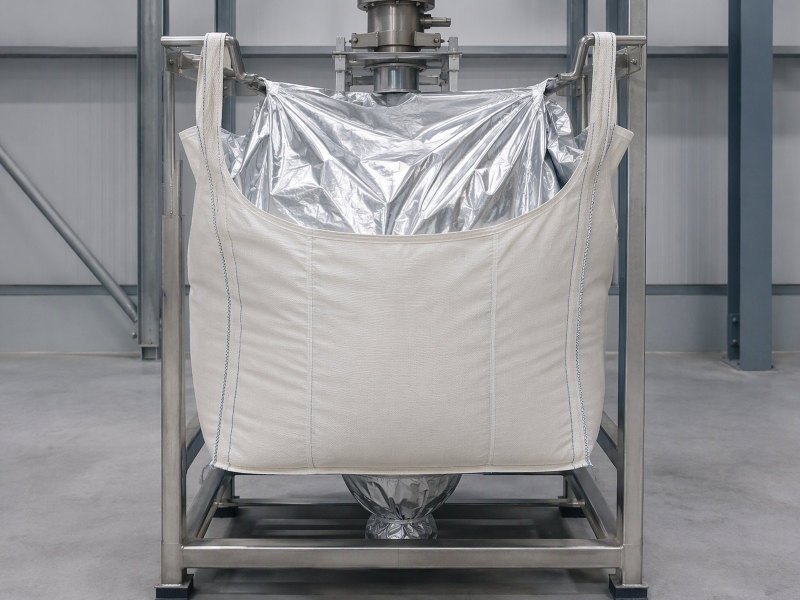
A foil laminate liner keeps a dry powder dry inside a woven bulk bag. This guide covers the barrier ply, the gauge, the spouts, the folds and the enquiry.
What does aluminium foil do inside a bulk bag liner?
A bulk bag is filled in minutes, lifted by a forklift, then left in a container for weeks. The fabric is not what keeps the powder dry.
The liner is a laminate, and its foil ply blocks moisture vapour and odour. It adds little strength: the woven bag carries the load while the foil protects the product.
The eight questions below follow the liner from the converter's roll to a filled bag in a container.
What does the foil layer actually do inside a bulk bag liner?
Inside a liner the foil is a barrier ply, never a structural one. It blocks vapour and odour while the fabric carries the load.
Continuity is the point: vapour must find a pinhole or a crease to pass. Strength and puncture resistance come from the other plies.
Dive deeper
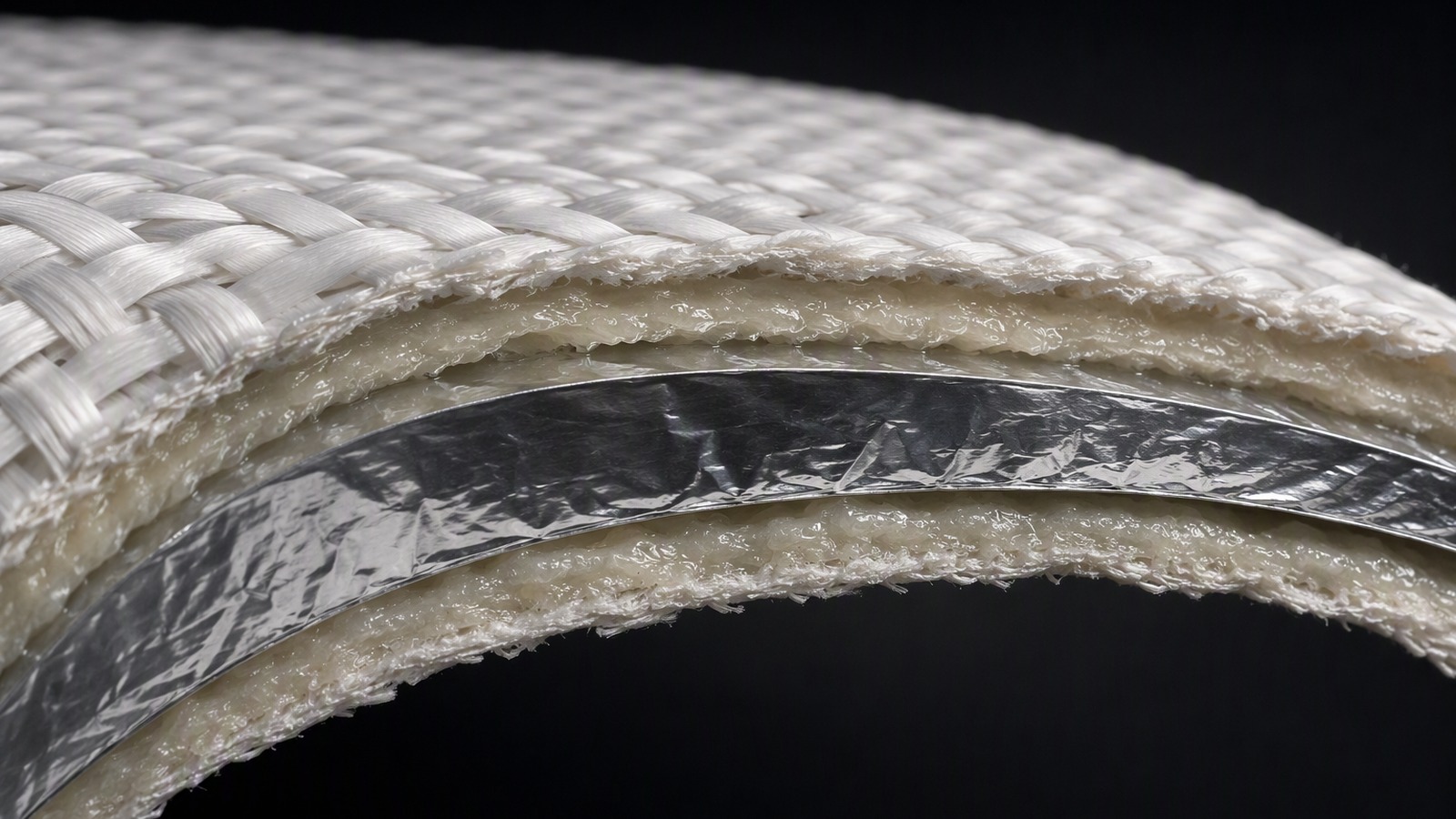
Think of the liner as three jobs stacked into one thin wall: an inner sealant film that heat-seals to itself, a middle ply of aluminium foil whose only real duty is to stay a continuous metallic sheet, and an outer ply that bonds the laminate and shields the foil from abrasion.
Only the foil resists vapour and odour properly. Polymer films are long chains with gaps between them, and small molecules work through those gaps over time. A metal layer has no such gaps, so a molecule must find a defect, a pinhole or a crease, before it can pass. One hard wrinkle can undo more barrier than a heavier ply can add.
The foil does nothing for tensile strength. A filled bag hanging from its loops puts the load into the woven fabric and the loop seams, and the liner hangs inside like a loose bladder that is not asked to carry anything. Nor does foil resist puncture: a sharp granule is stopped by the sealant and the fabric behind it.
Keep those roles separate and the specification writes itself. The foil is asked for one property, and every decision about gauge, laminate order and handling follows from protecting it. Aluminium foil - Wikipedia describes the material in general terms; the duty inside a liner is narrower.
Why is a plain polyethylene liner enough for some powders and not for others?
Polyethylene is tough, sealable and cheap, and for many powders it is right. The question is what the product must not gain.
If the powder tolerates a little moisture and carries no aroma, plain polyethylene works. If it cakes, reacts or picks up taint, polyethylene is the weak point.
Dive deeper
Start with the product, not the film. A mineral filler or a coarse polymer granule sits in a polyethylene liner for a season and comes out behaving exactly as it went in. A hygroscopic salt, a spray-dried ingredient or a reactive chemical is a different proposition: those change at the first sign of moisture, and the change is not reversible.
Odour runs in both directions. A polyethylene wall lets aromatic compounds migrate slowly, so a product carrying a flavour can lose it into the fabric, while a product stored beside a scented or solvent-bearing cargo can pick up a taint it never had. A metal ply closes both directions at once.
Time and distance follow. A bag consumed in a fortnight in a dry plant is not the same duty as one that crosses an ocean and waits in a warehouse. Time and temperature push vapour through a polymer wall, and small consumer packs meet the same question, as foil for tea and dry goods packaging shows at retail scale.
Then what the customer does at unpacking. If the plant tips the bag into a process that tolerates damp powder, polyethylene is honest and economical. If it weighs the whole content into a batch and rejects anything caked, the extra ply pays for itself in one avoided claim.
Which foil gauge belongs in a liner, and why is the liner a laminate rather than foil alone?
Foil is chosen for continuity, not thickness, and the liner usually carries a light ply. Foil alone cannot be sealed or stretched.
A ply from a few thousandths of a millimetre up to about 0.03 mm covers most liners. Items such as 0.06 mm suit stiffer inserts.
Dive deeper
Gauge selection starts from the fold, not the barrier. Any foil thin enough to fold will develop pinholes at a sharp crease, and their number grows with the severity and repetition of the fold. A liner gathered at a spout and pressed against a pallet is folded hard in the same places every time.
In practice a liner foil sits at the light end of the mill range, up to roughly 0.03 mm, driven by how the liner is gathered and how often it is handled. A ply such as 0.06 mm belongs to a stiffer insert, though converters do ask for it where the liner must stand up during filling.
Alloy follows the same logic: 1235 or 1100 for a flexible laminate, 8079 and 8021 where pinhole resistance matters more, 3003 or 3004 where the part needs stiffness, in a soft temper such as O or H18. Both everyday items are ordinary mill stock, 1235 aluminium foil at 0.03 mm and 1100 aluminium foil at 0.06 mm, with material data from European Aluminium to cross-check.
A liner is never foil alone. Foil has almost no elongation, so a crease becomes a crack; it cannot be heat-sealed to itself, so the ends would need tape or a tie; and it has no abrasion resistance, so the fabric would wear through it. A laminate answers all three.
What happens at the fill spout and the discharge spout where the liner is gathered and tied?
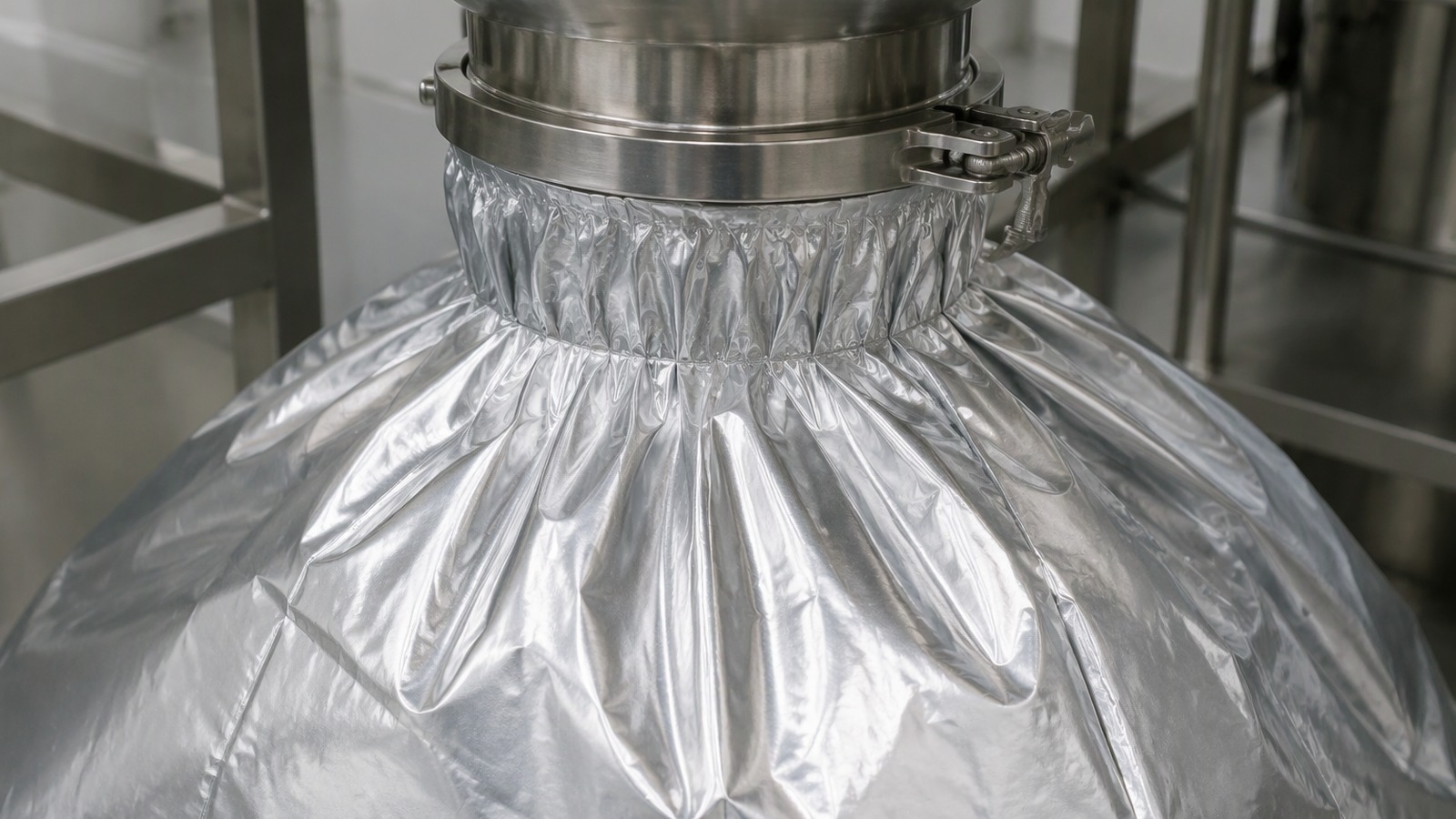
Both spouts force a flat laminate into a bundle of folds. That gather is the most heavily creased area of the liner.
At filling the neck is pulled over the spout and gathered. At discharge the same neck is opened, and knife and tie act on the barrier.
Dive deeper
The fill spout is a controlled collapse. The operator pulls the liner neck over the metal or plastic spout, gathers the surplus into pleats and fastens it with a tie, a clamp, tape or a heat seal. Product then falls through that neck, and the powder abrades everything it touches on the way in.
Three things go wrong there. The gather concentrates creases into one band, and a foil creased twice along the same line will crack along it. Product can be trapped in the pleats, holding moisture against the foil from outside. A tie pulled hard enough to hold the neck can also cut the film.
The discharge spout is worse in one respect, because the liner is folded into the bag mouth and left there for the whole journey. That fold is flat, sharp and loaded by the product above it, and a knife aimed at the fabric can pass through the liner behind it.
Keep the two ends different. The fill neck is long enough to gather without stretching, often with a collar that holds the pleats in place. The discharge end is a plain skirt or a defined neck with its own closure, chosen by whoever empties the bag, and a designed vent keeps the neck calm while air leaves.
How is the liner fitted and closed so the barrier stays continuous?
A liner works only if it is attached without stretching and closed without puncturing. Most failures are fitting decisions.
The liner is fixed at the fill spout, sometimes at tabs, and closed at both ends. Every grip or cut is where the barrier must be rebuilt.
Dive deeper
Fitting begins with size. A liner must be large enough to follow the bag as it bulges and settles, and small enough that surplus does not fold into hard creases. A tight liner is stretched at the seams as the bag deforms; a generous one hangs in folds that rub together for the whole journey.
Attachment is the next decision. The common arrangement pulls the liner neck through the bag spout and holds it with a collar, a clamp band or adhesive tabs, so it cannot slip down during filling. Every tab is a hole, so it must sit outside the product contact area and be sealed around its edge.
Closure after filling is a sequence that matters. The liner neck is gathered and closed first, then the bag spout closes over it, so fabric protects the liner. Where the liner is heat-sealed, the seal must be made on clean film: powder in the seal is the commonest reason a seal leaks, and it looks like a failed foil.
Sampling is the quiet destroyer, because a probe pushed through the wall leaves a hole nobody closes. The closing logic is the one used on retail packs, where foil for flexible pouch and sachet structures sets out the sealant trade-off, and a bulk liner applies it by hand.
Why does a filled bag in a container test the liner more than filling ever does?
Filling is minutes in a dry building. A container is weeks of vibration, heat, condensation and load.
Vibration settles the powder, the bag slumps and the foil fatigues at the creases. Condensation on the roof adds liquid water.
Dive deeper
The container is a slow test rig. The bag is loaded, often stacked, then left on a ship, a rail car or a truck for weeks. Vibration at low frequency runs continuously, and the powder settles. As it settles, the liner that was a loose bladder becomes a taut skin pressed against the fabric, and every soft fold becomes a sharp crease.
Temperature adds a second cycle. Day and night, a steel roof heats and cools, and the air inside expands and contracts. Moisture that entered during filling migrates to the coldest surface, condenses and drips. That is liquid water at the top of a bag specified for vapour, and no foil ply compensates for water on a seam.
Handling adds events that filling does not. A forklift presses the bag against a neighbour or a container wall, and the bag is set down hard on a trailer bed. The loops take the load unevenly and the body twists, and each event flexes the liner at the same crease line.
This is why a liner is never judged by the filling line alone. One that fills perfectly and leaks after three weeks has passed the wrong test. Reduce hard folds before they happen: fit the liner loosely, keep corners rounded, keep tabs out of the product area, and look at the bag's shape when it sits full.
Where does a bulk bag liner fail first, and what does the evidence look like?
Liner failures leave traces that can be read before the bag is emptied. The damage pattern names the cause.
Check the base corners, the fill gather and the discharge fold first. Caking or a smell at one end shows where the barrier broke.
Dive deeper
The base corners come first because that is where a flat sheet is asked to become a three-dimensional shape. The laminate is folded, tucked and pressed by the weight above it, and the foil takes the fold line. If the powder at one corner is a hard lump while the rest is free-flowing, that corner is where moisture entered.
The fill gather comes second. Cut the neck open along its length and look at the crease band in a bright light. Cracks in the foil show as fine bright lines, and a delaminated area shows as a pale blister. Both are visible without an instrument, and both mean the barrier ended at the gather.
The discharge fold comes third, and it is often the same fold as the one under the bag, so the two are easily confused. Mark fold positions on an empty bag, fill it, then see where the liner sits; the marks and the creases will not agree, and the difference names the loaded fold.
Material evidence is worth reading. A white crease line across a laminate is a foil flexed until it cracked, while the film behind it is usually intact, which is why a bag holds product and fails its specification. Holding the empty liner against a light shows where to look.
What must an enquiry for a foil laminate liner contain?
An enquiry that lists only a foil thickness produces a quotation for a foil, not for a liner.
State the product and what it must not lose, the bag and spout arrangement, the closure method, the laminate, the alloy, the width and the quantity.
Dive deeper
Begin with the product. Name it, say whether it is a fine powder, a granule or a crystalline solid, note whether it is hygroscopic, whether it carries a flavour or a solvent, and whether it is abrasive.
Then describe the bag: its dimensions, the position and diameter of both spouts, whether the liner is held by a collar, tabs or adhesive, and how it is closed at each end. A liner heat-sealed on a line differs from one tied by hand.
Then the laminate. State the plies you want, or ask for a recommendation and give the reason. Give the alloy, temper and foil thickness in millimetres, and mention the roll width and the core size, 76 mm or 152 mm.
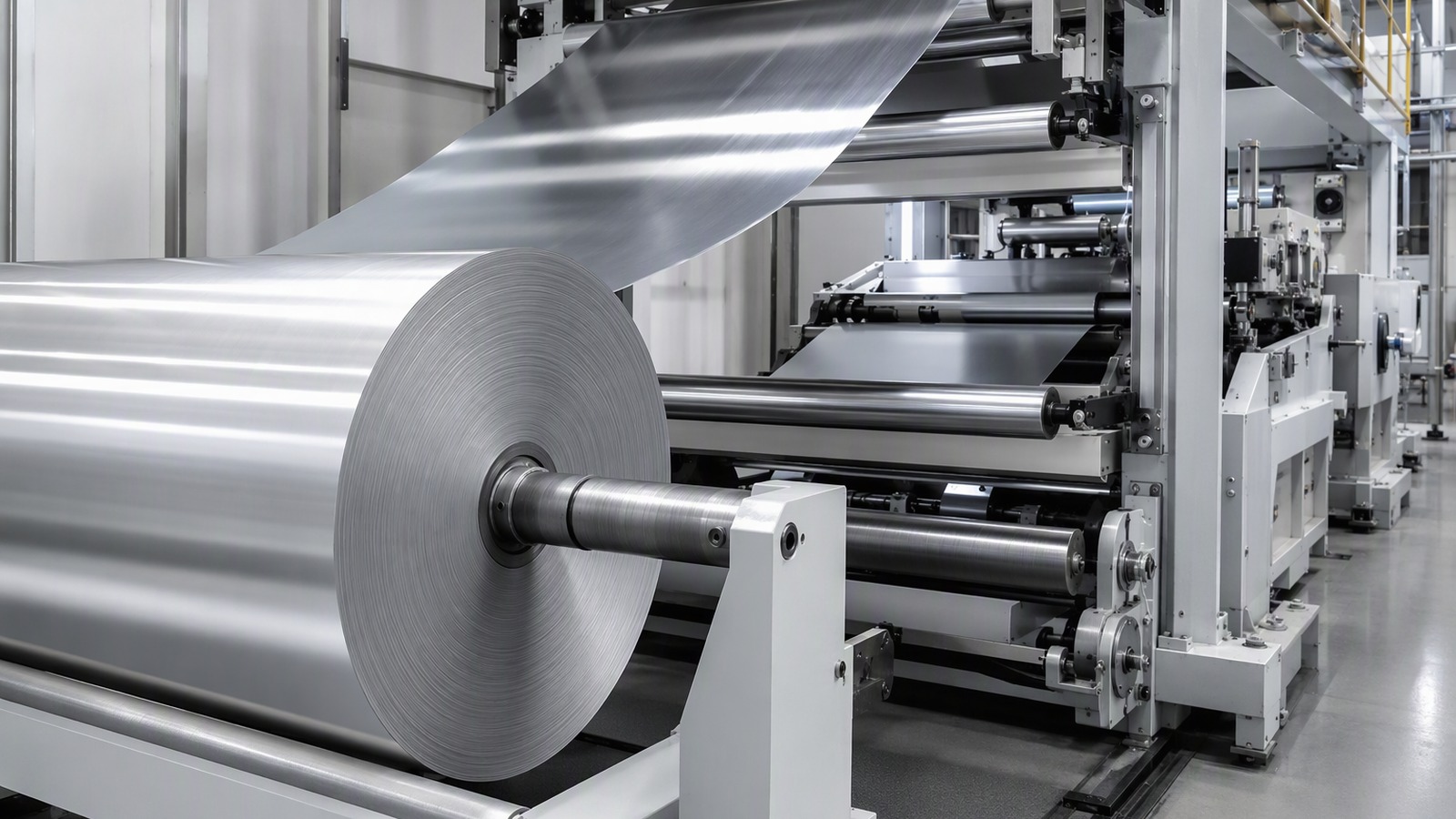
Then the commercial frame: quantity per size, since foil is quoted against a minimum of 3 MT per size; destination port, with Qingdao, Tianjin and Shanghai usual; packaging of the rolls; and whether the first delivery is a trial. The range sits under packaging and container foil, with background from the foil industry organisation and the Aluminum Association.
The foil is a barrier ply, chosen for continuity and protected by the plies around it. Get the gathers and closures right and the powder arrives as it left.