Aluminium foil for tea and dry goods: why does moisture arrive first?
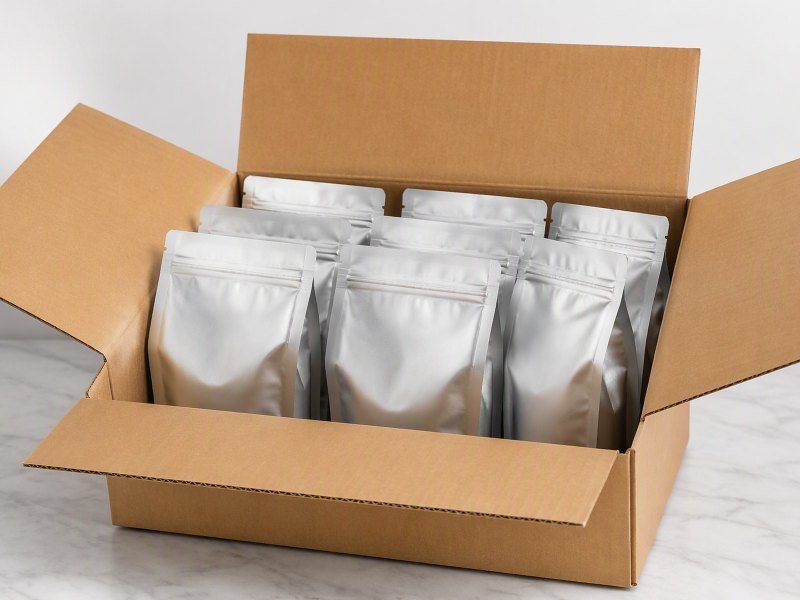
Tea is packed to keep water out, not to let gas escape. Foil, seal and reclosure decide how long the leaf stays dry, aromatic and presentable.
Aluminium foil for tea and dry goods: why does moisture arrive first?
Tea does not push gas out of a pack. It pulls water in, and the aroma it loses afterwards is the second loss, not the first.
Aluminium foil slows vapour and light, gives the laminate stiffness and a dead fold, and lets a bag stand and reclose. There is no valve, because nothing has to escape.
The eight questions below follow a tea pack from the leaf in the warehouse to the seam that has to hold twice.
Why is tea a moisture problem before it is an aroma problem?
Most packers describe tea as an aroma product. The leaf usually meets water first, and the aroma loss follows.
Dry leaf is hygroscopic. It takes water from the air through any path open to it, and once moisture is inside, the volatiles that carry the smell leave more freely and the leaf stales.
Dive deeper
The leaf that leaves the dryer is a porous solid with a large internal surface, and that surface is chemically thirsty. Water vapour in the headspace is taken up quickly and then moves inward along the cell walls, so a narrow path at a seam can soften a layer of leaf that never sees outside air.
Once water is inside, the structure changes. The leaf matrix softens, particles swell slightly, and the volatile compounds a drinker reads as freshness partition into the water phase instead of sitting where they were. Aroma loss is therefore downstream of moisture rather than a separate event, which is why a pack chosen only against smell usually disappoints in the market.
The same logic applies to any dry good with a large surface: ground spice, powdered drink mix, dried herb, dried fruit, nut pieces. Each has its own critical point, and each is agreed against the customer's own product rather than assumed from a table. What the pack must do is hold the gradient: keep outside air outside while the pack is closed, and slow the exchange while it is open.
That framing changes the questions a buyer asks: not how good the barrier is in the abstract, but where the path is and how often it opens.
Why does a tea pack have no valve, and what does that change?
A coffee pouch is built to let something out. A tea pouch is built to keep everything out, and that reverses the design.
Tea does not degas after packing, so the pack is closed and stays closed. The structure works inward, which removes the valve, its housing, its placement and the leak path it creates.
Dive deeper
Roasted coffee generates carbon dioxide for days after the roast, and a sealed bag without a route out will stretch, distort and load its own seams. That is the reason a coffee pack carries a one-way element, and how coffee packaging handles the opposite problem is worth reading as a contrast rather than a template.
Tea has no such pressure source. The leaf is dry, the pack is filled at ambient conditions, and nothing inside generates gas once the seam is closed. The internal pressure stays close to the outside pressure, so the laminate does not need a vent.
Removing the valve changes more than a component list. There is one less penetration in the sheet, one less membrane that can clog with dust, and one less housing to seal against the print film. The headspace can be kept small by compression and settling instead of being sized for gas flow, and the bag fills flatter in the case.
The structural consequence is that stiffness has to come from the laminate rather than from internal pressure. A coffee bag can look firm because it is slightly inflated; a tea bag has to look firm because the material holds a shape. That single difference runs through the next question.
What does a foil laminate give a bag that a clear film cannot?
Barrier is the argument buyers expect. On a tea bag the stiffness is often what the packing line notices first.
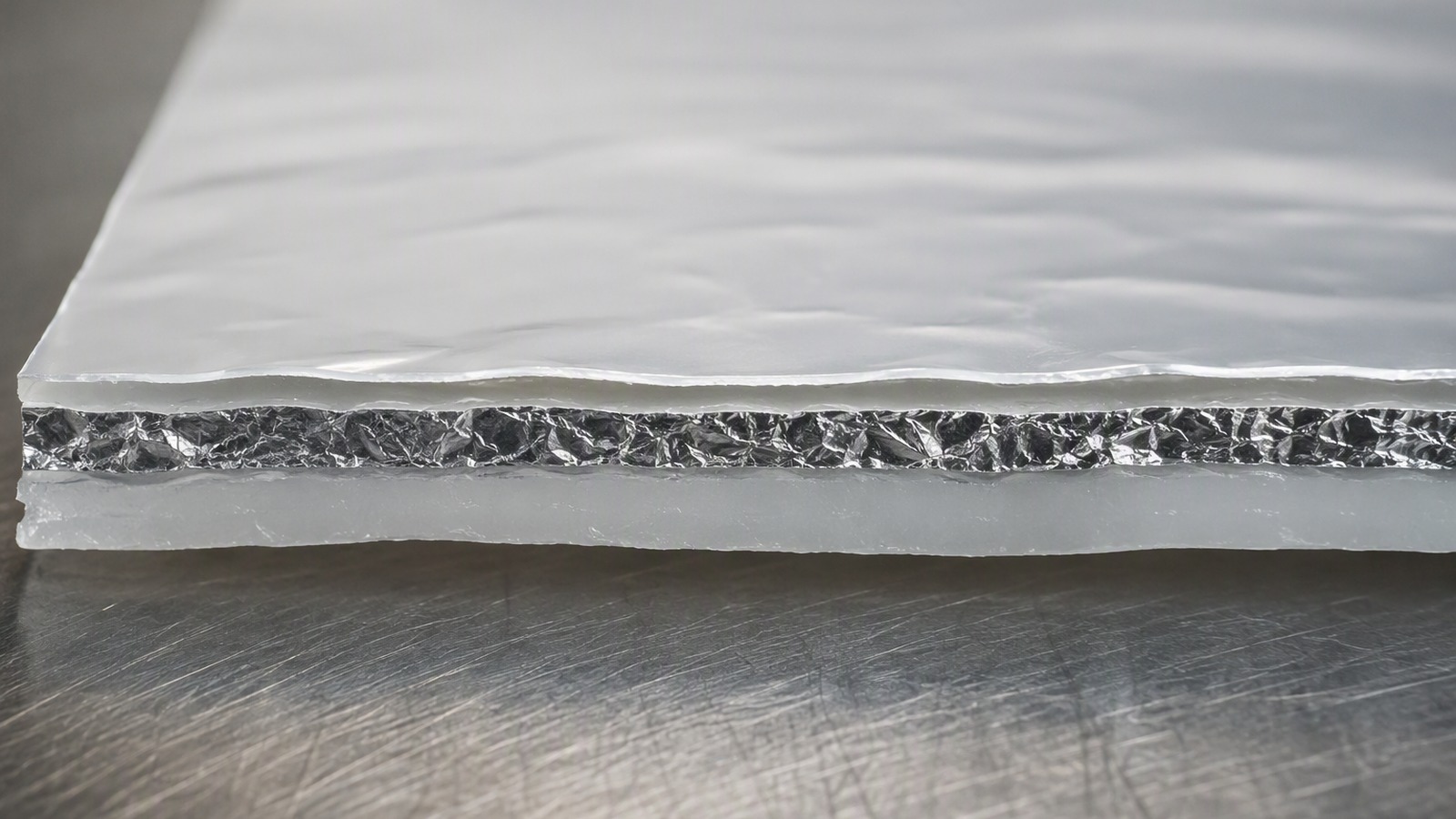
Bonded foil adds bending stiffness and a dead fold to a film that would otherwise be floppy, so the bag stands on the shelf and creases where the pack was designed to crease.
Dive deeper
A polymer film bends and springs back. A thin metal sheet bends and stays. When foil is laminated between films, that behaviour is transferred to the whole structure, and the pack gains a property that no coating can imitate: a fold becomes permanent. The base of a standing pouch is a set of deliberate folds, and it squares up because the material remembers them.
Stiffness also earns its place on the filling line. A bag that opens cleanly, holds its shape under the filler and does not collapse while the top is being sealed runs faster than one that behaves like a limp sleeve. On a retail pack, the same stiffness keeps the shelf face flat after weeks of handling, so the print still reads as designed.
Dead-fold and embossing are related: a textured surface changes how the sheet creases and how it reflects light, and what embossing does to a foil surface explains when that is worth the extra step. Trade bodies such as European Aluminium describe the material side, but the choice is always made against one pack on one machine.
None of this replaces the barrier argument; it adds to it. A pack that stands and recloses properly is opened less violently, which protects the leaf inside.
Where does a tea pack actually leak: the seal or the reclosure?
A flat sheet of laminate is rarely the failure. A pack fails where it was joined, and again where it was opened.
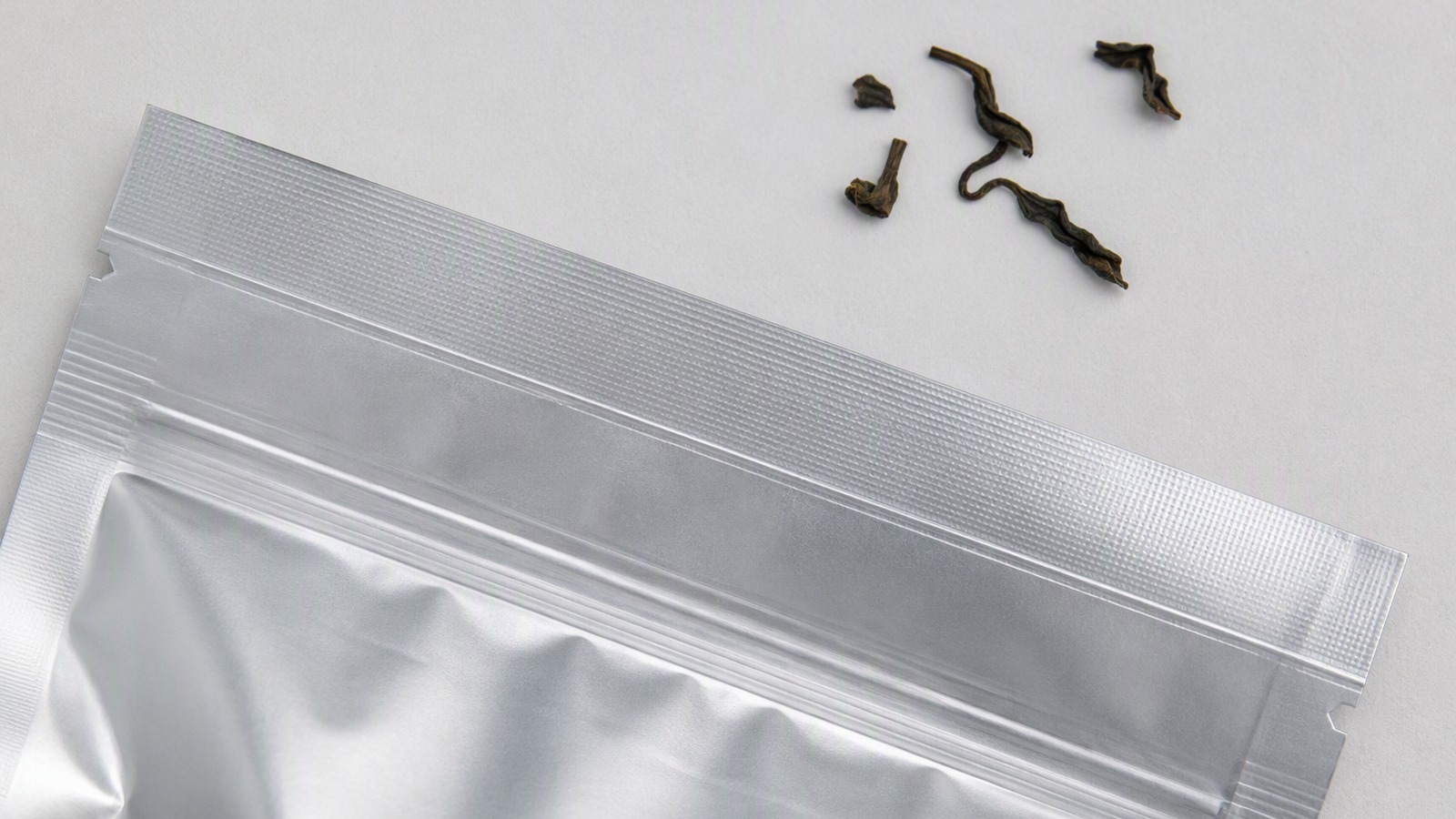
Seal integrity and reclosure are the two weak points. The seal must close through dust and fold lines, and the reclosure must seat again after every opening, in a kitchen warmer and wetter than the warehouse.
Dive deeper
The flat film is the easy part: a continuous metal sheet inside a laminate has no seam to leak through, and a pinhole is a manufacturing defect rather than a design feature. The joints are different. A fin seal, a lap seal or a gusset fold compresses, doubles and heats the laminate, and the sealant has to flow around contamination that should not be there.
Tea dust is that contamination. Fine particles and broken leaf land in the seal zone during filling, and a sealant that cannot swallow them leaves channels. A gusset corner is four layers thick, and the pressure that closes two layers may not close four. Seal width, dwell, temperature and pressure are therefore set on the real product, not on a clean sample.
The reclosure is the second, slower failure. A press-to-close profile, a tin tie, a hook-and-loop patch or a folding label all depend on two surfaces meeting in the same place every time. In use they collect dust, and a pack left open on a counter is no longer a barrier at all. That is why the reclosure is specified with the seal rather than after it.
Both sit at the edge of the foil's competence, so the structure is agreed against the customer's own pack and line.
Why does light matter to the leaf but not to the metal?
Light is invisible in a specification until a retail pack has stood under a lamp for a season.
Light drives oxidation and colour change in the leaf and in any added flavour, while the aluminium itself is unaffected. An opaque foil layer removes the question instead of slowing it.
Dive deeper
Tea colour is a chemical state, not a dye. Chlorophyll, polyphenols and the pigments formed during processing all respond to light, and the reaction continues after the pack is closed, because light needs no air to reach the leaf. Green tea that fades from bright to olive, and a flavoured blend that loses its top note, are both describing the same process.
Metal behaves differently. Aluminium reflects and absorbs across the visible range, and it does not photodegrade, so a foil layer is opaque at any gauge used in a flexible laminate. A clear window in an otherwise printed pack gives light a path straight to the product, and no print on the rest of the panel compensates.
The polymer layers are the part that can age. A print film may yellow or chalk under strong light, and an adhesive may lose clarity, so the outer layer is chosen for the light the pack will actually see. The foil industry background from trade bodies is fair context.
Light also arrives with heat. A pack near a window or under a display lamp is warmer than the aisle suggests, and warmth accelerates every process described here. Foil helps twice: it blocks the light and its reflective surface reduces absorbed heat.
Why do a catering pack and a retail pack ask different things of the same foil?
The same alloy can go into a retail pouch and a catering bag, and the two packs fail in different places.
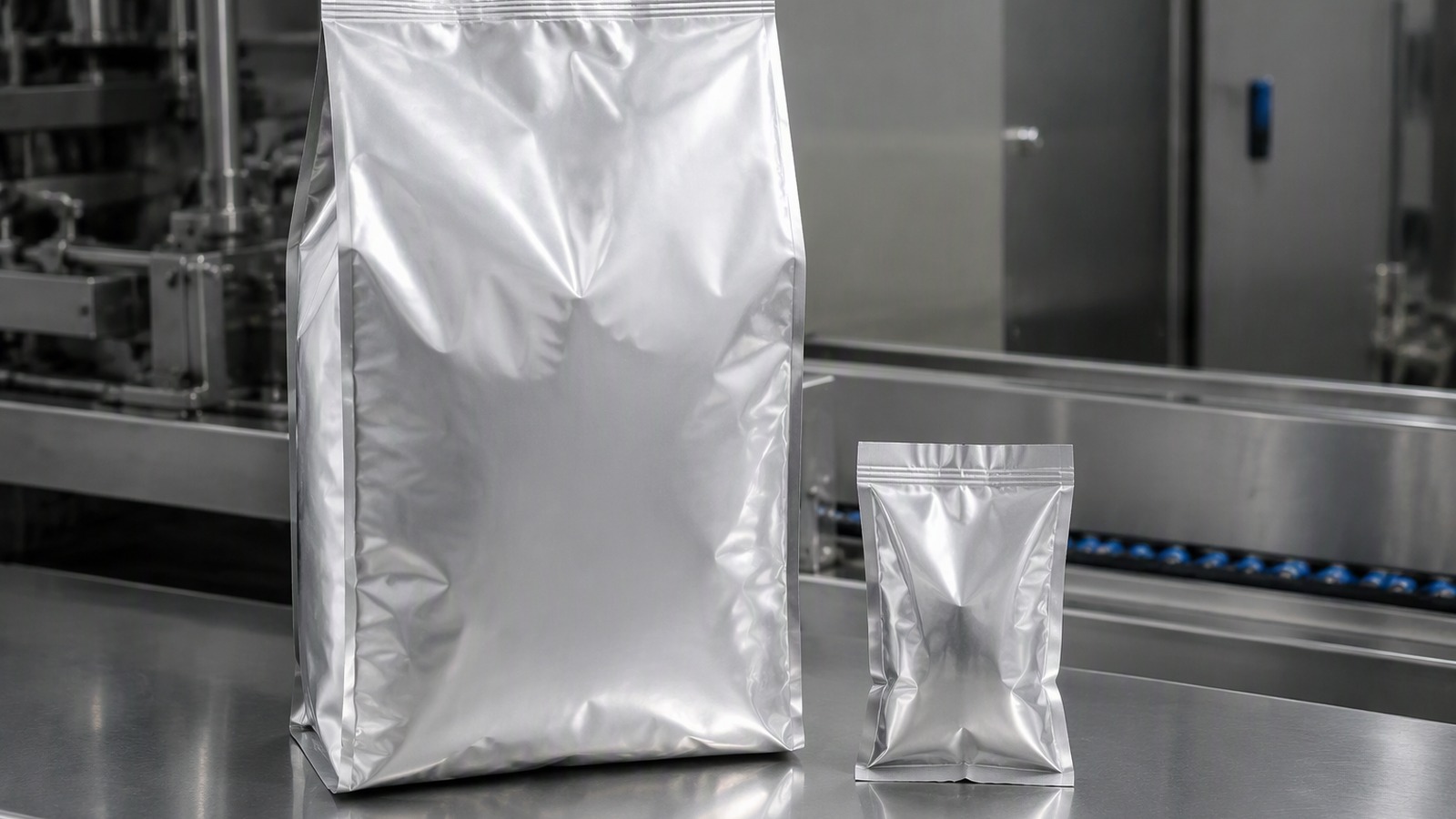
A retail pack is judged on shelf presence and repeated opening. A catering pack is judged on drop strength, stack load and how quickly it can be emptied in a busy kitchen.
Dive deeper
In a retail pack, the surface area is large relative to the contents. That makes every edge, every seal and every opening proportionally more important, and appearance part of the specification: the pack has to stand square, print without cracking at the fold, and look intact after a delivery cycle. Thin foil is normal here, and the laminate carries the stiffness.
A catering pack inverts the ratio. There is more product behind each square metre of film, so the barrier is less critical per kilogram, while the mechanical duty rises sharply: a heavier bag is dropped, stacked, dragged and opened with a knife or a scoop. Seal toughness, gusset design, tear initiation and the strength of the top closure matter more than the print.
The format changes how the pack is used. A retail pouch is opened and closed many times, so the reclosure is a design feature. A catering bag is often opened once and left folded or clipped in a working kitchen, so the practical requirement is a large, clean opening and a closure that survives being folded back.
Both formats start from the same range of food and household foil, and both end with a specification agreed against the customer's own line. What differs is which property may be marginal.
How is the laminate built for a pack that has to stand and be reclosed?
Structure follows duty: stand, fill, seal, open, close, and survive the journey to the shelf.
A print film for the shelf face, foil for barrier and stiffness, a sealant for the seam and the reclosure, and adhesives to hold them together. Each layer is chosen against the filling line, not only the shelf.
Dive deeper
The print film is usually polyester or an oriented polypropylene, chosen for gloss, scuff resistance and how it takes ink. It also shields the foil from handling, so its thickness is a durability decision. Where a softer feel is wanted, a paper outer layer is used. Material background sits at aluminium foil, and industry data gives market context.
The sealant decides the seam and the reclosure. A polyethylene gives a broad sealing window and a forgiving seat; a cast polypropylene gives heat resistance and a firmer feel where the pack has to hold a shape. For a press-to-close profile, the sealant has to bond to the profile without creeping under load, and that is a lamination question as much as a film question.
In the middle, the foil carries the barrier and much of the mechanics. Pouches commonly use foil from 0.006 mm to 0.012 mm, heavier formats go upward within the 0.005 mm to 0.20 mm range, and alloys such as 8011, 8021, 8079 and 1235 cover most of the work, with 3003 and 3004 where more strength is needed. Tempers O, H14, H16, H18, H22 and H24 describe how hard the sheet arrives, and the choice follows the folds the pack must take. A starting point such as 8011 aluminium foil at 0.02 mm is only meaningful once the pack format is known.
What must a packer state in an enquiry for tea and dry goods foil?
An enquiry that says only foil for tea will be answered with a guess.
State the product and its form, the pack format and reclosure, the laminate and sealant, the alloy, temper and thickness in mm with tolerance, the width and core, the quantity per size and the destination port.
Dive deeper
Begin with the product. Leaf size, dust level, added flavour and oil content all change the sealant and the seal zone, and a fine powder behaves differently at the seam from a whole leaf.
Then describe the pack. Flat pouch, stand-up pouch, block bottom, sachet, caddy liner or catering bag each load the laminate differently, and the reclosure type decides the sealant and the top construction.
Name the filling machine and sealing method, which fix the sealing window the laminate must survive. The material line comes next: alloy, temper, thickness in mm with the tolerance you will accept, width within 100 mm to 1500 mm, core of 76 mm or 152 mm, and roll mass.
Quantities are planned against a 3 MT minimum per size, and sea freight from Qingdao, Tianjin or Shanghai is normal, so name the destination port and the packing method. Finish with the checks you will make on arrival: gauge, pinholes, surface, edges and splices. Aluminium foil for packaging sets out the parameters that can be confirmed at quotation stage, while the structure itself is agreed against your own product and line.
Tea asks the opposite question to coffee: not how to let gas out, but how to keep water and light out and still close again.