Why Does an Electronics Shielding Bag Need Aluminium Foil?
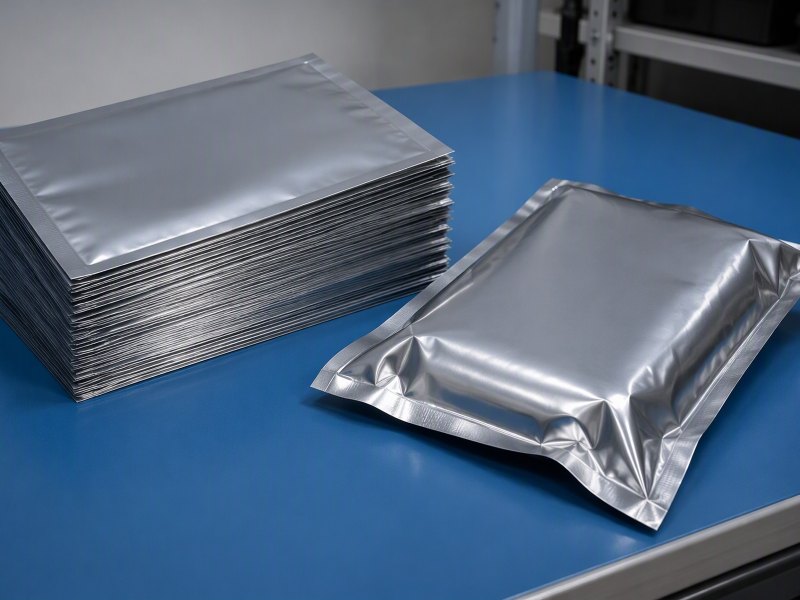
A component bag has to stop a static field and slow moisture at the same time. Here is how the foil laminate does both, where the seam and the crease fail, and what an enquiry needs.
A module that leaves the line clean can arrive at the bench dead, or alive but corroded. The bag it travelled in is the last thing anyone inspects.
Because a plain film bag only moves static charge around; it does not block a field, and it barely slows moisture. A foil laminate does both, since one continuous metal ply spreads the field and interrupts the path of water vapour.
The two duties are usually handled by different people: static on the line floor, moisture on the shelf. In a component bag they meet in one wall, which has to be built for both at once.
Why Is a Plain Film Bag Not Enough for a Part Sensitive to Static and Moisture at Once?
A polymer film is an insulator, and an insulator keeps charge where it is placed. It is also a wall that water vapour can cross, slowly but steadily.
A plain bag therefore handles neither threat. A dissipative version drains charge, but a dissipative surface does not block a field, and no polymer alone keeps moisture out for a storage life.
Dive deeper
An insulating film holds charge where it is put. When a bag slides across a bench, or a board slides inside a bag, the two surfaces exchange charge and the film keeps it. The bag itself then becomes the charged object sitting next to the part. A dissipative film is a partial answer: it is compounded so that charge drifts across the surface and away towards ground. That helps against a discharge from the bag to the part, and it is why dissipative bags suit parts that are not especially field-sensitive.
It is not a shield. A dissipative surface has no continuous conductor, so it cannot cancel a field arriving from outside. A charged object passing over the bag, a trolley, a stretch of conveyor, a person's sleeve: each carries a field, and a dissipative wall lets that field pass to the part almost unchanged. Damage happens without anything touching the bag.
Nor does the same film deal with moisture. A polymer wall lets water vapour through slowly, so a bag that is only dissipative is a bag with a door left open. A part sensitive to both threats needs a wall that answers both, and that is a different construction, not a different grade of the same film.
How Does a Continuous Metal Layer Behave Against a Static Field?
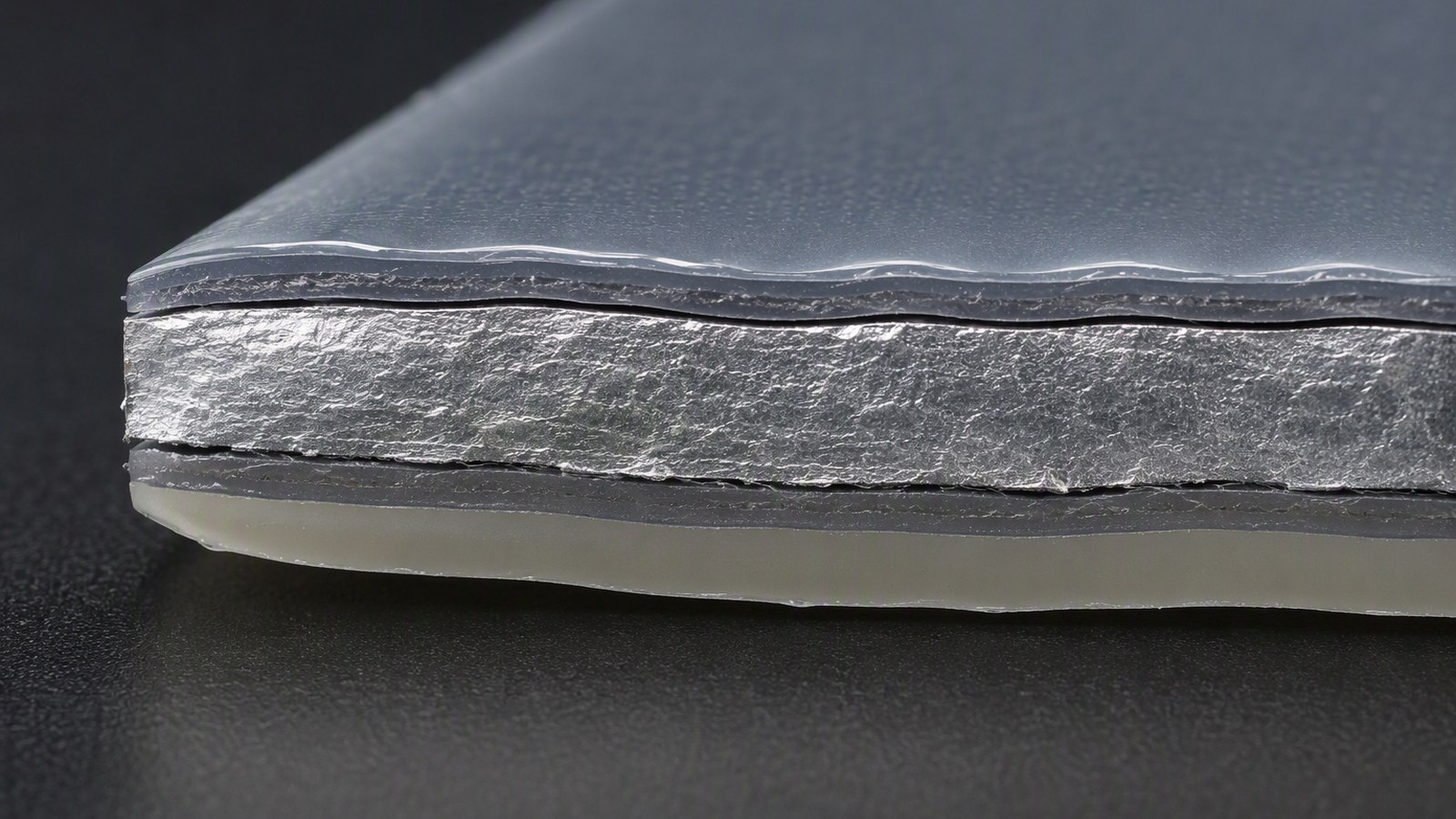
A dissipative surface lets charge crawl away to ground. A metal ply does something else: it spreads charge across its whole area at once, then cancels the field.
Metal is conductive, so charge arriving anywhere on the ply redistributes over the surface. The field the ply carries then opposes the field outside it, and the enclosed part sits in a quiet space.
Dive deeper
The behaviour is the everyday one of a conductive enclosure. Charge on the outside of a closed conductive shell arranges itself so the field inside falls away, and a part inside is screened from what happens outside. Nothing needs to be grounded for that screening to work, which is the point people miss: grounding protects the operator and drains the bag, while continuity protects the part.
Continuity is the whole of it. A ply that is interrupted, by a crease that has cracked, by a pinhole, by a seam that is only folded, is no longer an enclosure; it is a surface with a gap, and the gap is where the field gets in. This is why a bag is judged by the metal layer being unbroken over the whole bag, not by the metal being present in most places. You can read the same reasoning in the way aluminium foil in cable wrap and shielding is specified around a bundle, where the screen has to close on itself along the run.
A second effect follows. A conductive ply equalises charge across the bag, so a local charge cannot build into a large difference between corners, while a dissipative surface spreads charge more slowly and a plain film not at all.
Why Is Moisture the Other Half of the Problem?
Static kills a board in a second. Moisture works over weeks, on a shelf, in a container, in a humid season, and it is usually blamed on the part maker.
Water vapour dissolves into a polymer, crosses the wall and leaves on the far side. A metal ply has no such path, so the layer that spreads charge also holds moisture back.
Dive deeper
A polymer is not a solid wall at the scale of a water molecule. Vapour enters the film, dissolves into it, diffuses along the concentration difference and desorbs on the inner face. The rate depends on the polymer, the temperature and how dry the bag is inside, which is why a bag with a desiccant sachet inside keeps working while the sachet lasts and then stops.
What moisture does is slower and more varied than a static event. Terminations oxidise, plated surfaces dull, solderability falls away, and some moulding compounds take up water that later leaves as steam at reflow. None of that shows on receipt; it shows at the end of the line, as a batch of joints that will not wet.
The metal ply answers this because a metal has no diffusion path for water vapour: a continuous foil is a barrier by construction rather than by chemistry. That is the same argument that governs aluminium foil for flexible pouches and sachets, where the foil is chosen for what it stops rather than for what it weighs.
The practical consequence is that moisture and static are not two projects. One layer, made continuous, serves both, and any break in it fails both at the same time.
Which Foil Gauge Belongs in a Shield Bag, and Why a Laminate?
Foil alone would shield well and fail in service. It creases, it pinholes at a fold, and it cannot be heat-sealed to itself.
A bag uses thin foil, usually towards the lower end of the 0.005-0.20 mm range we roll, buried in a laminate. The plastics carry seal and strength; the foil carries the barrier.
Dive deeper
Gauge selection starts from what the metal has to do: be continuous after converting, after bag making and after handling. A foil thick enough to survive those steps is thick enough to shield, because shielding depends on continuity, not mass.
For most component bags the foil sits well down the range, and the alloy is chosen for formability. Soft tempers such as O and H14 fold without cracking, and they conform to the bag geometry instead of fighting it. Converters commonly work with 8079 or 1235, and 8021 where a tighter gauge is wanted, while 3003 or 3004 suits a semi-rigid pack. General rolling background helps when two gauges are compared. Both 8079 aluminium foil in 0.03 mm and 1050 aluminium foil in 0.03 mm are rolled for this kind of converting.
The reason the bag is a laminate and not foil is mechanical and thermal. Foil has no sealant of its own, so a bag made of foil would have to be glued, and a glued joint is a path. Foil also has almost no elongation, so a bag that is filled and dropped would tear at the fold. A laminate puts a sealable film inside, a printable carrier outside, and lets the foil do only the job it is good at.
Why Is the Seam the Weak Point, and Why a Fold Is Not a Seal?
A bag is a flat web folded and joined. Whatever the web does well the seam must match, and it is made in a moment under heat and pressure.
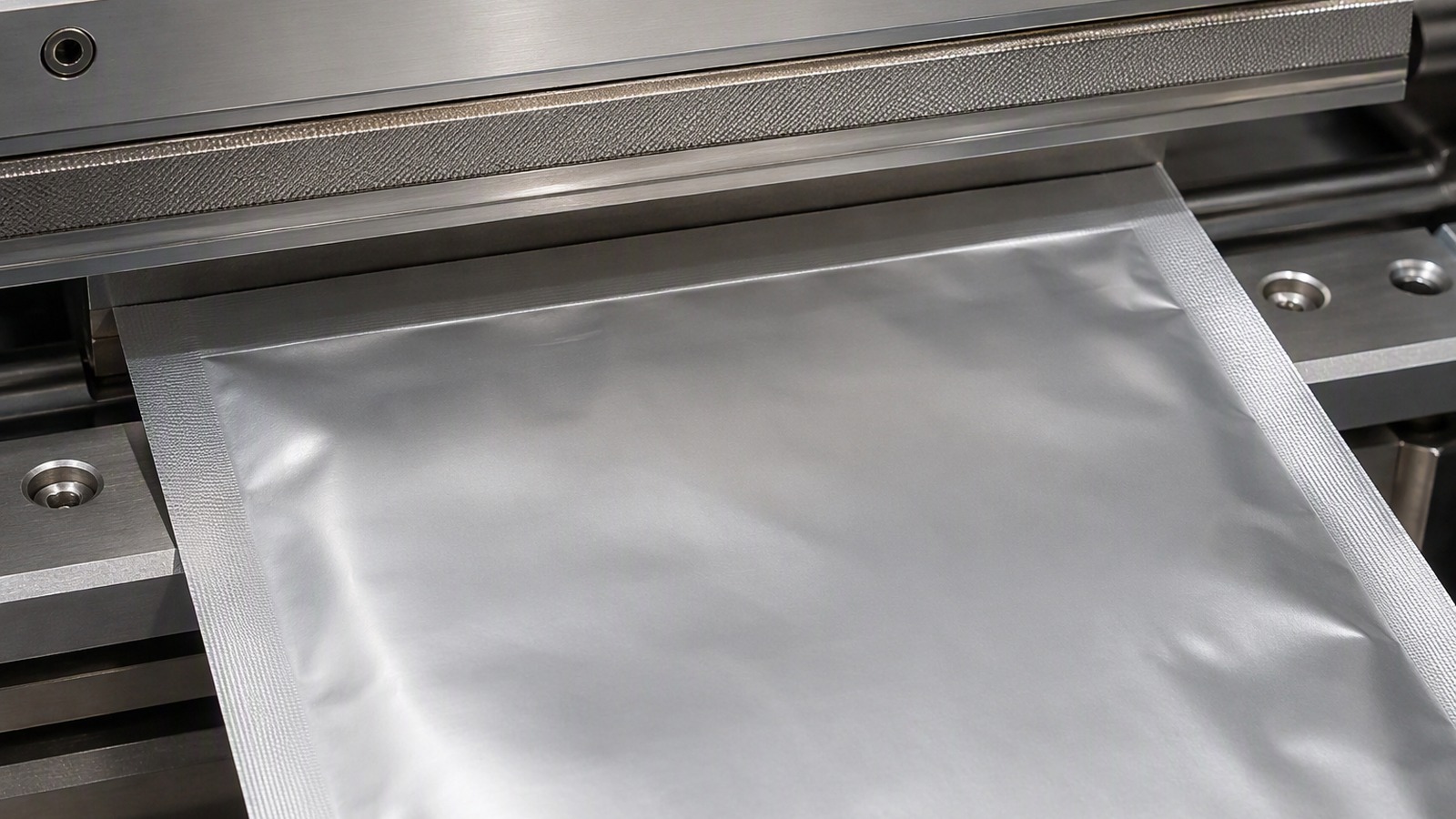
A fold is a mechanical closure with a path running along it. Only a welded seam, where sealant on one face melts into sealant on the other, closes that path.
Dive deeper
In a heat-sealed bag the two inner faces are the same sealant film. Heat and pressure for a short dwell melt them into one another, and on cooling the joint is a single thickness of polymer. That is why the foil must stay out of the seal zone: metal does not weld to metal at these temperatures, and a seal made through the foil carries a conductor.
Sealing has a window. Too little heat and the films only touch, so the joint peels. Too much and the sealant is squeezed thin at the edge of the bar, leaving a line that fails under load. Between those limits the seal is strong, and the window narrows when the line runs fast, when the sealant is dusty and when the bar is not flat across the width.
Seams fail in a characteristic way. A channel, a wrinkle trapped in the seal, a gusset folded into the seal area: each leaves a narrow open path to the room. Moisture enters through it, and the metal layer, continuous everywhere else, is bypassed where the bag was closed.
A fold is not a seal, and tape is not a seal either. Both leave an interface that gas can travel along, and both depend on the fold staying tight, which it does not once the bag is filled.
What Does Warehouse Handling Do to a Bag, and Why Does Abrasion Fail It?
Between the bag line and the bench a bag is stacked, dragged, compressed and stacked again. None of it is violent, and all of it repeats.
Flexing and abrasion open pinholes in the metal ply. A pinhole does not make the bag slightly worse; it breaks the continuity the shielding depended on.
Dive deeper
A laminate is tougher than foil alone, and that is exactly why the failure is easy to miss. The plastic layers hold the bag together while the metal inside develops fine cracks along the crease lines. The damage is in the one layer that cannot be seen.
Carton edges, pallet corners, the lip of a tote and pallet compression all load the same creases. Foil in a soft temper bends with the film rather than resisting it, which is why soft tempers survive handling better. A bag compressed and released many times has been flexed at the same lines many times, and a crease that has been rubbed is a crease with a crack in it.
Single-trip use is the working assumption: a bag opened, emptied and reused has been folded on new lines each time, and its metal ply has a history nobody recorded. That is also why the seams and fold lines are the places to look: damage concentrates where the web was already worked. Industry notes on converting make the same point.
A bag left open on a bench in a humid room takes up water in its desiccant and on its inner surface, and closing it later seals that water in with the part.
How Is the Bag Built Layer by Layer, and What Does Each Layer Do?
A shielding bag is three jobs in one web: something to print on and wear, something to block, something to seal. Adhesive between them holds the stack together.
An outer carrier film takes print and abrasion, the aluminium ply blocks field and moisture, and an inner sealant film welds to itself. Each layer is there for one reason.
Dive deeper
The carrier is usually a polyester or an oriented polypropylene film. It is chosen for print quality, for stiffness enough to run through a bag machine, and for abrasion resistance.
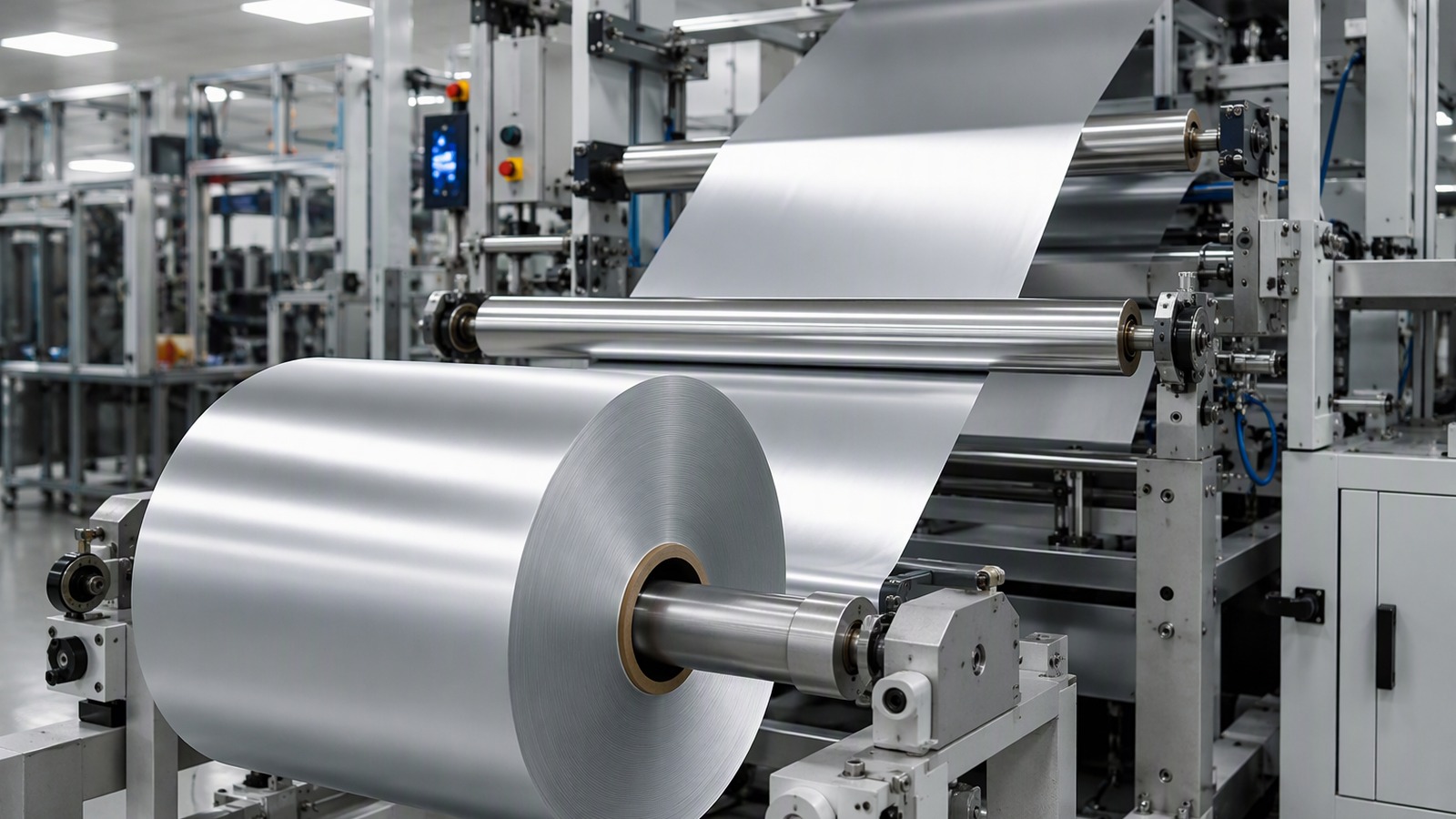
The foil comes next, and it is the only functional barrier in the build. Its gauge is set by the converting and handling it must survive, and its width by the bag line: we roll from 100 mm to 1500 mm on 76 mm or 152 mm cores, so a converter can match the web to the machine. The third functional layer is the sealant, usually a polyethylene or cast polypropylene film, chosen because it welds to itself at a temperature the foil and carrier can tolerate.
Between the layers sit adhesives, and they matter more than their share of the thickness. A laminating adhesive has to bond metal to two different plastics, survive the heat of sealing without bubbling, and stay flexible when the bag is folded.
The build is symmetrical in duty even when it is not symmetrical in thickness: outside for wear and print, middle for barrier, inside for seal. That is the whole logic of aluminium foil for packaging and containers, and a bag is the version of it that has to conduct. The industry association for foil in Europe covers the supply side in more detail.
What Must an Enquiry for Bag Foil Contain?
An enquiry that says only shielding foil will be answered with the wrong web. The answers live in the bag, not in the foil on its own.
State the bag format, the layer build, the alloy and temper, the gauge and width, the core, the quantity and the destination port. Then say what the bag must survive.
Dive deeper
The format sets the width. A flat bag, a gusseted bag and a reel-fed sleeve each consume a different web width, so give the finished bag size and the machine it runs on. We roll between 100 mm and 1500 mm, so a width that matches the bag line is the first thing to fix.
The build sets the gauge. If the converter already laminates, the foil position in the stack and the sealant type show what heat and tension the foil will see, which drives the choice between a soft temper such as O or H14 and a firmer one such as H18. Alloy follows the same logic: 1050, 1060, 1100, 1235, 8079 and 8021 for flexible builds, 3003 and 3004 where the pack is semi-rigid, and 8011 where a converter is already tooled for it.
Our minimum order is 3 MT per size, and the port matters: Qingdao, Tianjin and Shanghai suit different inland legs.
Finally, say what the bag must survive: the handling, the storage life, the climate at destination, and whether the part is field-sensitive, moisture-sensitive or both. Those answers, plus the numbers above, are enough to specify a foil. General industry background is a useful second read.
The bag is a laminate with a continuous metal ply, a welded seam and a wall that survives handling. Specify the bag, and the foil follows from it.