Which aluminium foil should you specify for hot foil stamping?
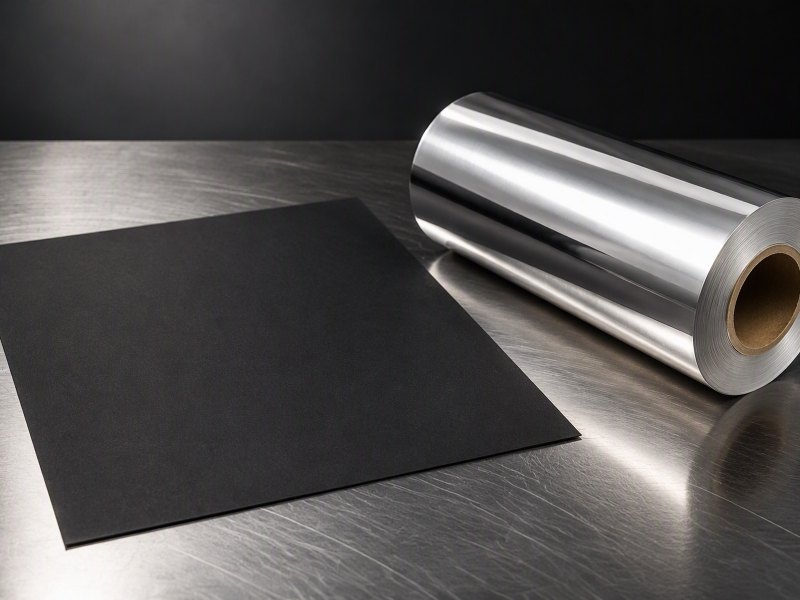
Transfer foil and the plain foil a converter laminates are different products with different buying logic. This guide explains the layer stack, the transfer process, why edges blur, and what to put in an enquiry.
Buyers order "aluminium foil" and printers order "foil", and the two mean different things, so specifications drift and stamped labels fail at the press.
Transfer foil is a coated film, not bare metal: carrier, release layer, metallised layer and adhesive transfer under heat and pressure. Plain aluminium foil is a metal web that a converter laminates or lacquers. The two are specified differently.
The confusion costs money in both directions: a buyer may expect stamping performance from a laminating roll, or pay transfer-foil prices for a job that only needs a laminated web. The eight questions below separate the two.
What is transfer foil for hot foil stamping and labels?
Transfer foil is the material a stamping press consumes, and it is a coated film rather than a sheet of metal, which is where most specification confusion begins.
It is a thin carrier film coated with a release layer, then a metallised or pigment layer, then an adhesive. Heat and pressure release a shaped area of that coating onto the substrate, and the carrier leaves with the web.
Dive deeper
The stack is built in a fixed order. The carrier is a thin plastic film, usually polyester, strong enough to pass through a heated press without stretching. On top of it sits the release layer, a waxy coating that decides how cleanly everything above it lets go. Then comes the decorative layer: either a vacuum-metallised aluminium film, far thinner than any foil a converter would laminate, or a pigmented coating for colour and effects. Last is the adhesive, the layer that actually bonds to paper, board or film. Background on the metal itself is in Aluminium foil - Wikipedia.
Read the order backwards and the commercial logic appears. A buyer is not purchasing aluminium by weight; they are purchasing a controlled release event, repeated across a web at press speed, with a defined edge. Two rolls can carry similar amounts of metal and behave completely differently, because the carrier, the release and the adhesive are doing most of the work.
Rolls arrive slit to a press width, on cores that suit the unwind mandrel, with splices that must survive tension. The coating is sensitive to heat and pressure, so a roll stored on its side under load can flatten and stamp unevenly. Treat it as a precision coated product, not a metal coil.
How does transfer foil differ from the plain foil a converter laminates?
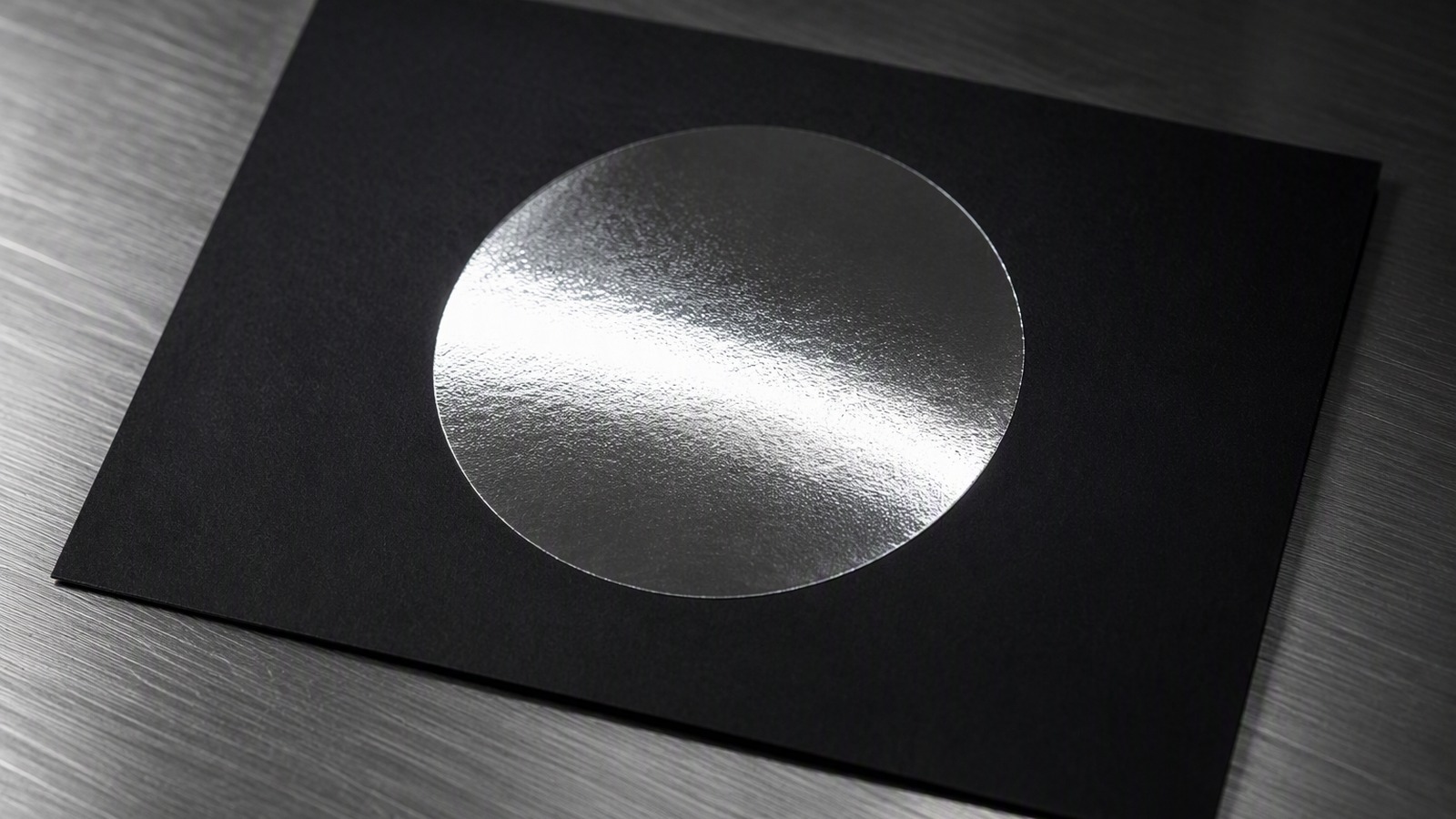
Plain foil and transfer foil both look metallic on a finished label, yet one is a metal web and the other a coated film, so the buying logic differs.
Plain aluminium foil is rolled metal, supplied by alloy, temper, thickness and width, and a converter bonds, lacquers or prints it. Transfer foil is a coated carrier that deposits a thin decorative layer during stamping. One is converted, the other is consumed at the press.
Dive deeper
Plain foil is rolled metal, bought by alloy, temper, dimension and surface. A converter may specify 1050, 1060, 1100, 1235, 8011, 8079 or a harder 3003 or 3004, in tempers from O and H14 through H16, H18, H22 and H24, at 0.005-0.20 mm and 100-1500 mm wide on 76 mm or 152 mm cores, with an MOQ of 3 MT per size. It arrives as an aluminium foil roll and is then laminated, lacquered or printed; the wider foil roll and sheet range shows how those options are grouped.
Transfer foil is not that product. Its metal layer is deposited, not rolled, and it exists only to be moved. A laminating converter buys metal to keep; a stamping printer buys metal to release. The first cares about pinholes, barrier and deadfold. The second cares about edge definition, release consistency and how much of the roll leaves the carrier.
The purchasing consequence is blunt. Plain foil is quoted by weight, alloy and dimension; transfer foil is quoted by area, construction and print behaviour. Asking a foil mill for stamping foil, or a coating converter for a laminating web, wastes a week and usually produces a polite refusal. Both are legitimate products; they simply answer different questions.
How does the hot foil stamping transfer process actually work?
The press does one thing at a time: it brings foil, die and substrate into contact, then separates them, and that single event repeats thousands of times an hour.
A heated die presses the coated side of the foil against the substrate. Heat softens the release layer, pressure activates the adhesive, and the die shape shears the coating away from the carrier. The carrier lifts clean, leaving the image behind.
Dive deeper
A stamping cycle is short and repetitive. The foil indexes forward by the length of the next impression, the heated die descends, and for a moment the foil is held between die and substrate. Heat softens the release layer, pressure brings the adhesive into contact, and the die edge shears the coating. The die lifts, the carrier pulls away, and the image stays on the sheet. Used carrier is taken up on a waste spindle.
Every defect maps to a stage. Patchy transfer suggests the interface never got hot enough, or that pressure was uneven across the die face. A halo around the image suggests heat spread wider than the die edge and softened release beyond the impression. Ragged edges suggest the release did not fracture cleanly. Blistering or a glossy skin suggests too much energy, which can also distort the carrier. Fine lines fail first, because they demand the sharpest release. Consistency across a long run matters more than one perfect impression, since a roll that releases well at the start can drift as the die heats.
Flat-bed and rotary presses load the foil differently, and a construction that performs on one may disappoint on the other. Industry background on foil supply and converting is published by Alfed, the UK aluminium foil industry association.
Why do the carrier film and release layer decide image crispness more than the metal?
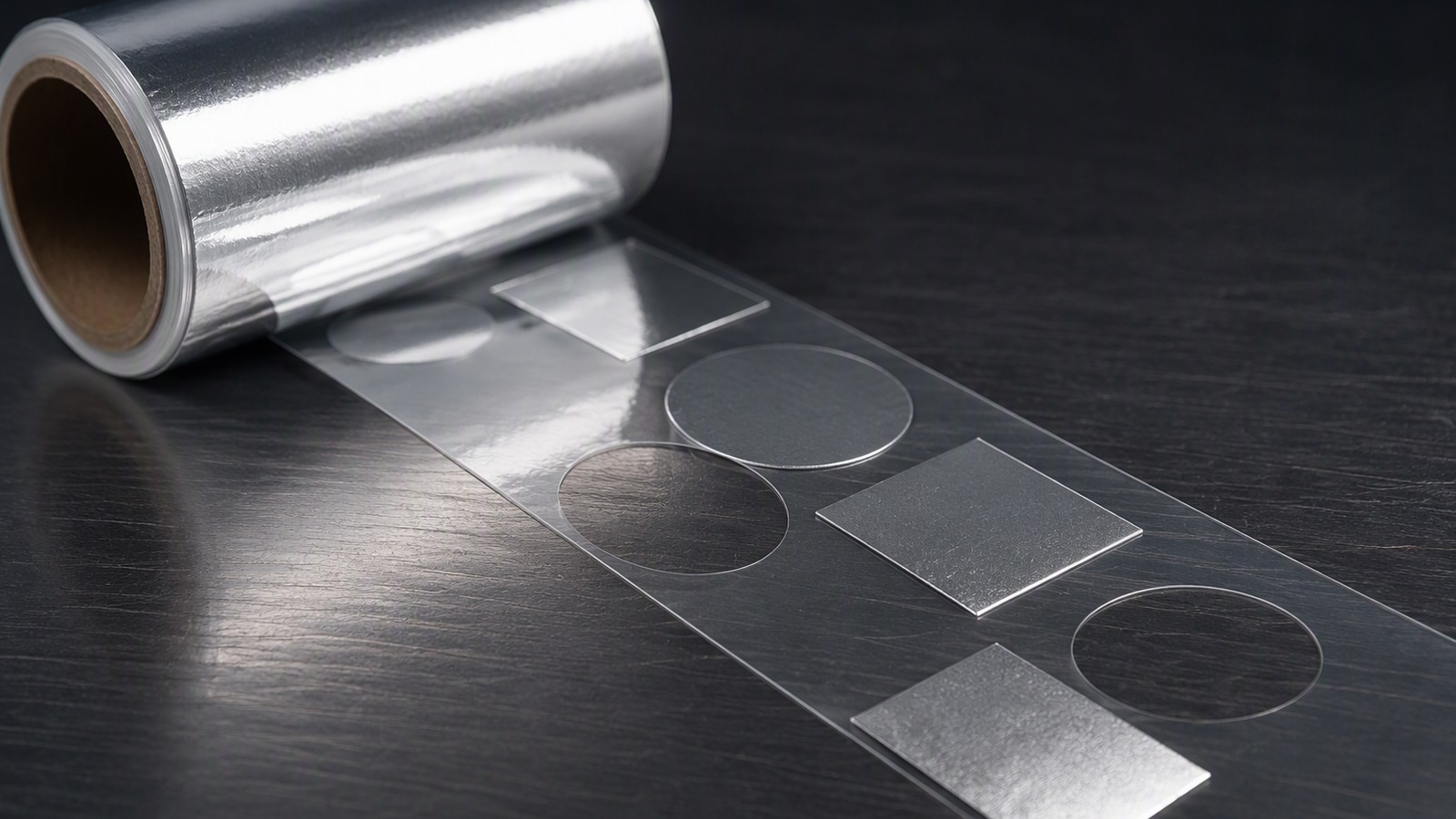
Printers blame the metal when an edge looks fuzzy, yet the metal is the passive layer; the release and the carrier shape how the image leaves the film.
Crispness is a release event. The release layer must soften sharply and let go along the die edge, and the carrier must stay dimensionally stable under heat. A weak carrier stretches, a lazy release tears, and both blur an edge regardless of metal quality.
Dive deeper
Think of the die edge as a knife that cuts coating rather than paper. For the image to be crisp, the decorative stack must separate exactly where the die shears it, and not a fraction beyond. That is a property of the release layer: how sharply it softens, how completely it liquefies at the die edge, and how quickly it re-solidifies outside the impression. A release that softens gradually produces a soft edge, however good the metal is.
The carrier then decides whether the geometry survives. It has to stay flat and dimensionally stable while hot, resist stretching under tension, and release the coating without dragging. A carrier that elongates will smear the trailing edge of every impression. Carrier thickness also changes how heat travels to the interface, so two foils with identical coating chemistry can need different press settings simply because the film differs.
Surface preparation on the substrate side matters as much. Adhesion is a wetting event, and a substrate whose surface energy or lacquer is inconsistent will pull the coating unevenly. Our note on aluminium foil lacquering explains how coating layers change a metal surface; the same wetting logic applies to a stamped image. A contaminated, aged or poorly anchored surface can defeat the best foil construction.
Why does the same transfer foil behave differently on different substrates?
A foil that stamps cleanly on coated paper can mottle on uncoated stock and smear on film, and the press settings are only part of the reason.
Adhesion depends on the surface it meets: roughness, absorbency, coating chemistry, surface energy and moisture all change how the adhesive wets and sets. Substrate variation also changes heat flow, so the same die temperature reaches the interface differently.
Dive deeper
Adhesion is chemistry at an interface, so the substrate is half the specification. Uncoated paper pulls adhesive into its fibres and can starve the bond unless pressure and dwell compensate. Coated paper presents a dense, smooth surface that transfers well but can blister if the coating is heat-sensitive. Recycled board varies batch to batch in absorbency and roughness, which is why one pallet stamps perfectly and the next mottles.
Films behave differently again. A non-absorbent surface gives the adhesive nowhere to go, so the bond depends almost entirely on surface energy and on how the film reacts to heat. Polyolefin films soften, some shrink, and some carry slip additives that repel adhesion. A varnish or a lamination layer becomes the real substrate, and its chemistry may be nothing like the sheet underneath. Thin films are also less forgiving of temperature variation across the sheet.
Heat flow completes the picture. A thick board absorbs energy and slows the rise at the interface; a thin film passes heat through to the packing beneath. Backing and counter-die therefore change results as much as the foil does. The industry association European Aluminium publishes background on foil production and use, and it is a useful starting point when a specification has to be justified internally.
What must a buyer state in an enquiry for transfer foil?
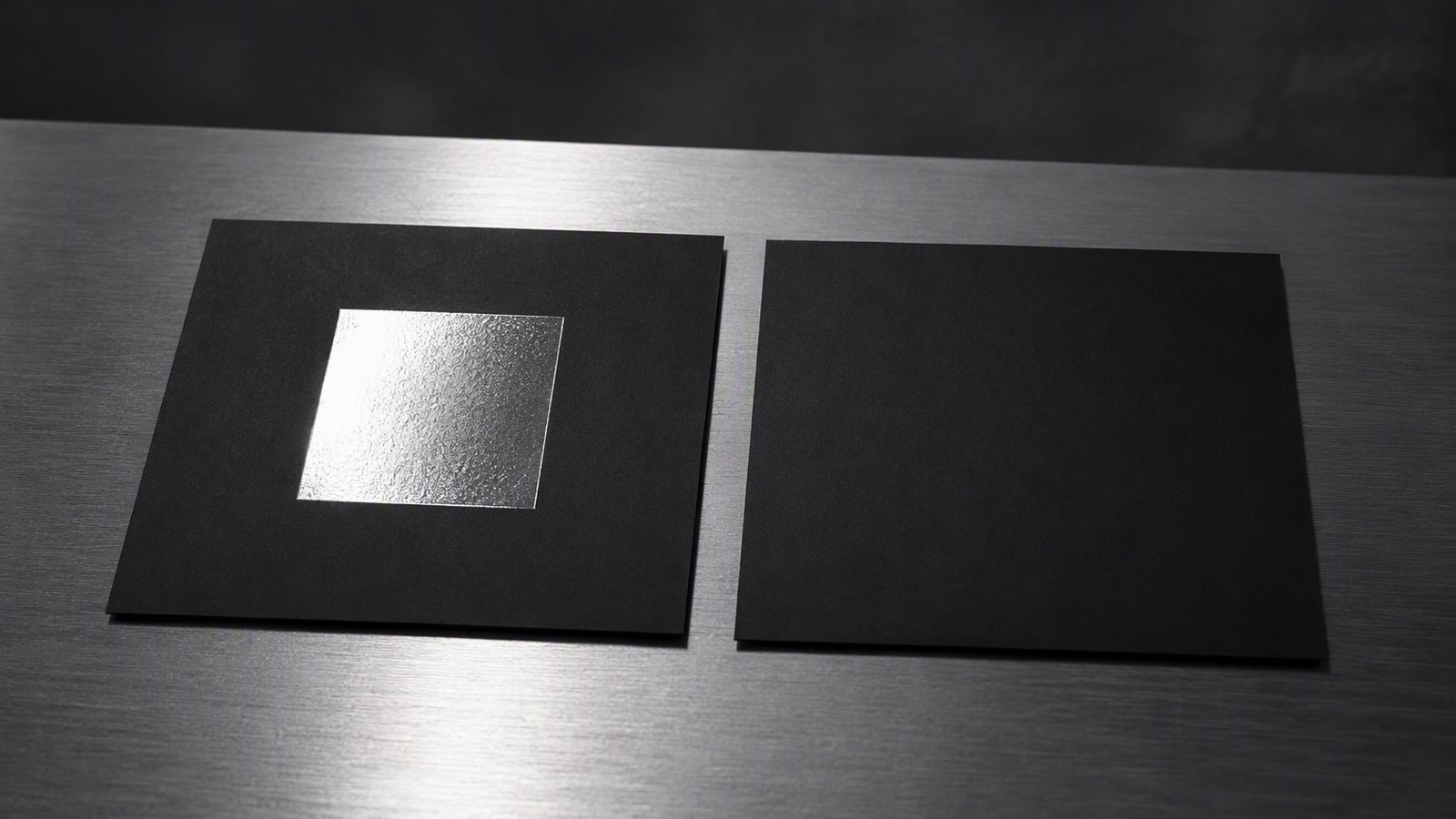
An enquiry that says "silver foil, stamping grade" cannot be answered properly, and the trial-and-error cycle that follows costs more than the material.
State the substrate, the print area and coverage, the die type, the finish, the roll width and core, the intended use and any post-press process. Add the colour reference and the quantity so the supplier can match a construction rather than guess one.
Dive deeper
Start with the substrate in plain words: coated paper, uncoated board, recycled board, self-adhesive laminate, film, or something textured. Then describe the image: solid areas, fine lines, reversed type or a hairline logo, because each stresses the release differently. State coverage as a proportion of the sheet, since a small logo and an almost-full sheet are different problems. Name the die type and the press type, and say whether the work is sheet-fed or web.
Next, the finish and the sequence. Is stamping the last operation, or do varnish, overprinting, lamination, embossing or die-cutting follow? Will the label sit in a fridge, rub against a carton on a shelf, or meet solvent? Those answers decide the adhesive and the carrier far more than colour does. Add the colour reference, the roll width, the core diameter, the quantity and the delivery port you expect.
Finally, ask what the supplier needs to see. A printed sample of the substrate, or a few sheets of the actual stock, shortens evaluation more than any specification sheet. If the job is a conversion from laminated foil, say so and describe the current construction; a 8079 aluminium foil laminated label and a stamped one fail in different ways, so the comparison has to be like for like.
Why are stamping temperature, pressure and dwell time agreed with the press rather than published?
Buyers ask for a setting chart and suppliers refuse, which looks evasive until you see how many variables sit between the foil and the sheet.
Those three settings depend on the die, the substrate, the machine, the ambient conditions and the image. No supplier can fix them for a press they cannot see, so they are agreed during a trial on the customer's own equipment and stock.
Dive deeper
A die is a heat exchanger with an unknown mass, a press has a controller reading somewhere other than the interface, and the substrate changes the path in between. The figure that matters is the temperature at the adhesive for the duration of contact, and nobody can read that from a chart. Add ambient conditions, press speed, dwell geometry and the age of the foil, and a number copied from another shop becomes a guess.
A trial is therefore a controlled escalation. Begin below the expected window, raise one variable at a time, and keep the others fixed. Judge the result on the actual stock, at production speed, with the image that will run, not on a test patch. Record what worked, on which substrate batch and with which die, and treat that record as the recipe for the job rather than a universal setting. Keep the trial sheets, because a reprint months later has to match them.
Suppliers hedge because the variables are theirs to describe and the customer's to control. A responsibly worded recommendation describes direction rather than numbers: more energy, shorter dwell, a different adhesive, a carrier with better stability. Background on aluminium markets and applications from the Aluminum Association is useful context, but it will not set a press.
Where is transfer foil not the right choice?
Transfer foil is excellent at images and poor at surfaces, and buyers sometimes specify it for jobs that need a continuous metal layer instead.
Skip it for full-surface metallisation, barrier requirements, heavy embossing over large areas, or where the label must survive harsh abrasion and solvents. It is also wrong where coverage approaches the whole sheet, since cost and release defects rise together.
Dive deeper
Transfer foil deposits an image; it does not build a surface. Where the job needs continuous metal across the whole sheet, a laminated plain foil is the honest answer, because a rolled web brings thickness, opacity, deadfold and barrier that a deposited layer cannot. Full-coverage stamping also consumes foil across the entire sheet, so material use and defect exposure both climb.
Harsh service conditions argue against it too. Labels that wrap small diameters, shrink onto a container, or face abrasion and solvents can crack or lift a stamped layer at its edges. Deep embossing over a large area stretches the image. Rough, fibrous board can leave unprinted pits inside a solid. Where the design needs a brushed, matte or coloured metal surface, a laminated or lacquered foil usually delivers it more predictably.
Cost logic deserves a mention. Stamped foil is consumed per impression plus a margin for indexing waste; laminated foil is consumed by area, but the metal is bought by weight with known dimensions. For heavy coverage the laminated route often wins on cost and on consistency, and the appearance question then becomes one of bright side and matte side rather than of release chemistry.
Match the material to the job: transfer foil for images, plain foil for surfaces, and a specification that names substrate, die and finish before anyone quotes.