Why Does Aluminium Foil Have a Bright Side and a Matte Side?
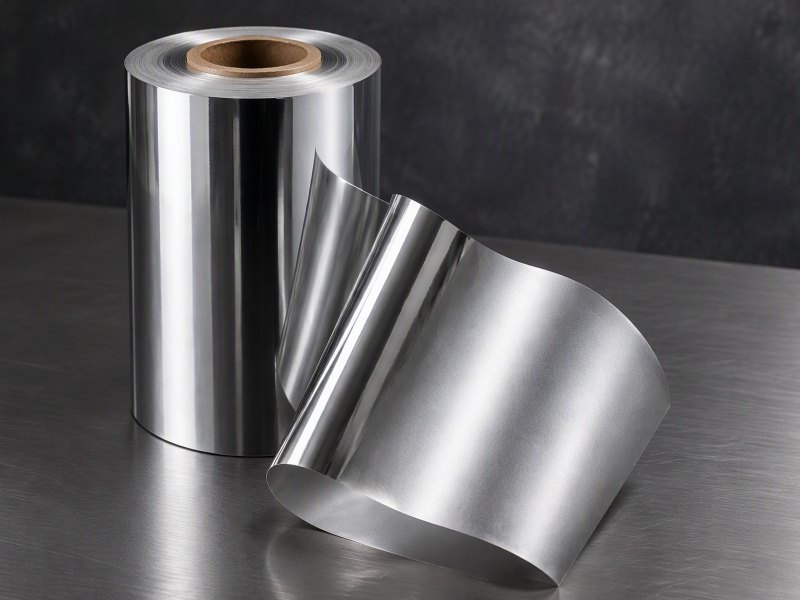
Aluminium foil shows a bright face and a matte face because the thinnest gauges are rolled as a doubled sheet, not because either surface is coated. This guide explains which face is which and how to state the required face in an enquiry.
An enquiry that asks for bright foil can come back with the wrong finish, because the two faces are made by the rolling itself and not chosen from a catalogue.
Aluminium foil has a bright side and a matte side because the thinnest gauges are rolled as a doubled sheet. The face pressed against the polished roll comes out bright; the faces pressed together inside the pack come out matte.
Below, the material is followed from the last pass at the mill to the printing press, ending with wording that puts the right face onto the reel.
Where do the bright and matte finishes come from?
Both faces appear in the final rolling pass at the mill. Neither is sprayed, deposited or chemically treated onto the surface afterwards.
The finish is created as the pack passes between two polished work rolls: one face is ironed by a roll, the other is pressed against its neighbouring sheet.
Dive deeper
Every foil leaving a rolling mill has travelled through a long series of passes, and the strip becomes thinner at each one. In the final pass the material is not a single web but a pack of two sheets, and that pass creates the two finishes. The work rolls are hard, finely ground and highly polished, and under the very high pressure of rolling they transfer their own surface condition into soft aluminium.
The two outer faces of the pack each run against one of those rolls, so both are ironed smooth. The two inner faces never see a roll at all; they press against each other instead. When the pack leaves the mill the sheets are separated, and each sheet then carries one roll face and one pack face. Nothing has been added to either surface: there is no sprayed layer, no deposited film and no chemical etch that produces the difference. The same pass that sets the gauge also sets the finish, which is why the two faces arrive together and cannot be ordered independently. General background is available in an overview of aluminium foil, and the material in roll form is described on our aluminium foil roll page.
Why is foil rolled as a doubled sheet at the thinnest gauges?
At the thinnest gauges a single web is too fragile to travel through the mill without tearing or losing its shape.
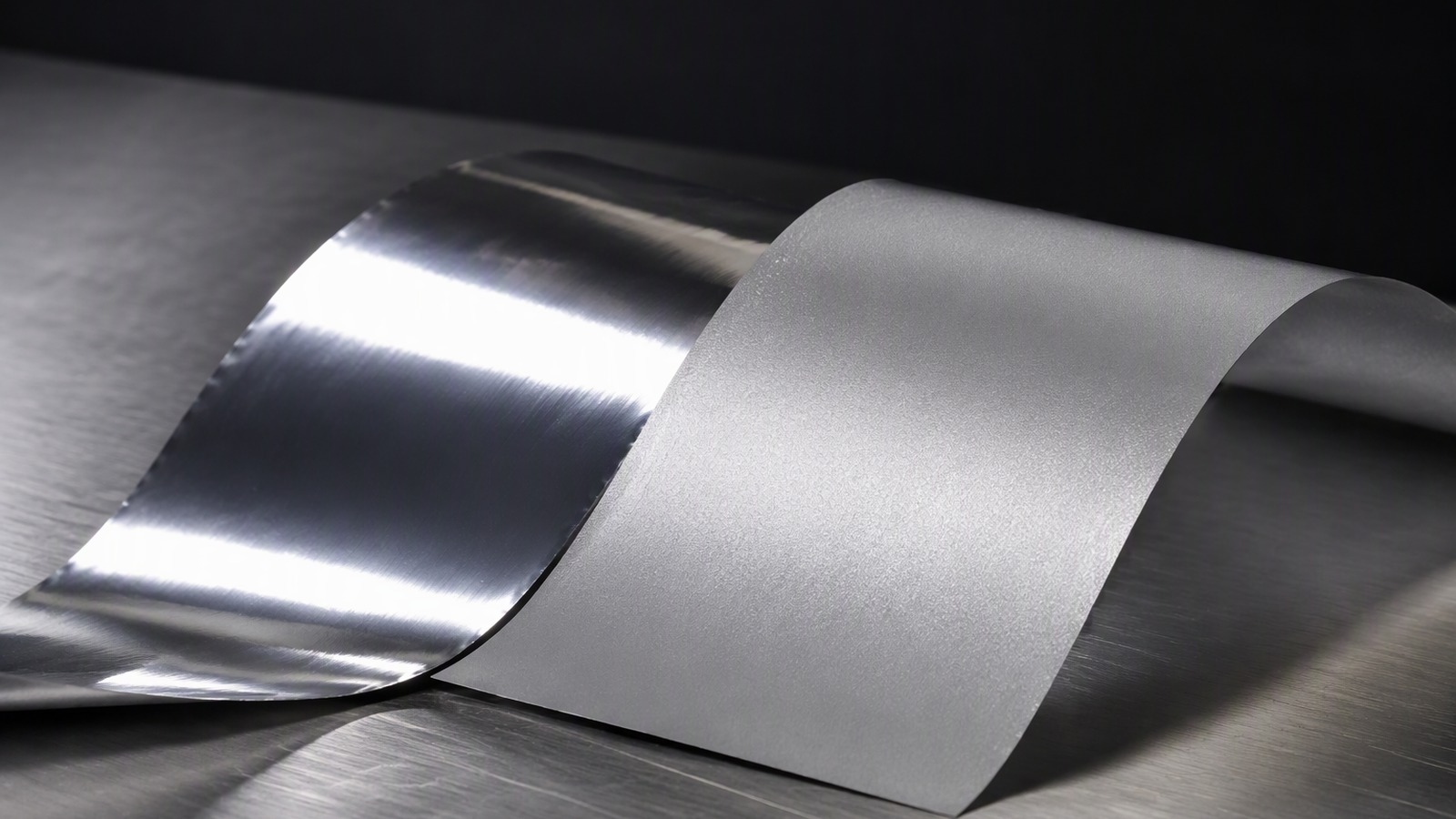
Very thin foil is rolled as two sheets stacked together, then separated. The doubling gives the pack the stability the rolls need, and it leaves one face matte.
Dive deeper
The doubling exists for a practical reason. As the gauge falls, a single web becomes too thin and too light to behave predictably between the rolls: it can flutter, wrinkle or tear, and the tension that keeps it flat becomes difficult to hold. Rolling two sheets together solves that problem, because the sheets support each other and the pack behaves like a heavier, stiffer strip. The mill can therefore keep reducing the gauge without losing control of flatness or width. Once the target gauge is reached, the pack is opened and the two sheets are wound separately, each one carrying the finish of the pass it has just been through.
The doubled operation is therefore tied to the thinnest material. Heavier gauges can be rolled as a single web, and they come out with a broadly similar finish on both faces. The characteristic bright-and-matte combination is a signature of the doubled pass, so when a buyer sees it the material has almost certainly been rolled in a pack. Width is set in the same programme, across a 100-1500 mm band. Roll-form material of this kind belongs to our foil roll and sheet range, and the doubled pass is normal production rather than a speciality.
Which side ends up bright and which side ends up matte?
Once the doubling is understood the rule follows: the outside of the pack meets the rolls, the inside meets the neighbouring sheet.
The face in contact with the polished roll becomes bright. The face in contact with the other sheet becomes matte, its texture copied from that contact under load.
Dive deeper
Think of the pack as a sandwich before it is opened: foil, foil, with a polished roll above and another below. The two surfaces that touch the rolls are the outside of the sandwich, and they are the ones pressed flat and made bright. The two surfaces in the middle touch nothing but each other, and they take the matte finish. The naming can still confuse a shop floor: a converter may call the foil bright on one side while the mill calls the same sheet matte on the other.
It also explains why the pairing is fixed rather than random. One face of each sheet is always the roll face and the other is always the pack face, so bright and matte always appear together, one of each, on every sheet produced by that route. A coil that looks uniform on both faces has usually been rolled as a single web or has been processed further. The finish also runs with the rolling direction, so the two faces stay parallel to each other lengthwise, which matters when a converter has to register print or bond a web on a machine. Background on these industry terms is collected by the aluminium industry association in Europe.
Why does contact with a roll make one face bright?
Brightness depends on how flat and uniform a surface is, not on what the surface is made of.
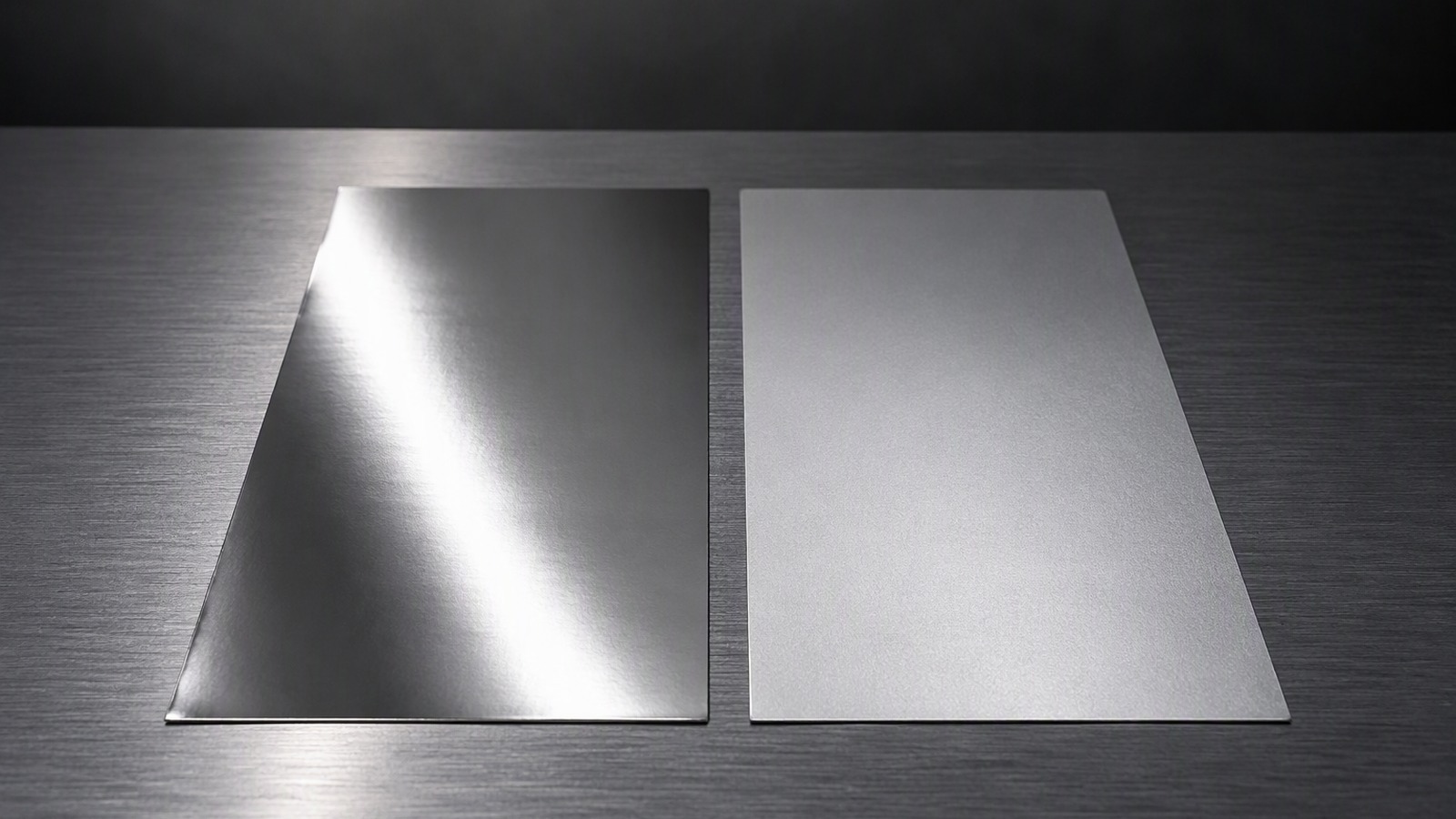
A finely ground roll presses the outer face very flat, so light reflects in a narrow, ordered way. The inner face is lightly indented, so it scatters light and reads as matte.
Dive deeper
Brightness is a matter of geometry at a very small scale. If a surface is flat enough, light arriving from one direction leaves it in a narrow, ordered way, and the eye reads that as a bright, mirror-like finish. If the surface is broken up by tiny ridges and hollows, the light is sent in many directions, and it reads as matte. The final pass decides which condition each face ends up in.
The polished roll is the flatter surface, so the face it touches is ironed towards a smoother, more ordered state. The neighbouring sheet is not a polished tool; where two sheets press together, small asperities and slight unevenness interlock and leave a fine, irregular texture, the texture a buyer sees as matte. Both effects come from the same pressure at the same moment, and both are worked into the surface layer of the metal rather than deposited on top of it. The practical consequence is that the finishes are durable: they belong to the sheet, survive normal handling and winding, and do not wash off or rub away as a coating would. Further orientation on the material and its uses is gathered by the aluminium foil industry association.
Is one face a different alloy, temper or metal from the other?
It is worth stating plainly, because the question is asked often: the two faces belong to the same metal.
No. One sheet carries one alloy at one temper right through its thickness, so barrier behaviour, strength and forming behaviour are essentially the same on either face.
Dive deeper
The reason the two faces are the same metal is that no second material is involved anywhere in the process. A sheet of foil is one alloy from face to face, and heat treatment sets one temper through the whole thickness. The difference a buyer can see is a difference in surface form, described by the shape of the surface rather than by its composition. Barrier behaviour, tensile behaviour, elongation and forming behaviour are therefore properties of the sheet as a whole, and they are not better on the bright face or on the matte face.
What does change from face to face is how the surface interacts with things placed on it: ink, lacquer, adhesive and, in some structures, the product itself. Those interactions are about wetting and mechanical key, and a converter can use them deliberately, which ties the choice to the downstream process. Material of this kind is commonly produced in alloys such as 1050, 1060, 1100, 1235, 3003, 3004, 8011, 8021 and 8079, in tempers O, H14, H16, H18, H22 and H24, and one product example is 1235 aluminium foil. Choosing between them is a question of the duty the foil must perform, never a question of which face happens to be brighter.

Which face should you print on, lacquer or bond?
Printing, lacquering and adhesive bonding all depend on how well a liquid or a film grips the surface in front of it.
The matte face is usually chosen for printing, lacquering and bonding, because its lightly textured surface keys better. The bright face is usually left outward where a reflective look is wanted.
Dive deeper
Printing and lacquering are surface processes. In both cases a liquid is applied to the foil, spread across it and then dried or cured, and the quality of the result depends on whether that liquid spreads evenly and locks onto the surface. A lightly textured face offers more purchase than a highly smoothed one: the texture gives the ink or the lacquer something to grip, and it also helps a thin film of liquid stay where it is put instead of pulling back into droplets.
That is why the matte face is the usual choice when the foil will carry print, a lacquer or an adhesive, and why the bright face rarely is. The bright face, with its ordered, reflective surface, is normally left exposed where a clean metallic look is wanted, for instance where the pack should catch the light. Because both faces carry the same metal, the choice is not a compromise on barrier or strength; it is about the next process the web will meet. The same material can also be supplied for applications where a brighter appearance matters, and the underlying distinction between this thin material and heavier rolled products is explained in how foil differs from aluminium sheet.
Which face should look at the product inside a laminate?
Inside a laminate the foil sits between other layers, so the useful question is which face meets the adhesive and which meets the product.
There is no fixed answer. Where the foil is bonded to another layer the matte face is often turned towards the adhesive, and the product face is agreed with the customer.
Dive deeper
It helps to picture the finished laminate as a stack. Typically one or more films or papers sit outside, and the foil is somewhere inside, bonded with an adhesive. The surface that faces the adhesive has to accept that adhesive and hold the bond through winding, slitting, conversion and the life of the pack. The surface that faces outward, or that faces the product, is chosen for a different reason: appearance, or contact with what the pack contains.
In many structures the matte face is turned towards the adhesive, because a textured surface is generally easier to bond reliably, and the bright face is then available outward or towards the product. In other structures the opposite is needed, for example where the customer wants the reflective face in contact with the goods. Because the choice belongs to the finished article rather than to the foil alone, it is not something a supplier can settle from a catalogue line. It is agreed between the converter, the brand owner and the machine that will run the reel, and it is confirmed before the material is scheduled. A trial on the machine settles the question faster than a drawing does. Guidance on the selection step is collected in choosing a foil thickness.
How should you state the finish in an enquiry?
The finish is an outcome of the process, so an enquiry should describe the downstream operation rather than the look of a sample.
State the alloy, temper, gauge range, width and core, then say which face is printed, lacquered or bonded and what the finished pack must do.
Dive deeper
A clear enquiry removes most of the risk. The description should begin with the material: alloy, temper, gauge range, width and core. A typical specification might call for one of the common alloys such as 1050, 1060, 1100, 1235, 3003, 3004, 8011, 8021 or 8079, in tempers O, H14, H16, H18, H22 and H24, in a gauge somewhere in the 0.005-0.20 mm band, at a width between 100 and 1500 mm, on a 76 mm or 152 mm core. It should then say what will happen to the foil: which face is printed, which is lacquered or bonded, and what the finished pack must do.
Only after that does it make sense to mention appearance, and even then as an outcome rather than an instruction. A phrase such as "face for printing to be confirmed by the mill" is more useful than a demand for a bright finish, because it tells the supplier what the surface has to survive, which is the detail that decides the rolling route. Minimum order is commonly 3 MT per size, and loading ports are usually Qingdao, Tianjin or Shanghai, so quantity and routing can be settled in the same exchange. Background on the industry is available from the U.S. aluminium industry association.
The finish is decided by the last rolling pass, so describe the process rather than the look, and confirm the face before ordering.