Why Does Aluminium Foil Behave Differently on a Label?
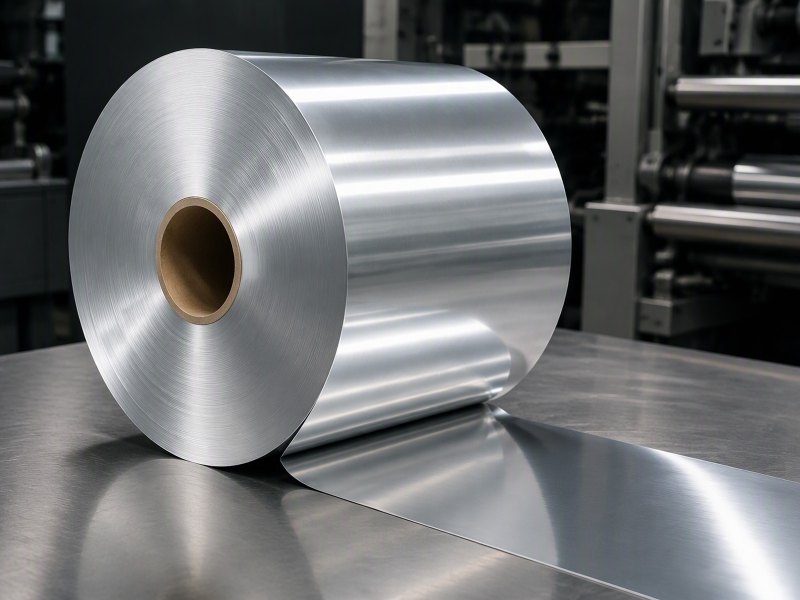
A foil-faced label does not absorb, does not tear along a grain and reflects instead of scattering light. This guide follows face, adhesive and liner through die-cutting and dispensing, and shows what to put in an enquiry.
A foil-faced label is ordered like paper stock, quoted like paper stock, then curls, lifts or splits at the die. The difference begins at the surface.
Aluminium foil does not absorb, so it carries no moisture path; it does not tear like fibre, so it must be cut rather than nicked; and it reflects light instead of scattering it. Converters build stock around those facts.
The result is a laminate whose behaviour is settled before the press runs: by the face the mill supplied, the adhesive chosen for it and the liner underneath. What follows is how those decisions connect.
Why Does a Foil-Faced Label Behave Unlike a Paper Label?
Paper forgives handling. Foil does not. A converter who changes face stock without changing anything else usually meets the difference at the press.
Foil has no fibre to absorb adhesive or moisture, no grain to tear along, and a smooth face that reflects light in one direction. Every downstream decision, from nipping to die geometry, follows from those three differences.
Dive deeper
A paper face is a mat of fibre with air inside it. Adhesive partly sinks into that mat, the fibre swells a little, and part of the bond is mechanical. Foil offers none of that structure: the metal is solid, non-porous and stable, so nothing wicks away from the adhesive, and a water-borne coat can stay tacky longer on foil because moisture leaves only through the exposed face.
Tearing follows the same logic. Fibre tears along a preferred direction, while metal tears from a point of initiation and then runs. A nick that paper tolerates becomes a tear line in foil, and a die that is only slightly dull can stretch or pinch the metal rather than cut it. Light adds a third difference: paper scatters what falls on it and hides shallow dents, while foil returns light in a narrow band and shows every ripple and liner wrinkle.
None of this makes foil difficult to run. It makes foil a different material, and it means a face cannot be swapped without revisiting adhesive, die geometry, web tension and drying. Where the change is treated as a substitution, the complaint arrives weeks later as edge lift or curl rather than as a stoppage.
What Does the Foil Actually Contribute to the Label?
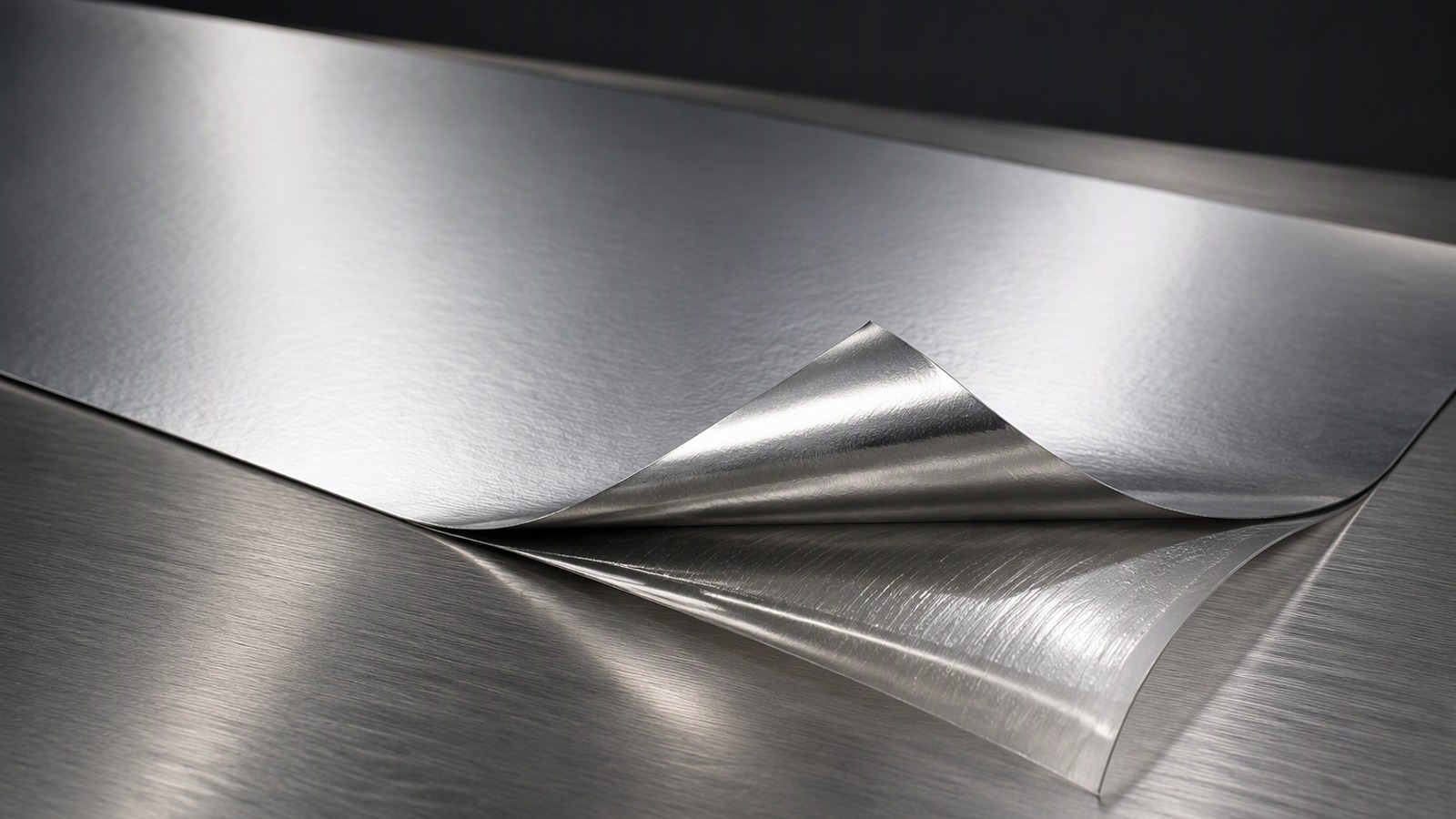
Three contributions, and only the first is obvious: a metallic face, a barrier between the print and what lies beneath, and enough stiffness for a thin face to lay flat.
The foil supplies the appearance, blocks migration from the adhesive and the container, and stiffens a light face so it can be applied without wrinkling. Each of those jobs is a reason to keep the specification stable.
Dive deeper
The metallic face is the visible contribution. Because the surface is continuous, ink sits on a reflective plane rather than sinking into fibre, so a thin ink film reads as a solid colour and no show-through appears from the adhesive beneath. Brightness and colour are decided by the mill finish and by the print, which is why converters match against a physical reference rather than a description.
The barrier is the second contribution and the one buyers underestimate. A continuous metal layer blocks migration in both directions: adhesive components cannot pass into the face, and substances from the container cannot pass back through the label. It also blocks light and moisture, which matters on clear or dark containers where a paper label would yellow, and where the print must hold its colour.
Stiffness is the third. A thin face backed with foil behaves like a stiffer sheet, so it peels from the liner cleanly and lays flat on the container instead of following every imperfection. Too much stiffness, however, fights a curved surface, and the label lifts where the curvature is tightest. The balance is found on the customer's own container, and a converter sourcing through an aluminium foil roll route can adjust temper before thickness.
How Is Foil-Faced Label Stock Built, Layer by Layer?
Three layers do the work: the foil face, the adhesive and the release liner. Each one asks something different of the metal.
The face must be clean and flat enough for the adhesive to wet it evenly; the adhesive must suit that surface and the application; the liner must release without distorting the face.
Dive deeper
The face carries three demands: cleanliness, flatness and continuity. Residual rolling lubricant interferes with wetting; a face that is not flat will not laminate without trapped air; and where a barrier matters the metal must be free of pinholes, which grow more likely as the foil gets thinner. A converter cannot correct any of this downstream, which is why aluminium foil is bought on a surface description as much as on an alloy name.
The adhesive is chosen for the foil, not for paper. It must wet a non-absorbing surface, hold a coat weight that stays where it is put, and cure without solvent or water needing to escape through the metal. That changes drying: heat has to come through the liner or along the face, and an oven profile that suited paper is rarely right for foil.
The release liner sets how the label leaves the roll. It must release steadily, stay flat through changing humidity, and be firm enough not to crease under a stiff face. A liner that is too soft will telegraph through the foil and appear as mottle after printing.
Built together, the three layers behave as one sheet, and most failures are interface failures somewhere in that stack.
Why Does Surface Condition Matter More Than Alloy?
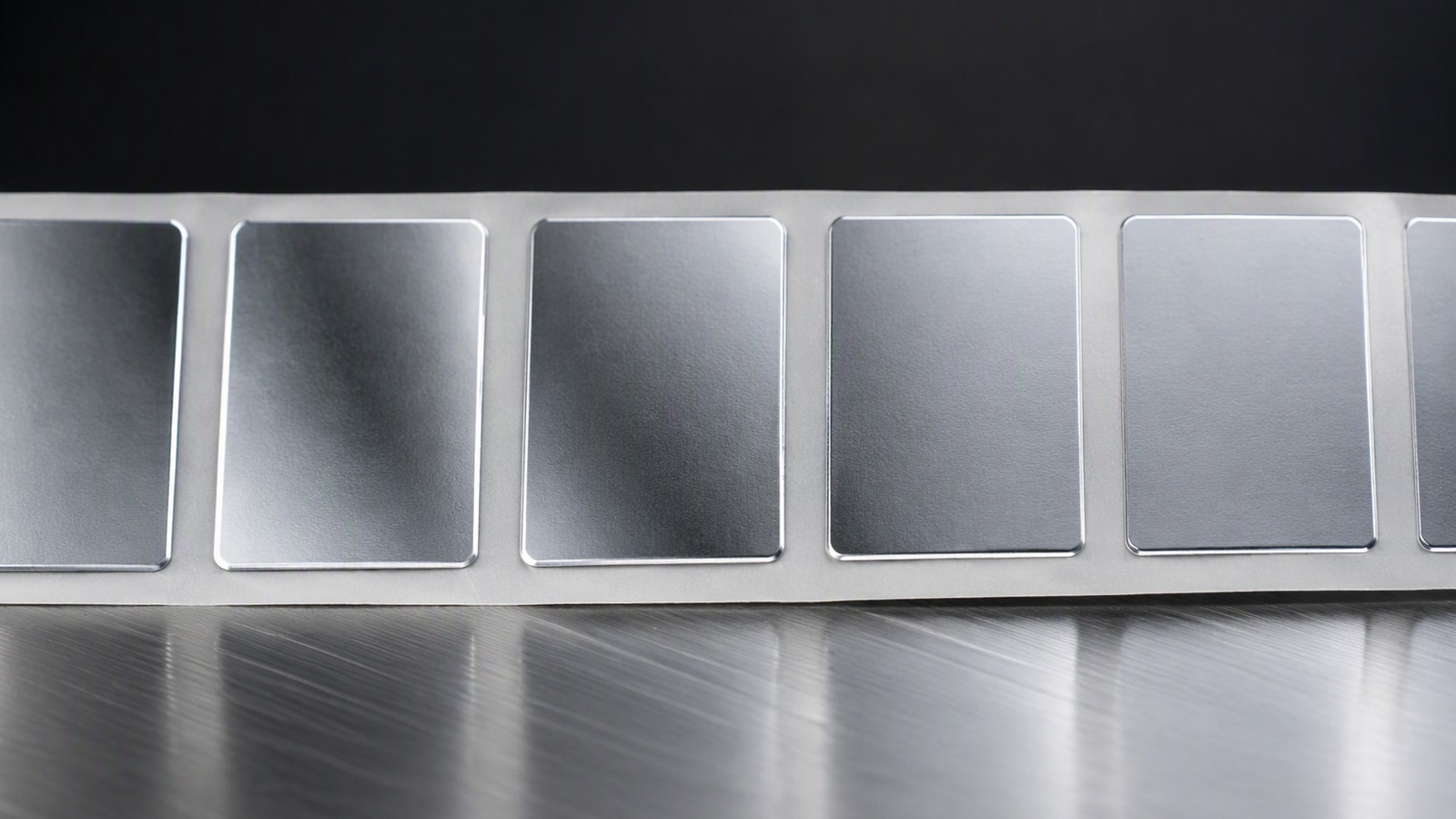
Two foils of the same alloy can bond differently. The adhesive does not read the alloy designation; it meets whatever the mill left on the surface.
Rolling lubricant residue, oxide condition, surface texture and flatness decide how evenly an adhesive wets and how stable the bond stays. Surface, not alloy, sets the bond a converter actually gets.
Dive deeper
Alloy designations describe what the metal is made of, not what its surface is like when the coil is opened. Two coils of the same alloy from different casts, or from the same cast stored differently, can present different surfaces: one wets evenly, the other shows dewetting and a patchy bond.
Three conditions matter most. Residual lubricant from rolling changes the energy of the surface and interferes with wetting. The oxide layer grows slowly in storage and behaves differently depending on how the coil was kept. Surface texture decides how much real contact the adhesive achieves, and it is also what separates a bright finish from a matte one, so appearance and bonding are decided in the same place.
Storage adds to this. A coil kept in a humid corner, or unwrapped for days before use, presents a different surface from one used straight from a wrapped roll. Converters who record how a coil was stored can usually explain a bond problem that a specification review cannot, and a 1050 aluminium foil face is no exception.
The consequence is that an enquiry focused only on alloy leaves the most influential variable unstated, and the answer arrives as a bond that works on one coil and not on the next.
How Do Die-Cutting and Dispensing Change With a Foil Face?
A foil face cuts like metal and dispenses like a spring. Dies that suit paper still run, but differently, and the difference shows in stripping and in the applicator.
Dies need sharper edges and controlled pressure; the web needs lower, steadier tension; and the liner must stay flat so the label does not lift before the applicator reaches it.
Dive deeper
Cutting a foil face is a shearing operation. The die has to penetrate cleanly and separate the metal rather than nick it, because a nick in foil becomes a tear when the matrix is pulled. Dies that have run paper for a long time may be worn in a way that paper tolerates and foil does not, and the symptom is usually a ragged edge rather than a clean cut.
Pressure and anvil condition matter for the same reason. Excess pressure crushes the edge and can damage the liner; too little leaves adhesive connecting label and matrix. The window is narrower than on paper and closes as the die wears.
Dispensing changes in a different way. A stiff face peels from the liner with less stretch, which helps registration on fast applicators, but it also springs back at the trailing edge, so a label can lift before the applicator presses it down. A reflective face can also confuse optical sensors set up on paper, which is a machine-setting matter rather than a material fault, and guidance from the aluminium industry association treats sensors and tension as one adjustment.
The liner has to hold the face flat, because a liner that is too thin or too soft lets the foil curl at the roll edge.

Which Alloy, Temper and Thickness Belong in a Label Face?
The range is narrow in practice: a few alloys, a few tempers, and a thickness that follows the application rather than the catalogue.
Label work usually sits among 1050, 1060, 1100, 1235, 8011, 8021 or 8079, in O, H14, H16, H18, H22 or H24, between 0.005 and 0.20 mm. The final combination is agreed against the customer's own stock.
Dive deeper
In practice the choice is narrow. 1050, 1060 and 1100 are the general-purpose faces; 1235 and 8011 are common where a finer surface and good forming behaviour matter; 8021 and 8079 are chosen where a thinner face must still hold a barrier; 3003 and 3004 come in when stiffness beyond the pure-metal grades is needed. None of these is a label grade in itself.
Temper decides how the face behaves on the container. O is soft and conforms to curvature but marks easily; H14, H16 and H18 climb in strength and spring; H22 and H24 give a partly softened sheet that balances flatness with formability. A face that is too hard will not follow a tight radius, and one that is too soft wrinkles in the applicator.
Thickness follows the same trade-off. A thinner face is more economical and conforms better, but it handles less kindly and is more prone to pinholes where a barrier matters. A thicker face is flatter and stiffer and less forgiving on a curved container. The exact point in that band is agreed by trial on the customer's own stock. Width runs from 100 to 1500 mm, cores are 76 or 152 mm, and the foil roll and sheet range is normally quoted from 3 MT per size.
What Goes Wrong Between the Roll and the Applied Label?
Most foil label complaints appear after application, not at the press: edge lift, curl, wrinkles, a dull patch, a label that will not release.
Curl and edge lift usually trace back to tension, liner or adhesive; wrinkles to web handling or a face too soft for the line; dull patches to surface condition or storage.
Dive deeper
Edge lift and curl are the most common complaints and rarely a foil fault on their own. They usually come from a mismatch of tensions through the press, from an adhesive that has not reached a stable bond before slitting, or from a liner that releases unevenly. A laminate slit too soon after coating carries internal stress that only shows on a curved surface.
Wrinkles point elsewhere. A soft face on a line running high tension will wrinkle before it reaches the die, and the wrinkles are then cut into the label. Trapped air between face and liner looks similar and is a laminating fault.
Dull patches, mottle and variable print density point back to the surface: lubricant residue, oxide condition or storage. They are often intermittent, because only part of the coil was affected, which is why a converter should record where in the coil a complaint came from. The same discipline applies to foil for hot foil stamping and labels.
Storage and handling decide a surprising share of outcomes, since foil-faced stock reacts to humidity through the liner and to pressure on the roll edge. The foil association publishes handling guidance for that reason, and it is worth reading before a complaint is filed.
What Must a Buyer State in an Enquiry?
An enquiry that says only aluminium foil for labels returns a quotation nobody can hold anyone to. Five or six lines prevent most of the rework.
State alloy or leave it open, temper, thickness in mm, width in mm, core diameter, quantity in MT per size and the application. Then say what may be adjusted.
Dive deeper
A useful enquiry reads as a short specification: alloy, or permission to propose one; temper, or the behaviour required; thickness in mm, width in mm, core diameter, quantity in MT per size and the destination port. Then the application, whether the container is flat or curved, whether the face will be printed, and what the surface should look like.
The surface line is the one buyers most often leave out, and the one the mill and converter need most. A description of finish, uniformity and freedom from visible defects says something useful. If an existing label performs well, a sample of the current stock is more informative than any wording, because the specification can then be agreed against the customer's own stock.
It also helps to say what may be adjusted. If the alloy is fixed by a brand requirement but the temper is open, or the thickness may move slightly to improve flatness, saying so removes a round of quotation. Noting which bright side and matte side the design expects belongs there too.
Trade bodies such as the aluminium foil industry publish general background that helps a buyer frame those questions, though the answer always sits with the mill and the converter.
Foil labels are not paper labels with a shinier face. Specify the surface, the temper and the liner together, and the label behaves predictably on the container.