Aluminium foil for wallpaper and decorative laminates: why light?
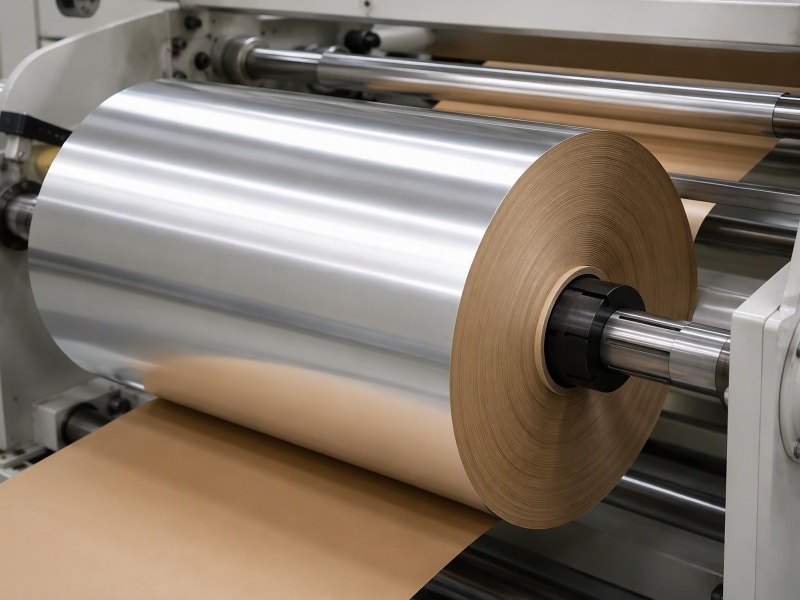
A decorative foil is chosen for the ground it gives to ink and the way it moves with its backing, not for what it blocks. Appearance and dimensional behaviour decide the sheet.
Aluminium foil for wallpaper and decorative laminates: why light?
A decorative wall covering fails for reasons a barrier datasheet never records: a sheen that shifts, a seam that lifts, a grain that shows through the print.
Foil is chosen here for how it reflects and how it takes ink, not for what it blocks. Bonded to paper or non-woven, a thin sheet gives a level face that prints cleanly and holds an emboss.
The eight questions below follow the material from the laminating line to a freshly pasted wall, where appearance and movement decide the specification.
Why is a decorative foil specified for light and surface rather than for barrier?
Buyers arrive with barrier language and leave with a surface problem. On a wall, nothing has to be kept out of the room.
The foil gives the face a uniform reflective ground that ink sits on evenly, and it stops the texture of the backing from reading through the decoration.
Dive deeper
The foil never sees weather. It sits behind a print, inside a room, on one face of a wall, and the only gradients across it are the ones the room creates. Nothing has to be held back, so what decides the result is optical and mechanical, and the result is judged by eye before it is measured.
Three things arrive at once: a reflective ground, a separation between decoration and backing, and a plane that ink can occupy without following fibres. Reference material on aluminium foil describes the material, but it is a starting point rather than a specification.
The separation is what buyers underestimate. Paper and non-woven are built from fibres, and fibres make a landscape. Print on that landscape looks uneven in a way that is hard to describe and impossible to correct afterwards, because the unevenness belongs to the substrate. A thin sheet bridges it, doing the work of a heavy coating without the added thickness.
The ground then decides how the colour reads. Ink on bright metal is not the same colour as the same ink on white paper; it carries a cast the designer either wants or does not. That cast depends on ink, laydown, lacquer and light, so it is agreed against the customer's own design, printed and hung.
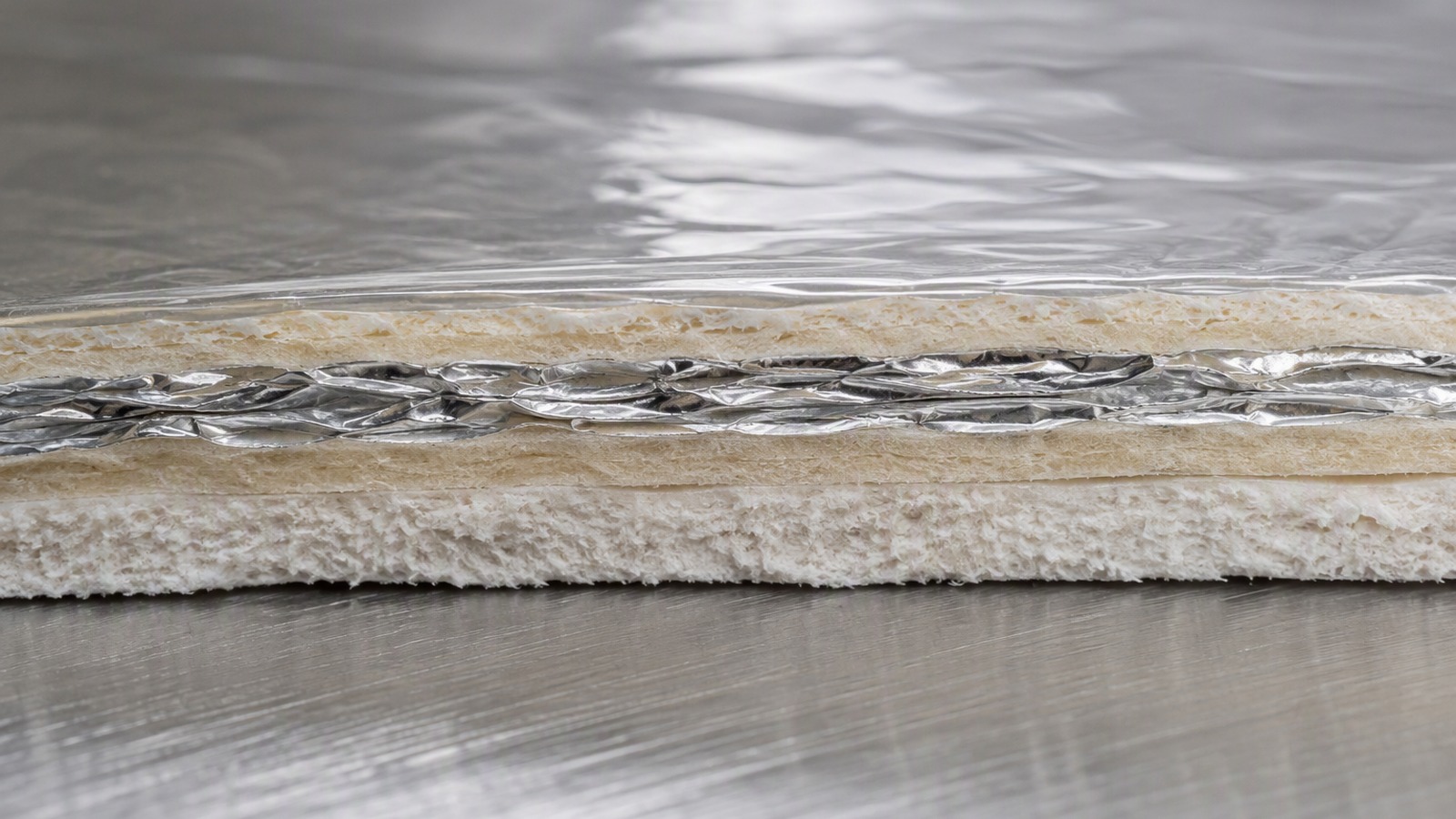
Why do the foil and the backing have to move together when the room changes?
A wall covering is pasted wet and dries on the wall. The backing swells, then contracts, and the foil has to follow without buckling.
Paper and non-woven take up water and expand, then shrink as they dry. A foil that cannot move with them shows as blistering, curled seams or a face pulled tight.
Dive deeper
Dimensional behaviour separates a wall covering from a label. A label goes onto a dry, sealed surface and stays. A wall covering goes on wet, onto a porous wall, in a room whose humidity changes daily, and dries in place.
The backing is the part that moves. Cellulose fibre takes water into the fibre wall, so the sheet grows when pasted and shrinks as water leaves. Growth differs by direction, because the fibres lie mostly along the machine direction. Laminating foil creates a composite in which one layer is nearly inert and the other is not.
What holds that composite together is compliance, not strength. A foil stiff enough to resist the backing wins locally, and the loss appears as a blister where the bond has sheared, or as a seam pulled open. A thinner sheet bends before it loads the adhesive.
The bond also has to be continuous. Spot bonding leaves unsupported spans that behave as separate layers, and a decorated face shows the difference as a mottled surface under shallow light long before anything lifts. How the composite behaves is a question for the converter's line and the customer's paste, not for a data sheet, and the wall itself holds the sheet while it cures.
Why must the surface accept print, lacquer or an emboss without the metal grain showing through?
A wall covering is read at arm's length and touched at the seam. Rolled foil carries its own faint topography, and ink sits on that topography.
Rolling leaves a directional texture and fine ridges. Print and lacquer are thin, so the metal grain must be levelled by the foil itself, or by a primer, before decoration.
Dive deeper
Foil is made by rolling, and rolling is directional. The sheet leaves the mill with a faint texture aligned to the rolling direction, and a difference between the side that met the roll and the side that met another sheet. Both survive lamination and reappear under ink.
A print film is thin, and it follows the surface it is printed on rather than filling it. Where the foil carries a ridge the ink carries a ridge, and that ridge catches light differently from the flat beside it. At reading distance it reads as grain or cloudiness in what should be solid colour, most strongly in dark, saturated prints.
There are two ways to level the surface: start with a foil whose finish is fine enough that the texture sits below what the eye resolves, or add a primer that fills it before decoration, at the cost of a pass.
Surface quality is also where alloy choice shows. The purer grades, 1050, 1060, 1100 and 1235, roll to a finer finish and are the usual starting point for a printed face. A converter testing a design usually asks for 0.008 mm foil for a decorative face first, because thin sheet levels well and follows the backing.
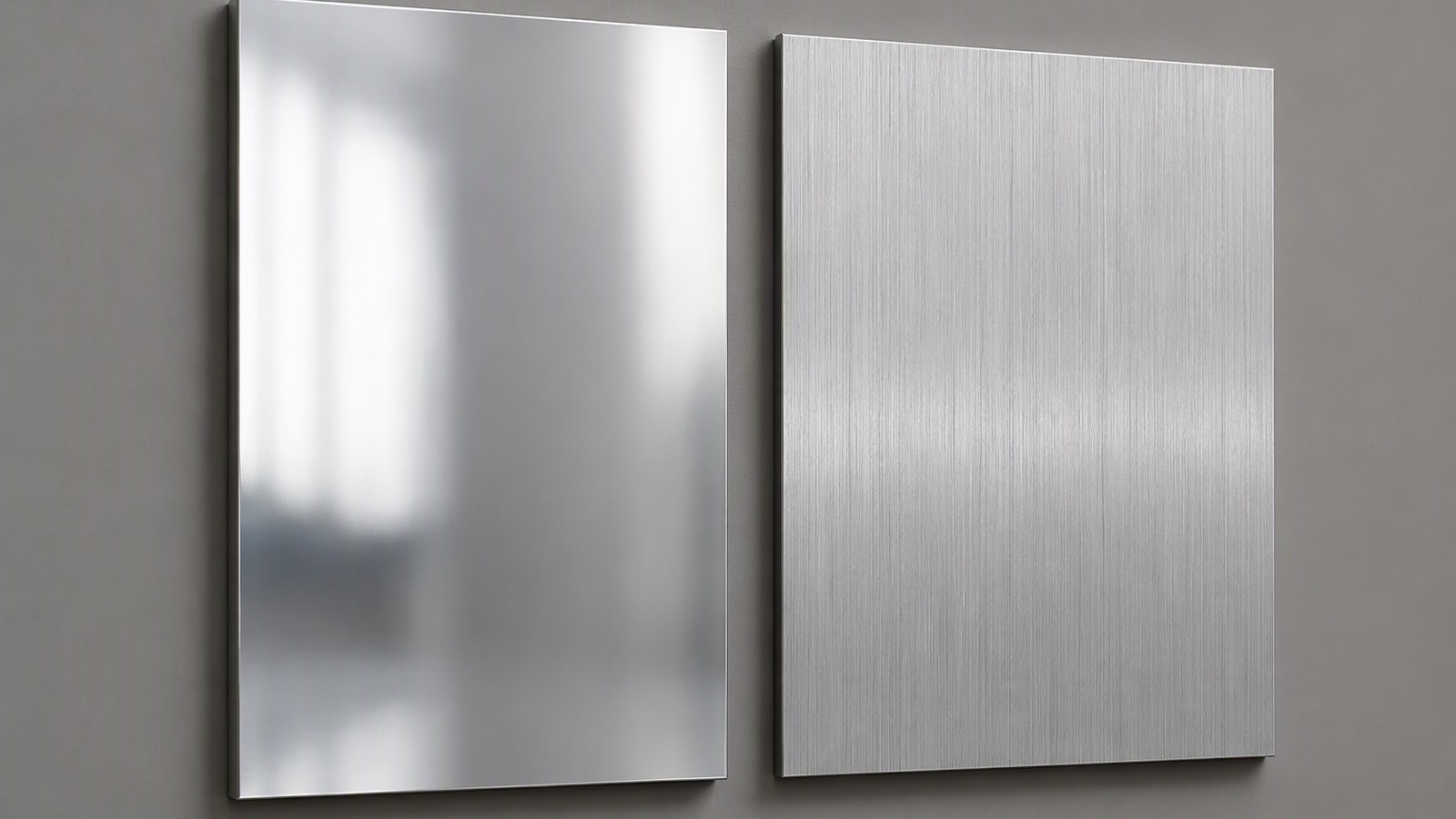
Why do a bright foil and a brushed foil read completely differently under raking light?
Under a ceiling wash at a shallow angle, a bright face throws a highlight and a brushed face spreads that highlight into a band.
Bright foil reflects in one direction, so every wave in the wall becomes visible. A brushed finish scatters light and hides substrate unevenness, which makes the finish a lighting decision.
Dive deeper
Raking light is the normal condition for a decorated wall. A window at the end of a corridor, a wall washer, a pendant close to the surface: each sends light across the wall at a shallow angle, and that angle turns a small deviation into a visible band of light or shade.
A bright foil is close to a mirror. Light arriving at a shallow angle leaves at the same angle, so the eye receives an image of the room rather than a colour. Any departure from flatness redirects that image and becomes a wave.
A brushed or matte finish does the opposite. The surface is made of many small facets pointing in slightly different directions, so an arriving beam leaves as a broad fan instead of a single ray. The eye receives an average rather than an image, and the same wall reads as a soft, even field.
The choice therefore belongs to the lighting design, not the material list. A reception wall lit from above with a narrow beam will show every imperfection of the plaster under bright foil, and will look controlled in brushed foil. Under diffuse light the two converge, so the finish is agreed by sample, hung and viewed in the room.
Why are the adhesive and the paste the real risk to a decorative face?
The foil is often blamed for a stain that came from behind it. Paste moves, and a decorated face shows movement of that kind immediately.
Water-based paste and some laminating adhesives carry salts and plasticisers. Where the bond line is porous or the coating is thin, they reach the face and mark it permanently.
Dive deeper
Migration is the hardest failure to argue about afterwards, because the material that failed looks sound. The foil is intact, the bond is intact, and the face carries a discoloured patch that follows the paste line rather than the print.
What moves is the water phase of the paste and whatever it has dissolved. A wall covering paste is water-based and alkaline, and carries salts from the paste and from the wall. As the assembly dries it travels towards the face and takes those salts with it. If the route is open they arrive under the decoration and stay.
Two things decide whether the route is open. The laminating adhesive matters: a continuous film closes the path, a sparse or foamed application leaves it open. The foil and its coating matter too, because a thin sheet with fine perforations, or a lacquer thin over a ridge, lets water through. Such a face does not fail because it is thin; it fails because the system around it was chosen for cost.
So the paste and the adhesive are part of the product: the converter's adhesive and the customer's paste are tested together, on the customer's wall preparation, before a construction is released. Guidance from the foil industry association in the United Kingdom covers handling; the rest is application testing.
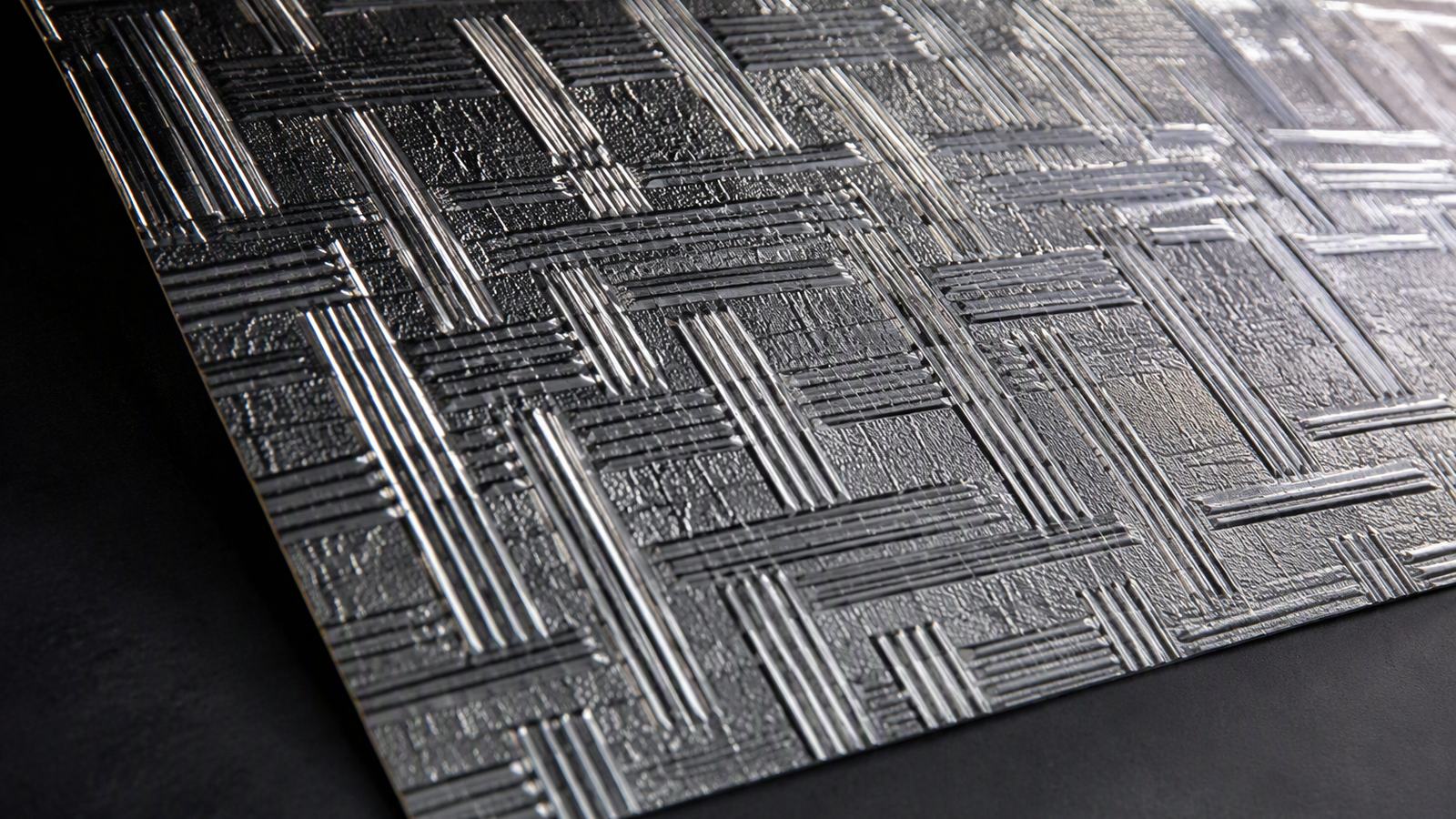
Why is embossing a thin decorative foil a different operation from embossing a thick one?
Embossing here is a forming operation on a very thin sheet carried by a compressible backing, not a deep draw on metal.
At 0.005 to 0.02 mm the foil has almost no reserve of elongation. Pattern comes from the backing, the engraving and the tension, and the foil follows rather than forms.
Dive deeper
A heavy foil embossed on its own behaves like a metal sheet: it stretches where the tool pushes and keeps a shape. A decorative foil at 0.008 mm or 0.012 mm aluminium foil has almost none of that reserve, and treating it as a small version of the heavy process produces a pattern that looks torn.
In a decorative structure the pattern is carried by the layers under the foil. The backing, paper, non-woven or foam, compresses under the tool and lets the foil descend without being stretched into it. The foil acts as a skin, taking a shape the backing has accepted, and depth is limited by how far that backing compresses rather than by the tool.
Temper sets the character. A soft temper such as O deforms readily and holds fine detail; a harder temper such as H18 springs back and is chosen when the pattern must survive handling rather than reach depth. Where pattern must register with print, behaviour during the pass matters more than strength.
Because the two operations differ so much, a decorative emboss is discussed with the converter who owns the pattern rather than settled from the foil side. What foil embossing is used for at all is a separate question: here the pattern is decorative, and depth is whatever the backing will carry.
Where does a decorative foil end and a technical facing begin?
The same alloy can face a wall or face a duct. The questions that decide the specification are not the same questions.
A decorative foil is judged on appearance, printability and how it moves with its backing. A technical facing is judged on vapour and thermal behaviour, and briefed differently.
Dive deeper
Both products are thin aluminium bonded to something else, and both are bought by people using the same vocabulary. That overlap causes more specification errors than any material decision: a requirement central to one product is irrelevant to the other, and neither buyer notices.
A decorative foil is judged by the eye and by the behaviour of a pasted sheet. Success is a face that prints evenly, holds a pattern, keeps its colour and stays flat after the paste has dried. Its failure modes are visible: a grain, a wave, a stain, a curled seam. None appear in a barrier discussion.
A technical facing is the reverse. It is judged on what crosses it, how it behaves in an assembly, and what happens to that assembly over time. Appearance is secondary, and a facing that looks uneven can be entirely correct for its job. The building insulation facings article follows that logic and is deliberately a different brief.
What the two share is a set of manufacturing habits: a clean surface, a continuous bond, controlled handling of a thin sheet, a winding that does not crease. Those are why a decorative converter and a technical converter often buy from the same industrial and technical foil range while specifying entirely different properties.
What has to be stated in an enquiry before a decorative foil can be quoted?
An enquiry that names only an alloy and a thickness leaves the two decisions that matter unanswered.
Name the backing, the decoration route, the lighting the finished surface will be seen under, the paste system and the laminating line. Then foil, temper and finish can be agreed.
Dive deeper
First, state what the foil is bonded to, in enough detail to describe how it moves. A paper backing and a non-woven behave differently when pasted, and a foam-cored structure differs again. Thickness follows from that answer, and the range from 0.005 to 0.20 mm is wide enough for a wrong choice to be costly.
Second, the decoration route: print, lacquer, emboss, or a combination, and in which order. Printing before embossing asks something different of the foil from embossing before printing, and a clear lacquer needs a smoother face than bare foil. Third, the light the wall will live under.
Alloy from 1050, 1060, 1100, 1235, 3003, 3004, 8011, 8021 and 8079; temper from O, H14, H16, H18, H22 and H24; thickness within 0.005 to 0.20 mm; width within 100 to 1500 mm; core 76 or 152 mm; MOQ 3 MT per size; shipment from Qingdao, Tianjin or Shanghai.
Such an enquiry can be answered with a proposal rather than a price. Reference data from an industry association for aluminium and from the aluminium association in the United States is background; the structure is agreed against the customer's decorative design and laminating line.
A decorative foil is a surface and a moving partner for its backing. Specify it from the wall and the light, not from a barrier table.