Aluminium foil or metallised film: which barrier layer is right?
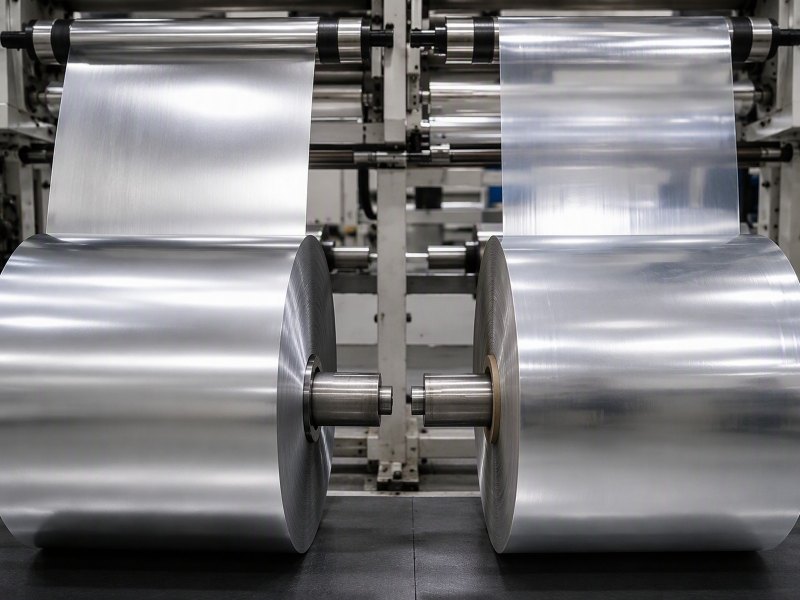
Foil is a wrought metal sheet; metallised film is a deposited layer on a carrier. This comparison follows both through the fold, the corner, the pinhole and the line.
Aluminium foil or metallised film: which barrier layer is right?
Two barrier layers, one shelf, one budget: solid foil and metallised film both promise protection, and neither datasheet says which promise survives the machine.
Foil is a wrought metal sheet; metallised film is a thin deposited layer on a plastic carrier. The first carries its own barrier, the second borrows one, and that difference decides most specifications.
The eight questions below walk both candidates through the tests a pack actually applies: the fold, the corner, the pinhole, the shelf and the line.
What is the real difference between a foil ply and a metallised film?
One candidate is metal all the way through; the other is a coating so thin that it needs a plastic web to exist.
A foil ply is rolled metal, homogeneous face to face. A metallised film is a plastic web carrying a microscopic metal deposit. Strength, stiffness and barrier come from different places, and they fail in different ways.
Dive deeper
A foil ply starts as cast slab, rolled, annealed and rolled again until it will flex. What reaches the line is wrought metal: one alloy through the whole section, a worked grain structure, and two surfaces formed by rolls rather than by anything laid on top. There is no carrier and no adhesive inside it. Tear it and you are holding metal.
A metallised film starts as a plastic web, usually a polyester or a polypropylene, and the metal is added afterwards in a vacuum chamber, condensing on the surface as a layer vastly thinner than the film beneath. The deposit copies the surface it lands on, surface texture included, and it is held by adhesion rather than by metallurgical continuity. Tear it and you are holding film with a sheen.
So the headline barrier claim is a weak guide. Both constructions may be called high barrier and both may be honest, because they are barrier for different reasons and they fail for different reasons. One buys metal; the other buys a surface treatment on a carrier already doing the mechanical work. The useful question is not which is more barrier in the abstract, but which mechanism your pack can keep whole until it is opened. Background sits in this entry on aluminium foil and how it is rolled.
Why does solid foil have no carrier, and metallised film no metal to spare?
Each construction lacks what the other supplies, and the missing part is usually where a specification quietly breaks.
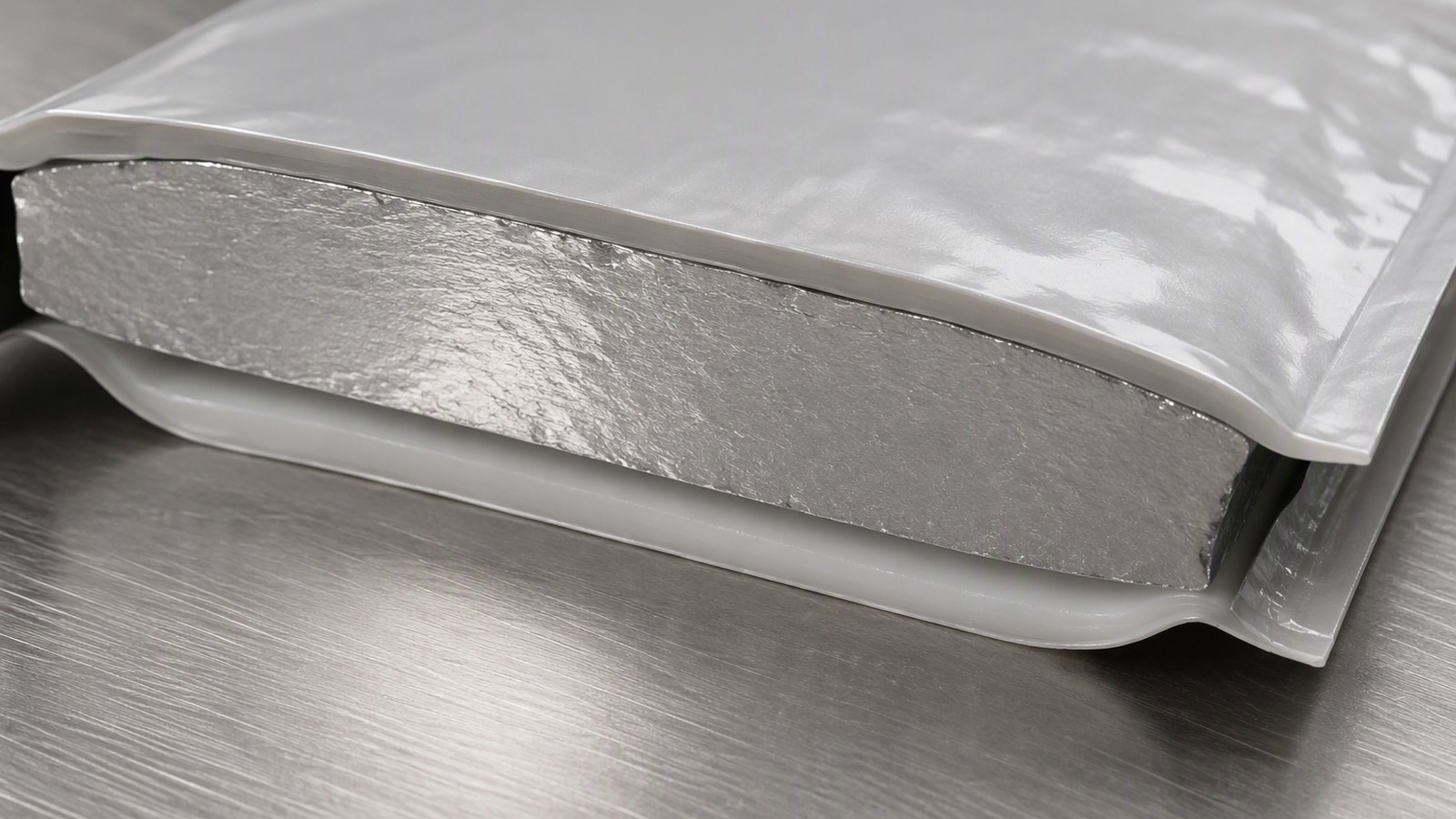
A foil ply must supply its own strength, so gauge and temper become structural choices. A metallised deposit supplies only the barrier, so the carrier must be smooth and handled gently for that barrier to stay whole.
Dive deeper
Foil in a laminate is asked to do two jobs at once. It is the barrier, and it is also a structural ply that resists bending, holds a fold and stops a pouch from collapsing. With no carrier behind it, every gauge reduction removes strength as well as metal, and the temper has to be chosen for the fold it will meet. Soft temper bends without cracking but marks easily; a harder temper resists handling and complains at a sharp crease.
A metallised deposit is in the opposite position. It contributes almost nothing to stiffness, and it cannot be made thicker to compensate for a rough surface, because thickness is not what the process sells. The carrier does the mechanical work and the deposit is a skin on it. The quality of the plastic web therefore becomes a barrier variable: a smooth, clean surface gives a continuous layer, while scratches, additive bloom and dust give breaks before the pack is filled.
Handling is the second consequence. Foil can be unwound, printed and laminated with ordinary care. A metallised web cannot be dragged over a rough idler or wiped with a harsh solvent without losing deposit locally. How the metal is produced and used is described by the aluminium industry's own material notes.
How does each behave at a fold, a crease and a formed corner?
Flat samples agree with each other. Corners do not, and a formed corner is the closest bench test to the abuse a pack meets in a carton.
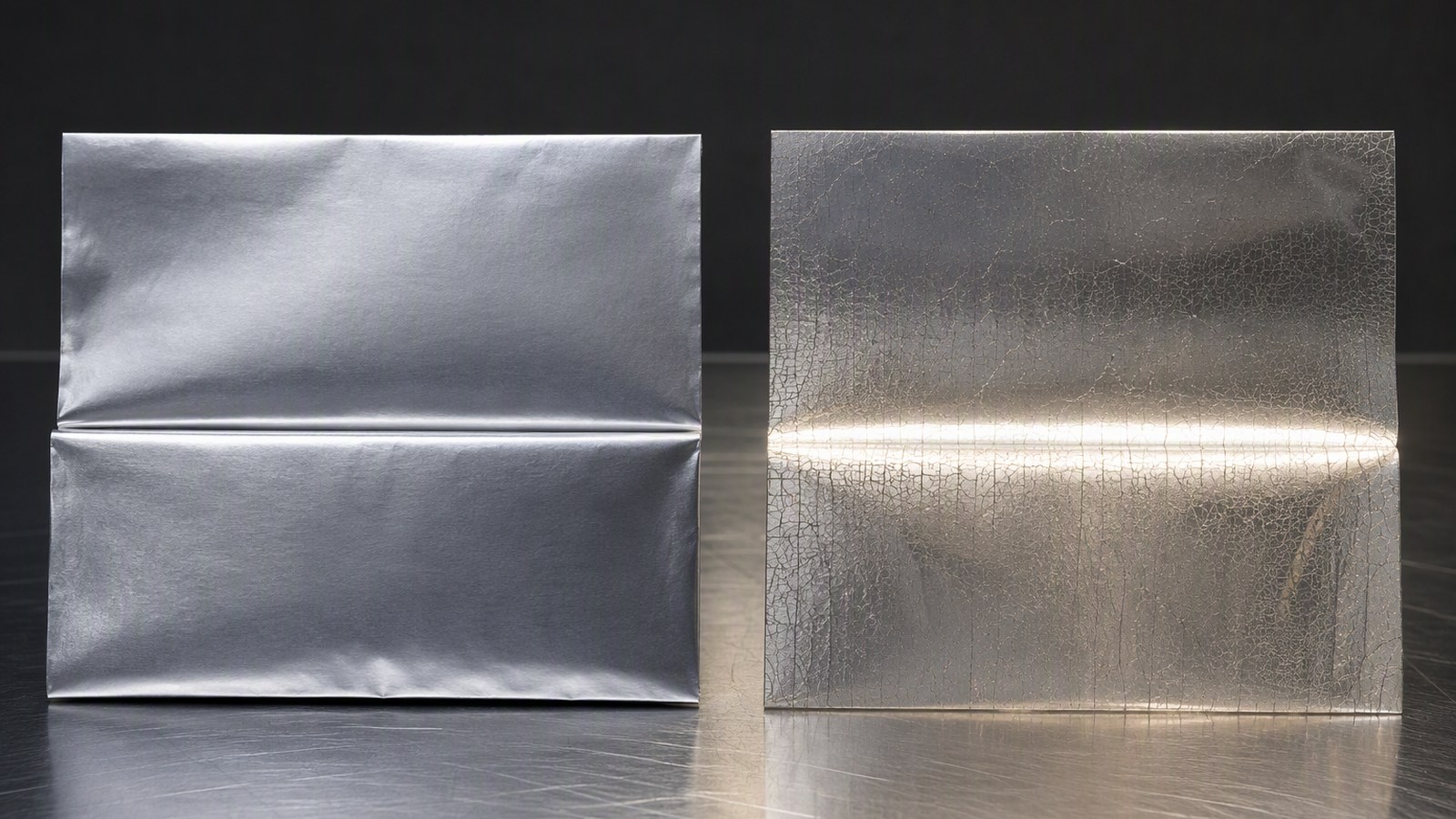
Foil folds and stays folded, thinning at the crease and sometimes cracking across it. Metallised film springs back, but its deposit can craze along the fold and lose barrier where the pack is tightest.
Dive deeper
Fold a foil ply and the metal deforms plastically. It thins at the bend, work-hardens there, and keeps the shape you gave it, which is why a foil sachet stays flat. The weakness is the same property: at a tight crease the outside of the bend is stretched until it can crack, and a crack that starts there opens further with every handling.
Fold a metallised film and the carrier behaves like a spring. It bends, then returns, and the deposit on the outside of the bend is asked to stretch with it. A very thin metal layer has little ductility to offer, so it crazes: fine cracks appear in the deposit, visible as a dull haze across the fold, while the film looks unharmed. The pack still holds its product; the barrier along that line does not.
A formed corner on a form-fill-seal machine combines both insults. The web is drawn over a shoulder, stretched, folded into a fin and pressed at a jaw within a short distance. Foil tends to thin and pinhole where the draw is sharpest; metallised film tends to craze along the shoulder lines. That is why a fold test on the bench often predicts field behaviour better than a flat measurement, and why converters keep thin 1235 aluminium foil for lamination in soft tempers for packs that will be folded hard.
Why do pinholes mean different things in foil and in a metallised layer?
A hole is a hole until you ask what it interrupts: here a barrier ply, there a skin on a carrier that still stands.
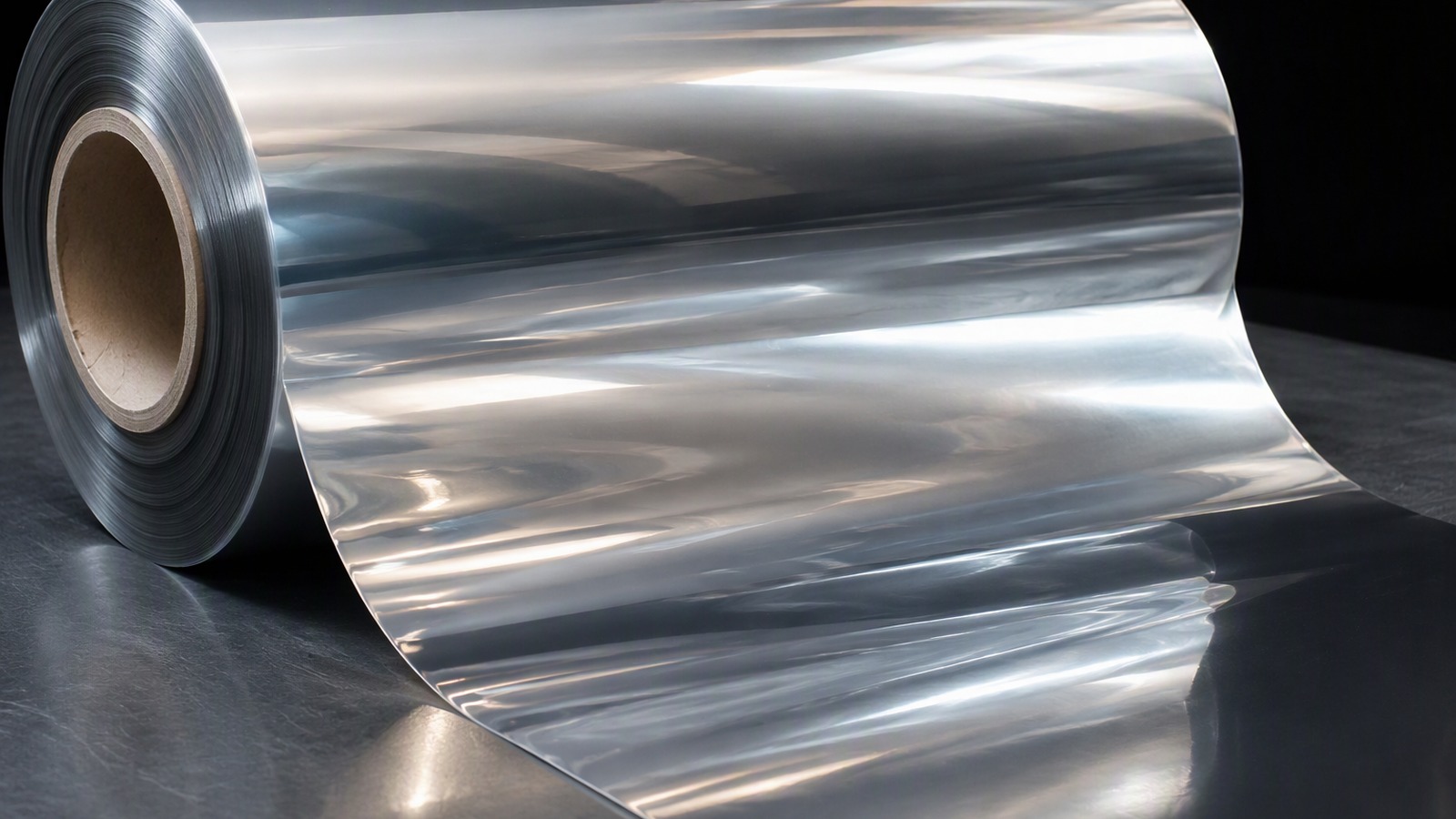
In foil, a pinhole is a passage through the whole barrier ply. In metallised film, a break exposes the carrier, which slows transmission in its own way, so each defect matters less but the count is higher.
Dive deeper
Foil pinholes arrive from several directions. Some are rolled in, where a hard particle or a sliver of oxide was pressed into the sheet and later fell out. Some are mechanical, made by a crease, a rough guide or a handling nick. Some grow in service, as flexing fatigues the metal along one line until it opens. Whatever the origin, the consequence is identical: a continuous path from the product to the room.
Breaks in a metallised deposit behave differently. They are usually more numerous and far smaller, they follow the texture of the carrier, and they appear wherever the web has been stretched or scratched. Because the plastic underneath is still a barrier in its own right, one break does not create an open path the way a foil pinhole does. The penalty is gradual rather than immediate, which is reassuring for a dry product with a short life and less so for aroma retention over a long one.
Inspection follows the same logic. Foil is checked by looking for light through the sheet and by counting what shows. A metallised web is checked for continuity, haze, mottle and streaks, because its defects are distributed rather than isolated. The mechanics of the first case are set out in this note on what causes pinholes in thin aluminium foil.
Why is looking metallic not the same as being a barrier?
Shelf presence is bought with brightness. Barrier is bought with continuity, and the two are rarely sold in the same proportion.
A metallised film can look more mirror-like than a foil laminate and carry far less metal. What the shopper sees is reflectivity; what protects the product is an unbroken layer, however slight.
Dive deeper
Brightness is an optical effect, and it depends on how smoothly a surface reflects light rather than on how much metal is present. A very thin deposit on a glossy carrier can look like a mirror, because the carrier underneath is already smooth and the deposit simply follows it. A foil ply is bright for a different reason: light reflects from solid metal, and the surface was polished by the rolls that made it.
This is where a specification written around appearance goes wrong. A brand team asks for a metallic look, a converter delivers a metallised laminate that photographs beautifully, and everyone assumes the barrier question was answered at the same time. It was not. The two properties are set by different things, and a pack can be spectacular on shelf while being ordinary in the carton.
Printing and lacquering hide the difference further, because a printed metallised web and a printed foil web are almost indistinguishable once artwork is laid over them. The honest way to separate them is to hold the web against a light and look for variation, then fold it and look again. A surface that mottles or hazes is telling you about continuity, not about style. Constructions used for packaging are described in this overview of packaging and container foil.
Where does each win on a form-fill-seal line?
A vertical or horizontal line rewards stiffness, dead fold and predictable running far more than it rewards a laboratory figure.
Foil wins where the pack must hold a shape, crease at the jaw and run without spring-back. Metallised film wins where the web must stretch, seal across a wide window and survive a long, fast path.
Dive deeper
On a form-fill-seal machine the web does something different at every station. It is drawn from a roll, pulled over a shoulder, formed into a tube or a pocket, filled, then sealed and cut. Foil helps at the jaw, because a dead-folded metal web keeps the crease the jaw gave it and produces a flat, tight sachet. It helps at the fin, where stiffness keeps the seam straight. It struggles at the shoulder, where a tight draw concentrates strain and a crease can become a crack.
A metallised film helps where the machine is fast and the path is long. Its carrier stretches and recovers, so it tolerates misalignment and tension swings that would mark a foil web. It seals over a broader set of conditions, because the seal is made through the carrier and the deposit plays no part. It struggles where the forming shoulder wrinkles the web, since every wrinkle is a craze line, and where the pack must stand after filling.
The practical consequence is that the two rarely run on the same settings. Tension, former geometry, seal pressure and dwell all shift, and a trial that keeps the old recipe flatters whichever material the line was set up for. Running notes for thin gauges are collected by the foil industry's technical pages.
Where does each win in a laminated pouch?
In a pouch the barrier is one ply in a stack, and the stack decides how much of the barrier survives the journey.
Foil wins in a pouch that must hold a long life, resist aroma loss and take handling, because the metal is continuous. Metallised film wins where the pouch is a shorter-life, high-impact shelf piece.
Dive deeper
A pouch is a structure, not a material. An outer print web, a barrier ply, the adhesive between them and a sealant inside all have to work together, and each changes what the barrier ply experiences. Foil in that stack contributes stiffness as well as barrier, so a pouch with a foil ply tends to stand, to crease rather than stretch at the gusset, and to keep a crisp shape after filling. Its risk is flex cracking where the gusset meets the base, and that risk rises as the pouch grows and the foil thins.
A metallised ply changes the stack in the other direction. It adds almost no stiffness, so the pouch depends on the outer web and the sealant for body, and it bends rather than creases. That is an advantage in a large format that must survive a rough chain without cracking, and a disadvantage where the pack should look rigid and premium.
Adhesive choice matters for both, for different reasons. A foil ply is bonded metal and tolerates most laminating systems. A deposit can be affected by the adhesive laid over it, so that pairing has to be checked rather than assumed. Stiffer pouch structures often use a firmer foil for a pouch that must stand.
Why does the honest answer depend on the pack, and what should an enquiry state?
There is no better material in general, only a better fit for a particular life, a particular sensitivity and a particular journey.
Pack life, product sensitivity and the abuse the pack will take decide the choice. An enquiry that states all three, plus the test the pack must pass, gets a usable answer.
Dive deeper
Start with life: a pack filled on Monday and opened on Friday tolerates defects that a pack meant to sit for a year does not. Then sensitivity: a dry powder, a fatty snack, a coffee and a cosmetic each care about a different part of the barrier, and a construction generous for one may be marginal for another. Then abuse: a pouch travelling in a carton is treated differently from one carried in a bag.
Only after those three are written down does the material question become answerable. A short-life pack with high shelf impact can be served by a metallised film; a long-life pack with an aroma-sensitive product is better served by a foil ply, which stays a barrier while the metal stays continuous.
What to put in an enquiry
State the product and its sensitivities, the target life, the pack format and its dimensions, the filling line and its speed, the abuse expected in distribution, the structure you run now and what it fails to do, and the quantity in MT per size. Ask for the alloy and temper recommended, the gauge range considered workable, the width and core the coil would come on, and the port of loading. Structures are compared in this note on how a flexible pouch structure is put together, and market context sits with industry market data on aluminium use. A first order at 3 MT per size is normal, on 76 mm or 152 mm cores from Qingdao, Tianjin or Shanghai.
Compare both candidates on the pack you actually fill: the material that keeps its barrier through your folds and your distribution is the right one.