How does rolling oil affect the aluminium foil surface?
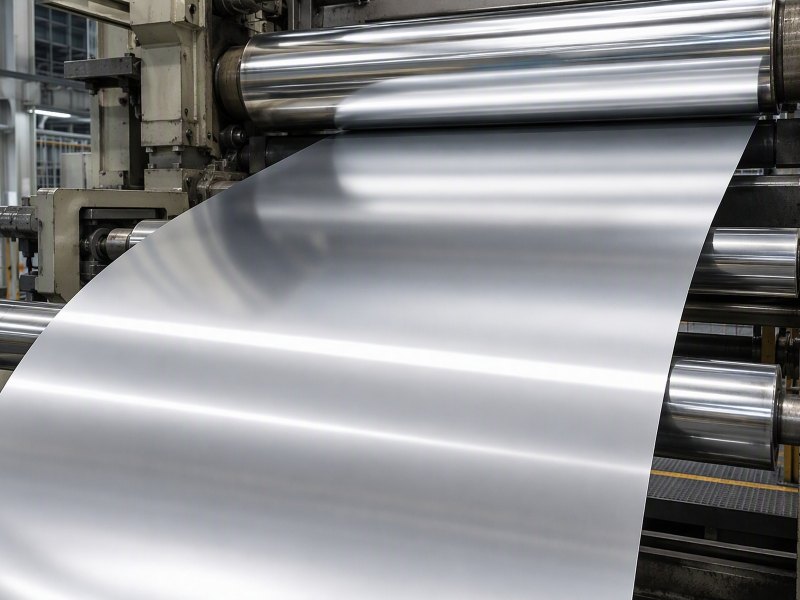
A residue you cannot see decides how ink, lacquer and adhesive behave. This guide follows rolling oil from the mill bite to the converter's first print run.
How does rolling oil affect the aluminium foil surface?
Two coils leave the same mill looking identical. One prints cleanly, the other dewets in patches, and the difference is a film nobody can see.
Rolling oil cools the bite, and a thin film stays on the strip. That film, with its additives and fines, changes how ink, lacquer and adhesive wet the metal.
The eight questions below follow that film from the roll bite to the converter's first print run, and end with what an enquiry should state.
What is rolling oil doing inside a foil mill?
Oil is not a coating applied on purpose. It is the medium the pass happens in, and every function leaves something behind.
The oil separates roll from strip, carries heat out of the bite, flushes fines and controls friction. Without it the pass would seize; with it, a film stays on both faces.
Dive deeper
A foil mill does not print oil onto the strip; the oil is the condition under which the pass is possible at all. Two work rolls are pressed together until the gap is thinner than a human hair, and at that gap the metal does not flow like a liquid. It extrudes, and the roll faces must slide over it without tearing. A film of oil in the bite does that work: it keeps aluminium from welding to steel, spreads the load, and carries away the heat that the deformation generates. Without such a film the pass would pick up, mark, and eventually break.
That is why the oil is chosen for what happens inside the bite rather than for what happens afterwards at a press. Additives that adsorb on freshly exposed metal lower friction, and they do it best before the surface has grown its oxide. The reference entry on aluminium foil describes the reduction sequence from strip to thin gauge.
The consequence is unavoidable. The same additive that helps in the bite is still on the surface at the exit. How much remains depends on the oil, the speed, the reduction and the mill's own practice, and it is the mill's own method, not a published figure, that establishes it.
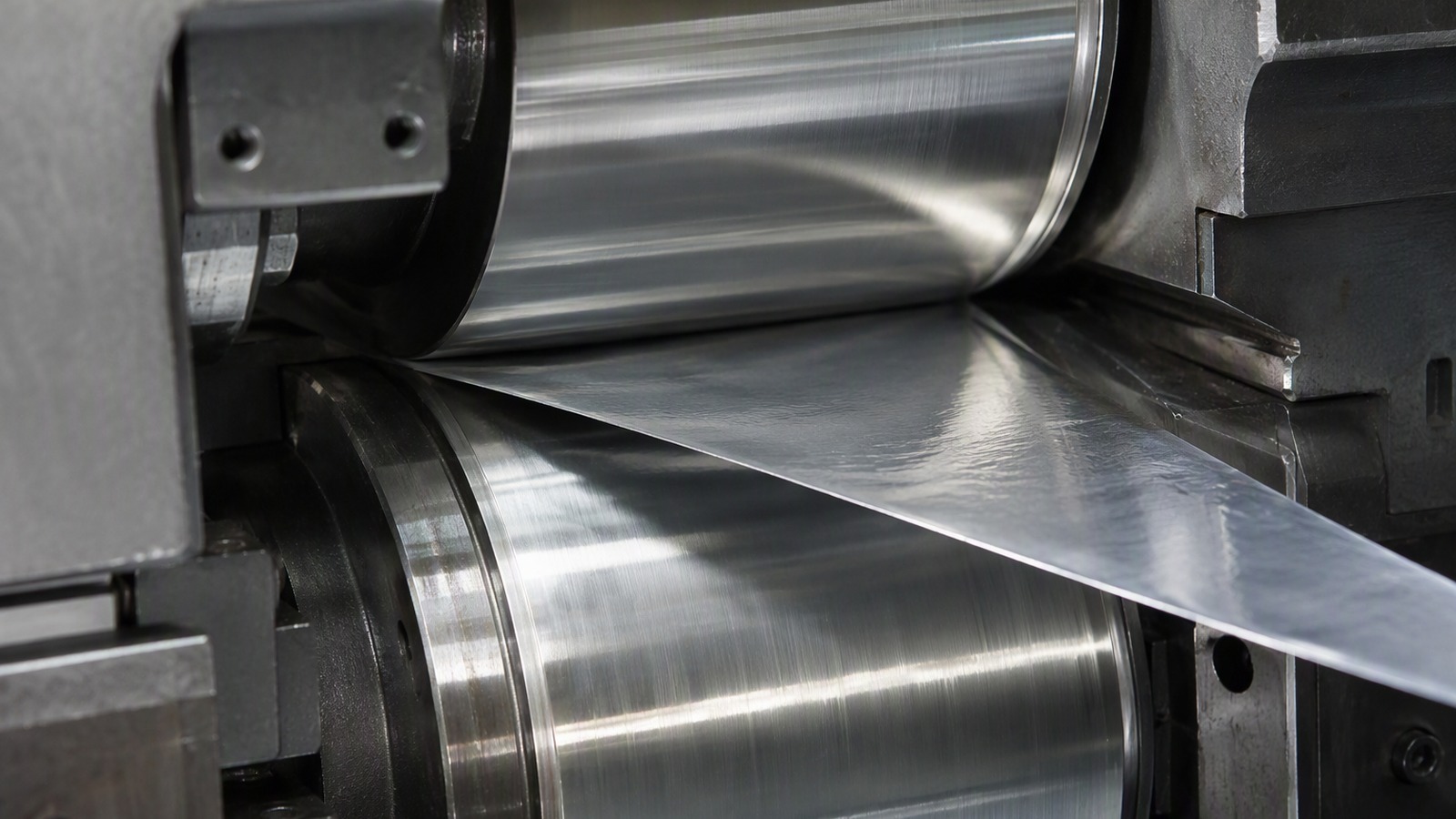
What does the oil leave behind on the strip?
A mill does not hand over dry metal. It hands over metal still carrying the pass, and what survives is not one substance.
Two things remain: free oil that a solvent will lift, and a bound layer of additive attached to the oxide that a dry cloth will not shift. Fines ride with both.
Dive deeper
At the exit the web is warm, fast and wet. What happens in the next moments decides how much stays: some oil drains back into the mill, some is blown off, the lighter fractions of the carrier leave, and some is pressed into the coil as the web is wound under tension. A coil that feels dry on the outside has simply lost the part that could leave.
The bound layer is the difficult one. Its polar end has attached itself to the oxide on the metal, so it behaves as part of the surface rather than as something sitting on it. A wipe lifts what is loose and polishes what is bound. This is why two coils can pass the same wipe test and behave differently on the same press.
Both layers carry debris: metallic fines from the pass, oxide particles, and the products of oil that has been worked and warmed many times. These sit in the film and travel with it into the coil, so the surface delivered to the first unit is not the surface the mill inspected.
The foil association alufoil treats surface condition on thin gauge as part of the product description rather than an afterthought, which is a useful way to read any supplier document.
Why does a residue you cannot see still matter?
A film thin enough to be invisible still decides what a liquid does when it lands on the metal.
Ink, lacquer and adhesive are liquids that must wet metal and grip it. A low-energy film redirects them, so the failure appears in the converter's process rather than on the coil.
Dive deeper
An oxide surface is a friendly place for a liquid. Aluminium oxide carries a polar character, and most printing inks, lacquers and laminating adhesives are built to spread on it. The oil film interrupts that relationship. Where a layer of fatty additive sits on the oxide, the liquid arriving on top meets a low-energy surface instead of a receptive one, and its choice is to pull into droplets rather than to spread.
The practical result is not a stain. It is a decision taken by the liquid, in the first fraction of a second, at every point across the web. Where the film is continuous the liquid retreats and leaves bare metal; where the film is broken the liquid grips. The converter then sees a pattern that follows the oil rather than the ink. No ink adjustment removes it.
Nothing here is reversible by waiting. A wound coil can transfer free oil from one lap to the next, so a clean outer wrap proves little about the laps beneath it.
Which foils meet this question is largely a matter of what they are made for. The industrial and technical foil range covers the gauges that go on to printing, lacquering and lamination, and those are the processes where a surface film is measured by its consequences.
How does residue show itself at printing, lacquering and lamination?
The three processes fail differently, and each failure carries a signature that points back to the surface it started from.
Printing shows dewetting and a hazy, mottled solid; lacquering shows craters and rivulets; lamination shows bubbles, streaks and weak peel. All three begin where liquid met metal.
Dive deeper
Printing is the most sensitive of the three, because the ink layer is thin and the result is judged by eye. A surface that repels ink in small areas shows as mottling, as a haze over a solid panel, or as a speckle that looks like a dirty anilox. On a halftone the same condition appears as lost detail in the highlights.
Lacquering leaves another signature. A clear coat over a contaminated band breaks into craters, and the craters have a rim where lacquer flowed away and piled up. In bad cases the coat pulls into rivulets that run along the web direction. Adhesion can pass a fingernail test and still fail in service, because the lacquer is sitting on film rather than on oxide. The article on what lacquering does and when it is needed keeps the coating's job separate from the surface's condition.
Lamination fails at the bond line. Adhesive applied over a contaminated band does not wet evenly, so the bond is strong in some strips and absent in others, and the laminate shows bubbles or a silvery streak that opens when the pack is flexed. A peel result from one strip will not describe the whole width. In all three processes the pattern runs along the machine direction, because that is how the film was laid down.
Why is the residue not evenly spread across a wide web?
A coil is wound from a web that was never uniform, so its film is a map rather than a layer.
Roll crown, coolant delivery, edge drainage and winding tension all differ across the width. The film is heavier in some bands than others, and so is the risk.
Dive deeper
The work rolls are ground with a crown, so the gap is not the same at the centre as at the edge. The strip arrives with a flatness profile, and tension distributes itself across the width according to that profile. Oil is delivered through nozzles whose pattern is never perfectly even, and it escapes through a gap that narrows at the edges. Each of these turns the residual film into something with structure.
Drainage matters as much as delivery. At the exit the web runs upward or sideways, and oil leaves it under gravity and airflow. The path is shorter at the edges, so free oil clears there sooner; the centre keeps a film longer and winds it into the coil. Where the web is pressed tight against a roll the film is squeezed thin, and where it runs slack a heavier film survives.
Slitting adds a second pattern. The knives are lubricated, and the cut edge carries oil the parent coil never had. A converter who tests a strip cut from the edge is not testing the centre, and a converter who tests the centre is not testing the edge.
European Aluminium describes rolling as a chain of dependent passes, which is why a surface condition can be set several steps before it is found.
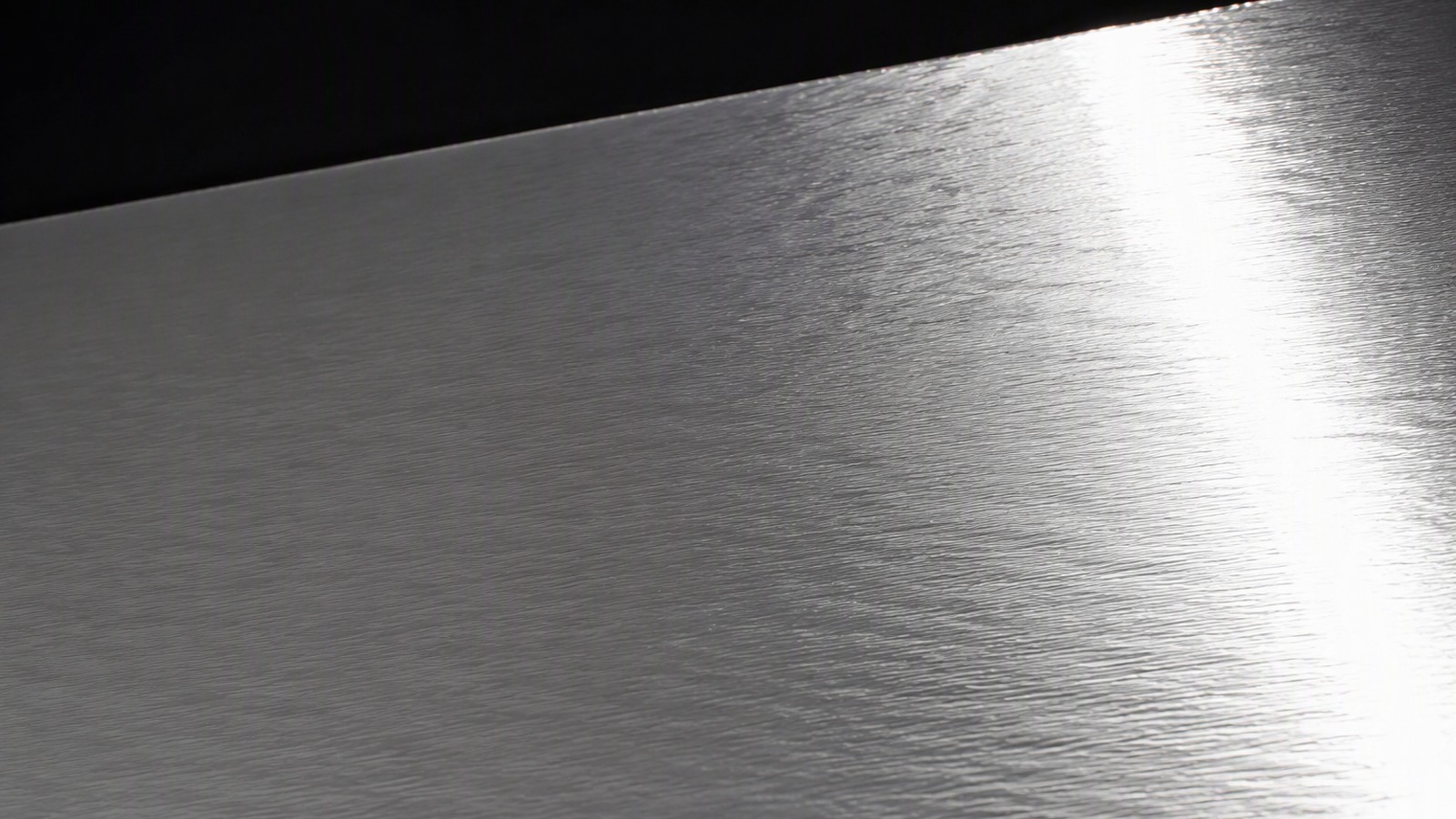
What does degreasing remove, and where does it sit in the process?
Degreasing is a step with limits. It removes what it can get at and leaves what it cannot, and its position decides which matters.
Degreasing lifts free oil and loose debris by solvent, by an aqueous bath, or by heat. It belongs after the last operation that adds oil and before the first that needs a clean surface.
Dive deeper
A solvent wipe or bath dissolves free oil and lifts loose debris. It is quick, it is usually done at the converter, and it leaves a bound layer largely in place. An aqueous line with an alkaline builder, a rinse and a dry removes more, and it can sit inside a coating line so the surface is cleaned immediately before the first application. Heat works differently: annealing burns off organic residue and at the same time grows the oxide, so the surface that comes out is not the surface that went in.
Rinse and dry decide the result. Water that carries dissolved material, or a dry that leaves the last of it behind, can put a residue back on a surface that was just cleaned, so bath condition and rinse condition belong to the process rather than to the chemical alone.
Position is the part converters most often get wrong. Degreasing must sit after the last operation that adds oil and before the first that needs a clean surface. If the coil is slit after degreasing, the slitting lubricant puts the problem back on both faces, and the cleaning was wasted.
General guidance from the Aluminum Association treats cleaning as a process step with its own controls rather than as a wipe before the line starts.
How can a converter check cleanliness on receipt without a laboratory?
A converter needs an answer in an hour, not a report in a week, so the useful methods are comparisons rather than measurements.
Flood a cut length with clean water, rub a marked band with a white cloth, look along the surface at a low angle, then run a small print trial.
Dive deeper
The oldest method is wet-out. A cut length is flooded with clean water and the film is watched. On a receptive surface the water holds as a continuous sheet; where the surface is oily the sheet retreats and breaks into islands, and the shape of the retreat shows where the film lies. The reading is by eye, so one operator should read control and trial side by side.
A wipe test is the second. A lint-free cloth, lightly wet with clean solvent, is drawn across a marked position, and the cloth is inspected against white paper. A grey trace is debris, a darker trace is oil, and a clean cloth on one band beside a marked cloth on another proves that the width is not uniform.
The third is an angled-light inspection. Held so that light skims the surface, a coil shows haze, streaks and handling marks that are invisible straight on. It will not show a bound layer, and it should never be the only check.
The fourth uses the converter's own materials: a print patch, a lacquer drawdown, or an adhesive bond pulled apart after its normal cure. Run it at more than one position across the width, label each piece with where it came from, and keep the record with the coil.
Why can a clean roll still fail an adhesion trial, and what should an enquiry say?
A bright surface describes how light reflects, not what sits on the metal, so appearance and adhesion can disagree without either being wrong.
A bound layer or a film of slitting oil leaves the surface bright and can still reduce wetting. An enquiry should name process, face, alloy, gauge and the method of judging.
Dive deeper
A coil can look bright and still carry a bound additive layer, a hydrated oxide, or slitting oil. None of these is visible on a coil end. The reverse also holds: a trial can fail for reasons unrelated to the coil, from ink condition to adhesive application to cure. Failure is evidence, not proof.
What closes the gap is a requirement both sides can test. An enquiry should state the alloy and temper, because 1100 aluminium foil 0.06 mm and a 3003 coil behave differently on a coating line; the gauge, anywhere in the 0.005-0.20 mm range; the width, from 100-1500 mm; the core, 76 or 152 mm; and which face will be coated. It should say whether the coil is expected to arrive degreased, and by whose method that is judged.
It should describe the converter's process and material, and whether acceptance will be by a trial on the converter's own line. Where a heavier gauge is wanted, 3003 aluminium foil 0.1 mm is ordered the same way, with the surface requirement written beside the mechanical one. Quantities are commonly a minimum of 3 MT per size, shipped through Qingdao, Tianjin or Shanghai.
Raising surface energy after the fact is separate, covered in corona or primer treatment. Treatment changes a surface; it does not take a film off it.
Rolling oil belongs to the process, not to a list of defects. What a converter controls is the requirement: name the process, the face and the method, judge by trial.