Why does aluminium foil need corona or primer before coating?
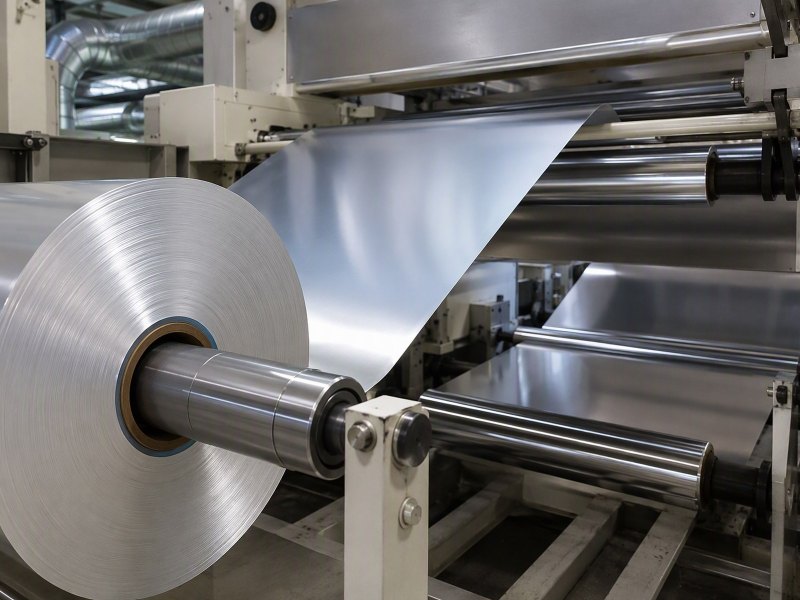
A bright foil face is smooth, oxidised and still carrying rolling oil, so adhesion rests on the weakest of three mechanisms. Corona and primer treatment exist to change that surface, and each does a different job.
Why does aluminium foil need corona or primer before coating?
A pack that passed every hand check on the line can still delaminate in a warehouse months later, and the surface it was built on is usually the reason.
Bare bright foil is smooth, unreactive in air and still carrying rolling oil, so an ink or an adhesive finds little to grip. Corona and primer treatment change that surface; neither rescues a wrong coating choice.
The eight questions below follow the surface from mill to coating head: what a bond needs, what each treatment supplies, and how to separate a surface fault from a formulation fault.
What actually holds a coating onto aluminium?
Adhesion is usually spoken of as one event. It is three, and a finished pack keeps only the weakest.
Wetting, microscopic keying and chemical bonding act together. On bare bright foil each is weak, so the joint rests on the weakest and lets go months later rather than at once.
Dive deeper
Start with wetting. An adhesive has to spread across the metal rather than bead on it, because a liquid that pulls itself into droplets touches the surface in islands and leaves the rest as a void.
Contact area is the currency of adhesion, and wetting is what buys it. A face that refuses a liquid refuses it however the line is set, and no pressure at the nip changes that.
Keying is mechanical, and foil offers almost none. Rolled flat between hard cylinders, it has no open structure: no pores, no fibres, no tooth. What surface texture survives is shallow, and a thin oil film buries it.
Chemical bonding is the link treatment protects. Freshly rolled aluminium is reactive, but it meets air at once and grows an oxide that is stable and unreceptive, so a bond must reach through that layer, and it needs a chemistry the bare metal does not offer, as reference material on aluminium foil sets out.
All three are weak on the same face at once, which makes bright foil the hardest case. A joint can look sound while having only wetted well, and nothing at the end of the line separates that from a good bond until time does the testing.
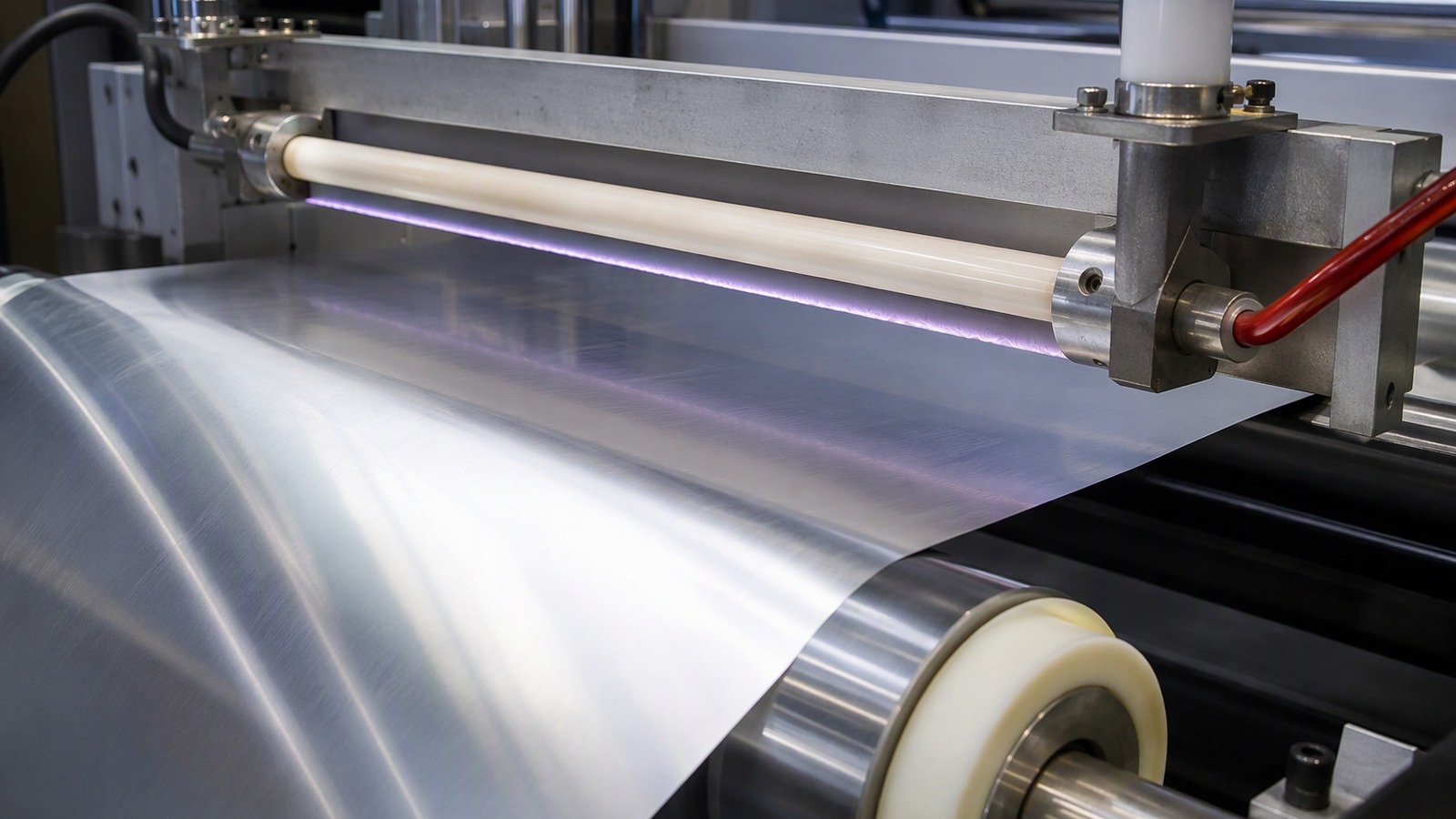
Why does rolling oil come first, and why is a wipe not a treatment?
Every roll arrives with a residue of the oil that kept it from welding to itself in the mill, sitting where the bond must form.
Oil is a release layer by design. A wipe lifts what it reaches but leaves the chemistry unchanged; a treatment alters the surface rather than only cleaning it.
Dive deeper
Rolling oil did not arrive by accident. It belongs to the process, sits as a film that varies across the width and along the roll, and stops turns of foil sticking while controlling friction at the gap.
On a converting line the same film becomes an obstacle. An adhesive wets oil more readily than oxide, so a bond may form on top of the film rather than on the metal, and it holds the coating well enough to survive a rub with a thumb.
It is also the bond that releases in a finished pack after months under load. The usual response is a solvent wipe, and it feels decisive, but the solvent evaporates and redistributes what it dissolved as a thinner film, unevenly across the web.
Cleaning leaves the chemistry underneath untouched, so the oxide is still unreceptive where the oil has gone. A hand-wiped sample is not the surface that ran on the machine, which is the real argument for a repeatable unit.
Order matters too. A treatment applied over a heavy film works on the film as much as on the metal, so results do not repeat from roll to roll, which is why even aluminium foil lacquering starts with the surface, not the lacquer.
What does corona treatment do to a metal surface, and where does it stop being useful?
Corona adds nothing to the web. It changes the outermost layer of whatever passes under it, which is why it is fast and easy to place.
A discharge in air beside the web makes reactive species that attack the organic film on the metal, oxidising it into something more polar and more receptive.
Dive deeper
On a plastic film corona activates polymer chains at the surface. On metal the mechanism is different: what the discharge meets first is an oxide and whatever organic material sits on it, largely residue of rolling and handling.
The reactive species oxidise it into more polar fragments. The surface becomes more receptive, so adhesive or ink spreads instead of beading, and loosely bound material is driven off, so the coating meets something closer to metal than to oil.
Both effects are confined to the outermost molecular layers, which is enough for wetting and not enough for everything else. Corona cannot build a film of chosen chemistry; it can only modify what is already there.
It cannot help if the organic layer is thick, because it works at the surface of that layer rather than through it. Nor can it seal the face against the next contamination, so a treated roll can pick material up again in storage.
And it does nothing for a bond needing a chemical bridge rather than a wettable face. A second limit appears late: the effect is only as good as the web entering the unit, so an uneven film is treated unevenly, as notes from an industry association for aluminium suggest.
What does a primer do that corona cannot, and why are the two sometimes used in sequence?
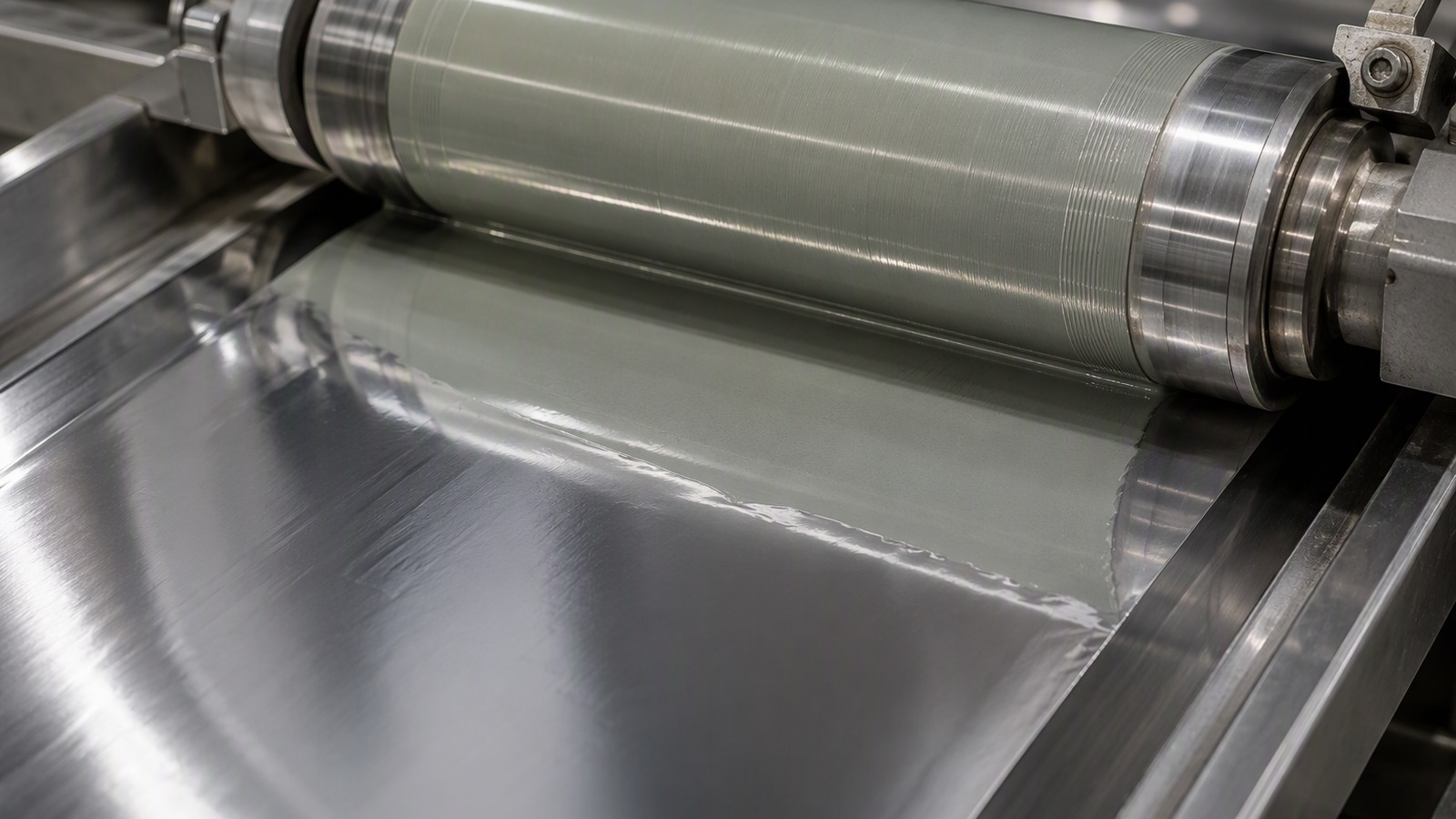
A primer is a material rather than an effect, putting a chosen chemistry on the metal so the interface stops depending on the roll.
Corona leaves no film behind. A primer deposits a layer that bonds to the oxide below and the coating above, and holds that interface stable in storage.
Dive deeper
The difference is one of kind. Corona changes the top layer of what is already on the metal; a primer adds a layer of chosen composition, which changes what the next coating touches.
A primer earns its place in four ways. It presents a defined chemistry bonding to an oxide on one side and to a specific lacquer, ink or adhesive on the other, so a mismatch is bridged.
It can carry coupling chemistry that reacts with the metal rather than lying on it. It seals the surface, so the interface stops being exposed to whatever the roll meets next. Being compliant, it absorbs stress when the web is flexed or heat sealed.
Run in sequence, the two do different jobs on one pass: corona prepares the metal so the primer grips, and the primer supplies the durable chemistry corona cannot. Skipping the first gives a primer that sits on oil; skipping the second gives a wettable face with nothing behind it.
Neither sequence is a rule. Some systems need corona alone, some a primer alone, some both. Which applies is a question about the coating, answered on the converter's trial; on a light gauge such as 8079 aluminium foil the balance shifts.
Why does the treatment have to be matched to the coating instead of fixed as a house rule?
A setting that works for one adhesive is not a standard. It is a result obtained with that adhesive and that line, and it does not travel.
A house rule survives because it usually works, and it fails exactly when a new coating arrives. Solvent-based, water-based and solventless systems wet a metal face differently.
Dive deeper
Coatings differ in how they reach the metal. A solvent-borne adhesive wets a surface readily; a water-borne system has to contend with the polarity of the face and its own surface tension at once, and refuses faces the solvent type accepts.
A solventless adhesive arrives with a different viscosity and appetite for surface texture, and a heat-seal lacquer has to survive a hot nip without being squeezed away from the interface. Each behaves differently on the same prepared face.
That is why a treatment level carried over from a previous product is a guess. It is usually close enough to run, which is the problem: the line makes saleable packs, the packs leave, and the failure arrives in a market the converter no longer controls.
There is a second mismatch that is easy to miss, because primer chemistry and coating chemistry interact. A primer chosen for one lacquer can block adhesion to another, or leave a face a particular ink will not key to, even when it is applied well.
The combination has to be qualified as a combination, never assembled from two separately approved parts. The same logic runs on the print line, where aluminium foil for labels shows white at a die-cut edge after handling.
Why can an over-treated surface be as bad as an under-treated one?
Treatment is not a dial that only helps when turned up. Past a point the surface is damaged rather than prepared, and the failure looks much the same.
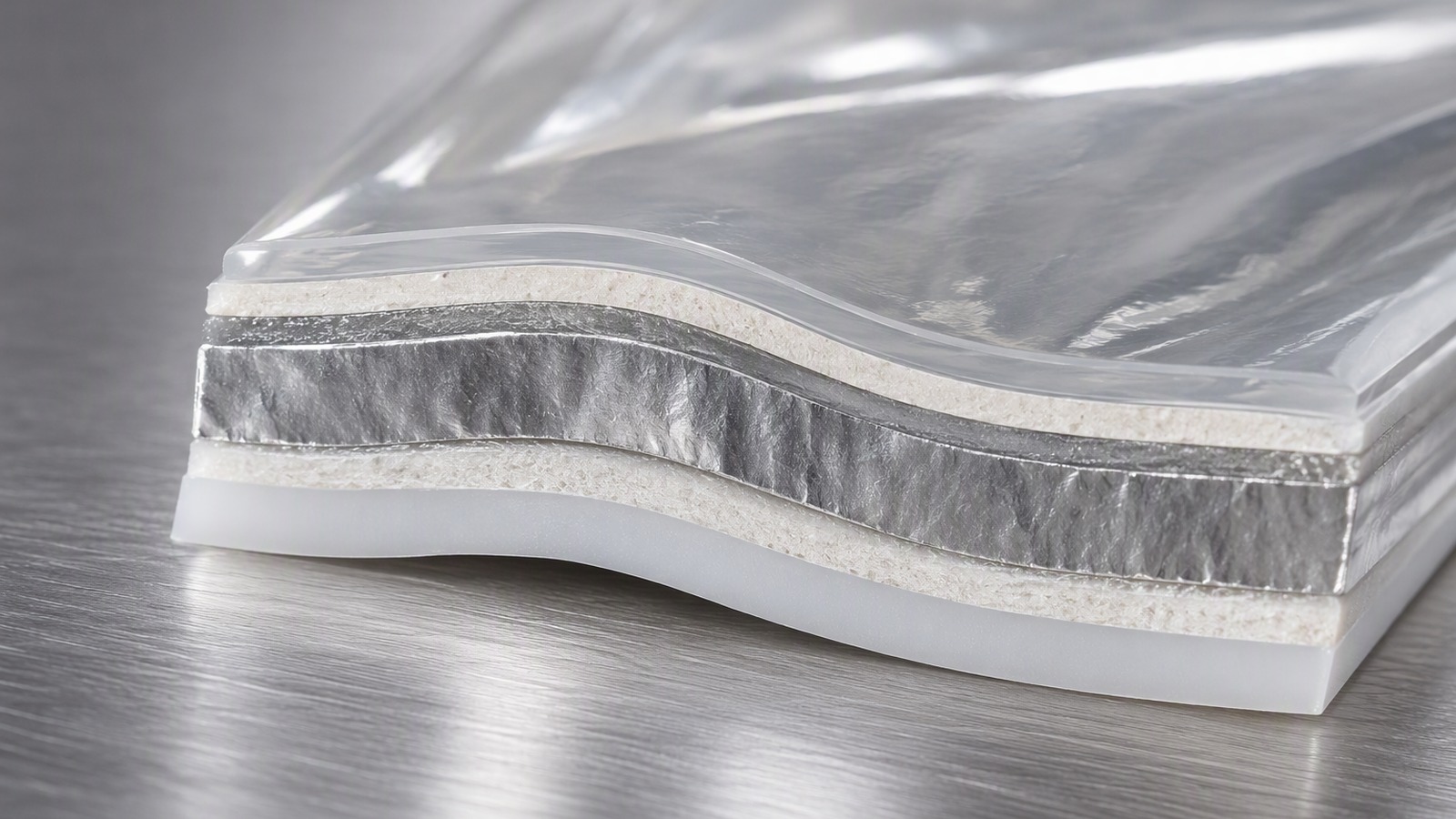
Excessive treatment breaks down the very layer the coating must bond to, leaving loose material at the interface. The joint then fails close to the metal.
Dive deeper
Under-treatment is easy to picture: oil remains, the face is unreceptive, the coating sits on top and lets go. Over-treatment reaches a similar result by another route, which misleads people expecting the two to look opposite.
Pushed too far, a discharge degrades the surface it is meant to prepare. Oxides grow thicker and less coherent, organic material breaks into fragments that stay on the web as a weak boundary layer, so the coating bonds to a layer only loosely attached.
The failure is then cohesive in that debris, close to the interface, and reads as poor adhesion when it is poor preparation. Thin foil is less forgiving: aggressive treatment can mark the face and disturb the flatness a coating needs.
It can also reach the reverse face on a light gauge, changing how the roll unwinds and how the second face behaves. Then the economic trap: if a little helps, more must help more, and the setting drifts upward over months.
The symptom is failures nobody connects to a change made long before. The way out is the way in: define what the coating needs, establish it on a trial, record it with the materials it belongs to. Gauge and temper deserve the same discipline on an aluminium foil roll.
How can a converter tell a treatment problem from an adhesive problem?
Both arrive as the same complaint, usually reported as delamination. The difference is visible in where the failure sits and how it varies.
Look at the failure surface, at the pattern across the web, and at whether the fault follows the foil lot or the adhesive lot.
Dive deeper
Start with location. If the coating came away cleanly and left a bright face, the joint failed at the interface, pointing to preparation. If the adhesive split within itself, the interface held and the adhesive or its cure is suspect.
If the failure sits in a layer of debris, the surface was prepared badly or over-prepared. Then look at pattern: a fault following position across the width, at one edge or from a splice is a line story, not a formulation one.
A fault uniform across the web and consistent from roll to roll more likely belongs to the adhesive or the coating conditions. Then separate the lots: the suspect foil with a known-good adhesive, the suspect adhesive on a known-good foil, the same day.
If the fault follows the foil the surface is implicated; if it follows the adhesive the surface may be blameless. One experiment answers more than opinions, and it needs nothing the plant does not already have.
A water film is a crude screen: poured on a prepared face it either stays continuous or pulls back into patches, which tells you whether the surface is receptive, not whether it is right. Background from the aluminium association in the United States is no substitute for ageing a sample.
What has to be agreed with the foil supplier, and what stays on the converter's line?
The split is clean once written down. The supplier owns the metal and its condition on arrival; the converter owns everything after the roll is opened.
Alloy, temper, gauge, width and finish belong in the agreement. Treatment settings, primer choice, coat weight and cure belong to the converter.
Dive deeper
On the supplier's side, the agreements concern what arrives: alloy and temper; thickness and tolerance, because a light gauge is less tolerant; width, core and winding, because tracking decides whether the web meets treatment evenly.
Surface finish belongs there too, since bright and matte faces present different surfaces to a coating. So does the condition as supplied: how much rolling oil is acceptable, how the roll is protected, whether the mill prepares the surface.
Everything downstream stays with the converter: the treatment, the setting, the primer and coat weight, the adhesive or ink, the drying and curing conditions, and the trial. A borrowed number is a starting point, not a specification.
Where the material comes from packaging and container foil, an enquiry can cover alloy 1050, 1100, 1235, 8011, 8021 or 8079, temper O, H14, H18 or H24, thickness 0.005 to 0.20 mm, width from 100 to 1500 mm, MOQ 3 MT per size, shipment from Qingdao, Tianjin or Shanghai.
Written down, the split is also a defence: when a lamination fails, the converter says what the metal was and what was done, the supplier says what left the mill, so the conversation moves from blame to cause, as a foil industry association describes.
Surface preparation is a short step that decides a long shelf life. Match it to the coating, prove it on your own line, and let the trial set the setting.