Why Does Aluminium Foil Curl After It Leaves the Coil?
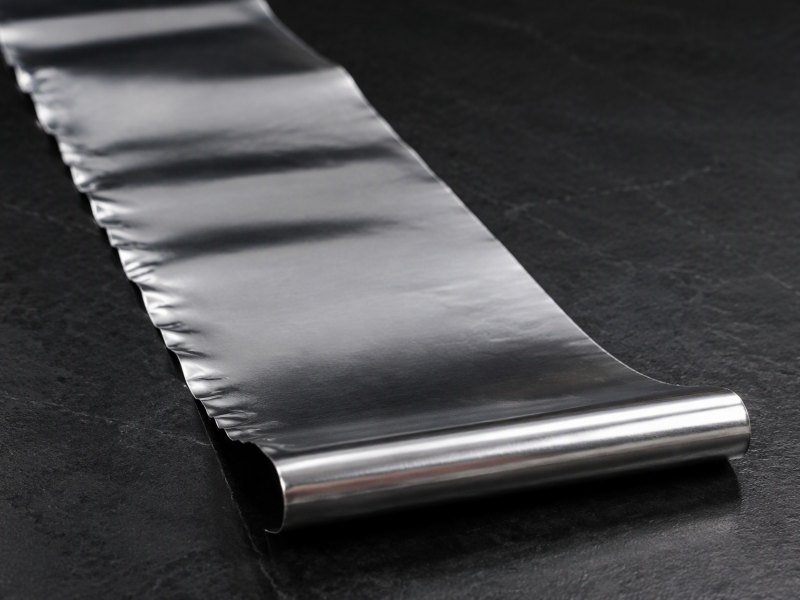
Why an unwound foil web will not lie flat, and what a converter can change on the line.
The coil arrives flat. The web does not. Between the unwind stand and the first roller an edge lifts, a centre bows, and nothing on the machine has changed.
Curl is a cross-direction flatness fault: the web leaves the coil with a built-in curve instead of lying in one plane. It comes from stress locked into the metal during rolling and appears only once the web is free.
The useful question is not whether the coil is bad, but where the curvature was made and how much of it the line can absorb.
What Does Curl Actually Mean on an Unwound Foil Web?
Most people see curl at once and describe it badly. It is a shape in the free web.
Curl means the free web is not flat across its width: one edge lifts off the plane, the centre bows, or the strip takes a gentle arc. It is geometry, not surface texture.
Dive deeper
Curl is a geometry, so judge it on a flat bench rather than on the coil. Cut a length, lay it down, let it settle without tension, and look along the strip. If the metal touches the bench across its full width, the web is flat. If light shows under one edge while the rest rests, the web carries a cross-direction curve. Repeat the check on a second sample taken further in.
The curve may be a simple bow, a shallow dish, or a twist with one corner up and the diagonally opposite corner pressed down. All three are curl, and all three are read the same way: from how the free web sits, never from how it looked on the coil. A crease is a different fault, because a crease is a sharp line while curl is a smooth, distributed departure from flat.
Curl is also direction-dependent: a dish and a twist read differently depending on which face is up, so flip the sample before you condemn the coil. And curl exists only in the free state. On the coil, layer pressure holds each turn against its neighbour and suppresses the shape; release the tension and the metal returns to the form it prefers. The foil roll and sheet range shows how many free forms one metal can take.
How Is Curl Different From a Winding Set or a Baggy Edge?
Three complaints sound alike on the telephone and have three owners. Naming the right one decides who pays.
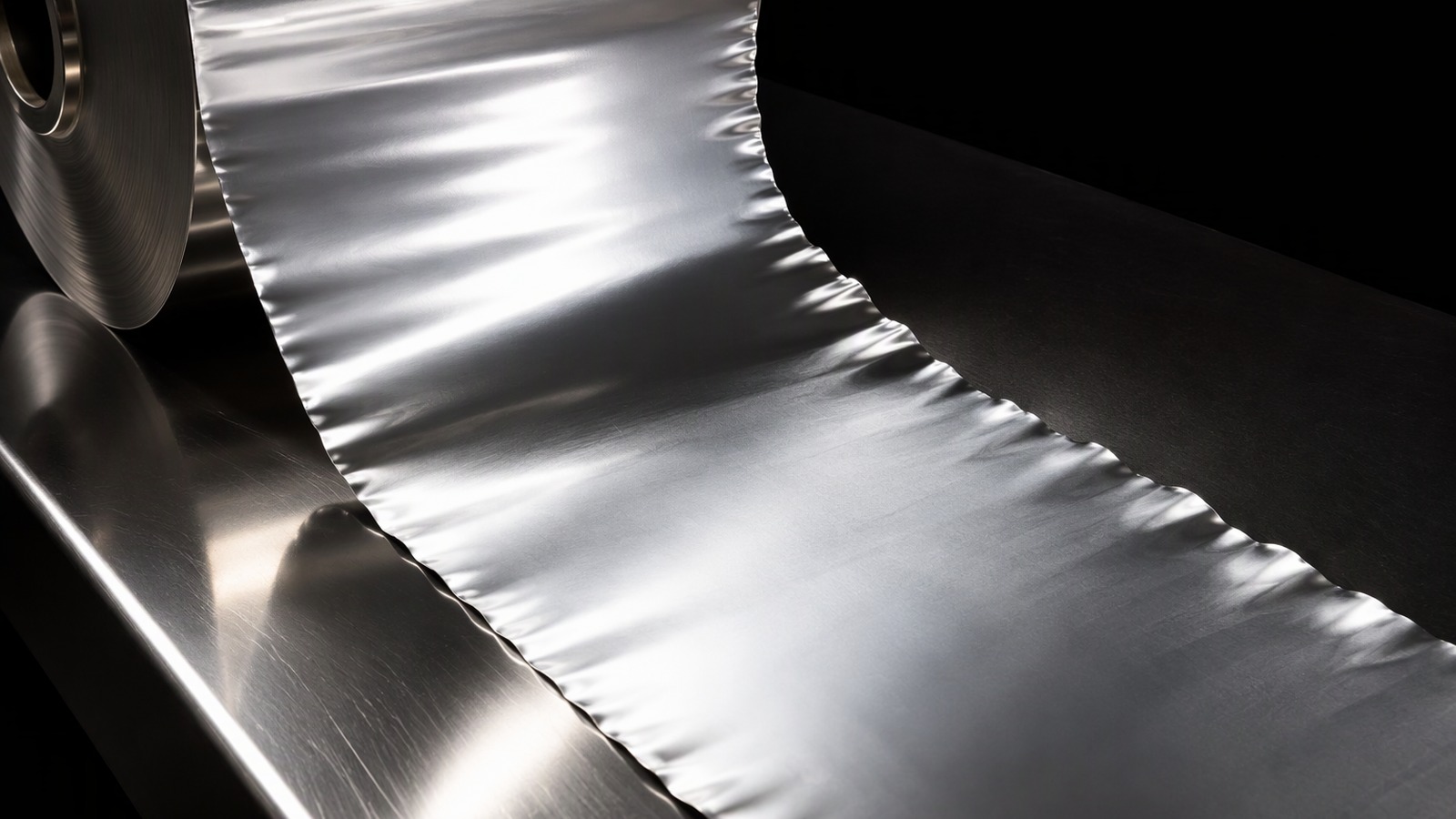
Curl is a shape across the width. A winding set is memory of the coil diameter, a curve along the length. A baggy edge is surplus length at one side, which shows as slack.
Dive deeper
Start with the winding set, because it is the mistake most often made. Every turn on a coil is bent around a core, and the metal keeps a trace of that bend. A length cut from the outside of a coil tries to stay curved along its own length, across the whole width. That is a set from winding: a curve in the machine direction. Shorter cores deepen it. It relaxes slowly, and unwinding does not remove it.
Curl is different in kind. There the departure from flat lies across the width, so one edge lifts or the centre bows. A baggy edge is a third fault: one side of the web is longer than the other, so the longer side stands slack or ripples when the web is pulled. Under light tension one side feels loose and the other tight.
The bench test separates all three. Lay a sample flat: a baggy edge lies down and wrinkles along one side, a curled edge lifts and stays up, and a set from winding bows along its length. A soft coil stored on its side can imitate curl and then relax. Record which fault you actually saw, because the reply you get will follow the description you send. The coil build behind a telescoped roll shows how layer movement loads a web unevenly.
Why Does Residual Stress From Rolling Show Up Only After Unwinding?
Rolling does not deliver flat metal. It delivers metal held flat by the mill, and that is not the same thing.
Each pass stretches the web through a roll gap, and the stretch is never perfectly even through the thickness or across the width. On the coil, tension and layer pressure hold the shape in; cut the tension and locked stress moves the metal.
Dive deeper
Think of the web as a stack of thin layers through its thickness. Friction and the way the gap closes act more strongly at the surface, so the outer layers leave the mill with a different history from the core. While the metal is under tension on a coil, those differences stay in balance. The web is flat because it is forced flat, not because it wants to be.
Unwinding removes the forcing. Tension drops, layer pressure disappears, and the internal balance must be found again by moving the metal. The result is a shape: a lifted edge, a bowed centre, an arcing strip. This is why a coil looks perfect while a sample from it looks wrong, and why the fault seems to appear at the unwind stand. The general description of aluminium foil notes how many passes build such a thin product.
Curl is not a surface condition you can clean off or press out. It is a stress state, visible only when the constraint is removed. That is also why the effect is worse on a slack unwind: less tension holds the shape down less. Tightening the unwind flattens by force, and the stress returns when tension drops downstream. European Aluminium describes rolling as a chain of reductions for exactly this reason.
Why Are the Two Faces of a Foil Not Identical?
One face met a polished roll, the other a rougher one, and neither left with the same history.
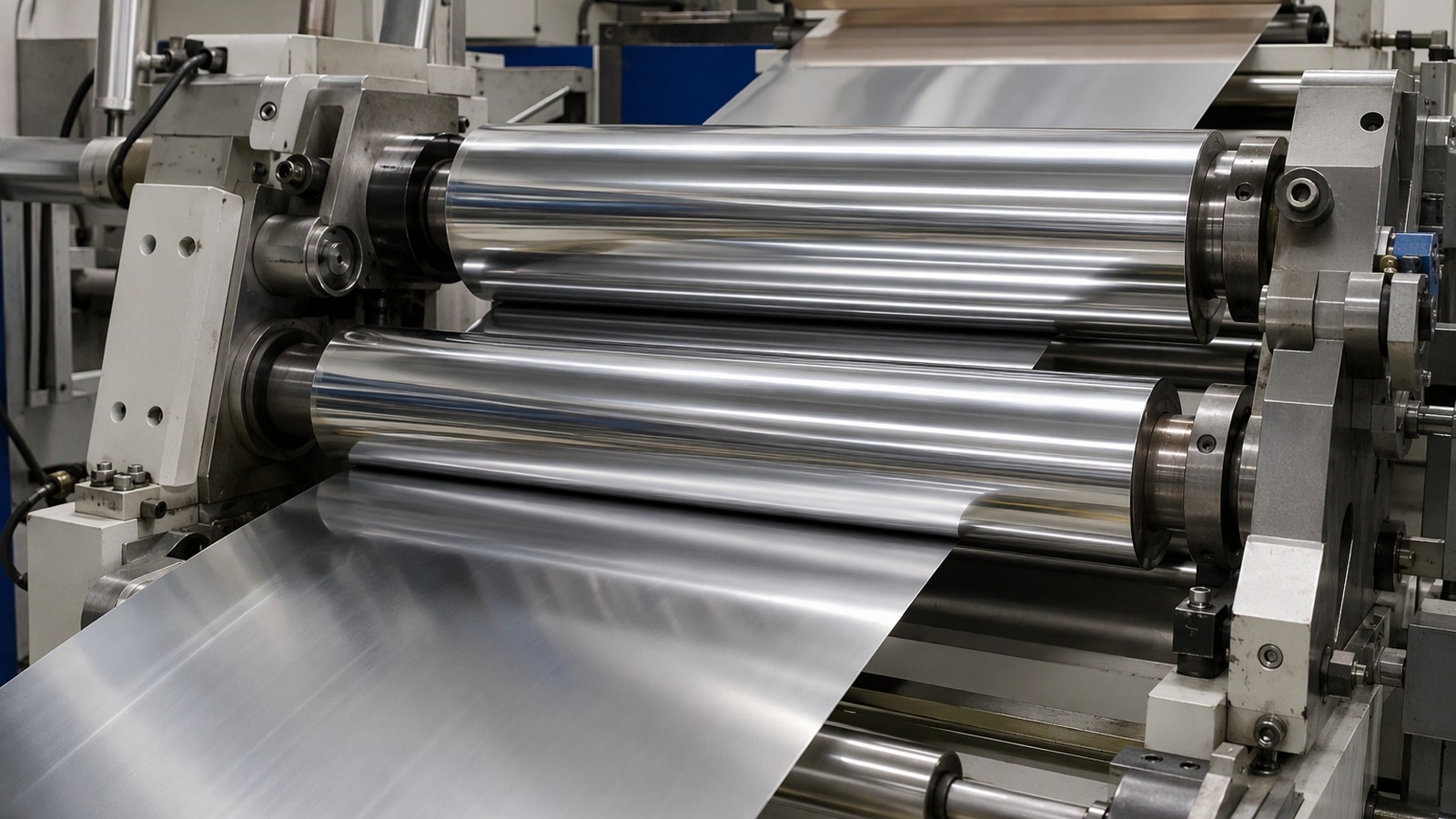
In double reduction the web is rolled as a pack. Outer faces run against the work rolls and inner faces against each other, so the two sides differ in texture and in stress. That imbalance alone can make a free web curl.
Dive deeper
The two faces of a thin foil are not mirror images. One side, the bright side, ran against a polished work roll. The other, the matte side, either met a roll of different finish or was pressed against another sheet while the pack was reduced. The texture differs, and so does the way each surface was deformed. When the web is free, the difference in stress between the two surfaces can only resolve itself by bending, and the web curves toward the face that is stretched less.
This is why a sample can show a gentle dish one way up, then flatten or reverse when turned over. It is also why two coils of one alloy and one gauge can behave differently after different pass schedules. No coil is at fault; the balance between the faces is not the same. Judging from one side only rejects good coils.
Surface condition is a separate question from shape. A face that has picked up water staining or handling marks reads badly under low light even when it is geometrically flat, and a textured face scatters light differently. Keep the two apart: is the web out of flat, and is the surface acceptable? For the product side of that distinction, the European Aluminium Foil Association describes how foil is rolled and finished.
How Does Gauge Variation Across the Width Become a Lifted Edge?
A web that is thicker on one side is also longer on one side, once it is free to relax.
Rolling leaves a thickness profile across the width. Metal that was reduced less carries different elongation, so on release one side has surplus length. That surplus can only go somewhere: it lifts, bows or ripples.
Dive deeper
Picture the web as many narrow strips side by side, each with its own thickness and stretch. Equal elongation in every strip would hang flat. Where one band was reduced less it is slightly thicker and slightly shorter after release; where another was reduced more it is thinner and longer. Joined together, the bands cannot take up different lengths, so the surplus leaves the plane. The result is a lifted edge or a bow that follows the profile of the coil.
This belongs to the same family as the profile on the coil, so read gauge crown across the width alongside this article, because crown describes the profile while curl describes what the profile does once the web is free. A buyer often reports the two as one fault, and separating them changes the answer. A profile inside a normal commercial band can still lift an edge on very thin metal, because thin metal has little stiffness to resist the shape.
A profile that slopes from edge to edge produces a directional curl easily mistaken for a machine alignment fault, because it always lifts on the same side. A profile high in the middle bows the centre. A profile that wanders produces a web whose shape changes along the length, the hardest case to run, because no single setting suits the whole coil.
Why Does a Heavy Web Curl Differently From a Thin One?
Stiffness is the difference. Thin metal bends easily, so it shows every uneven stress; heavy metal resists the bend.
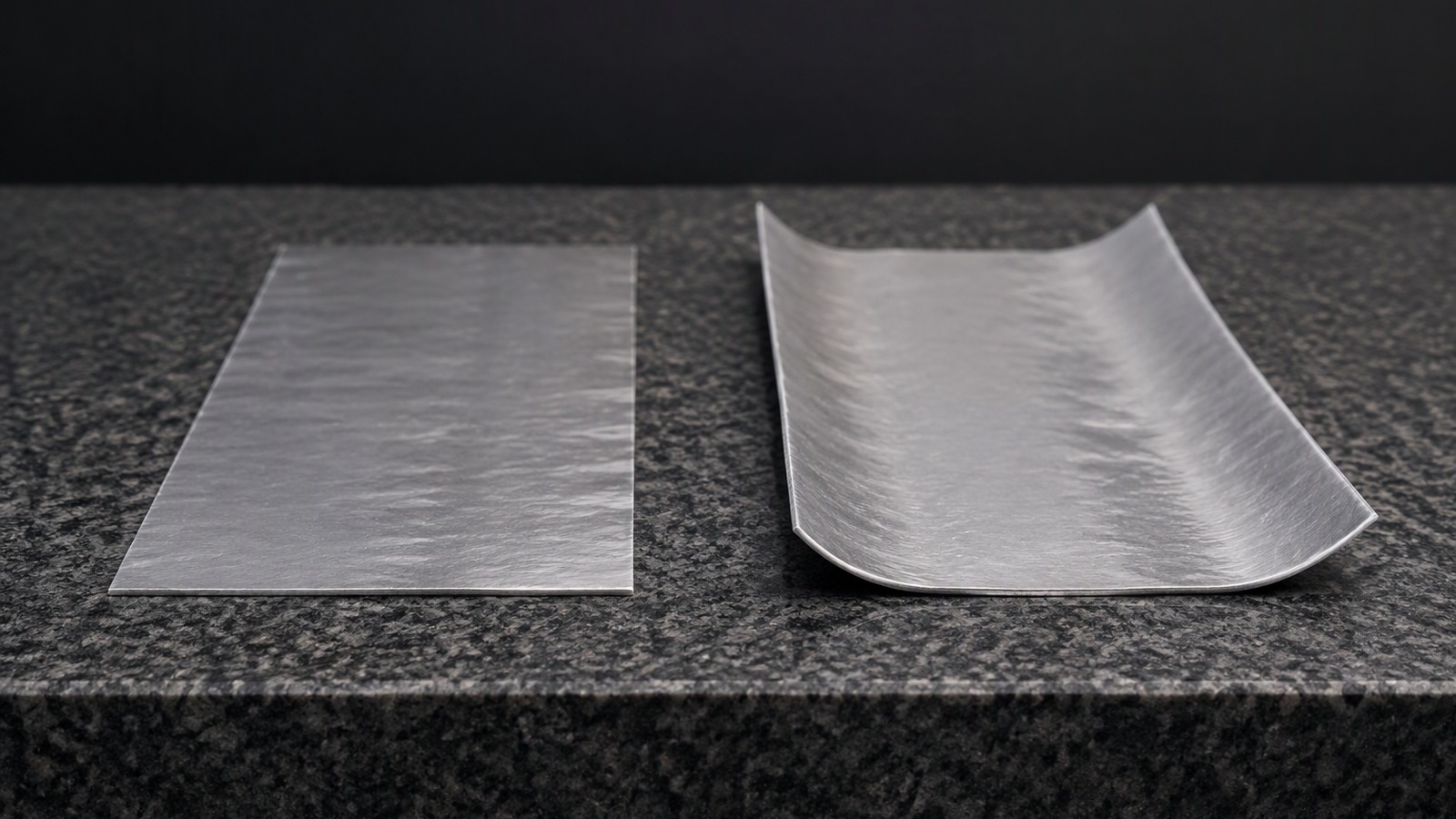
A thin web curls into a springy shape, visible at once but easy to guide. A heavier web holds a flatter line and then fails suddenly, with a hard lifted edge.
Dive deeper
Bending stiffness rises steeply with thickness, so one imbalance gives very different results at the two ends of the range. At the thin end the web has almost no stiffness and takes the shape its stress asks for: it curls visibly, it drapes, and tension can usually pull it flat. At the heavy end, near 0.20 mm, the web is stiff enough to stay flat under its own weight, so a small imbalance stays invisible. What appears is a web that runs flat for metres, then lifts a hard edge.
Thin and heavy foil fail differently and need different responses. On thin stock, look for stability: too little tension lets the web wander and curl, while too much pulls the shape out and stretches the edges. On heavy stock, look for the cut: a heavy slit web releases stress at the new edge. 1100 aluminium foil at 0.12 mm sits between the two cases.
Thickness also sets how much the line can correct. Tension can flatten a thin web because the metal is compliant; on heavy stock the same tension does less, and the shape that survives reaches the converting station. Temper changes the picture: an O temper web deforms easily, while a strain-hardened H18 web springs back rather than yielding. The Aluminum Association keeps public material descriptions for these designations.
What Can a Converter Change on the Machine, and What Cannot Be Fixed There?
Some curl responds to the line. Some does not, and no amount of tinkering will change it.
Tension, roller wrap, path length, guide settings and splice quality are yours. The stress built into the coil is not. A machine change holds a shape down; it cannot remove the stress.
Dive deeper
Tension is the first lever and the most overused. More tension pulls a curling web flatter, which looks like a cure and is really a loan: the web reaches the next station with the shape suppressed and the stress intact, and it releases wherever tension is reduced. Use tension to keep the web stable, not to force it flat. If the shape returns on the slack side of the last driven roller, the setting is hiding the fault.
Roller wrap and path layout are the second lever, and underrated. A web over a roller with a generous wrap is constrained over a longer arc, which distributes the shape and gives the guide something to work with. Short wraps and long unsupported spans give a curled web room to express itself. Adding a roller or changing a wrap can turn an unrunnable job into a routine one without touching tension.
What cannot be fixed on the line is the stress itself. No roller arrangement removes elongation differences built in at the mill, and no guide setting corrects a thickness profile. Heat would relax some of it, but it brings its own problems with flatness and surface. If a coil needs the line re-tuned for every run, and two coils of one specification need opposite settings, the constraint is in the metal.
How Do You Tell a Coil Problem From a Machine Problem?
The test is simple: change one thing and see whether the shape follows the coil or stays with the machine.
If a fresh coil behaves differently, the fault travelled with the metal. If every coil curls the same way on the same line, the line is shaping it. Run the check with a numbered sample and note which edge lifts.
Dive deeper
Begin with the coil-to-coil test: two coils of one specification run back to back with the line untouched. If one runs flat and the other lifts, the metal is the variable: stress, profile, or the balance between the faces. If both lift on the same side in the same way, suspect the line: a tilted unwind, a roller out of parallel, or a tension path tighter on one edge. That one comparison answers the question, and it costs one run instead of a week of argument.
Then test the unwind position. Turn the coil through part of a revolution and watch whether the lifted edge changes side or moves around the circumference. A shape that follows the circumference is a winding or profile effect; a shape that stays with the machine side is mechanical. A coil stored on its side may also behave unlike its neighbour without being out of specification.
When flatness is critical, put the mechanism in the enquiry rather than the adjective. Say what the web does, at which edge, and whether it changes along the unwind. Ask for the thickness profile across the width and the temper, and say which face will be coated or sealed. Where forming behaviour decides the choice, 8021 aluminium foil at 0.12 mm is one grade often specified that way.
Conclusion
Curl is stress made visible, not a machine fault. Read the shape, check whether it follows the coil, and change the line only when it does not.