What does aluminium foil actually do inside a liquid packaging board?
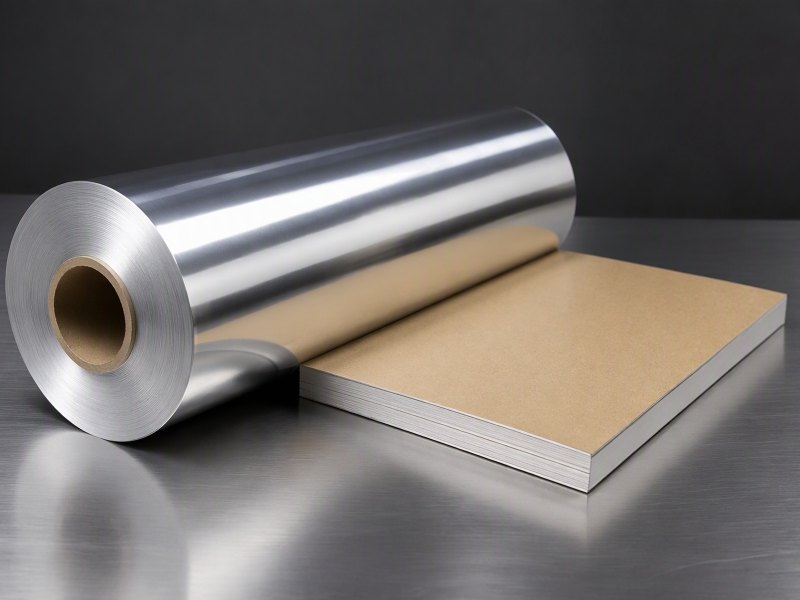
A converter's guide to the foil layer inside a liquid packaging board: why it is the barrier rather than the print surface, how the structure is built, and what to state in an enquiry.
What does aluminium foil actually do inside a liquid packaging board?
A buyer who files the foil under "shiny layer behind the print" will specify it last, and pay for that habit later.
The foil is the barrier, not the printing surface. It sits between the board and the product, bonded to the board through a tie layer and covered on the product side by a sealant, and it is the layer that holds oxygen, light and vapour away from the liquid through ambient distribution.
The eight questions below follow one web of foil from unwinder to purchase enquiry.
What role does the foil layer actually play in a liquid packaging board?
The foil is never seen by the consumer and it is never the surface that carries the design.
Foil is the functional barrier. It stops light almost completely and slows the movement of gas and vapour toward the product; the board supplies stiffness and the print surface, and the sealant supplies the joint.
Dive deeper
Take one layer away at a time and the division of labour becomes obvious. Remove the print and the pack still protects the product. Remove the sealant and it cannot be closed. Remove the foil and the pack still looks perfect, still feels rigid, still prints beautifully, and quietly stops doing the one thing that justified the whole structure.
That is why the foil is a barrier decision before it is a purchasing decision. In the finished laminate it faces the product only indirectly, through the sealant, and faces the board through the tie layer, so its two faces do different jobs: one anchors to the polymer that will later meet the liquid, the other to the polymer that carries the print. Both bonds must survive forming, filling and the heat of the sealing jaws.
Foil also brings dimensional stability. It does not swell with humidity as fibre board does, and it does not creep under web tension as a thin polymer film can, which is what keeps the barrier continuous around a folded corner. Both properties matter more than they sound.
The right model is a layer with two interfaces: a converter who treats it that way writes a better specification, and a buyer who understands it asks better questions.
Why does the foil layer make a long ambient shelf life possible without refrigeration?
Ambient distribution is a race against time, and the foil is the layer that buys the most of it.
Foil excludes light and slows gas and vapour movement toward the liquid. Held inside a sealed, filled pack through folding, transport and storage, that exclusion is what allows the product to travel and wait without a cold chain.
Dive deeper
Three things shorten the life of a liquid in a paper-based pack: oxygen reaching the product, light reaching the product, and moisture moving through the structure. Foil addresses all three at once, passively, without consuming anything and without needing a machine to keep working.
Light is the simplest case. A metallic layer is opaque, so photo-oxidation and light-catalysed off-flavour development do not happen behind it. Anyone who has compared a clear pack and a foil-based pack of the same liquid on a warm shelf has seen the difference without an instrument.
Gas and vapour are the more interesting case. Foil at these thicknesses is, when continuous, an extremely effective barrier, which is why the argument always returns to continuity rather than to thickness. A thicker web with a pinhole at a fold is worse than a thinner web that is sound, because the failure path is local.
The polymer layers support that barrier rather than replace it. The sealant keeps liquid away from the foil edge and closes the pack; the tie layer keeps the foil attached so the barrier cannot delaminate. The material is described in the reference entry on aluminium foil, but the conclusion is narrow: shelf life comes from a barrier that survives the whole route.
How is the structure built up, and why does each layer exist?
A liquid packaging board is assembled outward from the printed face, one function at a time.
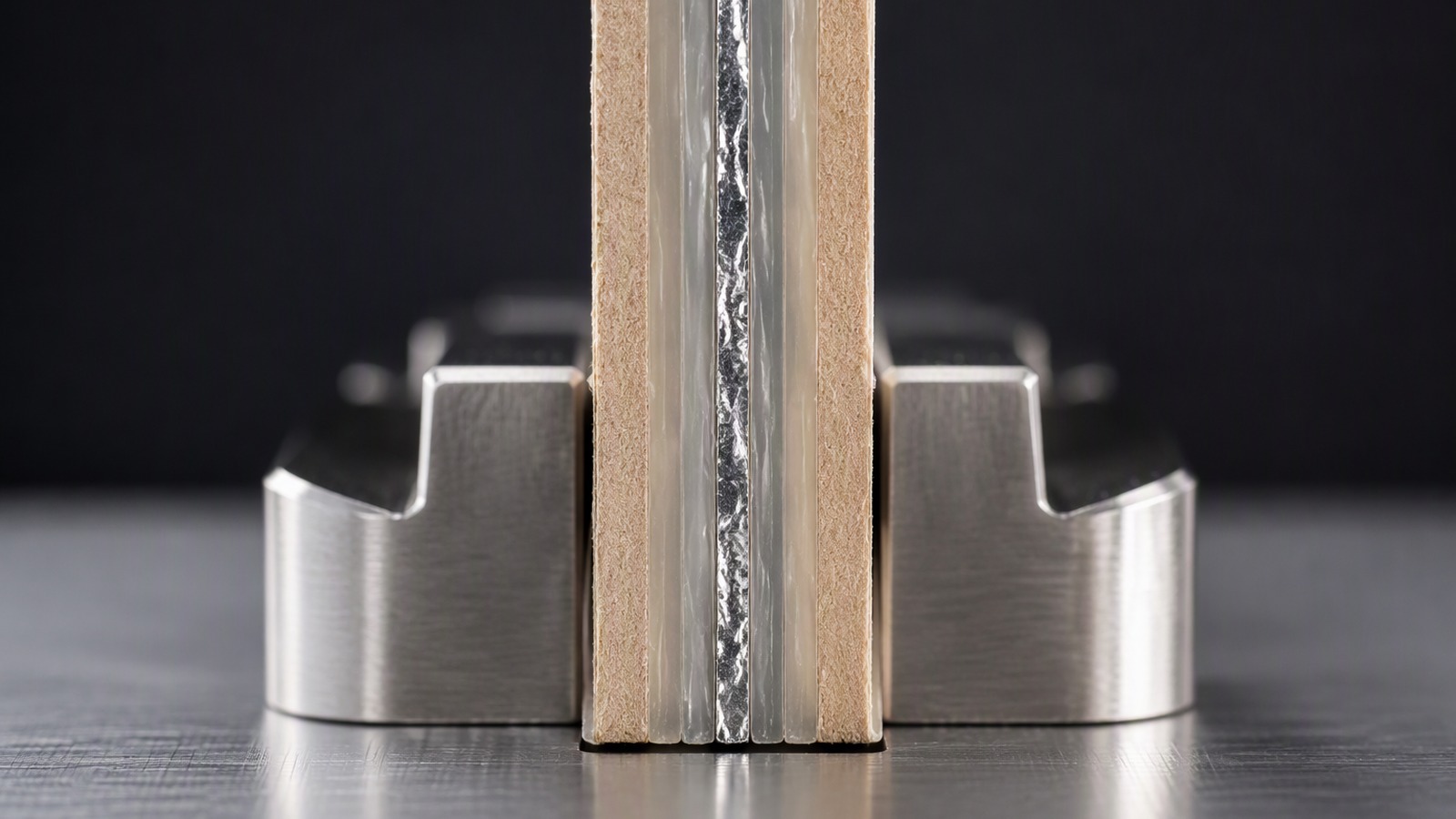
Typically a printed polymer surface, then the board for stiffness and print, then a tie layer for adhesion, then the foil for barrier, then a product-side sealant that heat-seals and keeps the liquid off the metal.
Dive deeper
Read from the outside in, the first layer is a thin polymer that takes the ink and protects the print from scuffing on the filling line and in distribution. It is thin because it carries no structural job.
The board comes next, and it is the reason the pack stands up. It provides stiffness, shape, the crease pattern and the printing surface, and it is the cheapest part of the stack per unit of strength. It is also the most moisture-sensitive part, which is why it never touches the product.
The tie layer is the least visible and the most underestimated. It is a polymer run between board and foil so two materials with nothing in common hold together through forming, filling and distribution. A tie layer that is too thin, too cold or contaminated gives a bond that survives the converter and fails at the filler.
Then the foil, which is the barrier. Then the product-side sealant, which heat-seals the pack, separates the liquid from the metal, and leaves the inner skin flexible enough for a crease to fold without cracking the metal behind it. Nothing in that stack is decorative; each layer answers a specific failure. The stack as a category is set out under packaging and container foil.

What does the converter need from the foil itself?
A converter does not buy brightness; it buys a web that behaves the same at the last metre as at the first.
Gauge consistency across and along the web, a clean and uniform surface on both faces, controlled wettability for adhesion, flat winding without buckles, and freedom from pinholes across the full width.
Dive deeper
Gauge consistency comes first because everything downstream is calibrated to it. Bond strength, lamination speed, tension profile and the heat input of the sealing jaws are set against an assumed thickness. A web that drifts across its width forces conservative running, and conservative running is expensive in a plant measured on output.
Surface condition comes second. The face that meets the tie layer must accept a bond, so it must be free of excess rolling oil, oxide patches and handling marks. The face that meets the sealant must be equally consistent, because a contaminated surface gives a bond that looks sound at the converter and opens at the fold.
Wettability is the practical measure of that surface state, and the method is worth agreeing with the supplier rather than assuming. A surface that has aged in storage, or was rolled with the wrong oil, will not wet the way the laminator expects.
Winding finishes the job. A roll wound with buckles or soft edges sends tension variation straight into the laminator, where it appears as wrinkles that cannot be removed once the foil is bonded. For the lighter end of the range, such as 8079 aluminium foil at 0.009 mm, the requirements sharpen, because there is less metal to absorb a variation.
Why does a pinhole matter more in a liquid pack than in a dry-food pack?
A dry pack forgives a small opening. A liquid pack does not, because the product sits against the interface.
In a dry pack a pinhole admits vapour into a large headspace. In a liquid pack the same opening sits against a wet product, so ingress is continuous and local: a wick or a stain.
Dive deeper
Start with geometry. A dry product such as a powder leaves much of the pack as headspace, so a small opening is diluted by distance and by the dry material itself.
A liquid removes that distance. The product touches the inner surface over the whole filled height, so an opening inside that wetted area is an opening directly into the product, with no headspace to dilute it and no dry material to absorb it.
The mechanism is also directional. Liquid keeps the path wetted, so what would have been slow diffusion in a dry pack becomes a persistent local exchange. The visible result is a stain, a soft patch in the board, or a wick along a crease.
The sealant is the only thing between the liquid and the metal, which is why it is specified for continuity and flex-crack resistance. A pinhole in the foil is not automatically a failure of the pack; a pinhole under a cracked sealant is.
Freedom from pinholes across the web is therefore worth putting in writing, and the method matters as much as the criterion. Transmission through the web is the usual check, and the discipline behind it is the kind described by the national measurement institute. Ask for a described method and a result across the width.
How is the foil combined with the board, by lamination or by coating?
The foil in a liquid packaging board is laminated, not coated, and the difference is structural rather than semantic.
The foil arrives as a solid web of metal and is bonded to the board through a tie layer under heat and pressure, so it remains a discrete metallic sheet inside the structure rather than a deposited film.
Dive deeper
Coating means depositing a thin layer onto a surface, in packaging usually a vacuum-deposited metallised film measured in nanometres. Lamination means bonding a finished sheet of foil to another substrate. They are different products with different failure modes, and a specification written for one cannot be met by the other.
In lamination the bond is mechanical and chemical at once. The tie layer, usually a polymer extruded between board and foil, wets both surfaces, solidifies under pressure and forms a continuous adhesive film. Its quality depends on the surface energy of the foil, the polymer temperature, the nip pressure and the line speed, so a foil that runs well on one line may not on another.
The consequences of a poor bond are worth spelling out. A bond void leaves the barrier unattached, so a crease can open a gap the foil cannot bridge. A wrinkle traps air and thins the metal along one line. Entrapped moisture can drive adhesion loss later.
Lamination also explains why the foil is chosen for continuity rather than thickness: because it is a discrete sheet bonded into a stack, its performance depends on that sheet being unbroken and fully supported. The lacquering step that often accompanies such structures is covered in this explanation of foil lacquering.
Which foil parameters belong in the specification, and which are agreed?
Part of the requirement is fixed by the material, and part of it can only be settled against the customer's own structure.
Alloy, temper, thickness, width range, core diameter and winding quality are stated in the purchase specification; the finer points, including surface treatment and pinhole acceptance, are agreed against the structure being converted.
Dive deeper
The material part is straightforward. Common choices for this family of work include alloys 1050, 1060, 1100, 1235, 3003, 3004, 8011, 8021 and 8079, in tempers O, H14, H16, H18, H22 or H24, at thicknesses from 0.005 mm to 0.20 mm and widths from 100 mm to 1500 mm, on cores of 76 mm or 152 mm. A typical order is 3 MT per size, shipped through Qingdao, Tianjin or Shanghai.
The alloy choice balances formability, strength and surface appearance. A softer temper forms more easily around a crease; a harder temper resists handling damage but demands more of the laminator. Two converters making a similar pack may choose different points on that scale, which is why alloy and temper should be named.
The surface part is where an enquiry earns its value. Whether the foil is plain or treated, how it is wound, which face is for the tie layer and which for the sealant, and how pinholes are assessed all depend on the line. None of it can be answered generically.
For an overview of the grades used here, see aluminium foil for packaging. Associations such as the European aluminium association publish general background on how foil is produced and handled, which is useful context.
What must a buyer state in an enquiry for a quotation that holds?
A short enquiry gets a short answer, and the price usually arrives with the assumptions still inside it.
State the structure and where the foil sits in it, the alloy and temper you will accept, thickness and width with tolerances, core, winding direction, quantity per size, destination port, and the surface and pinhole expectations your process needs.
Dive deeper
The first line of a good enquiry describes the pack, not the metal. A converter buys foil for a structure, and the structure decides temper, surface treatment, winding and handling. Two enquiries that both say 0.009 mm foil may need quite different material.
The second line states the acceptance basis. Alloy, temper, thickness and width with tolerance bands, core diameter, roll diameter range and winding direction can all be quoted against precisely. Anything left out becomes an assumption, and assumptions stop quotations being comparable.
The third line covers quantity and logistics. A minimum of 3 MT per size is normal here, so a buyer needing several widths should say so at once and let the supplier plan slitting. Name the port, the packing and any loading orientation; Qingdao and Tianjin are common departures.
Finally, ask for the documents that make offers comparable: the gauge profile across the width, the winding record, and a statement of how continuity is checked. If the method cannot be described, the number is not a specification. Related work is covered in this note on pouch and sachet structures, with background from the aluminium association.
Foil is the layer nobody sees and the one that decides whether the pack works: specify it as a barrier and ask for continuity across the web.