How Do You Plan Slitting Widths From a Master Roll?
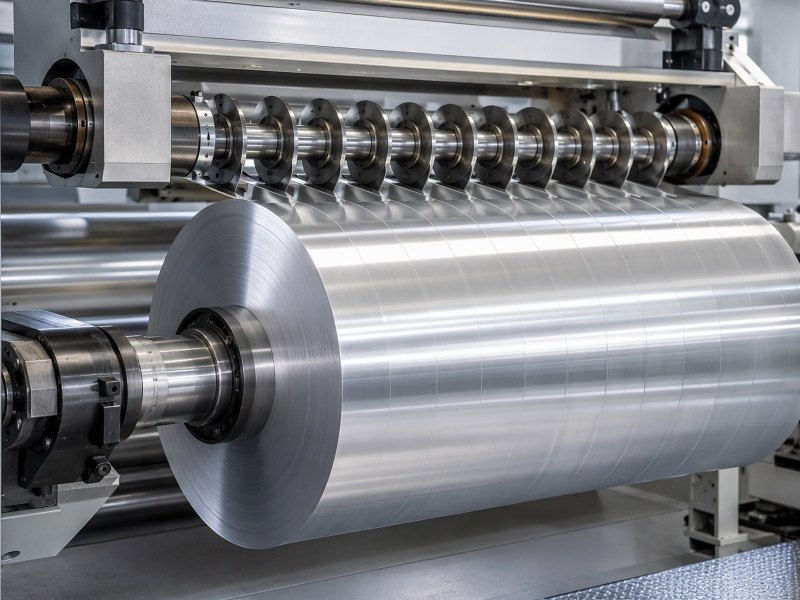
A slitting plan nests ordered widths across one master; the leftover becomes trim.
A buyer sends several widths, expects a simple answer, and gets back a plan with trim, a substitute width and a knife change. The waste was decided there.
A slitting plan nests the ordered widths across one master roll, chooses the running order and fixes knife positions. Where the widths land decides how much metal leaves as trim and how much ships as saleable coil.
Planning is the cheapest place to save metal and the easiest place to lose it. Nothing is cut yet, so every improvement is free and every mistake stays invisible.
What Is a Slitting Plan, and What Does It Decide?
Before a shaft is loaded, someone decides which widths travel together. That decision, not the machine, sets the waste.
A slitting plan maps one master roll onto a set of ordered widths. It fixes the combination, the running order, the knife positions and what stays behind as trim.
Dive deeper
A slitting plan is less a drawing of a machine than a decision sheet. It names the master roll to be opened, groups the ordered widths into runs, sets the sequence of those runs, places each knife on its shaft, and states what remains at the two edges. Everything downstream reads from it: the operator sets shafts to the plan, the winder builds coils to the plan, the packing line labels coils the plan already named. The foil roll and sheet range shows how many finished forms one plan may have to serve.
The plan also settles what the order never mentions. It settles how many knife changes the shift absorbs, how much edge trim leaves as scrap, whether a finished coil carries a join, and how much of the master's width is sold rather than written off. Two planners handed the same order can return plans that use the metal very differently. Both may be workable; one leaves more saleable coil behind, and that difference is made on paper at no cost.
This is why the plan deserves the same attention as the width tolerance on the order. Aluminium foil is thin, so a small nesting error travels a long way: a strip that misses its target by a little still has to be scrapped or sold as something else.
Why Do Ordered Widths Have to Be Nested Instead of Taken One at a Time?
Taking widths one at a time feels orderly. It also means the master is opened once for each width, and the edges pay for it.
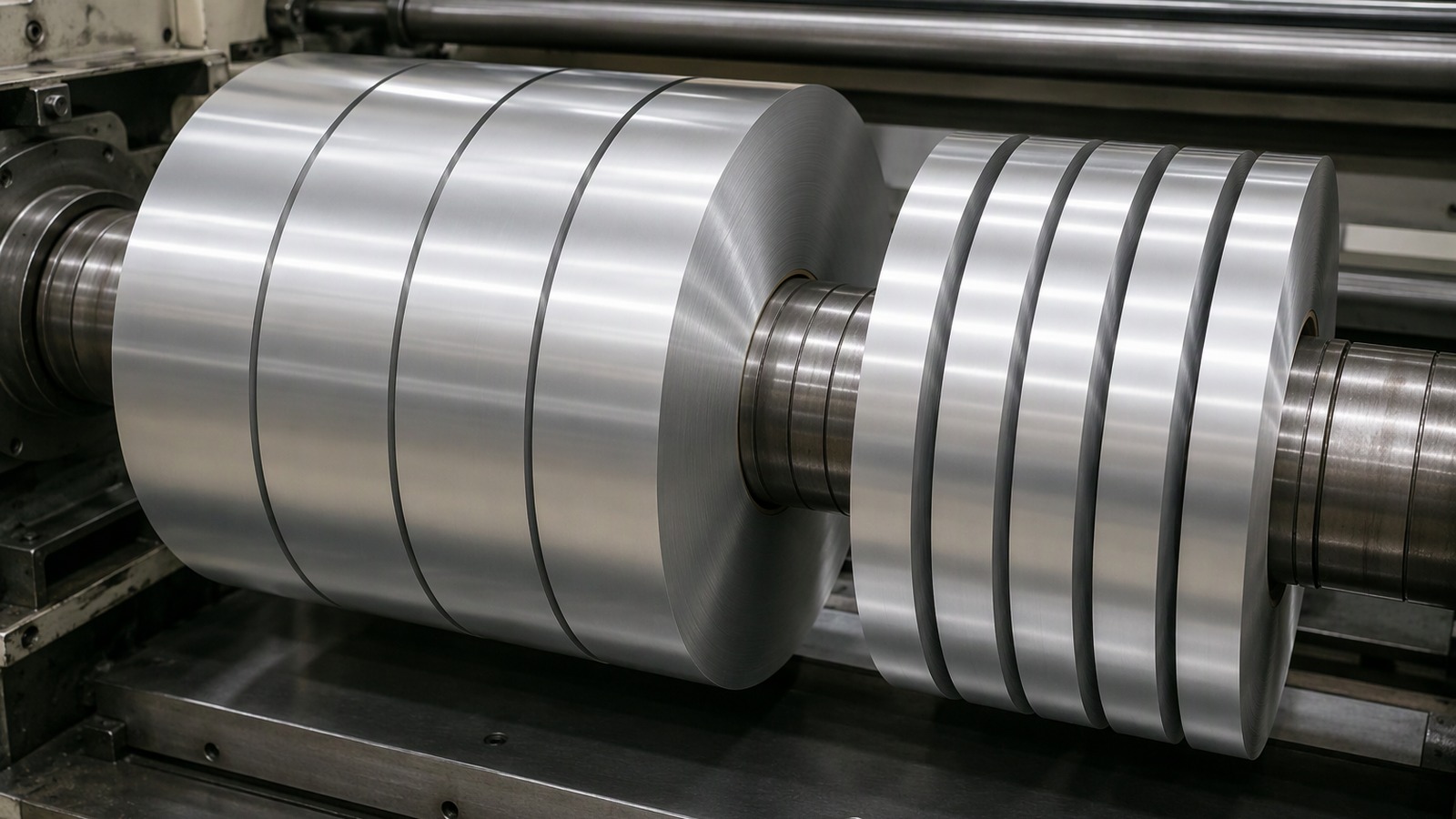
Widths are nested because every run consumes a full master width. Combining compatible widths in one pass uses more of the metal and leaves far less trim than running them separately.
Dive deeper
A slitting run always cuts a master roll across its full width. The shaft carries knives across the whole face, so the plan must account for every millimetre, needed or not. If a planner takes the widest ordered width alone, the remainder has to go somewhere: it becomes a narrower coil if a home exists, or trim. Running each width on its own master repeats that loss.
Nesting reverses the logic. The planner starts from the full face and fills it with ordered widths, trying combinations until the leftover is as small as the available widths allow. A narrow item that fits beside a wide one adds saleable output to a run that was already happening. That is why an order with several widths is often cheaper to produce than the same tonnage in one: the narrow widths ride along.
The nesting has limits. Widths cannot be combined freely: the finished coil must still be handleable, the combination must not overload one side of the shaft, and every width needs its own knife pair, so a plan that fills the face but cannot be set is not a plan. A good plan fills the face with combinations the line can actually run, and the 8021 aluminium foil in a narrow slit width shows the kind of narrow item that usually has to be nested rather than run alone.
Where Does Trim Come From, and Why Is Some of It Unavoidable?
Trim is not carelessness. It is the arithmetic of a fixed face meeting a set of widths that rarely add up to it.
Trim is the difference between the master's width and the sum of the slits plus the edge allowance. Some of it is unavoidable when no ordered width fits the remainder.
Dive deeper
Trim arises at the arithmetic level. The master has one fixed width, and the ordered widths are fixed too. Between them sits the edge allowance, material kept at each side so the outer slits take a supported cut rather than a torn edge. Whatever is left is trim, generated on every metre of the run, not only at the ends.
Part of that trim cannot be planned away. Widths are usually specified in round numbers, and round numbers do not tile a fixed face exactly. Even a careful nesting leaves a remainder smaller than the narrowest ordered width, and no combination can fill a gap narrower than the smallest width in the order. Trim also appears when the outer slits need a sacrificial strip to keep the knife evenly loaded, and when the master's own edges carry handling damage.
What a plan can do is choose where the trim falls and how much of it there is. A plan that concentrates the leftover into one edge strip is easier to handle than one that leaves slivers on both sides, and a plan that turns the remainder into a standard narrow item is better again, because that item can be sold. European Aluminium's industry information sets out the wider foil supply chain these decisions sit inside. Trim is not eliminated; it is placed where it costs least.

How Does the Plan Change When One Width Dominates the Order?
When one width takes most of the tonnage, the plan stops being a puzzle and starts being a compromise.
A dominant width is usually run in multiples across the face, with the remainder given to the smaller widths or accepted as trim. It sets the rhythm of the run.
Dive deeper
A dominant width behaves like a module. If it fits the face a whole number of times, the trim is whatever the edge allowance leaves. If it does not, the planner has a choice: run that width in the closest whole number and accept a wide remainder, or reduce the count and fill the space with smaller ordered widths. The first gives more of what the customer wants most; the second gives a better-used master.
The choice often falls to the smaller widths, because they can absorb a remainder the dominant width cannot. That is when a plan starts to look like a jigsaw: a narrow item slots into the strip left over, and the run produces two saleable widths instead of one plus scrap. Where the order has no small widths, the planner may propose a standard width already produced rather than leave a strip to be trimmed.
The dominant width also governs knife life and handling. One heavy combination for most of the shift means fewer set-ups and steadier tension, but the same knives work the same positions for longer, so any edge problem repeats across every coil. Some planners split a dominant width across two combinations to spread wear. On a heavier gauge the trade looks different again, as the 1050 aluminium foil at 0.18 mm suggests: thicker metal rewards a steadier plan.
Why Does Knife Set-Up Order Affect Edge Quality and Downtime?
The same set of knives can be set in more than one order. Some of those orders cut cleanly; some produce burrs and a stoppage.
Knife order sets which slit is cut first and how load is spread across the shaft. A layout that loads evenly cuts cleaner and needs fewer corrections than one that crowds a single side.
Dive deeper
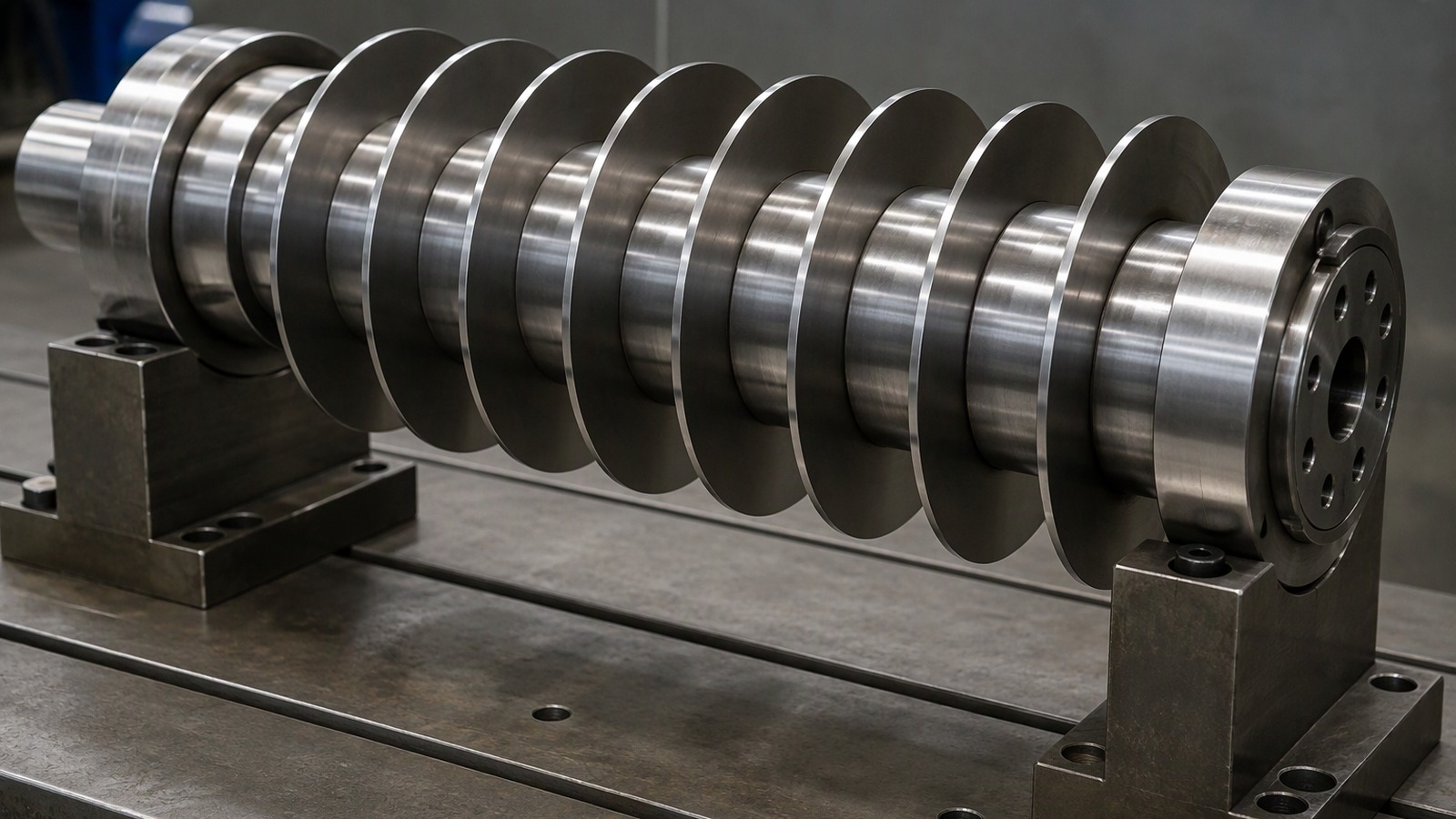
A slitting shaft is a stack: knives, spacers and the collars that hold them, all clamped along one axis. The order in which the widths are stacked decides how clamping force arrives at each knife. Stack a heavy combination at one end and the far end may run underloaded, so the cut there is less definite. Spread the same combination and the cut becomes consistent. Nothing about the metal changed; only the order did.
Order also decides what the operator has to undo when something goes wrong. If a width in the middle of the stack is out of position, every knife outboard of it has to come off before the correction can be made. Placing the least certain widths at the outside turns a long correction into a short one. That is a planning decision, made before the shaft is touched, and it shows up later as downtime.
There is a second order: the order the combinations run in. A plan that moves from a wide combination to a narrow one keeps the shaft stable, because the heavy stack is set while the line is settled. A plan that alternates between extremes forces repeated rebuilds, and each is a chance to introduce an error nothing catches until the coil is unwound. The US Aluminum Association publishes general material on aluminium products and their markets.
What Can a Buyer Do at Enquiry Stage to Make the Plan Better?
Most of the waste in a slitting job is fixed by the wording of the enquiry, long before the knives are set.
Group widths that share an alloy and temper, accept a published width where the process allows, and order a multiple that suits a sensible nesting. Small changes reduce trim.
Dive deeper
The first thing a buyer can do is group. Widths that share an alloy, a temper and a thickness can be nested into one run; widths that differ on any of those are separate jobs, each with its own trim. A buyer who splits an order across similar alloys, when one would serve, has created extra runs and extra trim for nothing the end use requires. Reviewing the list first costs nothing but a second look.
Second, flexibility on width. A published width that is already produced may sit in a nesting far better than a bespoke width a few millimetres away, and the difference in fit can be larger than the difference in dimension. Where the process allows it, accepting the published width often turns a plan with heavy trim into one with little. It has to be offered rather than assumed.
The third is the order multiple. A quantity that matches the arithmetic runs without a part-used roll at the end; a quantity just under a clean multiple leaves a remainder to be dealt with. Buyers rarely see this; it lives on the supplier's planning sheet. Asking what multiple suits the line, and placing the MOQ of 3 MT per size with it in mind, is a fair question, and the alufoil.org foil information site is useful background on where slit foil ends up. The route from jumbo roll to slit coil explains why.
Why Does a Narrow Coil Cost More Than Its Width Suggests?
A narrow coil looks like less metal and therefore less money. Its conversion, though, is charged against the whole master.
A narrow coil carries the same handling, the same knife setting and the same edge allowance as a wide one, but the work is spread over fewer tonnes, so each tonne carries more of it.
Dive deeper
Cost in slitting is mostly per run, not per millimetre. Opening a master, setting a shaft, threading the line and packing the output happen whatever the widths are. A run that produces wide coils spreads that work over a lot of metal; a run that produces narrow coils spreads the same work over much less. The narrow coil is not intrinsically expensive, but it carries a larger share of a cost that does not shrink with width.
Narrow widths also consume proportionally more edge allowance. Every slit needs a supported cut, and the material given to the edges is a larger fraction of a narrow strip than of a wide one. Add the practical limits: very narrow coils are harder to wind without wander, harder to handle without damage, and more likely to need extra protection in the pack. None of it appears in a width measurement, and all of it appears in the conversion.
The commercial consequence is that a plan full of narrow widths needs more care, not more metal. Nesting them beside wide items keeps their cost sane, which is why a supplier may ask for the full width list first. Bore discipline matters for the same reason: a coil that cannot be mounted is not saleable however well the widths nested, as slitting width tolerance and core diameter sets out.
How Do You Read a Slitting Plan a Supplier Sends Back?
The plan arrives as a table of widths and a note about trim. Read in the right order, it answers most of the questions a buyer has.
Read the nesting first, then the trim, then the knife sequence, then any substitute width. A plan that shows how the remainder was used is usually worth discussing.
Dive deeper
Start with the combination. For each run, the plan should show which ordered widths sit side by side and how the face is filled. If the widths plus the edge allowance account for the master, the run is fully used. If not, the difference is trim, and the plan should say where it falls. A comfortable fit everywhere is either good planning or a quietly substituted width.
Then read the trim column. Trim stated as a physical strip, with a name and a destination, is more useful than trim stated as a loss. Some plans show the remainder converted into a standard narrow item, turning waste into something sellable. Others show it as scrap. Both may be legitimate, but the buyer is entitled to know which is being applied.
Then read the sequence and the substitutes. The knife order tells you how many rebuilds the run needs; the substitutes tell you where the supplier proposed a nearby published width. Neither is a defect. A plan that arrives with both, and with the reasoning visible, is a plan the supplier has thought about. A plan that arrives as one line of widths and a total has answered nothing.
A slitting plan is a decision made before any metal moves. Read the nesting, the trim and the order, and the waste stops being a surprise.