How Do You Set Unwind Tension as the Coil Gets Smaller?
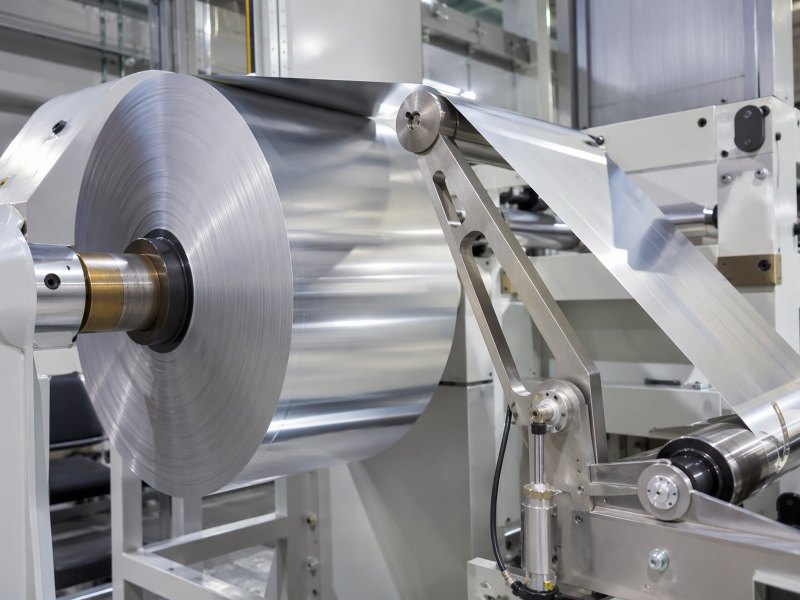
Why a fixed unwind brake fails as a foil coil shrinks, and how to hold tension through the run.
How Do You Set Unwind Tension as the Coil Gets Smaller?
A full coil runs quietly. Two thirds of the way down the web starts to snatch or go slack, and nobody has touched the setting.
The brake holds a torque, not a tension. As the radius falls, the same torque acts on a shorter lever, so the web is pulled harder unless the reference changes with the coil.
Tension control is therefore a strategy that runs with the coil, not a number set at the start of a shift.
Why Is the Tension That Suits a Full Coil Wrong for a Nearly Empty One?
A full coil hides a great deal. The brake works through a long lever, so a small error in torque becomes a small error in web force.
Tension is brake torque divided by coil radius. A torque that gives a workable web at full radius gives a rising, excessive tension near the core.
Dive deeper
The unwind does not control tension directly. It controls a resisting torque, applied by a caliper or a pneumatic brake, and the web converts that torque into a linear force where it leaves the coil. The conversion is a lever: web force equals torque divided by radius. The relationship is not linear in time, because radius does not fall at a steady rate.
At the start of a run the radius is large and the lever is long, so a given brake torque produces a modest force in the web. As the coil empties the lever shortens. The same torque then produces a larger force, and it climbs quickly in the last part of the run, where the operator is least able to see it.
This is why a setting copied from a full coil fails near the core. The web does not become unmanageable because the brake changed, but because the geometry changed under a fixed command. The excess appears as stretched foil, pulled edges, a web that will not sit flat, or a brake that slips and then grabs. Winding the brake down by hand is one answer, and it depends on the operator noticing in time. The general description of aluminium foil is a reminder that the web has almost no spare length to give.
What Actually Changes on the Unwind Through a Run?
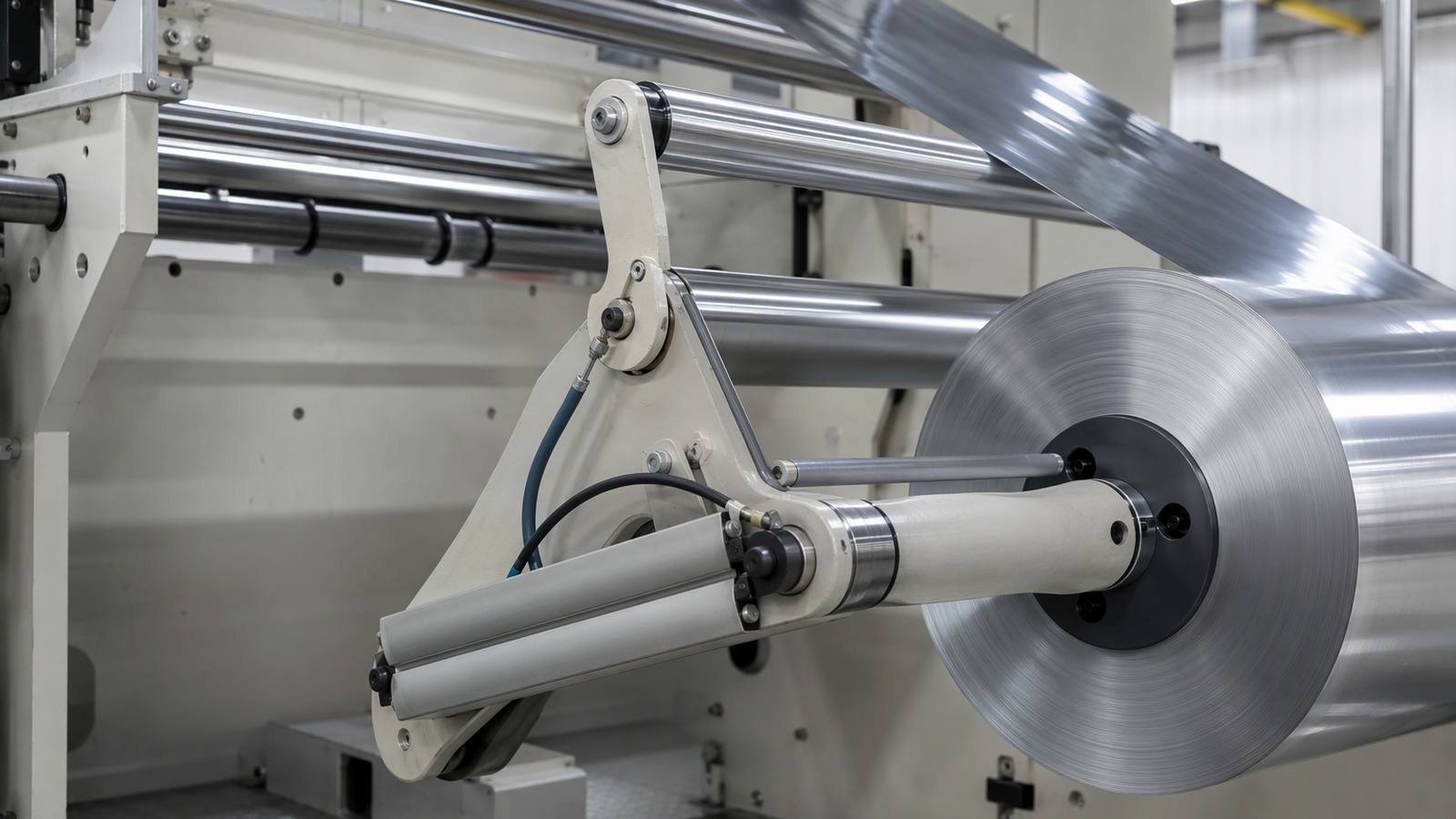
More changes than the radius. Inertia, wrap angle, bearing drag and the stability of the remaining coil all move as the coil pays out.
Radius falls, so mechanical advantage, rotating mass and the geometry of the free span shift together. The brake also heats and wears, and the coil left on the core behaves differently.
Dive deeper
The obvious change is radius, and it drives the rest. A smaller coil has less mass, so it accelerates and decelerates more easily; a correction the brake could absorb at the start of the run now registers as a tension spike. The same coil turns faster for a given web speed, so bearing drag and brake friction generate more heat for every metre paid out.
The free span geometry changes as well. A fixed roller path sees the web leave the coil at a different angle as the coil shrinks, so the wrap on the first roller and the length of unsupported web both change. A load cell calibrated against a wrap angle at full coil is asked to read a different geometry at the end. The error is small for a single degree, but it is systematic.
Then there is the coil itself. The wraps near the core were wound under whatever tension was used when the jumbo roll became a slit roll, and they have been compressed ever since. As the coil empties, those wraps are all that is left, and they behave differently: harder, sometimes set in a curve, releasing in steps. This is where a line that ran well begins to produce a ripple once per revolution.
Is Holding Tension Steady the Same as Holding It Proportional?
No. One keeps the web force constant at every radius; the other lets it fall with the coil, for the sake of the material left on the core.
Steady tension means the same force from first wrap to last. Proportional, or tapered, tension means the reference declines as the coil shrinks, following radius or a curve chosen for the product.
Dive deeper
Constant tension is a statement about the web in front of the line: whatever the radius, the force in the web stays the same. That is what a dancer or a load cell loop is for, and it is the right target for many processes, because the forming or coating step downstream only cares about the web it receives. The coil is treated as a supply that must deliver a steady force.
A tapered reference is a statement about the coil instead. It accepts a lower tension as the coil empties, because the remaining wraps no longer carry the same load and because a hard, tightly wound tail is difficult to open without slip. The shape of the decline is a recipe decision: it can follow radius directly, or fall more steeply near the core, where the geometry changes fastest. The point is that it is chosen and repeatable, not adjusted by feel.
The confusion in most shops is a third thing: an open-loop brake set to a fixed torque, which is neither. It produces a tension that rises with the coil. Operators call that constant tension because the knob has not moved, then spend the run correcting a drift the control scheme created. The three schemes fail in different ways and need different evidence.
How Do a Dancer, a Load Cell and an Open-Loop Brake See the Problem Differently?
Three devices, three pictures of the same web. One watches position, one watches force, and one watches nothing at all.
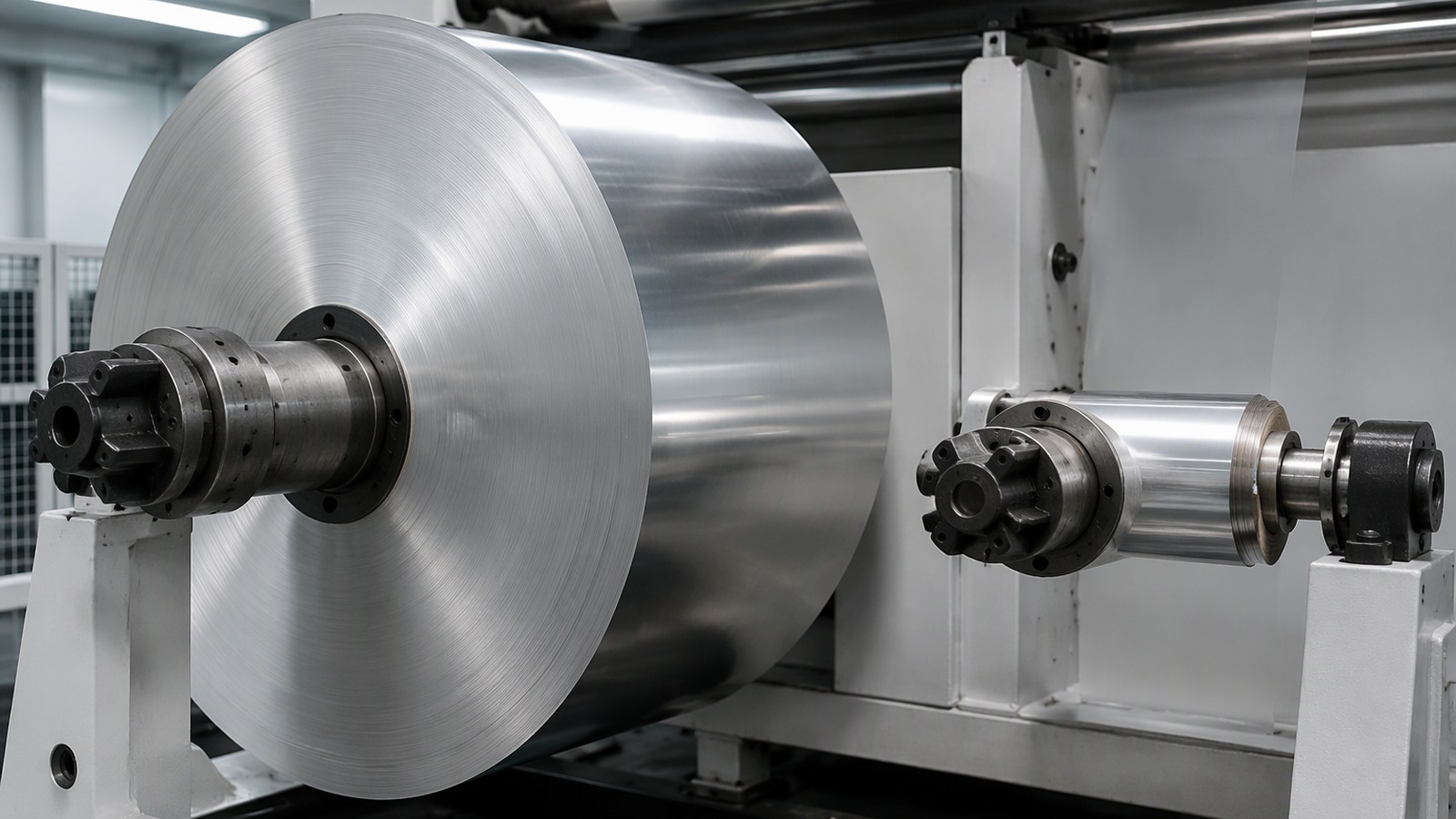
A dancer reads arm position and stores web. A load cell reads force directly. An open-loop brake only applies a command, so it cannot see the tension it creates.
Dive deeper
A dancer roller
The dancer is a floating roller on a pivoting arm, loaded by a spring or an air cylinder. Tension is inferred from where the arm sits: if the web pulls harder than the load, the arm rises; if the web goes slack, it falls. Its advantage is storage, because the moving arm gives the line a buffer. Its weakness is that it reports an average: a short spike passes before the arm moves, and a heavy arm will hunt when the gain is set high. That matters most when the coil is nearly finished.
A load cell roller
A load cell measures the force the web applies to a roller of known weight at a known wrap. It responds quickly and reads the web itself rather than the position of a mechanism, which suits foil, where the events that matter are short. It needs a clean tare, a stable wrap and a temperature it can tolerate; drift and debris read as a slow error nobody can trace.
An open-loop brake
An open-loop brake has no sensor. It receives a command, usually a current or an air pressure, and produces a torque it hopes is proportional. Everything the other two devices measure is invisible to it. It can work on a stable process with a generous tolerance, and it fails quietly on foil.
Why Is Foil Less Forgiving Than Paper or Film?
Paper stretches and recovers. Film stretches and survives. Foil has almost no strain range, so a tension error becomes a defect rather than a slight elongation.
Foil work-hardens and barely elongates before it tears or takes a permanent set. There is no elastic buffer, so tension errors pass straight into wrinkles, marks and breaks.
Dive deeper
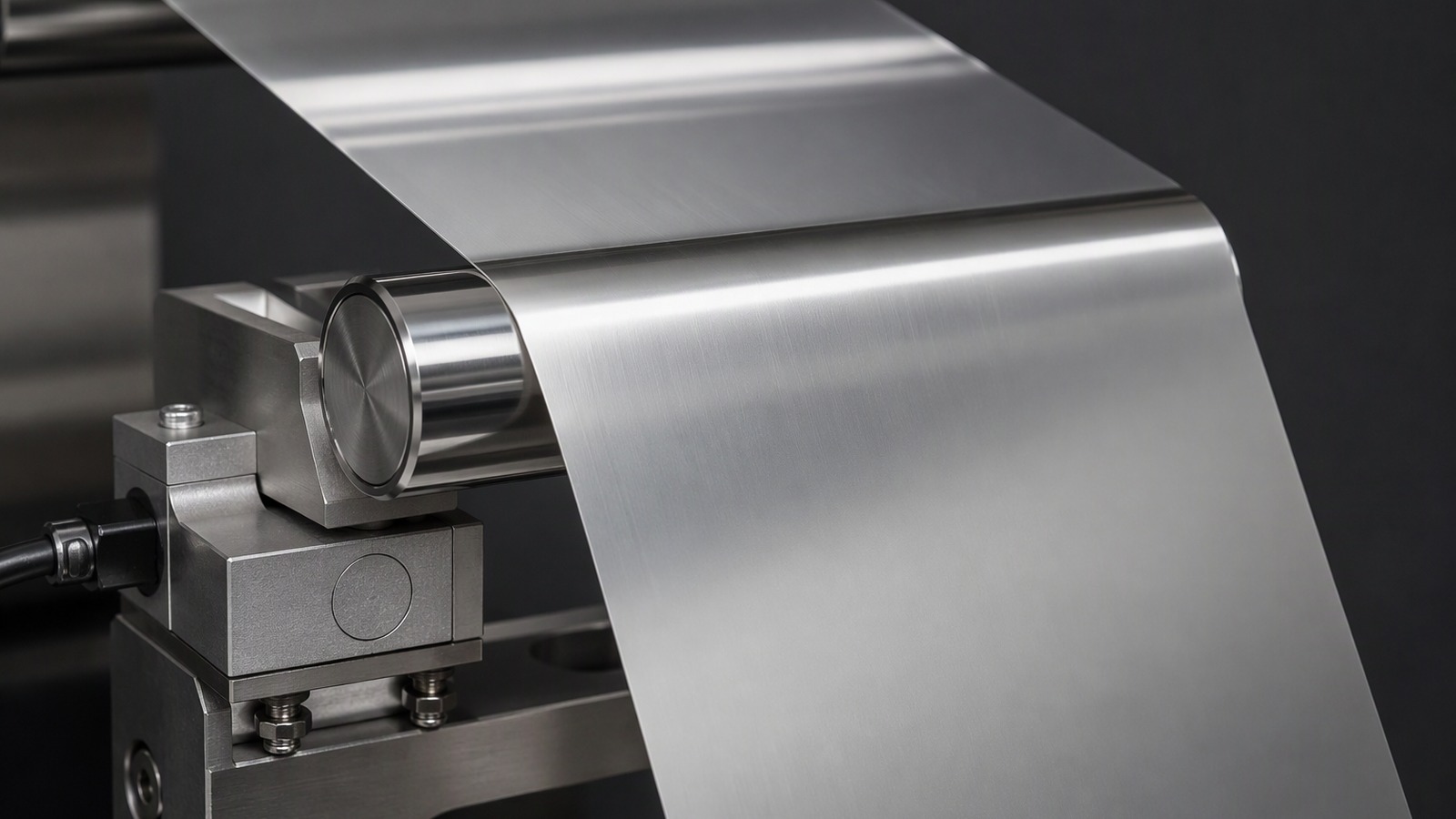
A paper web can be pulled a little harder and will stretch, recover and still run. A plastic film has more elastic range again. Aluminium foil from 0.005 mm upwards has very little elongation available, and what it has is not evenly distributed across the width. Once the elastic limit is passed the foil does not spring back; it stays longer, thinner and wavier, and the next pass sees a different material.
The second difference is stiffness. Thin foil has so little bending stiffness that it cannot bridge a tension imbalance. On a paper machine a slightly tight side pulls the sheet straight; on a foil line the same imbalance produces a slack edge that folds, or a tight edge that cockles, within a short distance of the unwind. The web cannot redistribute the load, so the defect stays close to its source.
The third is surface. Foil is soft enough that a slip event leaves a mark, and grit between wraps is pressed into the metal under tension. A line that tolerates a slight tension error in paper writes that error onto the foil, where a buyer will see it under a lamp. That is why a grade such as 1235 aluminium foil at 0.18 mm is often discussed together with the unwind it will run on. The sector is represented by European Aluminium.
What Does Tension Do to the Coil Behind the Line?
Tension is decided at the unwind, but it is paid for at the winder. The coil built at the end of the line becomes the next line's unwind problem.
Winding tension sets the pressure between layers. Too much and the coil is hard, marked and difficult to open; too little and it is soft, loose at the edges and prone to slip.
Dive deeper
A winder pulls the web and lays it down under tension. Each new wrap compresses the ones beneath it, so the tension at the winder decides how much pressure is trapped inside the finished coil. A coil wound hard holds its shape and travels well, but the wraps grip each other and the inner layers can deform under the accumulated load.
The unwind and the winder are two ends of one decision. If the coil you buy was wound with a falling tension profile, the tail will be softer than the body, and a line set up for a uniformly hard coil will find the last part of the run behaves differently. If it was wound flat and hard, the first wraps may need more effort to separate.
There is a further link through gauge. A coil with bands of heavier gauge, wound under tension, stores them as bands of higher pressure, which release unevenly on the next unwind and appear as a tension ripple repeating with every revolution. The symptom is at the unwind; the cause was in the coil build. It is the same family of behaviour that lets a roll telescope when layers slide, except that here the layers are held. The European Aluminium Foil Association describes the industry that meets these coil conditions daily.
How Do You Tell a Tension Fault From a Profile or Alignment Fault?
All three look like a bad web. The difference is in the pattern: what changes with radius, what repeats each revolution, and what follows the path.
A tension fault changes as the coil empties and retreats when the reference is corrected. A profile fault repeats per revolution; an alignment fault follows the path, not the coil.
Dive deeper
Start with time. A tension fault is a slow drift, or a change that begins at a particular point in the coil and worsens towards the core. If the web runs clean at the start and starts to wrinkle or snatch after a predictable interval, radius is the variable to test. Reduce the reference and watch whether the symptom retreats; if it does, the control scheme is implicated rather than the metal.
Next, look at frequency. A fault that repeats once per revolution of the unwind is geometric: an out-of-round coil, an eccentric core, a thick band, a splice. A fault that is steady across the width and constant in time is more likely to be a reference that is wrong for the product. A fault fixed at one position across the width, at every radius, points to the incoming profile.
Then look at tracking. An alignment fault moves the web sideways and the edge guide fights it; the wrinkle is diagonal and changes with the path length. A tension fault makes the web wander only as a secondary effect, usually because one edge has gone slack. Swapping the coil before changing the machine is the cheapest test: if the symptom follows the coil, the coil build is implicated.
What Can a Buyer Ask About Coil Build So the Line Can Be Set Up?
A buyer does not need to specify a tension. The useful questions are about how the coil was built and how it will behave when opened.
Ask for the winding practice, the tension profile, the edge condition, the gauge profile and the core. Then describe the line, so the coil can be matched to it.
Dive deeper
The first question is how the coil was wound. Was tension held flat, or did it fall as the coil grew? A supplier who can describe the winding practice is saying what the coil will feel like at the unwind. The second is edge condition: a coil wound with a wandering edge will not track.
The third is gauge profile across the width, because heavy bands are stored as hard bands and released as tension ripples. The fourth is the core: bore, condition and how the first wraps sit on it, since an oval core produces a disturbance no loop can remove. The fifth is temper, because the same gauge in O and H18 behaves differently under tension.
Then describe the line: width, gauge range, whether there is an accumulator, whether the unwind carries a dancer or a load cell, and how the coil is mounted. If the enquiry is about a grade, the foil roll and sheet range sets out the forms available, and 1060 aluminium foil at 0.12 mm can be discussed against the unwind. The Aluminum Association is one place to read around the material before that conversation.
Conclusion
Unwind tension is a moving target. Control it as a strategy that follows the radius, measure it at the web, and describe the coil you need.