What Causes Roll Marks on Aluminium Foil?
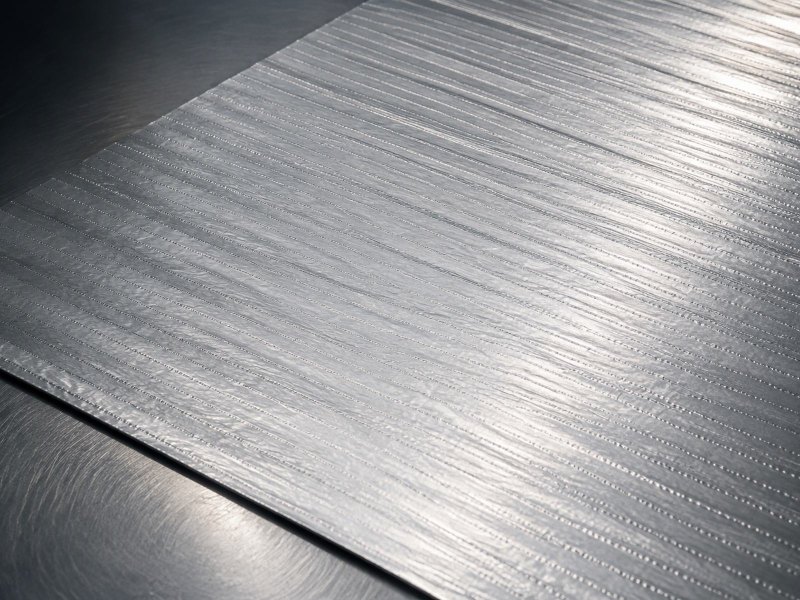
A repeated pattern at a fixed interval is a roll’s signature. Read it before accepting a coil.
What Causes Roll Marks on Aluminium Foil?
A delivery arrives carrying a faint pattern that was not on the sample. Before you accept or reject it, know what made it.
A roll mark is a pattern pressed into the foil by contact with a roll surface, or by the foil winding onto itself. It repeats once per turn of whatever touched it, so the interval identifies the source.
This page separates roll marks from every other blemish behind the same complaint, and shows how to describe one so it can be corrected.
What Is a Roll Mark on Aluminium Foil?
A roll mark is not dirt and it is not a coating. It is a shape the metal took because something pressed it.
It is a pattern transferred to the foil from a roll surface, or from contact with another layer, during rolling, slitting, rewinding or handling. The metal copies the shape it was pressed against, and keeps the copy.
Dive deeper
Every metre of foil has been squeezed between two hardened steel surfaces. The metal leaves that gap thinner than it entered, and its surface takes a copy of whatever it last touched. When the copy is a repeated feature, a band, a line or a patch of different texture, the cause is a surface rather than the alloy.
Two families exist. The first is a mark from a roll: the work roll that reduces the gauge, a deflector roll that only guides the web, a coiler drum that begins the wrap. The second is a mark from contact with foil itself, where a high spot, a trapped particle or a crease in an earlier lap prints into the lap above. Both look alike on an unwound sheet and both repeat, but at different intervals and on different faces.
Separating them starts with the web. A mark from a roll sits on the same face and returns with mechanical regularity along the length; a mark from winding appears on the face pressed against the previous lap and often fades as the coil is unwound. Neither is a gauge problem, which is why a thickness check can pass while the surface is refused. Metal for visible forming work, such as 8021 aluminium foil at 0.12 mm, is chosen for its surface as much as for its gauge.
Why Does a Roll Mark Repeat at a Fixed Spacing Along the Web?
A single scratch happens once. A mark that returns again and again is reporting the size of the object that made it.
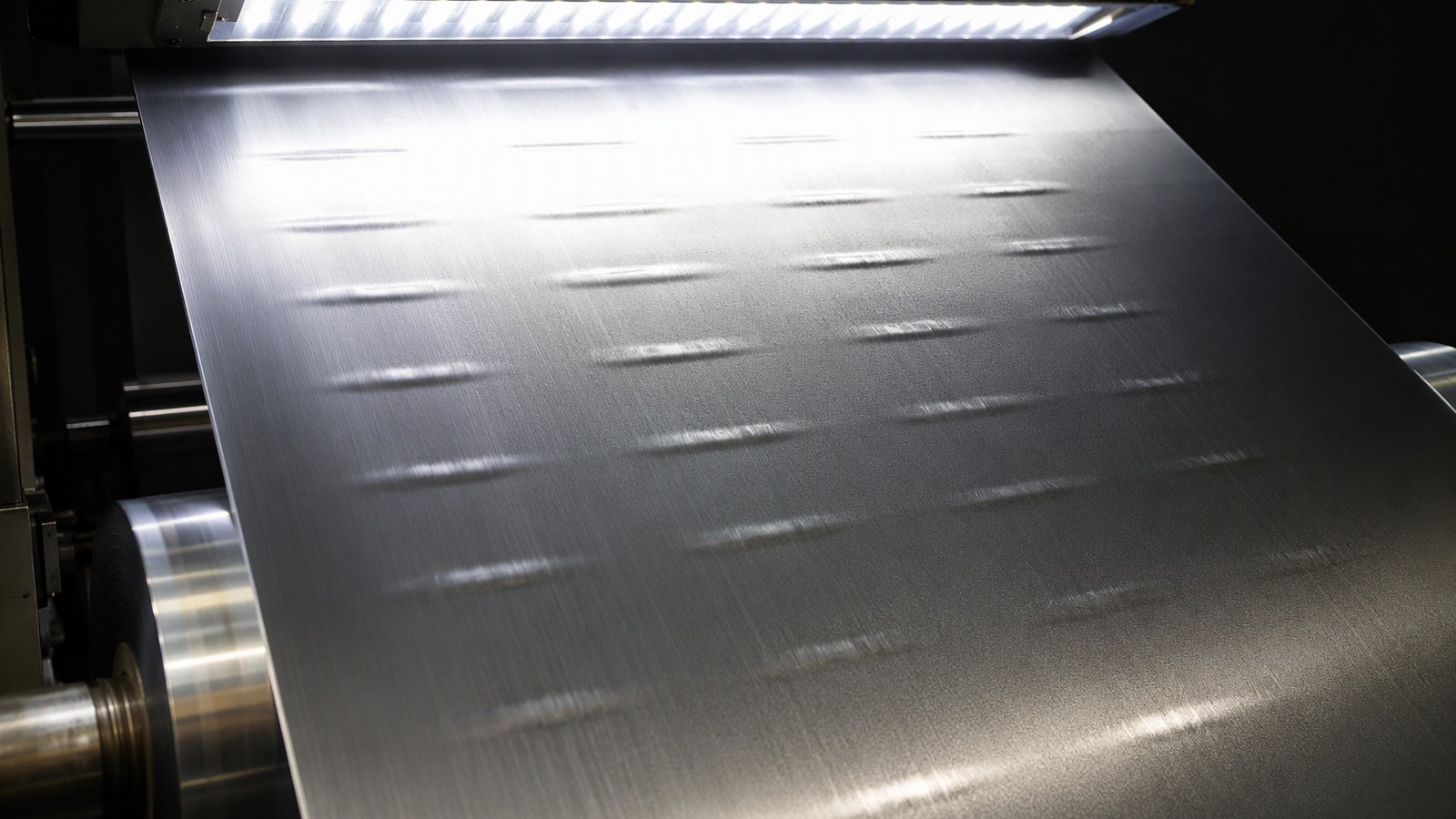
The pattern returns once per revolution of the roll in contact, so the distance between repeats equals one turn of that roll. Short intervals point to a small roll, long intervals to a large one.
Dive deeper
Picture one damaged spot on a polished roll face. That spot touches the foil once in every revolution, so it prints once in every revolution, and the foil carries a row of identical prints at a constant pitch. Nothing else on a coil behaves that way: a drag mark smears, a stain spreads, a dent is solitary, but a roll defect is periodic, and the period is set by the tool.
The pitch is therefore a measurement, not an impression. Measure from the start of one print to the start of the next, then look for the same value in a second sample from another position in the coil. If the interval holds, one roll is responsible and the fault is repeatable, which is what a mill needs to find the damaged station. If it drifts, the cause is something that grows or slips, such as a wrap that tightens as the coil builds.
Two variations carry information of their own. A mark that appears twice in a revolution usually means two defects on the same roll, or a roll turning faster than the web. A mark that runs continuously instead of printing in rows means the damage runs right around the circumference, so every point of the roll marks the foil. Neither is a handling accident.
How Do Roll Marks Differ from Water Staining, Oil Pattern, Handling Dents and Coil Marks?
Four faults arrive described as marks on the surface. They are made by different things, and only one of them is a roll.
Water staining follows moisture trapped between laps and leaves darkened areas with wet edges. Oil pattern is a film, not a shape. Handling dents are local impacts. Coil marks are the wrap printed by the coil's own layers.
Dive deeper
Water staining is a chemical event. Moisture sits in the gap between laps, the surface reacts with it, and the result is a darker area whose border follows where the water stopped. It has no pitch and no direction, it is usually worse where the coil was coldest, and it often shows on the outside wrap as well as inside. A roll mark has a direction and a period, and does not change with humidity afterwards.
Oil pattern comes from the film used in rolling and from how that film is laid down and removed. It reads as streaks, bands or a general haze, and it responds to cleaning because it sits on the metal rather than in it. That mechanism belongs with how rolling oil affects the aluminium foil surface, a separate subject from a shape pressed into the metal.
A handling dent is a single event with a boundary: a knock at a coil edge, a fork, a dropped core. It is local, it displaces metal, and it does not repeat. A coil mark is the wrap of one lap printed into the next, so it mirrors the coil's own geometry and can appear as a broad patch rather than a line. A mark that is periodic, directional and on one face belongs to a roll.
Why Does a Mark That Looks Invisible in the Flat Become Obvious After Lacquering or Printing?
The mark was already in the coil when it was accepted. Coating did not create it. Coating revealed it.
Lacquer and ink dry as a thin, even film that reflects light predictably. Any local change in the texture of the metal changes how that film settles and reflects, so a shape too shallow to see flat becomes a visible difference in gloss.
Dive deeper
A flat sheet viewed straight on gives the eye very little to work with. The surface is bright and uniform, and a shallow depression scatters almost the same light as the area around it. Tilt the same sheet towards a light and the geometry changes: the disturbed area throws a shadow where its neighbour throws a highlight, and the shape appears. That is why an argument over a coil often depends on who looked and from where.
Coating adds a second surface on top of the first. A lacquer film is thin and follows the metal closely, so it inherits every local slope. Where the metal is slightly hollow the film settles differently, and the cured film reflects at a different angle. Printing adds a further demand, because ink transfer depends on contact between a plate or cylinder and the web; a low spot can take ink less evenly and show as a light patch.
This is the expensive sequence. The fault is created at the mill, passes a coil inspection, is converted at cost, and is discovered after lacquering, when the material already carries value that cannot be recovered. Coating also cannot bridge a gap, which is why what causes pinholes in thin aluminium foil is a separate question about continuity rather than surface shape.
How Do Mill Rolls and Their Dressing Schedule Shape the Pattern?
A work roll is a consumable. It is ground, run, worn and ground again, and each of those stages prints something different.
A freshly dressed roll prints its own direction and texture; as it wears, the pattern becomes uneven. The interval at which rolls are changed and redressed decides which of the two the foil carries.
Dive deeper
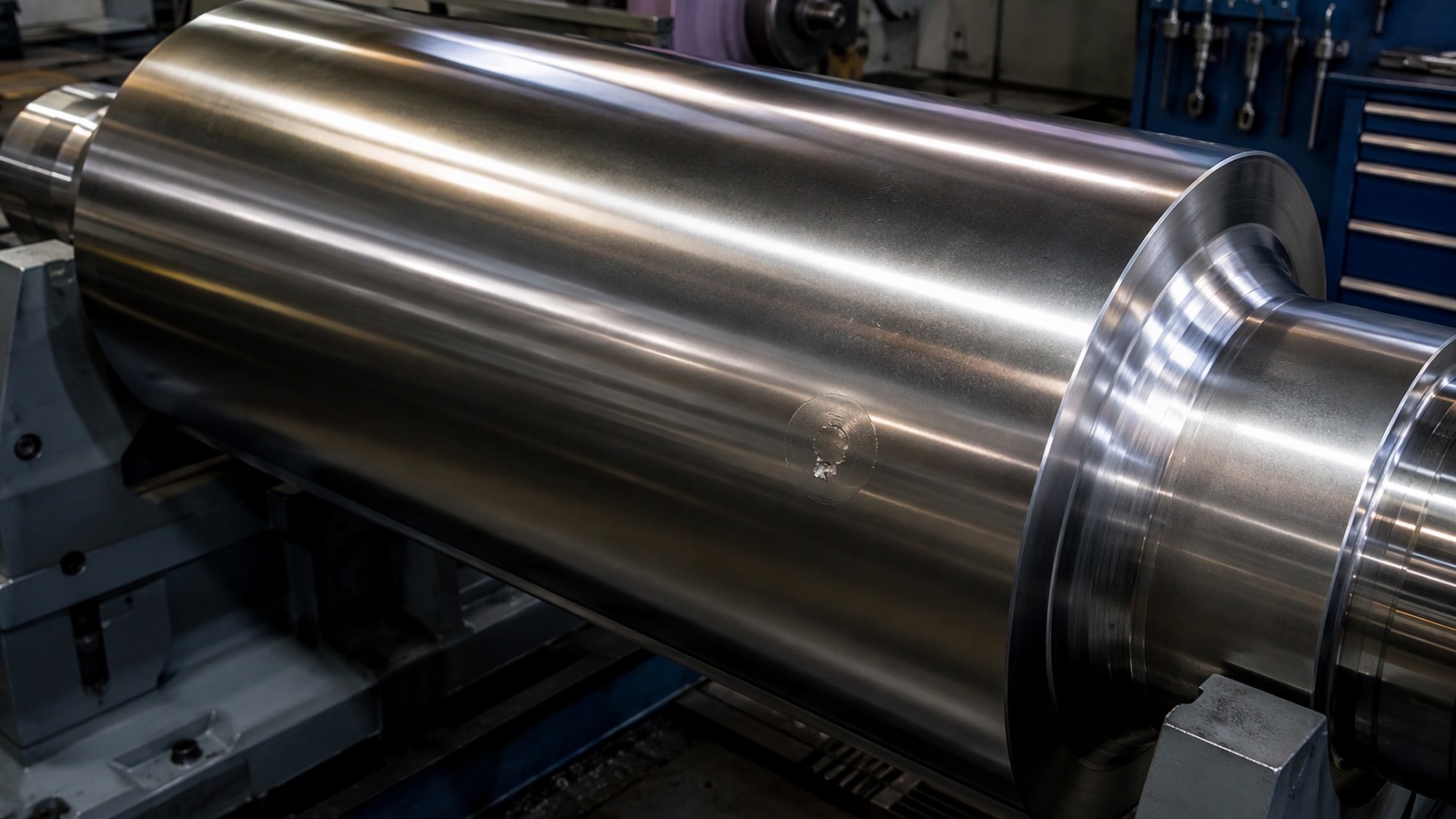
Rolls are not used until they fail. They are changed on a schedule, redressed in a roll shop, and returned to the stand with a surface cut back to a true shape. A freshly dressed roll is geometrically clean and prints a regular, faint direction that the eye reads as normal texture. A roll towards the end of its campaign has picked up local wear, edge build-up, fine damage and thermal history, and prints all of it. The difference is a coil that looks uniform and one that carries a pattern.
Dressing matters for a second reason. Grinding leaves its own direction, and if that direction is not aligned with the way the roll runs, the foil can carry a crossed appearance that looks like a mark but is only the tool's signature. Dressing also restores the roll's profile, and a roll whose profile has drifted marks the strip unevenly across its width, which is why a defect sometimes appears on one side only.
The schedule is a commercial decision as much as a technical one. Changing rolls more often costs production time; changing them less often transfers that cost to the customer. A mill that states its roll practice in a specification shows which side of that trade-off it has chosen.
Why Can the Same Fault Be Cosmetic in One Application and a Reject in Another?
One buyer refuses a coil that another would run without comment. Both are right, because the duty is different.
A mark matters where it changes appearance after decoration, disturbs a coating, or sits on a visible face. Where the foil is hidden or laminated away, the same mark may never be seen.
Dive deeper
Start with what the foil becomes. A container wall that will be printed and lacquered presents one large visible face, and any periodic pattern will read through the decoration as banding that ink cannot hide. A laminate bonded to board or film has its marked face buried, and the adhesive does not care about a shallow shape. A technical part that is punched and formed may lose the marked area in the trim.
The process decides as well. Lacquering and printing amplify a mark; forming can either remove it or make it worse, depending on whether the mark falls on a bend. A mark on a fold line concentrates strain and can start a tear, which turns a cosmetic question into a functional one. A mark on a flat panel that will never be bent stays cosmetic.
This is why acceptance criteria belong in the order rather than in the argument afterwards. Where appearance matters, the comparison should be a retained sample agreed by both sides and viewed under the agreed light. Where function matters, the criterion should be what the part must survive. A general purpose grade such as 3003 aluminium foil at 0.18 mm may suit a hidden application and be wrong for a decorated one, and the industrial and technical foil range is where such choices are made.
How Do You Inspect a Coil by Eye and Under Angled Light?
A coil inspected under office lighting will pass marks that a customer finds on the first day of use.
Unwind a length on a clean surface, view it flat, then at a low angle under one light. Angled light turns a change of texture into a shadow, and the repeat interval can then be measured.
Dive deeper
Set the coil so that a length can be drawn off without dragging it over an edge, and support the sample on a clean, flat surface. Look at it first from directly above, in ordinary light, and note what you can see. Then move the light to one side, bring it low, and look along the surface rather than down at it. The raking view exposes what the flat view hides.
Check both faces, because a roll mark usually lives on one and a winding mark on the other, and the difference tells you which part of the line to question. Take samples from the outside wrap, from the middle of the coil and from the last few metres, since a failing roll often marks more heavily at one end of a campaign. Where a pattern appears, measure from one print to the next and write it down.
Record the conditions along with the finding: which face, which position in the coil, the interval, the appearance flat and at an angle, and whether the mark survives a wipe with a dry cloth. Photographs taken with the light low to the surface say more than one taken square on. A description built this way turns a suspicion into checkable evidence.
What Should a Specification or a Complaint Say So the Mill Can Act?
A complaint that says marks on the surface cannot be investigated. A complaint that says where, how often and on which face can.
Name the face, the interval between repeats, the position in the coil, how it looks flat and at an angle, and what it does after your process. Send a sample length and an angled-light photograph.
Dive deeper
Begin with the face. Say whether the mark is on the outside wrap, on the inside of the outer lap, or throughout, and say which side of the web it sits on when the coil is unwound in the direction of use. A mill cannot map a complaint onto a rolling stand without knowing the face, because the top and bottom of the gap are different tools.
Then give the repetition. State that the mark returns at a constant interval, give the distance you measured, and say how many repeats you counted over the length you examined. That number does more than any adjective: it points to a rotating part anyone can verify on the same coil. Add the position, since a fault confined to the first metres has a different cause from one spread through the coil.
Describe the appearance flat and at an angle, and the effect after your own process, with the coating or print run that exposed it. Then state what you want: a replacement, a credit, or a joint examination of a retained sample. Close with the practical facts: alloy and temper on the label, size, coil number and quantity affected. For background, see the Wikipedia entry on aluminium foil, and for industry context the European aluminium industry association site, the North American aluminium association site and the foil industry association site.
Describe the repeat, the face and the light. That is what turns a rejected coil into a roll the mill can correct.