Why Does Aluminium Foil Tone Vary From Coil to Coil?
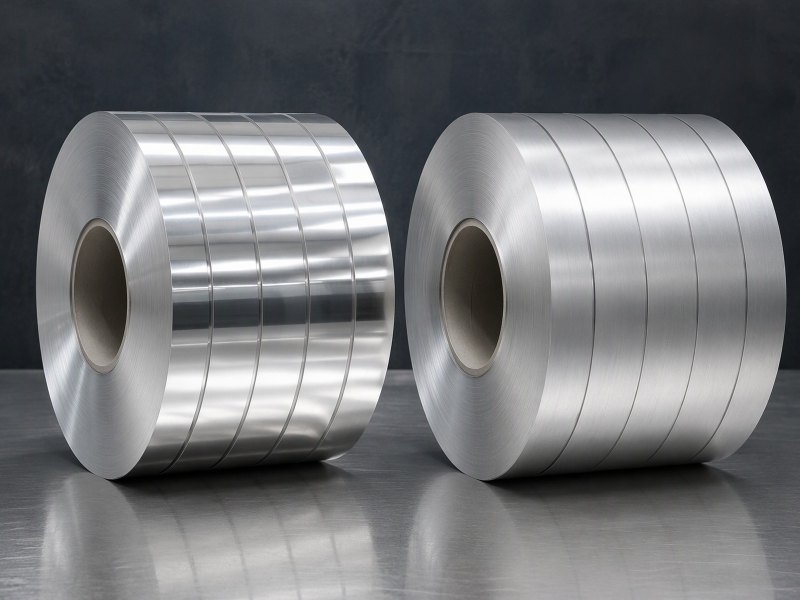
Two coils can meet one specification and still look different. Tone is surface, not alloy.
Why Does Aluminium Foil Tone Vary From Coil to Coil?
Two coils arrive against the same order, and one looks duller. Nothing in the paperwork has changed, yet the pack no longer matches the last run.
The alloy is usually identical. What differs is the surface: how finely the skin was rolled, how much oil film remains, and which face you are looking at.
This guide separates the surface from the alloy, explains why identical specifications still diverge, and shows how to compare two coils honestly before a complaint is raised.
What Actually Differs When Two Coils Look Different?
Rarely the metal. Two coils of one alloy and temper can differ only in how their surfaces send light back to your eye.
Brightness, the rolled skin left by the last pass, the oil film still present, and whether you are seeing the matte or the bright face decide the tone.
Dive deeper
A buyer comparing two coils suspects the alloy first, and that is almost always the wrong place to look. Alloy and temper set strength, ductility and how the metal behaves under a tool; they touch appearance only indirectly, through the way the metal rolled. What your eye reads as tone is light arriving at the surface and leaving it again. Change the direction or the amount of that light, and the tone changes, even when the two coils are metallurgically the same. The encyclopaedic overview of aluminium foil is a fair reminder of how thin that surface actually is.
Four things sit on that surface. Brightness is the underlying reflectivity of the metal as the last passes left it. The rolled skin is the fine texture transferred from the work roll, a faint grating spread across the full width. The oil film is a thin organic layer that both smooths and slightly tints what you see. And the matte and bright faces are two sides of one sheet, rolled against rolls of different finish, so they never match each other.
Read the four together and most puzzles dissolve. A coil that looks lighter often has a finer skin, or a more completely removed oil film, or you are simply seeing its bright face. None of that is a specification failure, and none of it appears in a chemistry report.
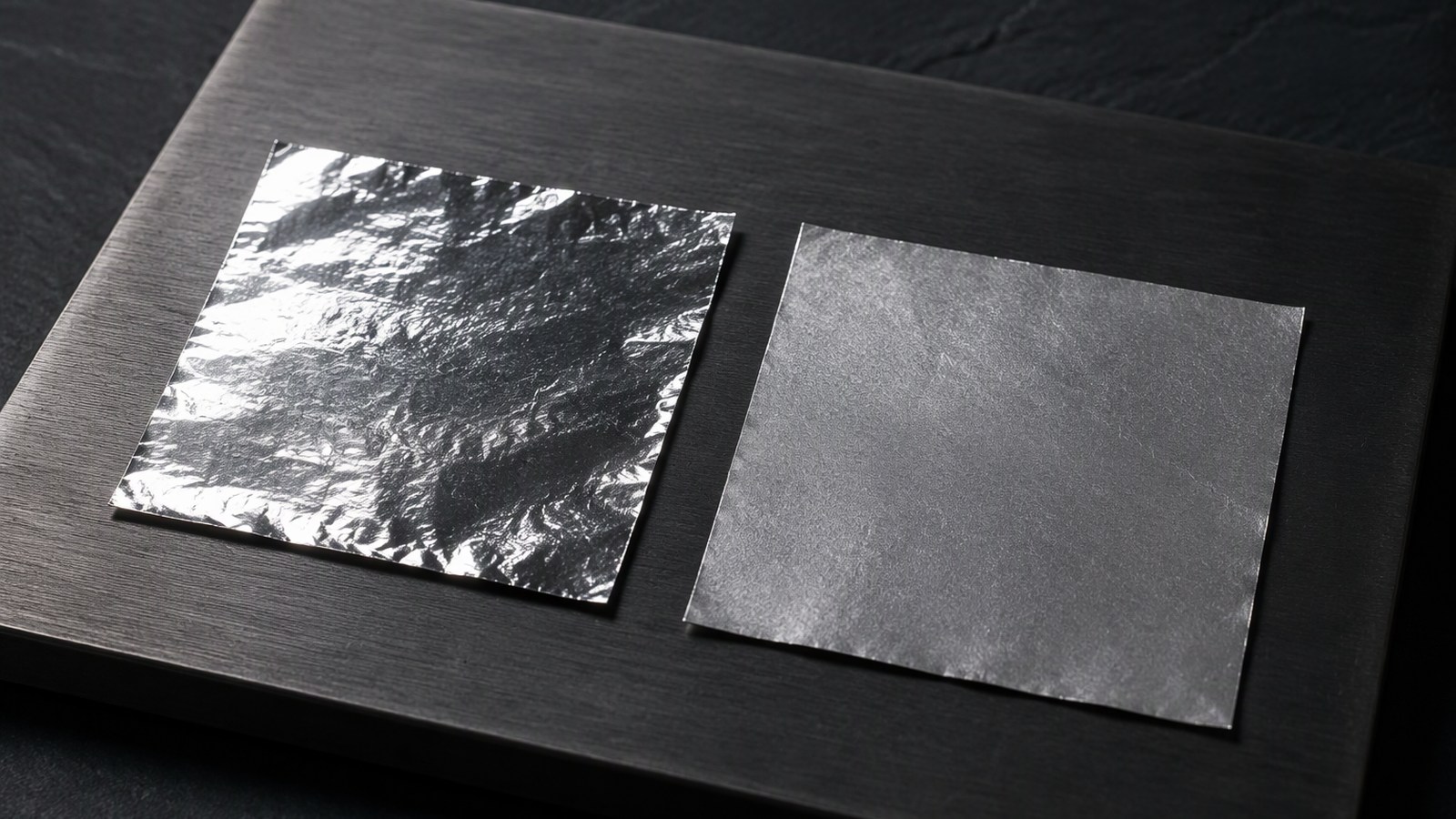
Why Can Two Coils of the Same Specification Still Look Different Side by Side?
Because a specification describes limits, not a production route. Two coils can satisfy every limit and still be made by different sequences.
Different pass schedules, different roll finishes, different annealing batches and different oil removal leave different surfaces, even when every declared value matches.
Dive deeper
Two coils can both be 1235 at 0.18 mm and 1200 mm wide, both inside every limit, and still have left the mill by different routes. One might have finished on a freshly ground work roll, the other on a roll near the end of its campaign. One might have been annealed in a batch furnace and cooled slowly, the other treated continuously. Each choice leaves a surface that scatters light differently.
Put the two coils side by side on the same pallet and the difference is plain; put them a week apart on the same line and nobody notices. That is the trap in coil-to-coil variation. It is not a defect in either coil, it is a difference between them, and a difference exists only where two things are compared. The same two coils, judged separately against a written limit, would both pass without comment.
There is also the question of which part of the coil you see. The outer wrap has been handled, exposed and rewound; the body has not. A sample cut from the outside of one coil and one cut from the middle of another are not the same sample, and comparing them says nothing useful about the coils. Where tone matters for a visible pack, a coil of 0.18 mm aluminium foil for containers is best judged on a sample taken from the same position on both coils.
How Do Rolling Routes and Roll Condition Change the Surface?
Foil is reduced over many passes, and each pass copies the work roll onto the metal a little more closely.
A route that ends on a fresh, finely ground roll leaves a fine skin. A route that ends on a worn or slower roll leaves a coarser one, and the tone follows.
Dive deeper
Every pass does two things: it thins the strip and it prints the roll onto it. A roll ground to a fine finish transfers a fine texture; the same roll after a long campaign, with its finish polished away by miles of metal, transfers something coarser. Because foil is rolled in packs, the surface you see could have been formed by a roll several stands removed from the one you would blame. The European aluminium industry association's pages describe the rolling sequence in general terms if you want the wider picture.
Speed, tension and reduction per pass matter as much as the roll itself. A fast final pass with light reduction tends to leave a brighter, silkier surface; a heavier reduction at lower speed can leave a surface that reads flatter and greyer. Neither is wrong, and both can be inside the same delivery tolerance, because the tolerance was written about dimensions and mechanical properties rather than about tone.
Discrete marks from a roll are a separate subject, covered in what causes roll marks on aluminium foil. What matters here is the continuous skin, the background texture over the whole width. Two coils rolled on different stands, or on the same stand either side of a roll change, will differ in that background, and no certificate will record it.
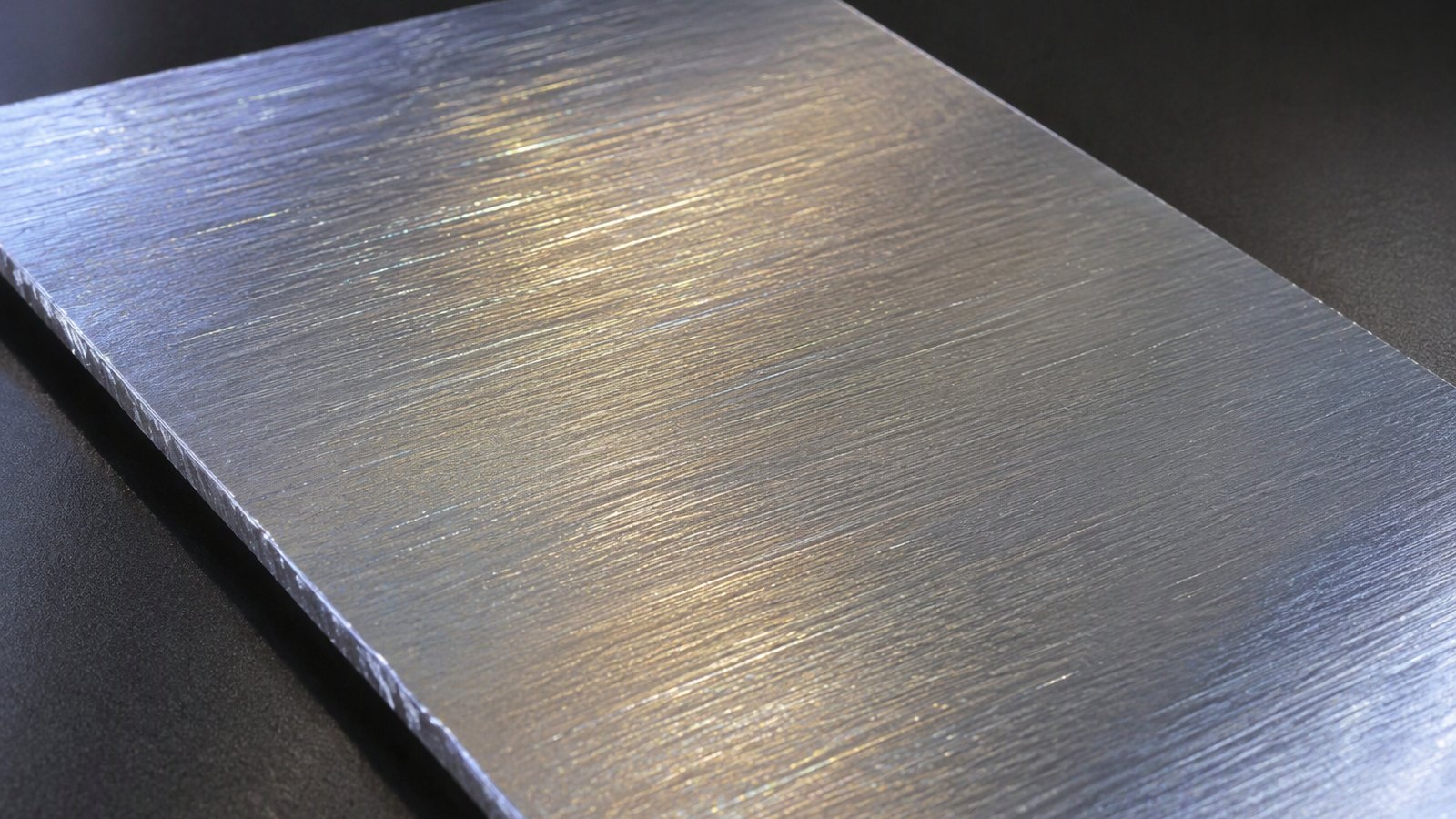
How Does the Oil Film and Its Removal Change Tone?
Oil sits on almost every coil, and its thickness and evenness change what you see before the metal itself is involved.
A heavier or patchier film reads darker and smoother. A fully removed film exposes the true skin, so the two states look like two different tones.
Dive deeper
A thin film of oil is not dirt; it is part of the product while the coil is in transit, keeping the surface from rubbing and marking itself in the wrap. It also changes the optics. A layer with a slightly different refractive behaviour from air bends light a little as it enters and leaves, which lifts the darker parts of the surface and softens the contrast of the texture beneath. The result is a surface that looks deeper in tone and smoother than the metal alone would look.
That film is never perfectly even. It follows the way the coil was cooled, the way it was wound and how long it stood. Edges often carry a different amount from the centre, and the outer wrap carries a different amount from the body. When one coil is cleaned before dispatch and the next is not, the two look like different products on the same bench.
The pattern the film leaves is a subject of its own, set out in how rolling oil affects the foil surface. For tone, the important point is that removal is a change of state. A coil judged before cleaning and the same coil judged after cleaning can differ enough to start an argument, and both readings are honest.
Why Does Annealing Change the Appearance of the Same Coil?
Heat does three things at once: it softens the metal, grows the surface oxide, and drives off or carbonises whatever oil remains.
So a coil before and after annealing, or two coils annealed in different furnaces, can differ in tone although nothing was added or removed.
Dive deeper
Annealing is where the metal stops being work-hardened and becomes soft and formable. The internal change is a rearrangement of grain structure, and that alone alters how the surface reflects, because the grains meet the surface at slightly different angles and etch or oxidise at slightly different rates. A temper O coil and an H18 coil of the same alloy are not expected to look alike, and they do not.
The furnace adds its own effects. Residual oil on the surface either evaporates or breaks down, and breakdown leaves a faint deposit that dulls the face. Cooling rate matters too: slow cooling in a batch furnace gives the oxide more time to form evenly, while a continuous line quenches the strip quickly and leaves a different surface history. Coils from two furnaces, or from the top and bottom of one charge, can carry slightly different tones for that reason alone.
This is why a soft foil for a formed or lidded pack is judged as its own product rather than against a hard-temper coil. A 0.12 mm 8079 aluminium foil for lidding is annealed for formability and barrier, and its face will read differently from a hard-rolled foil of the same thickness. The aluminium industry association's site is a reasonable place to read about temper designations in general terms.
Why Does a Difference Invisible Flat Become Obvious After Lacquering or Printing?
A bare coil hides variation well. A coated one reports it, because the coating adds a second reflecting surface on top.
Lacquer and ink form a smooth, partly transparent layer, so a difference in the metal beneath is read twice and read more sharply.
Dive deeper
A bare surface scatters light in many directions, and scattered light is forgiving: small differences in texture and tone average out. Add a lacquer and the top surface becomes smooth and slightly glossy, so it reflects a share of the light directly. What reaches your eye is now a mix of the coating's own reflection and the light that travelled through it, bounced off the metal and came back. The metal's tone is no longer averaged away, it is amplified by the smooth layer sitting over it.
Printing sharpens the effect again. A thin ink film over a darker substrate reads darker than the same ink over a brighter one, because the ink is not fully opaque and the substrate shows through. Fine type and thin lines suffer most, since their apparent weight depends on contrast against the background. Two coils that printed acceptably alone can look like two different jobs when their reels sit side by side.
Wetting and adhesion belong to the same story. A coating that wets a slightly oily or coarser skin differently will sit at a different thickness, and a different thickness is a different colour. This is why a lacquer trial, run on samples from both coils and compared after curing, is the only fair test for a visible pack. For foil in general, the aluminium foil association's pages are a useful primer.
How Do Lighting and Viewing Angle Make the Difference Look Worse?
Two panels can match under one light and clash under another. The material did not change between the two rooms.
Tone is a comparison of reflections, so a change of light source or a small change of angle can exaggerate a difference that is barely there.
Dive deeper
Foil is close to a mirror with a texture. Under a diffuse, even light it returns a soft, fairly uniform field and small differences flatten out. Under a directional source, a strip light or a window, it returns a bright band and a dark band, and the position of those bands depends on the angle between the light, the surface and your eye. Tilt the sample a few degrees and the bands move; where they move differently on two samples, the difference in texture becomes visible even if the tone is identical.
Surroundings matter as much as the lamp. A coil viewed against a white wall, a wooden bench or a coloured machine will be judged against that colour by the eye, which adapts continuously and unconsciously. Two coils judged in two rooms are being judged by two different instruments.
Cameras make it worse. A phone adjusts exposure and white balance for whatever fills its frame, so a close-up of one coil and a wider shot of another can show a tone difference nobody sees in person. If a tone question is being argued by photograph, the argument is about the camera, not the coil. Judge both samples in one place, under one light, at one angle, and the difference usually shrinks to something you can settle with your eyes.
How Should Two Coils Be Compared, and What Goes in a Specification?
Compare like with like, in one place, under one light. Then the question shrinks from an argument into a decision.
Take samples from the same position on each coil, clean them the same way, view the same face at the same angle, and record the result before coating.
Dive deeper
A workable comparison takes a few minutes. Cut a sample from the same position on each coil, a hand's width in from the outer wrap. Keep the same face upward on both, matte with matte, because mixing faces guarantees a false difference. Clean both the same way, or leave both uncleaned, but never one of each. Lay them on the same neutral surface and turn them together through the angles you will actually use.
Then coat. A lacquer or print trial on both samples, cured together, tells you what the customer will see, which is the only question for a visible pack. If the difference survives, record it with the retained samples.
For the specification, write tone as an agreement rather than a number. Name the approved reference sample and its date, state which face is to be judged, state whether the coil is bare or coated, and describe the viewing condition in plain words, such as a diffuse daylight bench with the sample flat. Add the practical frame: alloy from 1050 to 8079 as required, temper O to H24, thickness within 0.005-0.20 mm, width within 100-1500 mm, core 76 or 152 mm, MOQ 3 MT per size. Coils for a visible pack in packaging and container foil are usually best served by a retained sample held by both sides, so the next coil is compared with a known reference instead of with a memory.
Tone differences are usually surface, not alloy. Compare like with like, agree a reference sample, and write that agreement into the specification before the next coil is rolled.