Why Does the Cut Edge of Aluminium Foil Matter So Much?
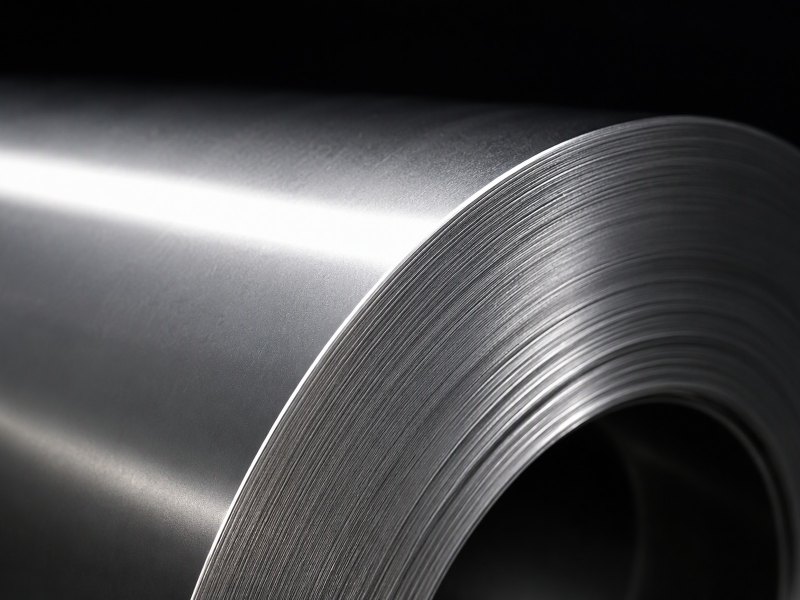
What slitting leaves on the cut edge of aluminium foil, and why that edge decides the run.
A tear at the coating head rarely starts where it appears. It starts at an edge nobody looked at when the roll was slit.
Slitting does not simply divide a web. It pushes metal aside, leaves a small raised lip and a work-hardened band along the edge. That edge then carries every tension the roll will ever see, so its condition decides whether the web runs clean or tears.
This article looks only at the edge: what the knives leave behind, how that feature grows into a failure, and what a buyer should put in writing.
What Actually Happens to the Metal When Foil Is Slit?
Two knives meet a web under tension, and the metal does not part cleanly. It is forced apart.
Slitting is controlled fracture plus plastic flow at the knife line. The separated strip keeps a narrow band of deformed, hardened metal on each side, and that band behaves unlike the rest of the web.
Dive deeper
The knives do two things at once. Where the cutting edges meet, metal is sheared until it separates. Around that line a wider zone is bent, dragged and compressed before it springs back. The result is an edge with three features that matter: a small raised lip where displaced metal has had to go somewhere, a narrow band of harder metal left by cold working, and a slight curl out of the web plane where the internal stress pattern has been cut open.
None of these is a defect in itself; every slit roll carries them. What differs is how pronounced each one is and how consistently it repeats down the roll. A strong lip on one strip beside a clean edge on its neighbour means the knife pair was not cutting the same way across the width, the first thing to check when one lane misbehaves.
The metal also remembers being slit. The worked band cannot relax, because the undeformed web holds it on one side. That stored energy later shows up as a tight edge, a web that wanders, or a curl that will not lie flat at the coating head. Background on how the metal is rolled and finished sits in this reference article on aluminium foil. The handling side appears in published foil industry material.
Why Is a Cut Edge Different from a Rolled Edge?
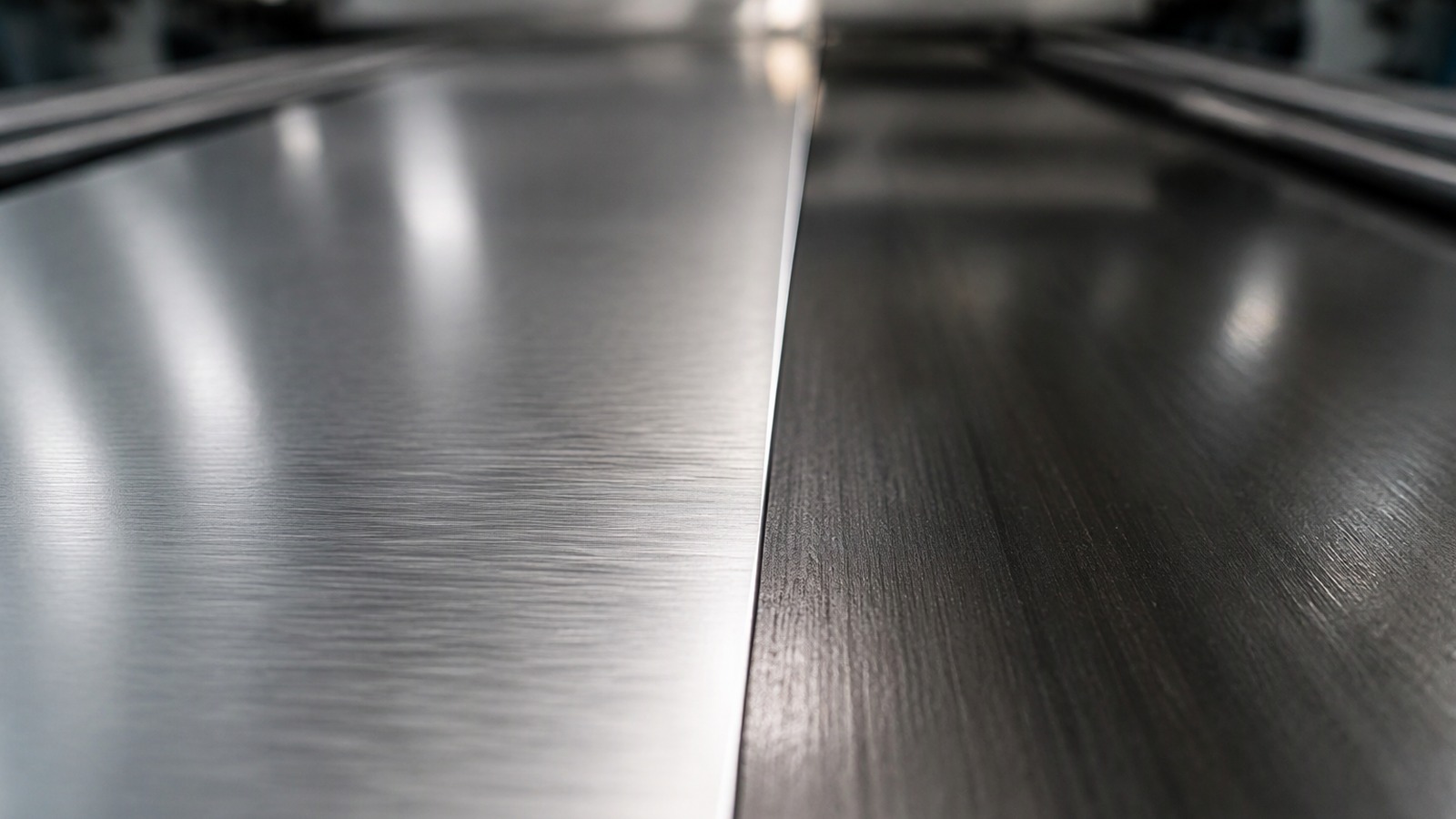
Look at the two edges of a jumbo roll. Both are aluminium, but only one of them has ever been cut.
A rolled edge is closed and smoothed by the mill roll, so the metal keeps the texture the mill gave it. A cut edge is newly exposed, torn at a small scale and plastically deformed, with no history.
Dive deeper
A rolled surface is a surface that has been pressed. The work roll flattens the metal, closes superficial porosity and leaves a directional texture that the rest of the process inherits. That surface has had time to grow its natural oxide, and it is the surface a coater, printer or laminator is used to seeing.
A cut edge has none of that history. The knife line exposes metal that has never been in contact with a roll, and it exposes it in a torn, folded state. The oxide that forms there afterwards is thin and uneven, sitting on a profile that is far coarser than the rolled face. Anyone who has watched a dyne test or a coating bead behave badly at the very margin of a web has seen the difference between the two surfaces rather than a problem with the bulk metal.
The asymmetry matters commercially. A converter may order a width and receive a roll whose faces are perfect and whose edges are not, and nothing in a width measurement will reveal it. The edge is a line, not a face, and it sits in the one place where every subsequent process applies its highest stress concentration. That is why two rolls of the same alloy, temper and gauge can behave completely differently on the same machine.
How Does a Burr Become a Tear?
A tear almost never begins in the middle of a web. It begins where the material is already compromised.
A raised lip concentrates tension into a thin ridge. Under repeated tension the ridge hardens further, a micro-notch opens at its root, and the notch runs across the strip until the web parts.
Dive deeper
A burr is a geometric problem before it is a mechanical one. Metal pushed to the edge of the cut has to go somewhere, so it stands proud of the plane. When the web is under tension, that proud ridge is the stiffest path available, and load concentrates along it instead of spreading through the strip. The root of the ridge, where it meets the flat face, is a natural notch.
Cycling does the rest. Every start, stop, tension correction and diameter change on the unwind re-loads that notch. The metal at the root work-hardens until it can no longer deform, a short crack opens, and the crack finds the easiest path across the width. Once a crack is running, the strip has far less remaining section than its nominal gauge suggests, and it fails quickly, often several metres downstream of where the damage started.
This is also why the symptom and the cause sit far apart. Operators see a break at a guide roller or in a packing machine and look there, while the initiating feature travelled inside the roll from the slitter and only revealed itself much later, under load. The mechanisms described in why foil tears on a packing machine begin with exactly this kind of edge damage.
Razor or Shear Slitting: Which Suits Your Web?
Two families of tooling do the same job by different means, and each leaves a signature on the metal.
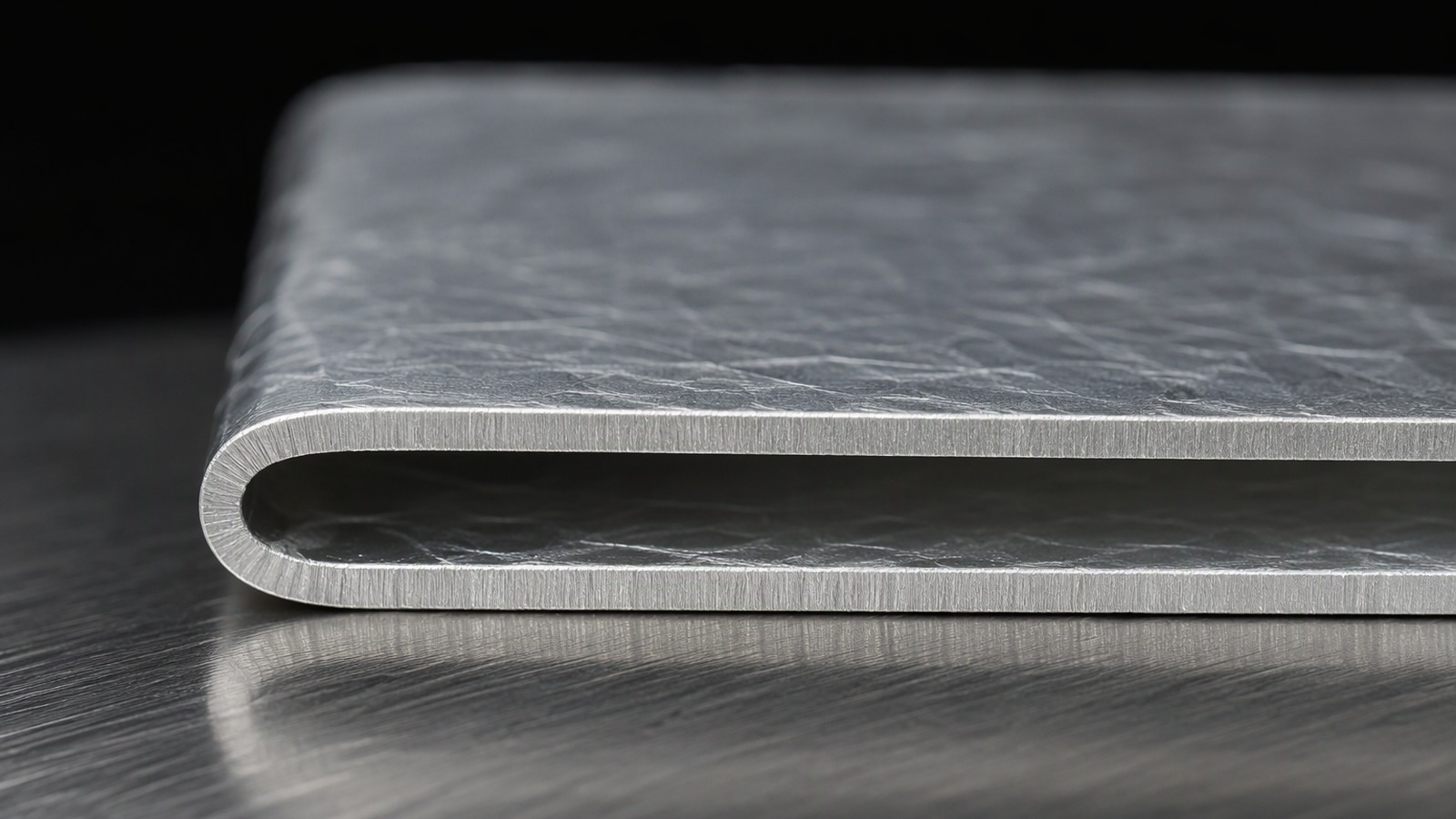
Razor slitting presses a single blade through the web against a backing, giving a fine burnished edge on thin, soft foil. Shear slitting parts the metal between two circular knives, giving a squarer edge that holds up better as gauge rises.
Dive deeper
Razor slitting works by pressure. The blade is pressed into the web, the backing takes the reaction, and separation happens by a combination of indentation and shear ahead of the tip. The edge it leaves is bright and slightly burnished on the contact side, with a small lip on the other. On thin foil in soft temper this is a gentle process, and the tooling is simple to set.
Shear slitting works by opposition. Two knives pass each other with a small clearance, and the metal is parted between them rather than pushed against a backing. The edge is straighter, the lip is smaller, and the deformed band is confined closer to the cut. The trade is that shear tooling demands discipline: clearance, knife condition and side load all have to be right, or the pair rubs instead of cutting and the edge arrives work-hardened and rough in texture.
Neither method is universally better. Thin and soft favours razor; heavier gauge and edges that must stay straight favour shear. What matters for a buyer is that the route is stated and kept, because a roll switched from one method to the other runs differently on the same line at an identical width. A broader view of how these finishing steps fit the wider chain appears in published industry material.
Why Does Edge Quality Matter More on Heavy Gauge?
Thickness changes the arithmetic at the edge. A lip on thin foil is a curiosity; on heavy gauge it is a wedge.
Heavier foil needs more force to separate, so the deformed band runs deeper, the lip is larger and the stored stress is higher. The strip is also stiffer, so the edge carries a bigger share of the load.
Dive deeper
On a thin web a small lip is a small fraction of the section, and the strip conforms around it. On heavier foil the same feature is a real change in section, and the strip resists conforming. It cannot flex aside, so the lip becomes both a load path and a hinge. Bending, forming and rewinding concentrate at that line instead of spreading through the width.
The consequence appears in three places. A tight edge builds up on one side of the coil and the roll face steps or telescopes. A curl that was minor at the slitter becomes a fold in a forming tool. And a burr rubbed away on thin foil survives on heavy gauge long enough to start a crack in bending, because there is enough section behind it to load the notch.
Alloy and temper interact with this. Soft O accommodates a rough edge by deforming locally; a harder temper cannot, so the stress goes into the crack instead. Heavy gauge supplied in 3003 or 3004 for forming work is a good example: the same edge that survives on a soft alloy will show as a split on a hard one, even at the same gauge. This is why the cut edge of aluminium foil at 0.2 mm deserves its own conversation in an enquiry rather than a footnote.
How Can You Judge an Edge Without a Laboratory?
Most edge problems are visible before they are measurable, and the useful tests cost nothing but attention.
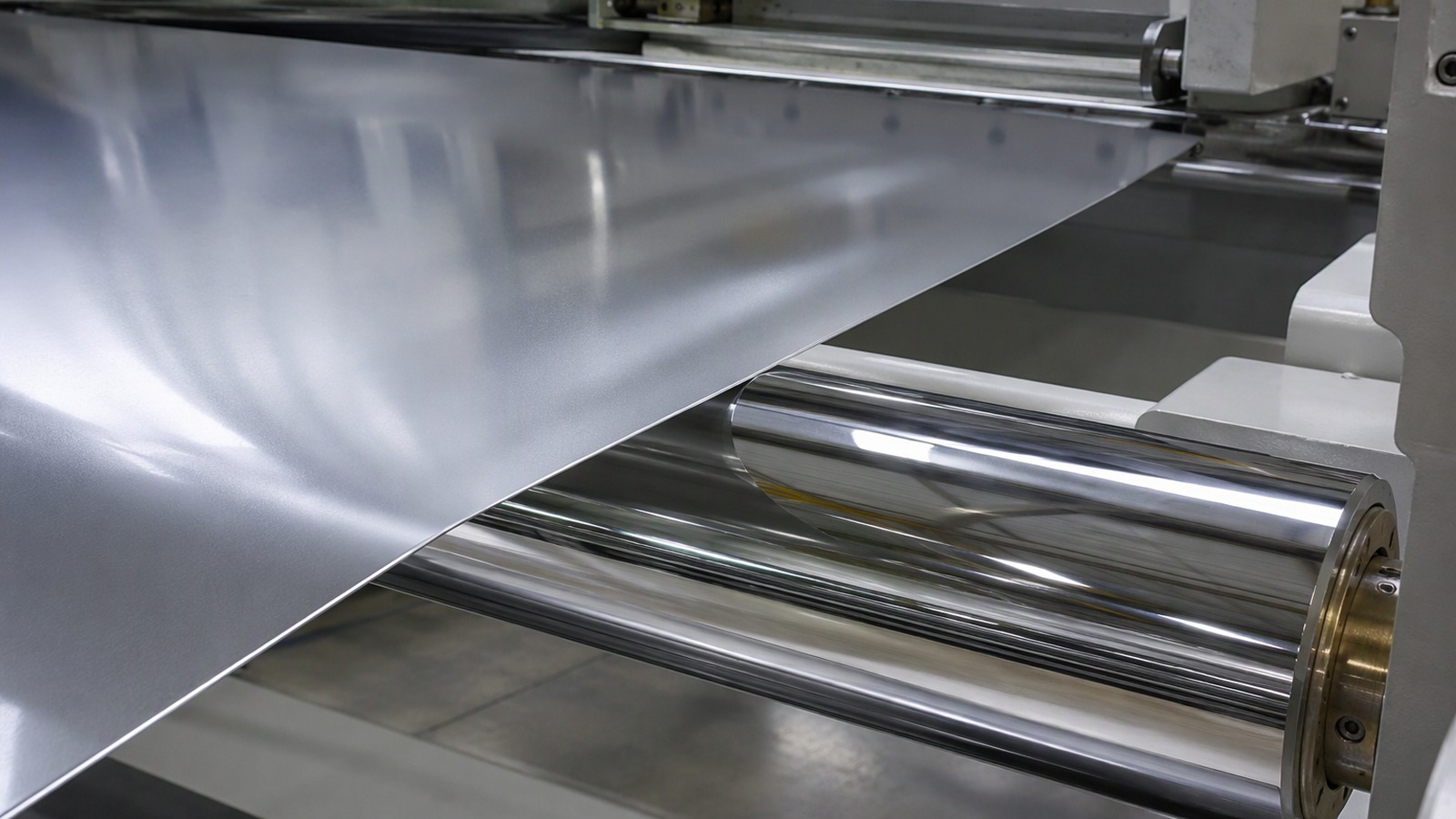
Look along the edge in raking light, feel it through a cloth, lay a length on a flat bench to see curl, and compare lanes side by side. Consistency between lanes tells you more than any single reading.
Dive deeper
Start with raking light. Hold the strip so the edge catches a low light source and look along it. A clean cut reads as a continuous bright line with an even highlight; a poor one shows a broken highlight, a feather of metal standing away from the plane, or a dark shadow line where the lip lifts. Rotate the strip and repeat, because a one-sided lip is easy to miss.
Then use your hands, carefully. Draw the edge through a folded cloth: a ragged edge snags fibres and a clean one passes. Lay a metre of strip on a flat bench and watch the ends, which is the quickest way to see curl and tight edge. Compare the first, middle and last lane, and compare the two edges of the same strip, because one-sided trouble points at tooling while two-sided trouble points at the parent roll.
Finally, read the wound roll. An end face that steps, dishes or shows protruding laps reports edge condition over hundreds of metres at a glance. These judgements are qualitative, and that is their value at the winder. Teams that record what they see in plain words build a better picture than teams that wait for a complaint. The wider picture of how cut edge quality of aluminium foil is discussed with converters follows the same logic.
What Does Edge Quality Do to Coating and Lamination?
A coating bead lives on a knife edge of stability, and the web edge is where that stability is tested first.
A raised lip disturbs the coating bead and leaves a ragged, uneven margin. A curled edge traps air in a lamination nip, and loose metal from a ragged edge transfers onto rollers and prints as marks.
Dive deeper
Coaters and laminators run a margin. The bead, the meniscus at the doctor blade or the film in the nip behaves well inside the web and deteriorates at the boundary. A lip that stands proud changes the local gap and the local wetting at exactly that boundary, so the coating thickness tapers, the margin wanders, and the dried film shows a ragged line. The material is rejected not for the coating but for the margin, which is expensive to trim away.
Lamination adds trapped air. A curled or wavy edge does not meet the second web cleanly at the nip, so a narrow unbonded lane forms along the margin. It may look acceptable on the roll and delaminate later in a pouch or lid. Fine metal debris from a ragged edge accumulates on rollers, on corona units and on static control hardware, then transfers back onto the web as repeat marks at a fixed pitch.
None of this is repaired downstream. Trimming a bad edge costs width, yield and an operation, and removes only what is at the margin, not the stress already in the roll. Specifying the edge as carefully as the gauge is cheaper than discovering it at the coating head, and a roll such as 1050 aluminium foil in 0.08 mm is a practical place to start that conversation for light coating work.
What Must an Enquiry About Cut Edge State?
An enquiry that lists alloy, temper, thickness and width leaves the most consequential variable unmentioned.
State the process the web will run on, whether both edges are slit or one is a mill edge, what a good edge looks like in plain words, and how the roll will be unwound. Add the width and core in digits.
Dive deeper
Begin with the numbers: alloy from the 1050, 1060, 1100, 1235, 3003, 3004, 8011, 8021 or 8079 range, temper in O, H14, H16, H18, H22 or H24, thickness between 0.005 and 0.20 mm, width between 100 and 1500 mm, and core of 76 or 152 mm. Add the quantity, 3 MT per size as a normal starting point, and the port, Qingdao, Tianjin or Shanghai.
Then describe the edge in the language of the process: say whether the web will be coated, laminated, printed, rewound or formed, and say what fails today. A converter who writes that the margin breaks down and the web wanders at the third roller has given more than a page of adjectives. Say whether both edges are slit or one is a mill edge, because that choice changes the tooling and the risk.
Finally, agree how the edge will be checked on arrival and what happens if it is not met. Edge condition is judged against a purpose, and a supplier who knows the purpose can hold the right feature where it matters. For the dimensional side, see slitting width tolerance and core diameter. Wider market context appears in published market material.
Ask for the edge, not only the width. A roll is proved by the line it has to run on, and the edge is where that proof begins.