Why does aluminium foil tear on a packing machine?
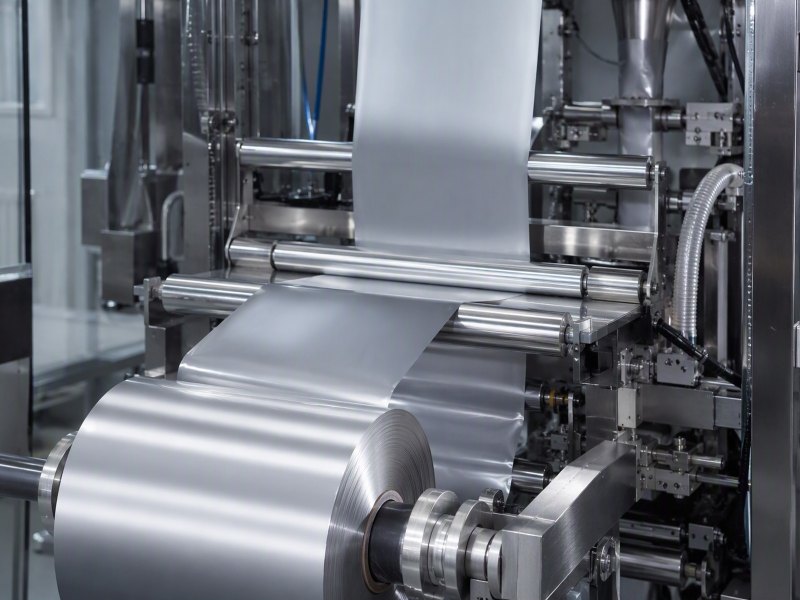
Most tears on a form-fill-seal or lidding line begin in the web path, not in the foil. This guide reads the break, the splice, the crease and the heat, and shows what to record.
Why does aluminium foil tear on a packing machine?
The line runs, then a narrow strip of foil lifts, splits along a fold, and the machine stops. The roll was sound when it left the warehouse.
Most tears start in the web path, not in the foil. A roller out of alignment, a dragging idler, a burred forming shoulder or a splice that was never flat will find the weakest point of any web, and a different foil will not remove the cause.
The eight questions below separate what the foil does from what the machine does, and end with what a buyer should record.
Where does the tear start, at the edge or in the middle of the web?
The position of the break is the first clue, and it separates two families of cause.
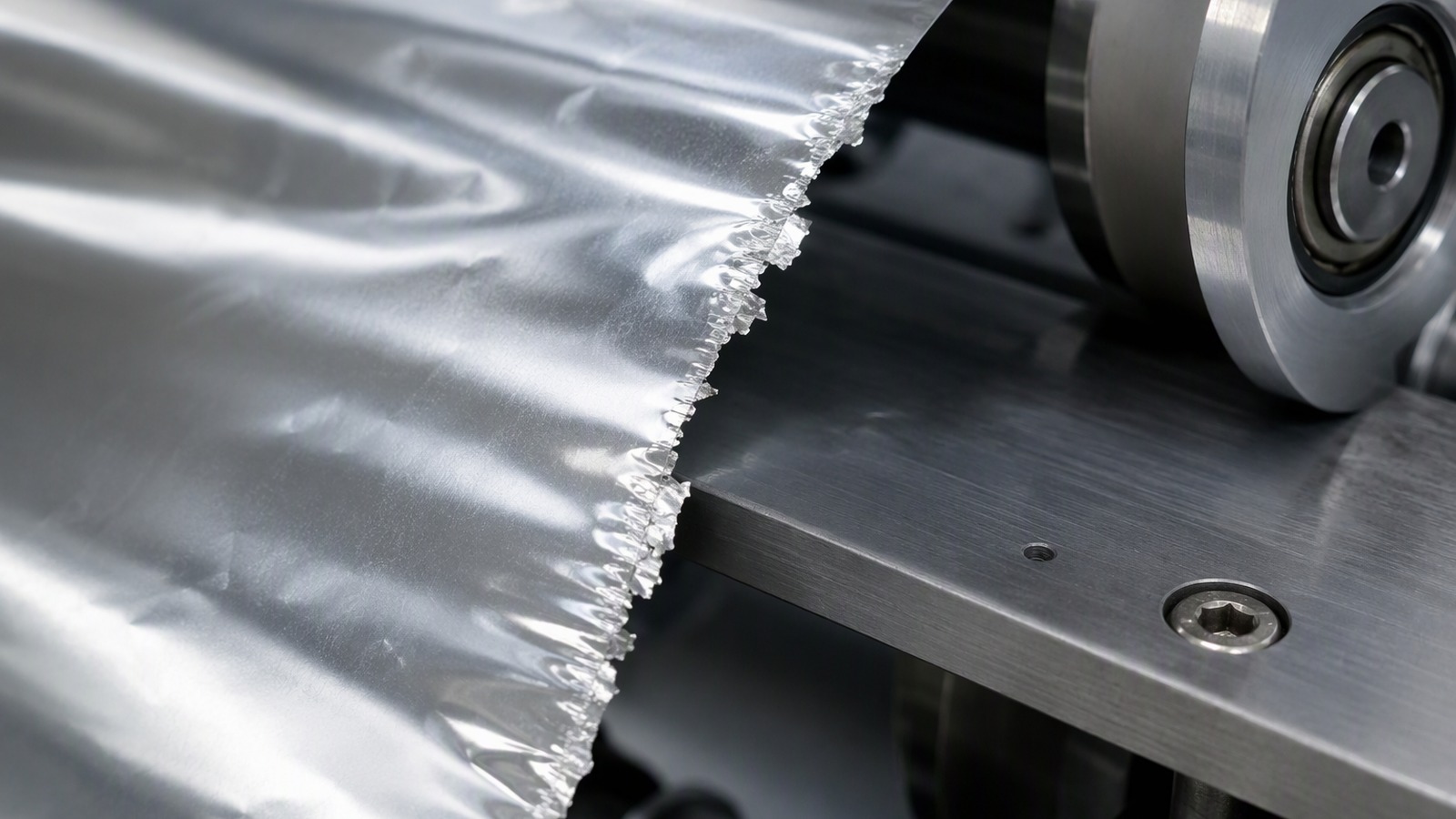
An edge tear begins where the web is guided, trimmed or rubbed, then runs inward under tension. A tear that starts mid-web follows a crease or a splice and rarely reaches the edge alone.
Dive deeper
Read the break before the web is touched. An edge tear has a starting point you can see: a nick, a rough guide face, a small step where two rollers do not quite line up, or a rubbed line where the web has been running against a fixed part. From that point the crack travels with the machine direction and then turns across the web, because the tension keeps feeding it. A mid-web tear opens along a line, and that line is almost always something the foil was made to remember: a crease from unwinding, a fold from a splice, a score from a roller that stopped turning, or a hard particle pressed in at a nip. Where the web narrows before it breaks, the foil has been pulled sideways and the cause is guidance rather than strength. The metal is rolled thin enough that a crease is a crack waiting for a reason, as the reference entry on how aluminium foil is made and used makes clear.
The distinction matters because the two tears are cured in different places. An edge tear sends you to the guides, the slitting burr and the unwind alignment. A mid-web tear sends you to the splice, the winding quality and the forming shoulder.
Why is the web path the first place to look, and not the foil?
Every tear needs a force, and on a packing machine the path supplies it before the foil does anything.
A roller out of parallel, a dragging idler or a burred former loads one band of the web harder than the rest. The foil fails where the load is highest, so check the path first.
Dive deeper
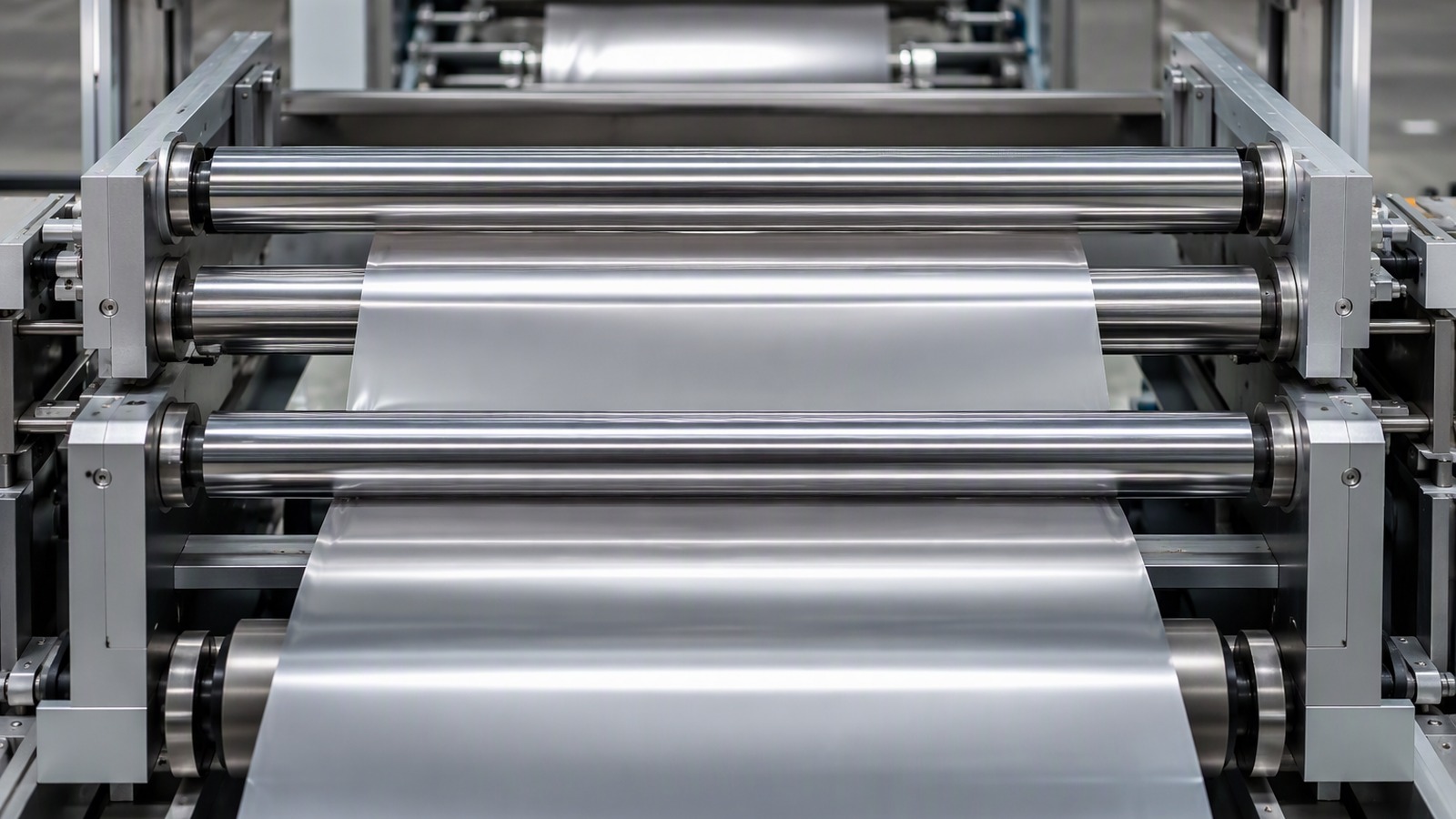
Walk the web from the unwind to the sealing station and treat every component as a suspect. Rollers should be parallel to each other and square to the machine, because a roller slightly out of line steers the web into a guide, and the guide answers with a scrubbed edge. Every idler should turn freely under a light hand. One that has stopped and is being polished by the passing web leaves a bright band and a scratch line, and the tear then appears at the same place on every roll.
A former, a chute, a plough or a folding board should be felt with a cloth, because a burr too small to see will lift a shaving of metal that then acts as a wedge. Check the wraps too: a long unsupported span vibrates, and vibration alternately slackens and snatches the web. Check that the web enters each nip square rather than at an angle.
Operators often change the roll first, see the line run for an hour and conclude that the roll was at fault, when the new roll only delayed the same failure. The machine is the constant and the roll is the variable, so a fault that follows the machine rather than the roll is a path fault.
Why does tension set for one gauge not carry over to another?
Tension is a force spread over a section, and the section changes with the gauge.
A setting that keeps a heavy web flat will over-stress a lighter one, so a gauge change needs a tension change. A heavier web is not safer: it hides the fault longer.
Dive deeper
A tension setting is only meaningful together with the width and the gauge it was set for. Thin foil has less metal to carry the same pull, so a setting copied from a heavier job puts the web closer to its limit before the machine has done anything wrong. The web then behaves like a spring that is already stretched: a small disturbance at a guide or a splice passing a nip is enough to take it over the edge.
Going heavier is the reflex answer and it is often the wrong one. A heavier web needs more pull to stay flat, so it presses harder on every roller, drags harder through every guide and carries a bigger load into the forming shoulder. It may run for a while, which is worse, because the misalignment behind the tear is never corrected and the failure returns as soon as the next roll is slightly different.
Set tension for the job in front of the machine, write down what was set, and re-set it whenever the gauge or the width changes. Where a line moves between gauges, a converter will keep a light gauge for the jobs that need it, such as 0.025 mm 1235 aluminium foil, and a heavier one for the rest, with the settings recorded for each.
Why is a splice the most common single point of failure?
A splice is the one place where the web is thicker, stiffer and no longer continuous.
A splice adds a step in thickness that must pass every nip and shoulder. A splice that is not flat, square or fully bonded will crease at the former and split there.
Dive deeper
A splice is a joint between two webs. Where the two ends overlap the web is locally thicker and stiffer, so it cannot follow a roller as closely as the rest of the web and it cannot bend as tightly around a shoulder. That single bump is enough to start a crease, and the crease becomes the split. A splice also carries the tension of the whole web across a bonded area, so a joint that is only partly bonded will creep and lift an edge that then catches a guide.
A badly made splice announces itself in ways an operator can learn. It ticks once as it passes a nip. It leaves a repeating mark at a fixed distance from the join, which tells you the mark is made by the splice and not by the roll. It shows a loose tail, a lifted tape edge, a diagonal cut, or a join stiffer than the web around it. Where the tears cluster at one point in the roll and the same distance repeats, stop looking at the foil.
The handling and splicing habits of the industry are described by the European aluminium industry, and the lesson is simple: a splice is a machine event as much as a foil event.
Why do creases that form before the forming shoulder split after it?
A crease is a fold the foil never recovers from, and the shoulder is where the web must stretch.
A crease thins and hardens the metal along a line. Before the shoulder it is only a mark; after it, that line must carry a curve, and it opens into a split.
Dive deeper
Creases are made early and paid for late. A roll stored on its side, a telescope in the wind, a slack edge on a wide roll, a web allowed to wander against a flange: each leaves a fold line in the foil before the web reaches the forming area. At that stage the fold looks harmless, because the web is still flat and the line shows only as a faint crease.
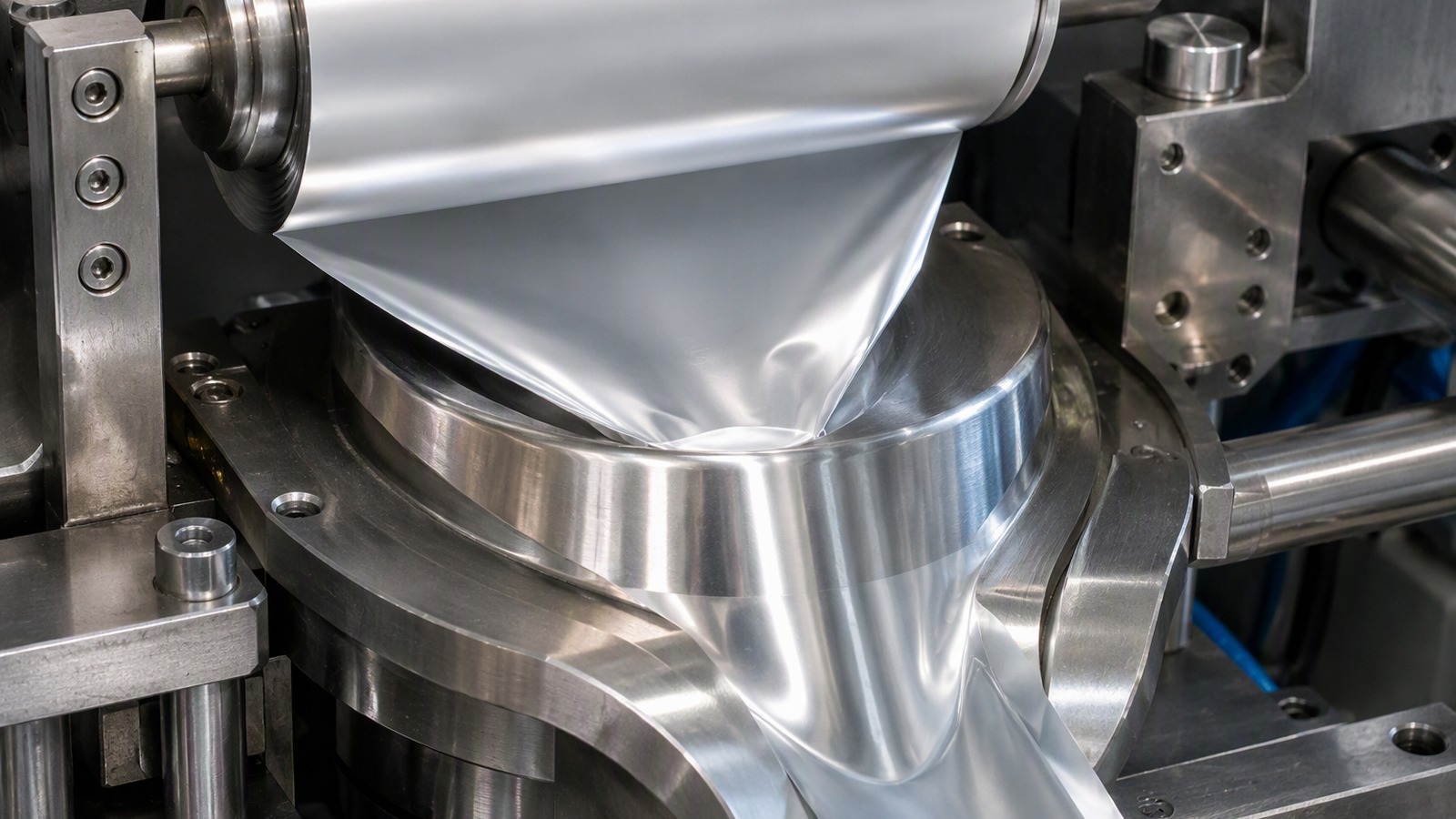
The forming shoulder changes the argument. There the flat web is pulled over a curved surface and turned into a tube, and the metal on the outside of the turn has to stretch. A sound web has enough reserve to do that. A creased web has a line where the metal is thinner and harder, so the strain concentrates there instead of spreading across the width, and the crease opens. This is why the split often appears some distance after the shoulder and looks unrelated to the mark upstream.
The cure is upstream: store rolls upright, keep the unwind aligned, avoid slack edges, and watch how the roll was cut and wound long before it reached the line, which is the subject of how a roll is cut before it ships. A split that follows a crease is a message about winding, storage or guidance, not about alloy.
Why does heat soften a web and change what it will take?
A packing line is a warm place, and warmth reaches the web before the web reaches the seal.
Heat from jaws, plates and hot air reaches the web upstream, warming the metal and softening any coating. A warmer web stretches more readily, slackens, wrinkles, then grips a roller it used to slide over.
Dive deeper
Heat reaches the web long before the seal does. Jaws that open and close, a heated plate, a hot-air knife and the radiant surfaces around them warm the air and the nearby rollers, and the web picks up that warmth.
The metal keeps most of its strength at the temperatures a packing line reaches, but a coated, lacquered or laminated foil does not: the coating softens first, and the web begins to behave like a different material. A warmer web stretches under the same pull, so a tension that was correct on a cold start is too high once the line is warm, and the foil creeps and slackens. A slack web wrinkles, and a wrinkle is a crease on its way to a split.
A softened coating also makes the web tacky, so it no longer slides over a roller but grips it, and drag rises without anyone touching a setting. The web is then pulled against a roller that has quietly become a brake. Treat warm-up as a change of condition: watch the web for slackening as the line warms, shield heat sources from the unwind span, and check rollers for build-up where a coating may have transferred. Background on how the metal conducts and radiates heat is available from the aluminium industry.
Why is the answer a joint decision between foil, splice and machine settings?
Because a tear is produced by three things at once, and changing one alone leaves the other two in place.
The foil sets what the web can take, the splice sets where it is weakest, and the machine sets what it is asked to take. Changing the foil alone rarely fixes a machine problem.
Dive deeper
A tear is an outcome, not a cause. What the web can take is decided by the alloy, the temper, the gauge, the width and the edge condition. Where it is weakest is decided by the splice and by the winding. What it is asked to take is decided by the path, the tension and the heat.
Move one of those three and the others stay exactly as they were, which is why a heavier gauge sometimes appears to cure a tear for a week. The line did not change, so the cause did not change; the margin simply moved.
The order of work matters. Fix the path first, because a misaligned roller damages every roll that passes it, and the damage shows nowhere. Fix the splice next, because it is a decision the converter controls and it is cheap to correct. Then choose the foil for the line as it now runs: a gauge and temper that suit the tension the machine can hold, an edge that suits the guides, and a width that suits the former. On a line running a heavier lidding web, that conversation often settles on a specification such as 0.04 mm 8011 aluminium foil, because it matches the machine rather than because heavier is better.
What should a buyer record when a tear happens?
The record made in the first ten minutes is worth more than the discussion held a week later.
Record where the tear started, which roll and lot, the gauge, alloy, temper and width, whether a splice was involved, the machine and station, and the settings in use. Photograph the web before it is moved.
Dive deeper
Write down what can be seen and measured before anything is cleaned up: the machine and station, the product being packed, and the position of the break, meaning which side of the web, how far from the edge, and whether it opened from the edge or from the middle. Note the roll, its lot, the alloy, temper, gauge, width and core, and whether it carried one splice or several.
Then add the behaviour, where the diagnosis usually hides: did the tear happen at start-up, after a stop or in steady running; did it repeat at the same distance; did a roll change clear it, and for how long. A tear that returns on the next roll is a machine tear.
Keep the record with the roll and send a copy to the converter, so both sides compare notes rather than accusations. If the line is also losing material at the unwind, the two losses belong in one conversation, which is why where waste is actually generated sits well beside this one, together with the foil packaging industry view of what a line should expect from foil in rolls and sheets.
A tear is a message from the web path. Read where it started, correct the machine and the splice, then choose the foil that suits the line.