Why Is a Toothpaste Tube a Laminate and Not an Aluminium Foil Tube?
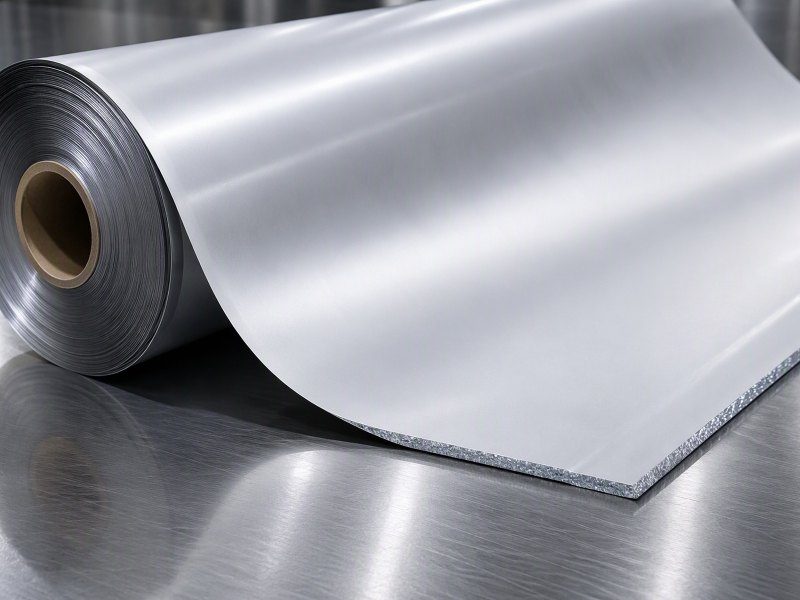
A tube is printed flat, seamed and headed before it becomes a package. Here is what the aluminium layer does, where the joins fail, and what to state in an enquiry.
A tube that splits at the shoulder or dries out at the crimp has a structure problem, not a filling problem. The foil is rarely the suspect.
Because the tube is a laminate: a printed plastic outer film, an aluminium foil core and a sealant inner layer, seamed and headed. The foil gives the barrier, the plastics give print, seal and squeeze.
That sentence hides the engineering. A tube is printed flat, wrapped into a cylinder, welded along one edge, joined to a shoulder and closed, then folded and squeezed by hand. Each step narrows the foil.
Why Is a Laminated Tube a Laminate Rather Than a Foil Tube?
An impact-extruded tube is a single metal wall, punched from a slug, lacquered inside and printed outside: a different product with a different failure mode.
In a laminated tube the foil is an inner layer, buried between plastics. The plastic carries the print, performs the sealing and absorbs the squeeze, while the foil never touches the hand.
Dive deeper
An impact-extruded aluminium tube begins as a slug punched into a die, formed into a seamless shell, lacquered inside and printed outside. A laminated tube begins as a flat web that is printed, laminated, slit and wrapped around a mandrel. The metal tube holds its shape through the stiffness of its own wall and stays folded where the user creases it.
A laminate is built the other way round. The outer film is chosen for print and feel, the inner film because it can be welded to itself, and the foil between them for what the two plastics cannot do. That division of labour is why the foil is almost never the surface a customer sees, and why a converter cannot simply buy the brightest foil available and laminate it.
There is a practical reason too. A drawn tube needs a wall thick enough to deform without tearing, and the format limits which diameters and lengths can be paired. A laminate is assembled from a web, so one foil supply serves a wider family of sizes, and printing is done flat, where registration is easier than on a curved shell. The tube is a printed, seamed object before it is a metal object.
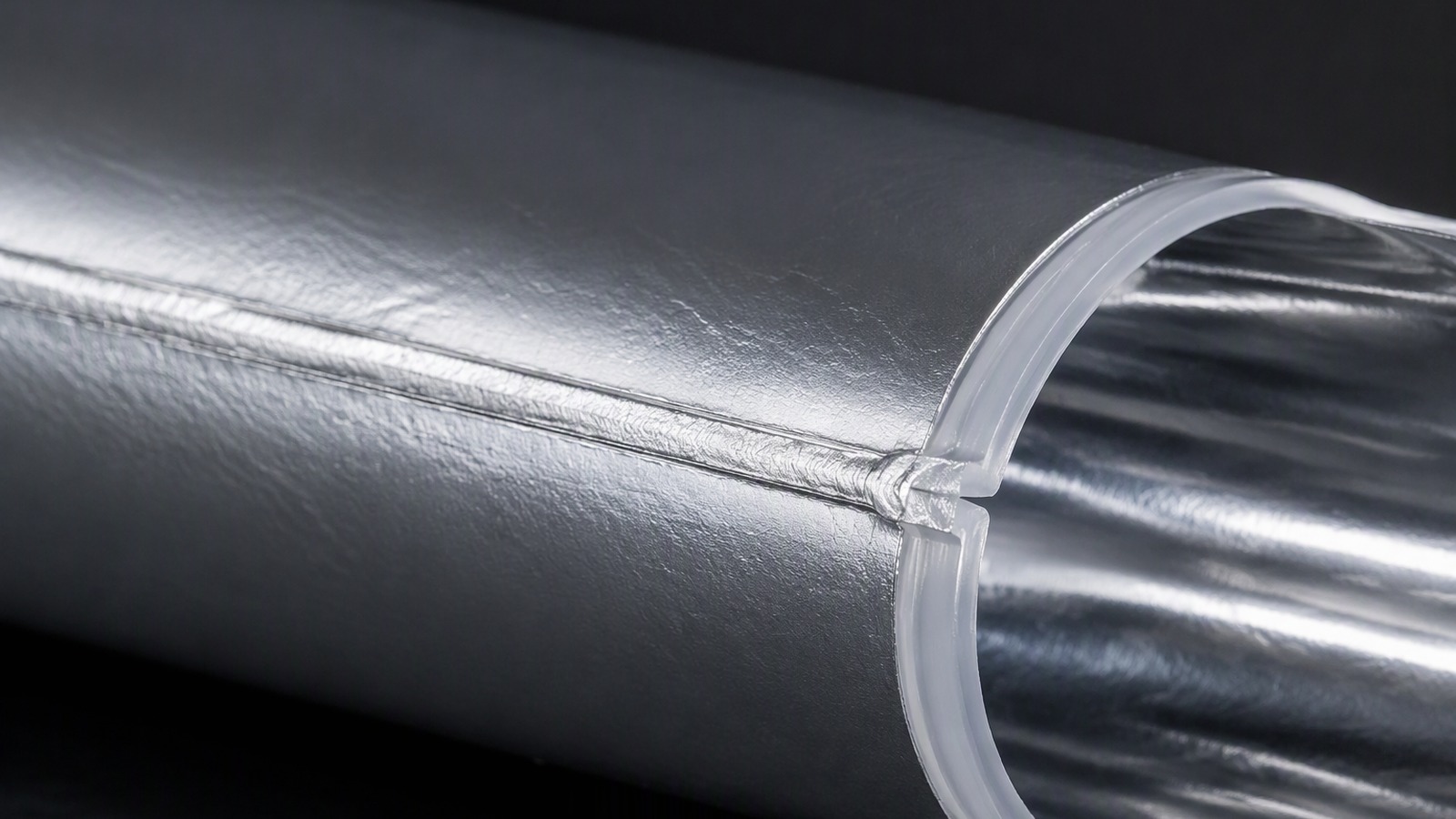
What Does the Aluminium Layer Do That the Plastic Layers Cannot Do Alone?
The polymers in a tube are chosen for sealing, printing and feel. None is a strong barrier on its own, and none excludes light.
The foil interrupts the path a molecule would take through the wall, blocks light completely, and stiffens the web so the tube holds its shape and recovers after squeezing.
Dive deeper
A polymer wall is not solid. Molecules of aroma, solvent, oxygen and water vapour dissolve into it on one side and diffuse through to the other, and the rate depends on the polymer, the temperature and the concentration difference. A continuous metal layer offers no such diffusion path. The foil is not a filter that slows the traffic; it is a wall that stops it, at a thickness far below what a structural metal part would need.
Light is the second job. Many fills are sensitive to the visible and ultraviolet part of daylight, and a pigmented plastic scatters light rather than excluding it. An opaque metal layer removes that variable altogether, which is one reason tubes for products that discolour keep a foil layer even after the polymer choice improves.
The third job is mechanical, and it is the one tube converters feel. Foil has almost no springback, so a laminate containing it takes a crease and holds it. That is what lets a tube stay folded at the crimp and keeps the wall from ballooning when the cap is screwed on. Stiffness also protects the print through filling, and keeps the tube standing on a shelf. It also keeps the print from scuffing in the carton.
Why Is a Tube a Barrier Problem With a Squeeze Problem on Top?
A pouch sits on a shelf. A tube is rolled from the base, squeezed in the middle and folded at the crimp, and every action loads the wall.
Barrier and mechanics cannot be designed apart: a wall stiff enough to resist flex cracking may be too stiff to squeeze, and a soft sealant that squeezes well may creep.
Dive deeper
The barrier question is not only how much passes through a flat area of wall. The wall is flexed repeatedly, and a metal layer bent many times will crack unless the surrounding films support it. The laminate must hold the foil in a mechanically neutral position, shielded by enough polymer on both sides that bending strain reaches the plastics first. This is the argument behind foil structures built for flexing, applied to a format folded far more often than a flat pack.
The squeeze question runs the other way. The product must leave the tube when a hand presses it, so the wall must be flexible and the sealant soft enough not to hold the contents back. Those are the same properties that make a sealant prone to creep, to absorb oils and to swell. A cream that separates in the tube is usually reporting that an oil-phase component has migrated into the sealant.
A gel that loses its solvent tells the same story from the other side: the solvent finds a path through the polymer, and the foil closes it. Both symptoms are structural, and both are settled by the stack and the fill; general industry background on foil is a starting point, not a tube specification.
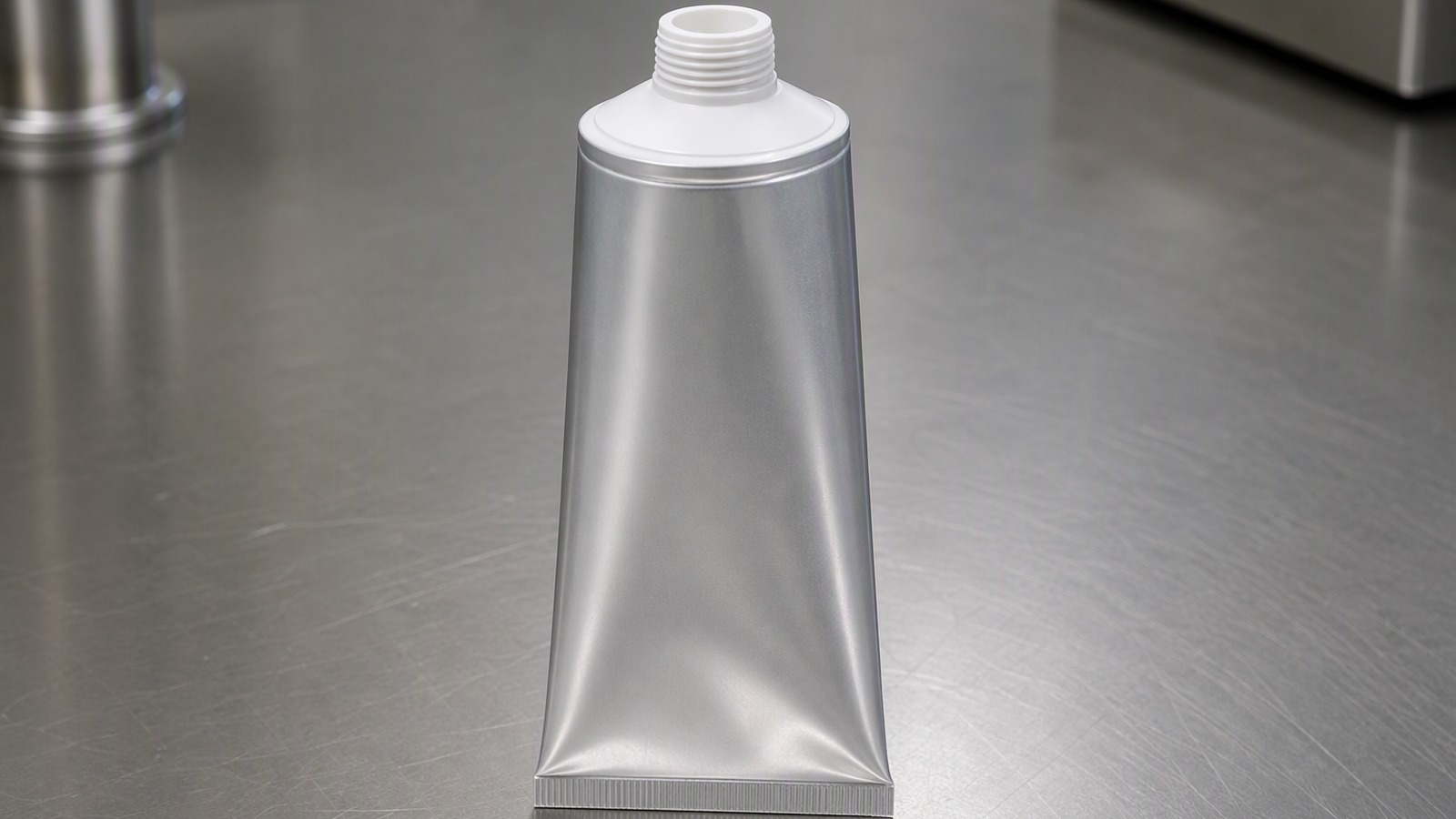
Why Do the Side Seam and the Shoulder Join Decide Whether a Tube Holds?
A wall can be perfect and the tube still fail, because the wall is not where the seams are. Two joints are made after printing, both blind.
The side seam welds sealant to sealant across an overlap, and the shoulder is welded onto the open cylinder. Both concentrate stress and both expose a foil edge.
Dive deeper
The side seam is an overlap joint: the inner sealant of one edge is welded to the inner sealant of the other, usually by induction or hot air, and foil never bonds to foil because the metal does not weld in that process. The sealant must flow through the overlap and displace air while the foil conducts heat away from the joint. A seam that looks closed can still carry a channel along the foil edge where the polymer never wet out.
The shoulder is the harder joint because it joins two materials: a moulded head in one resin and the inner sealant of the laminate in another. The interface must hold while the user hangs the weight of the tube from the cap and squeezes the shoulder with the same hand, so stress concentrates at the transition from rigid head to flexible wall.
Both joints expose the cut edge of the foil to the fill. An unprotected edge can be attacked, and the attack travels along the foil and under the laminate, which is why slit quality and seam wrap matter as much as the foil. Covering that edge with sealant is a converter decision, and two tubes with identical foil can behave very differently on a filling line.
Why Must the Foil Surface Be Bondable Rather Than Shiny?
Buyers judge foil by brightness. In a tube laminate, brightness is decoration and bond strength is manufacturing, and the two do not always pull together.
Lamination depends on the foil gripping an adhesive or an extrusion coating. Residual rolling oil, a heavy oxide layer or a polished surface can all reduce that grip.
Dive deeper
Foil leaves the mill with a film of lubricant and a thin oxide that forms within moments of contact with air. Both help rolling and both are hostile to adhesion. The converter therefore needs a surface prepared for bonding: degreased, given a controlled oxide, often primed or lacquered on the bonding side so the adhesive meets a known surface. A mirror finish is not the objective, and a slightly matte, uniform surface gives an adhesive more to key into.
The two faces of a rolled foil are not identical. One is brighter because it ran against the roll, the other is matte because it ran against the other ply, and they carry different lubricant and oxide. A tube laminate is specified with one face toward the print film and one toward the product, usually lacquered on the bonding face. If the structure does not say which is which, the converter is guessing, and printing on the matte face would show a different finish.
Bond quality also depends on the adhesive, the nip and the line speed, so a foil that laminates well on one line may not on another. A change of foil source is therefore a change of structure, re-qualified on the tube line rather than on a peel test alone.
Why Is a Tube Laminate Specified by Structure Rather Than by Gauge Alone?
A gauge tells you how much metal is in the wall, not what the wall does, how it bends, seals or prints.
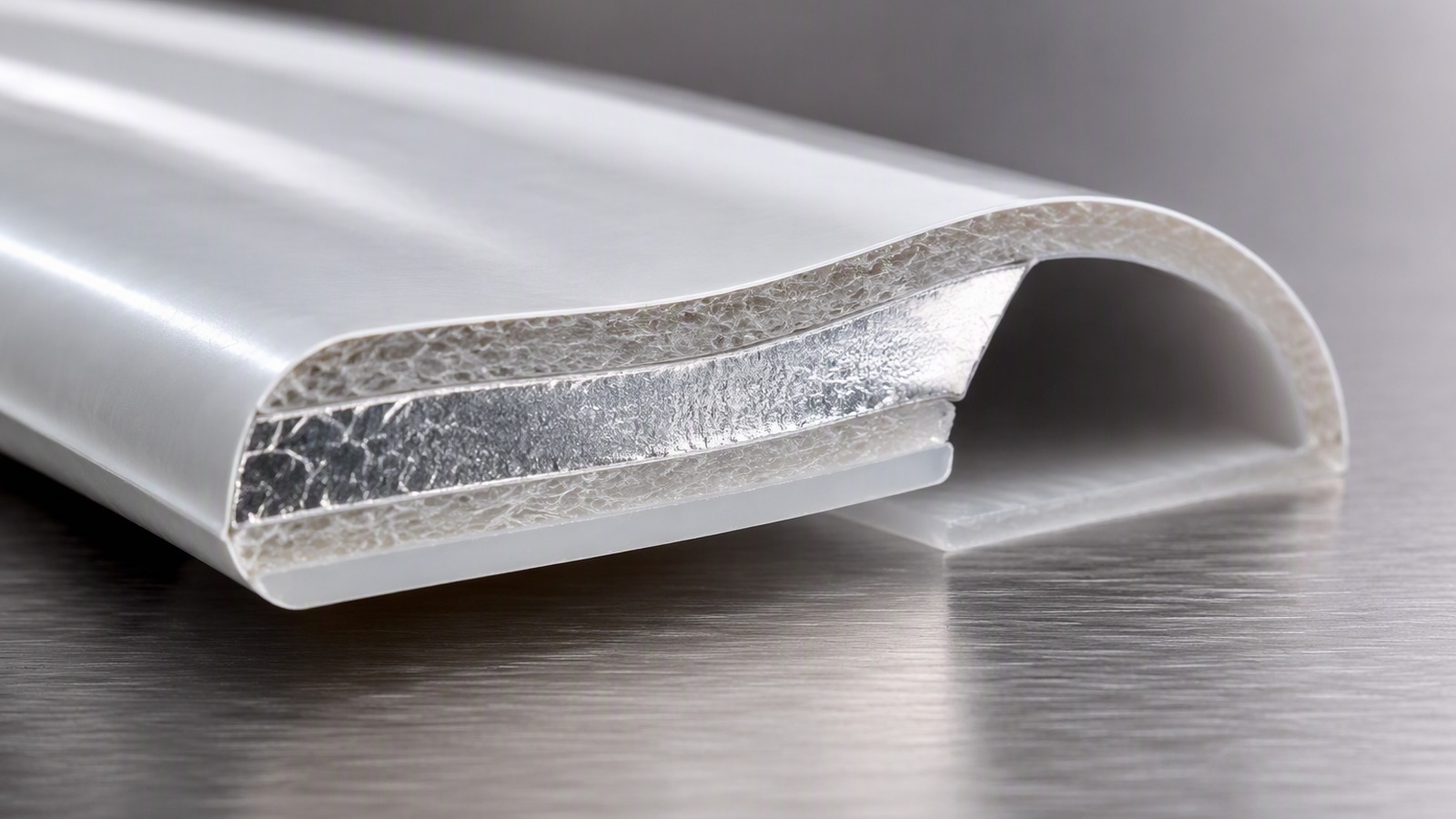
A tube laminate is a stack: print film, ink, adhesive, foil, adhesive, sealant. The order, the resins and the alloy and temper decide performance; thickness sets one input.
Dive deeper
Two laminates can carry the same foil thickness and behave differently. A stiff polyester outer film holds shape and prints well but resists the squeeze and may crack the foil at the crease. A softer film squeezes easily and supports the foil better but can distort the print on the mandrel. The sealant does the same work at the other end: softer welds below and creeps more, stiffer resists creep and asks more of the seam.
Alloy and temper matter as much as thickness. Alloys such as 8011, 8021, 8079, 1235, 1100 and 3003 behave differently in rolling and in flexing, and a temper chosen for formability is not one chosen for stiffness. That is why a tube foil is discussed as a 0.005–0.20 mm range with an alloy and a temper attached, and why two foils of the same thickness in different tempers are not interchangeable. A grade quoted without a temper is an incomplete answer.
A structure specification also fixes the print side, the lacquer, the seam type and the shoulder resin, which are the four things that fail in service. Suppliers publish packaging and container foil by alloy and temper for that reason: the grade is the start, and the stack is the specification.
How Do Printing, Forming, Seaming and Heading Constrain the Foil?
The tube is made in sequence, and each step puts the web through something: printing registers ink, forming bends, seaming heats, heading joins a part.
Each step narrows the foil window: it must stay flat through printing, bend without cracking around the mandrel, survive seam heat and bond to the shoulder.
Dive deeper
Printing is done on the flat web, by flexo or gravure, and the web is then rewound and slit. Registration is easier flat than on a curved shell, but the web must not stretch differentially, and a foil with residual camber or a slack edge prints out of register along one side. Width is specified with slit tolerance in mind, inside the 100–1500 mm range, and the core suits the unwind at 76 mm or 152 mm.
Forming wraps the printed web around a mandrel and brings the two edges together. The foil is bent to the tube radius, and the tighter that radius the more the outer film must stretch and the more the foil is asked to bend without cracking. A small-diameter tube is a harder laminate than a large one, and the alloy and temper conversation comes before the thickness conversation.
Seaming applies heat and pressure to an overlap, and heading joins the shoulder. Both steps are thermal and both depend on how fast heat crosses the stack: a thicker foil conducts it away faster, and a lacquer adds a layer it must cross. The foil seals nothing itself, yet it sets the conditions under which the sealant works, which is why foil industry notes treat the seam as a line-specific result.
What Must an Enquiry State Before a Tube Foil Can Be Quoted?
A price per tonne is not an enquiry. Without structure and fill, any number is a guess and any comparison is meaningless.
State the stack with resins and gauges, the print and lacquer system, the seam and shoulder type, the dimensions, the fill, then width, core and quantity.
Dive deeper
The first block is the structure, layer by layer from print side to product side: film, ink, adhesive, foil, sealant, and the gauge of each. Name the alloy and temper if fixed, and whether the foil is lacquered or primed and on which face. If the structure is still open, describe what the tube must survive, not what it must be made of.
The second block is the format. Diameter, length, orifice, head style, cap and the fill method all change the laminate. A tube filled hot, or filled with a product that attacks the sealant, needs a different stack from one filled cold with an inert cream. Say what the product contains and how it stores, since aluminium foil for packaging only becomes a grade once the fill is known.
The third block is commercial: slit width, core diameter, quantity per size, packing and port. Quantities are quoted from 3 MT per size, and the usual ports are Qingdao, Tianjin and Shanghai. For a narrow tube web the 8079 foil in 0.02 mm is a common starting point, and alloy and temper selection follows from the stack. A supplier with all three blocks can answer with a structure, not a price for an unknown.
The tube is a laminate before it is a package: the foil sets the barrier, the plastics set the seal and the squeeze, and the seams decide whether either survives.