Why Does a Retort Pouch Need a Different Aluminium Foil?
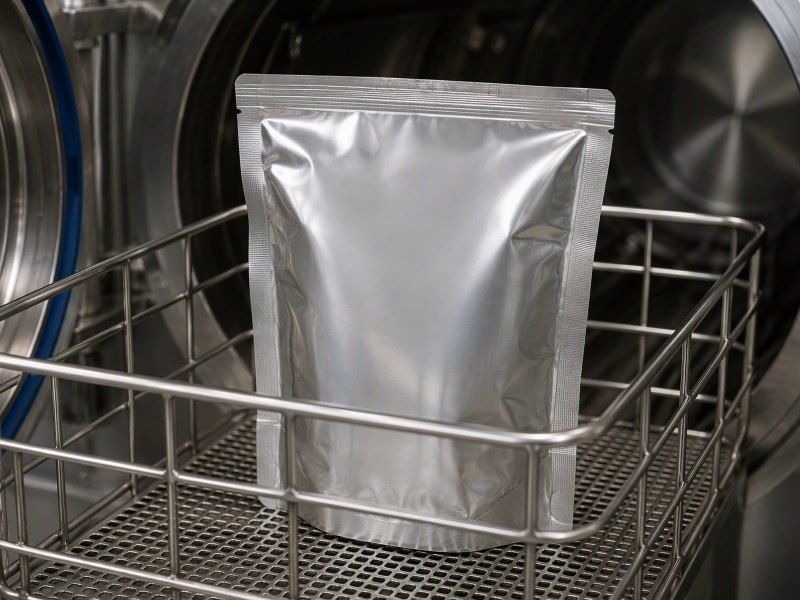
A retort pouch is stressed after it is sealed, so the seal and the foil edge decide the outcome. What the cycle asks of the laminate, and what an enquiry has to state.
A retort pouch is filled, sealed and only then put under process stress. Failures that appear weeks later usually began in the seal, not on the shelf.
The pack is container and closure at once, and it is stressed after filling rather than before. Foil carries the barrier and the heat path; the seal and the foil edge carry the risk. Structure and cycle are agreed against the customer's product and process.
That changes how the material is specified: not as a flat barrier, but as a sealed, filled pack that will be heated under pressure and then brought back down. The sections below follow the pack through that sequence.
Why is a retort pouch a harder problem than an ordinary pouch?
An ordinary pouch is judged on the shelf. A retort pouch is judged inside the vessel, where the closure is already closed and the product already inside.
Because the pack works as a pressure boundary and as a shelf pack in the same cycle, with no chance to close it again. Every stress arrives after the pack is finished.
Dive deeper
There is no dry run. In most packaging the pack is made, filled and closed, and then judged by how it behaves. In retort, closing is followed by the most severe event the pack will ever meet, and the pack cannot correct itself afterwards. A pouch that goes in with a weak seam comes out with a weaker one.
The pack also becomes part of the pressure boundary. Inside the vessel the pouch sits in steam or water, the product expands, and the load on the seal arrives from inside and outside at once. Those loads change through the cycle rather than staying constant, so the seal is worked rather than merely held.
The pack is also the closure. There is no cap or secondary seal to take over when a seam is marginal. The same narrow band of sealant is the only thing between the product and the process medium, so it is asked to do a mechanical job and a barrier job at once.
An ordinary pouch is specified against a filling line and a shelf, as described in pouch structures for that case. A retort pouch is specified against a vessel, a cycle and a product, and its weakest feature is found before the first run.
What does the retort cycle actually do to a laminate?
Heat, moisture and pressure arrive together and stay for the whole hold. None is unusual alone; the combination is what the laminate has to survive.
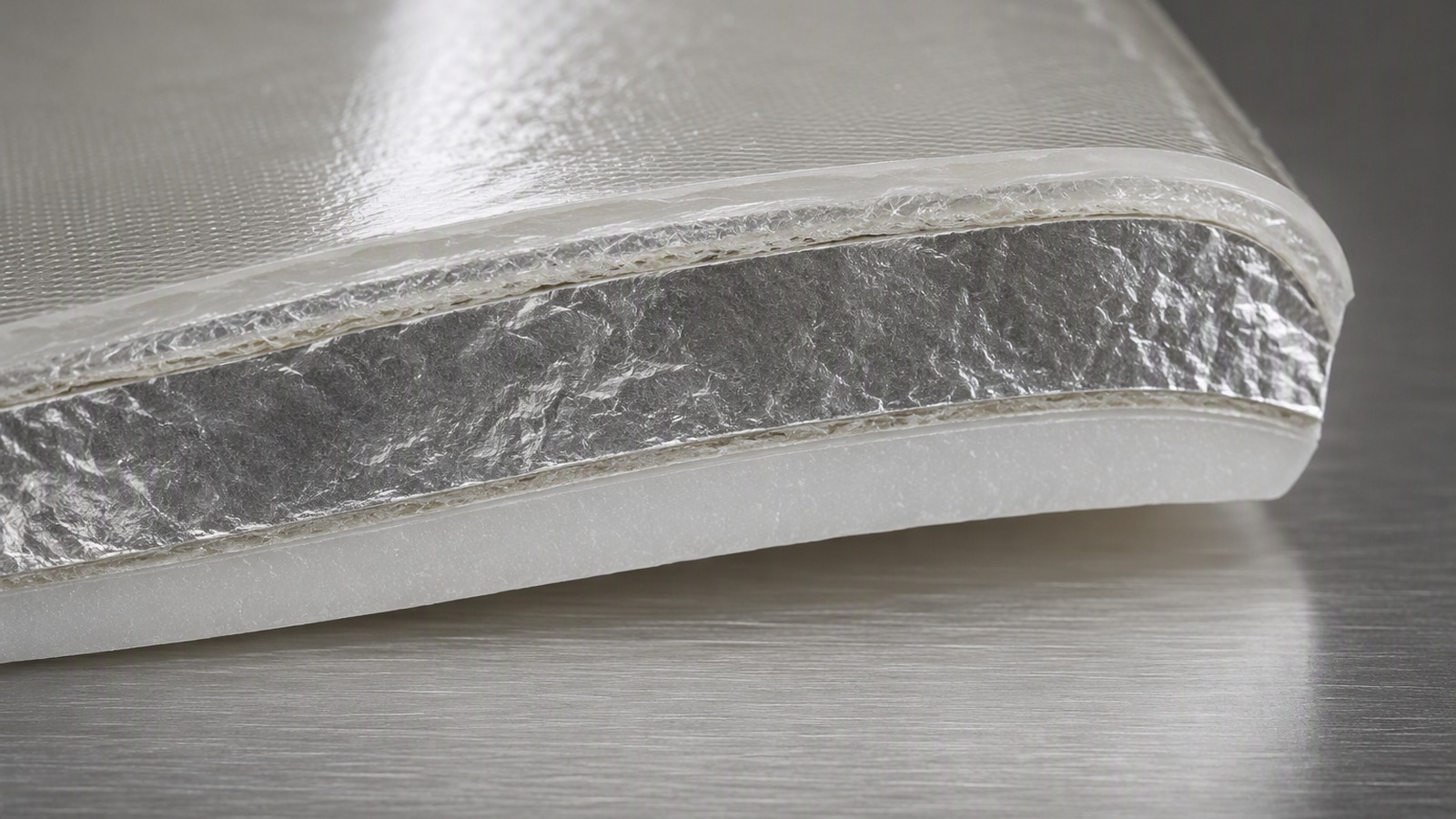
It softens the sealant, loads the bonds between layers and drives moisture into every exposed edge. The laminate is not damaged in one instant but worked for the entire cycle.
Dive deeper
The cycle first heats the pack through. Heat gets to the contents partly through the process medium and partly through the pack wall, and the aluminium spreads that heat sideways along the pack as well as through it. The seal region warms with the panel instead of lagging behind it.
It then softens the polymers. Every layer has a range in which it still does its job, and the sealant sits closest to that limit because it must flow enough to seal. Softened sealant deforms easily, so a load that arrives while the pack is hot is carried by a temporarily weaker material.
It also attacks the edges. Moisture, fats and salts migrate towards cut edges and seal transitions, and the bonds between layers are most exposed where they meet the process medium. A laminate that is sound across the middle can still delaminate inwards from an edge during a long hold.
The cycle is a sequence, not a condition: come-up, hold and come-down load the pack differently. The structure is agreed against the customer's product and process, because it is the sequence the pack must survive. European Aluminium covers the material side; the cycle belongs to the filler. The pack leaves the vessel changed rather than merely heated.
Why does a retort pouch fail at the seal and the foil edge rather than the flat area?
A flat panel is the easy part. It is supported by the product behind it and loaded evenly, with no geometry change to concentrate stress.
The seal and the foil edge combine a geometry change, a material change and an exposed cut, so loads that are harmless on the panel concentrate there.
Dive deeper
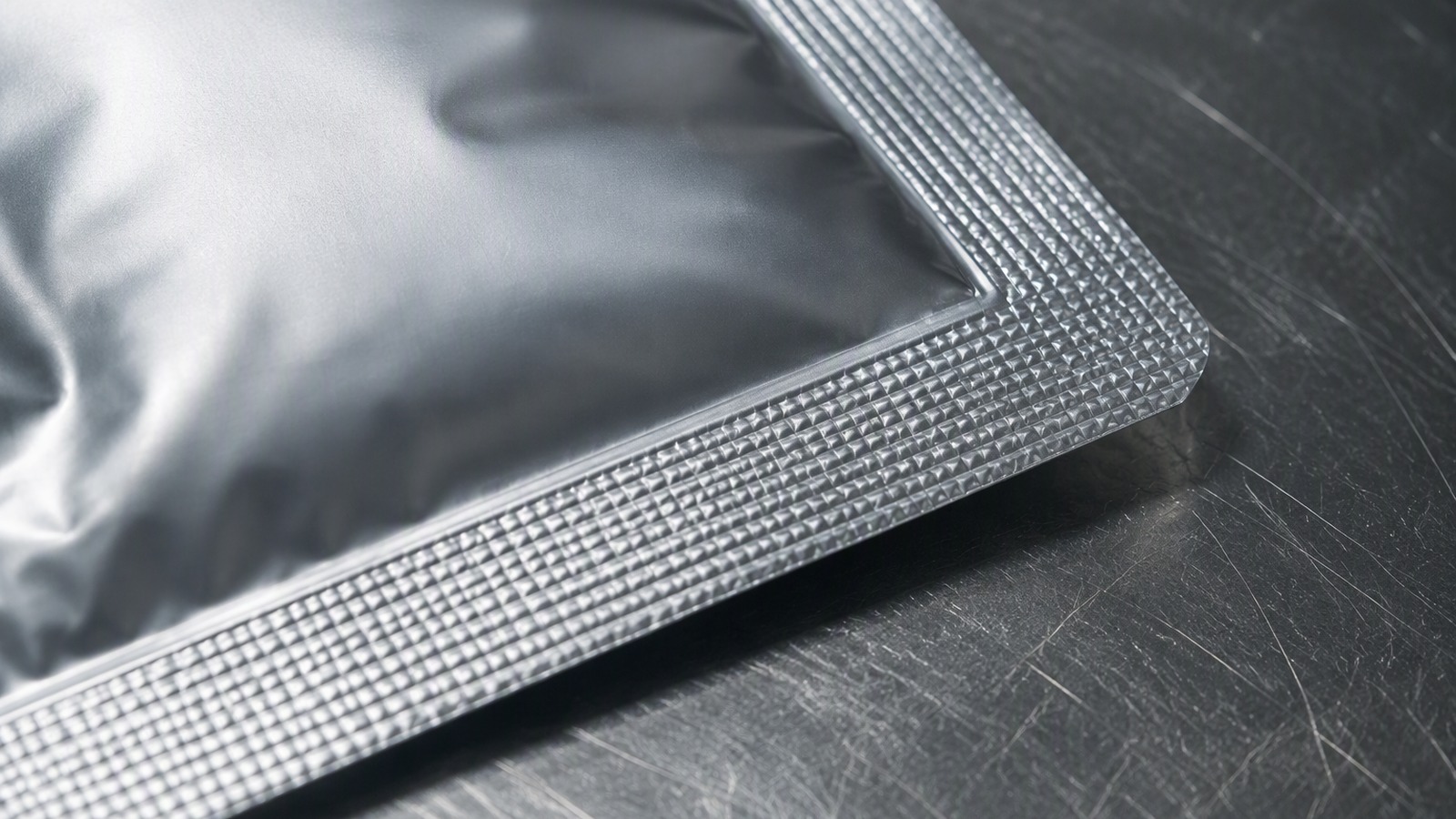
The seal is a transition. Two sealant faces are pressed together and fused, and at the boundary the laminate goes from bonded to unbonded over a short distance. Load carried across that boundary concentrates at its edge, which is why seal failures usually begin at the inner or outer boundary rather than in the middle.
The foil edge is where the aluminium stops. At a cut edge there is no continuous metal to spread load and no uninterrupted polymer to keep moisture from the layer interfaces, so delamination and flex cracking start there. If the seal is narrower than the distance the product can creep, that edge sits in the wetted zone.
Both features are also handled by the machine. The seal is gripped, heated and cooled by jaws, and the foil edge sits under the same jaws. A pack sealed off centre, or over a wrinkle, applies the same loads to a smaller area.
The flat area fails too, but later and for other reasons: flex cracking from handling, or attack by the product. Those are shelf mechanisms, while the seal and the edge are process mechanisms, and The Aluminum Association notes how much edge and surface quality shape foil performance.
What does the aluminium layer do that plastic cannot, and what does it not do?
Foil separates a retort pouch from a plastic bag: opaque, ductile enough to be rolled thin, and effectively closed to moisture, oxygen, light and aroma.
It gives the pack a metal-container character and deadfold, and it spreads heat. It does not seal, carry seal load or sterilise anything.
Dive deeper
In a retort structure the foil makes the pack behave like a thin metal container rather than a film envelope. It holds a shape instead of sagging against the contents, it stops light, and it provides a barrier that does not depend on the quality of a coating. A 8079 foil at 0.012 mm is a common reference for thin retort structures.
What foil does not do is seal. Sealing belongs entirely to the sealant layers; a foil surface will not fuse to itself or to a jaw in any useful way. A structure can have an excellent barrier and still leak at a seam, because the two properties come from different layers.
Foil does not carry seal load on its own either. At the seam the load passes through sealant and the foil terminates nearby, adding stiffness rather than strength. Nor does foil resist flex cracking by itself: thin metal flexed repeatedly at a sharp fold will crack, whatever its barrier performance.
And foil does not make a pack sterile. It keeps inside the pack what the process achieved; the process is what achieved it. For background, aluminium foil metallurgy is a reasonable start, but the pack is qualified as a system, not as a film.
Why do sealant choice, seal width and seal contamination decide the outcome?
Because the seal is the only closure, and it is made once, over a product that is already present. Small variations there are corrected nowhere else.
The sealant must flow and resist the product, the seal must survive a contaminated band, and product in the seal is the commonest cause of failure.
Dive deeper
Sealant choice sets the window. A retort sealant must soften enough to fuse under the jaws, stay tough enough to peel and flex afterwards, and resist the fats, acids and salts in the product. Thicker sealant gives more material to flow around a particle, and a sealant that wets the foil well keeps the bond at the seal boundary intact. The same foil for packaging can be paired with different sealants, and the pairing decides seal behaviour.
Seal width is a reserve. The useful part of a seal is the continuous part; a contaminated band, a wrinkle or a fold consumes width without adding strength. A seal that is just wide enough when clean becomes marginal when the filler runs fast, so width is chosen against the worst fill, not the average one.
Contamination is the deciding variable in practice. Product in the seal prevents sealant-to-sealant contact, and no later step repairs it. It comes from overfill, splashing at the fill station and viscous or particulate products that bridge the seal zone, so fill accuracy and a clean seal land belong in the specification.
The three interact: a wider seal tolerates more contamination, a thicker sealant tolerates more particulate, and a cleaner fill reduces the demand on both. They are set together and checked on the customer's own product.
Why do headspace and trapped air matter inside a retort pouch?
Air left in a sealed pouch expands during the cycle, presses on the seal from inside, and insulates the contents from the heat around them.
Headspace must be enough for expansion and small enough to keep the pack tight. Air trapped in the product and in the chamber does the rest.
Dive deeper
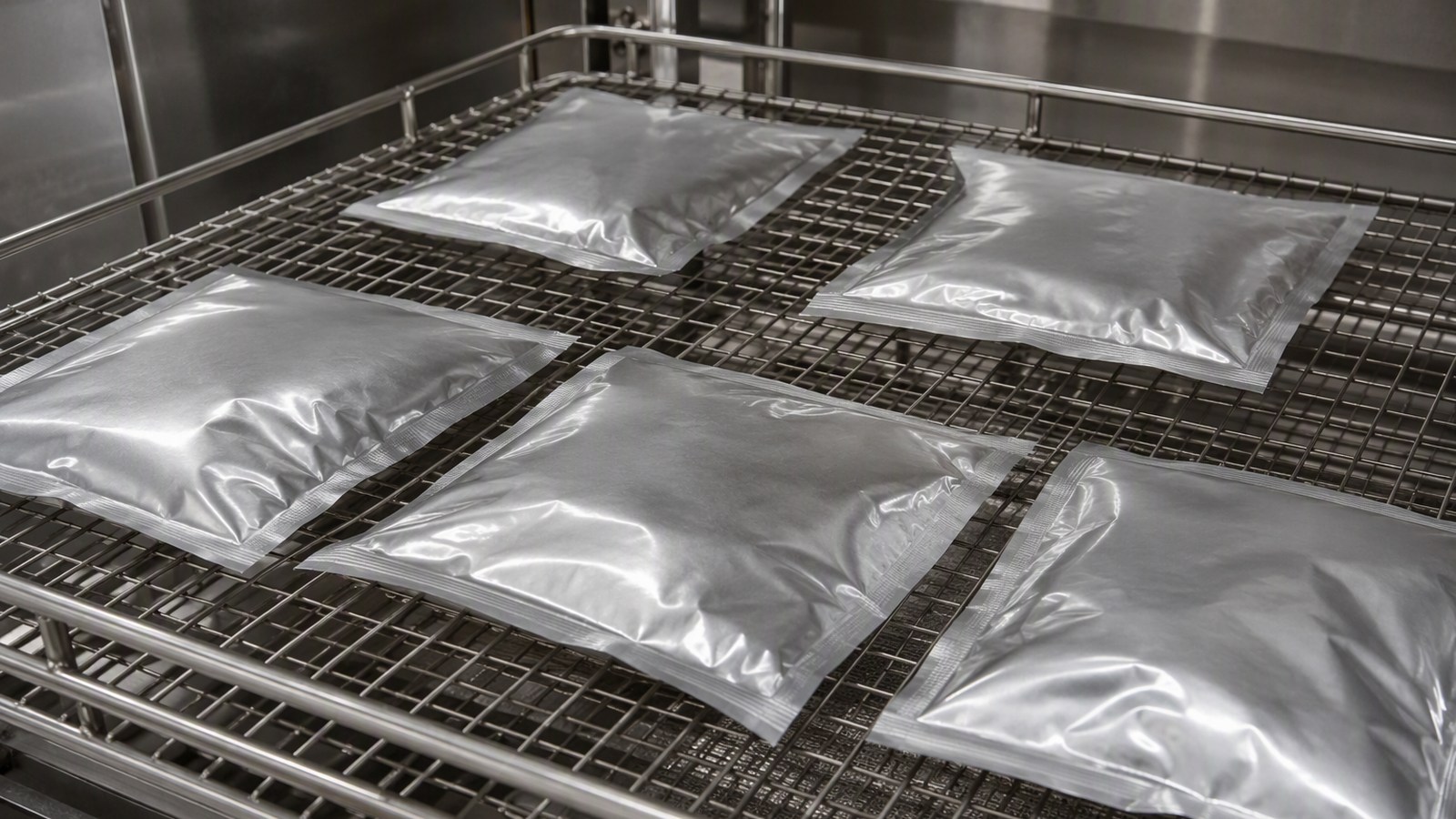
A sealed pouch is a fixed volume with a compressible gas inside. As the pack heats, that gas expands and the residual air gathers into bubbles that move to the highest available point, which in a pouch standing in a basket is usually the top seal. A bubble against the seal loads it from inside while the outside is under pressure, so the seal is worked in peel while the sealant is softest.
Too little headspace leaves no room, so the pack goes tight early and the seal carries the expansion. The contents are also pushed towards the seal during closing, which is one route to contamination. Too much headspace leaves a large pocket that travels, distorts the panel and keeps part of the surface away from the heat.
Air dissolved or dispersed in the product matters as much as the gap at the top. A product pumped hard, or filled warm without deaeration, releases gas during the hold and adds to the internal load. Air is a load in this pack, not an empty space.
Headspace is therefore agreed between filler and converter, because pouch dimensions, fill weight and closing method set it together. Background from alufoil.org is useful, but the figure belongs to the customer's product and process.
What happens to the pouch when the retort comes down in pressure?
During the hold, pressure outside the pouch roughly balances pressure inside. When the cycle ends, that balance is removed faster than the contents cool.
The pack balloons, the seal is loaded in peel and the panel is drawn out. How the pressure is released decides how much of that load the seal sees.
Dive deeper
Pressure release is the least visible part of the cycle and often the most damaging. While the vessel is held, external pressure keeps the pouch compact and the seal closed against its own internal load. When the pressure is released, the internal pressure has not yet fallen, because the contents are still hot, so the pack expands and the seal is loaded from inside outwards.
If the release is fast, the pack balloons sharply, the panel stretches and the seal is peeled at a rate it was never designed for. If the release is slow and matched to the cooling of the contents, the pouch contracts gradually and the seal sees a gentler load. The difference is in the release profile, which belongs to the retort operator.
Cooling adds the reverse load. As the contents contract, the pack is drawn in, the panel goes concave and product can be pulled towards the seal from inside. Water used for cooling can also be drawn towards any leak path.
This is where a retort pack differs from chilled packs, which are loaded by handling and ice rather than by a pressure step. The release profile is agreed with the customer's process and confirmed on the vessel.
What should a converter and a filler each state in a retort pouch enquiry?
An enquiry that names only a thickness cannot be answered properly. The converter needs the product and the cycle; the filler needs the structure and its limits.
Each side should state what it knows, what it assumes and what will be verified on the line, so laminate and seal are agreed as one specification.
Dive deeper
The converter should state the full structure, not a single layer: alloy and temper, foil gauge, sealant type and thickness, outer layer, adhesive system and foil surface condition. The alloys normally considered run through 1050, 1060, 1100, 1235, 3003, 3004, 8011, 8021 and 8079, in tempers such as O, H14, H16, H18, H22 and H24, at 0.005 mm to 0.20 mm, in widths from 100 mm to 1500 mm, on 76 mm or 152 mm cores.
The converter should also state the seal window the laminate was designed for, with the seal width, pressure and dwell it refers to.
The filler should state the product in detail: fat, acidity, salt, particulates, and how it behaves when heated. Then fill weight, headspace, pouch dimensions, available seal width and sealing method. Then the process: retort type, cycle sequence, how packs are loaded, and how pressure is released and cooling handled.
Both sides should separate what has been verified from what is assumed, because the pack is qualified as a system. Commercial terms belong in the same conversation: container foil is normally quoted from 3 MT per size, shipped through Qingdao, Tianjin or Shanghai, and that shapes how many structures can be trialled.
Fix the pack design, the product and the cycle first, then specify the laminate and the seal that can survive them.