Aluminium Foil for Transformer Windings: Does the Edge Decide?
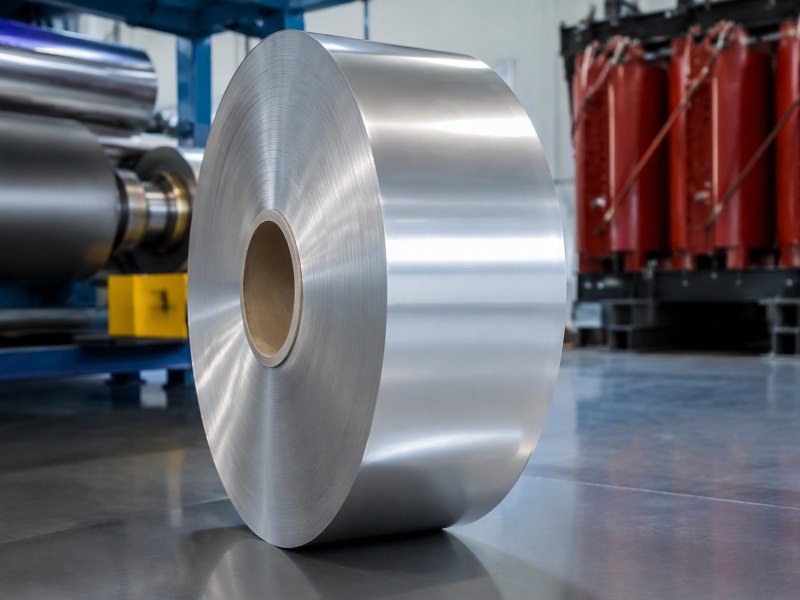
A foil winding is built in layers, not in passes, and the foil is the conductor. Width, gauge, edge, temper and surface decide whether the layers build square.
A winding that fails at the edge fails quietly: a burr under the insulation, a turn sitting proud, a build running out of height.
In a dry-type transformer the low-voltage winding can be one wide aluminium foil wound layer on layer, so the foil is the conductor and the mill's job is consistent gauge, accurate width, clean edges, soft temper and a clean surface.
What follows traces the foil from the slitter to the winding bench, and asks what has to be settled before the first layer goes down.
How Does a Foil Winding Differ from a Wire Winding?
A wire winding is built in passes. A foil winding is built in layers, and that one difference changes what the shop has to control.
With foil, one turn occupies the full winding height and one layer is one turn. The conductor arrives as a continuous sheet, so the coil grows in layers instead of in passes.
Dive deeper
A round wire winding is built turn by turn: the wire is guided into place, each turn lies beside the one before it, and the winding grows outward pass after pass until the turn count is complete.
A foil winding replaces that bundle with one wide sheet. One layer of foil is one turn, so the foil width sets the winding height and the number of layers sets the turn count. The shop still controls tension and alignment, but it cannot nudge a single turn, because a turn is a whole layer wrapped around the coil.
That changes how the coil is built. Interlayer insulation goes down with the foil, layer after layer, so the finished coil is a stack of conductor and insulation that has to stay square and compact. If the foil wanders sideways, every layer above inherits the wander; if the foil is crowned, every layer inherits the crown. A wire winding can absorb a small irregularity by spreading turns across a pass. A foil winding cannot, because each layer is a flat turn pressed onto the one below, and a fault in the strip repeats at every layer.
Foil winding therefore rewards consistency in the roll rather than skill at the machine.
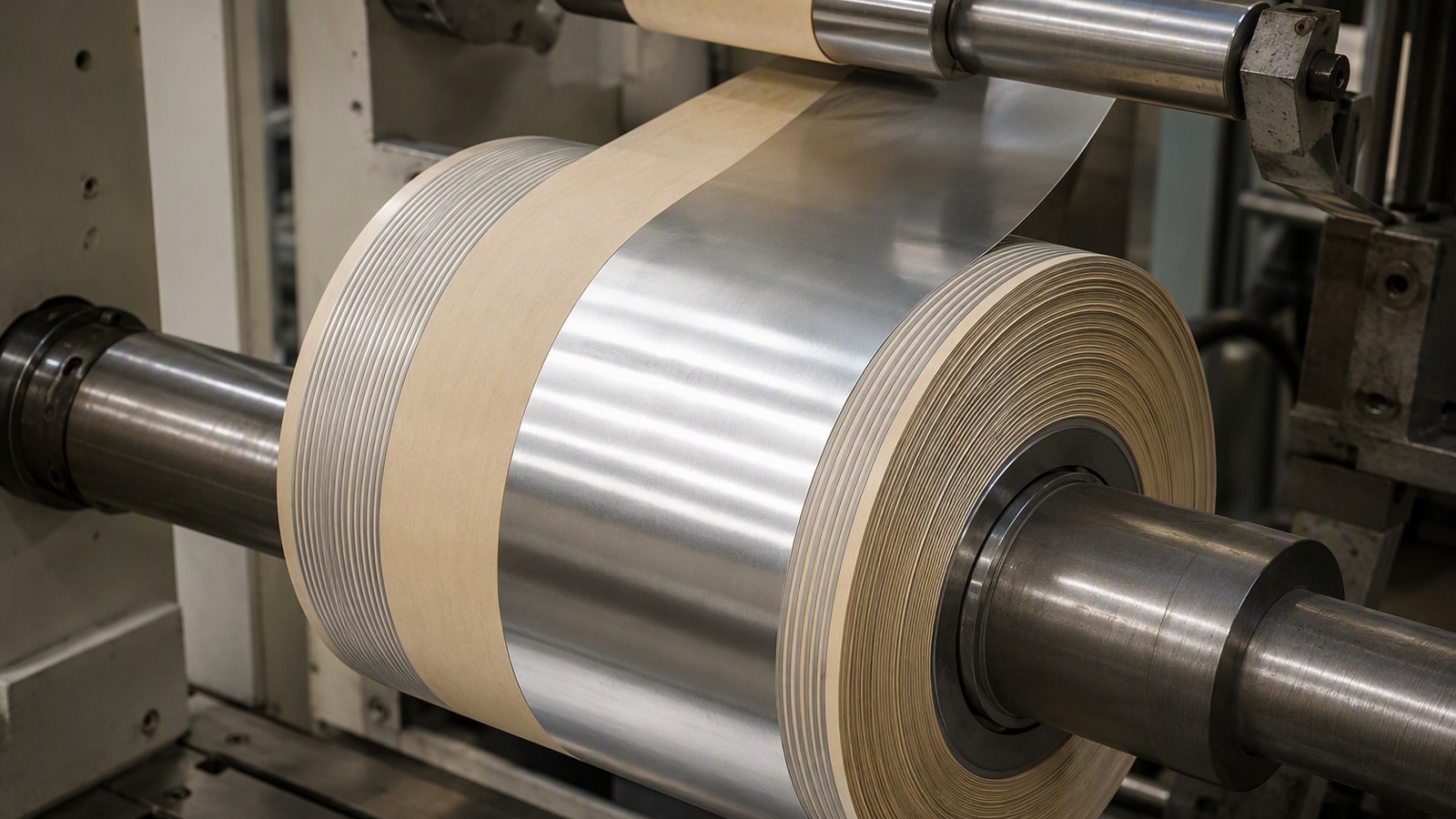
Why Must the Foil Width Match the Winding Height?
Foil wider than the winding height is scrap. Foil narrower leaves a step that the insulation has to bridge.
The strip width becomes the wound height, so width is set by the winding design, not by what is convenient to ship. Slitting to the agreed width keeps every layer inside the coil.
Dive deeper
In a foil-wound low-voltage coil the foil does not sit in a slot; it is the layer. The strip width therefore becomes the height of the wound coil, less the allowance the design leaves at each end. A mill slits a parent roll to the width the customer asks for, and that width is not a packaging convenience: it is the dimension the coil is built to.
This is why slitting accuracy sits close to the electrical design without being an electrical promise. A narrow strip leaves the coil short of height, and the design has to be recovered elsewhere, with more layers or a revised drawing. A wide strip leaves the foil standing proud of the insulation at one or both ends, and the extra metal must be dealt with before the coil is finished. Both outcomes are settled at the slitter, not at the winder.
Width also has to hold along the roll. A slit that drifts produces a winding whose height changes as it builds. The cure is a checked slitting setup and a roll wound squarely on a core of 76 mm or 152 mm. Aluminium foil roll is supplied to the width you nominate, confirmed against your drawing before slitting.
Why Does a Burr or a Sliver on the Edge Ruin a Winding?
A burr is a fragment of metal standing up exactly where the insulation expects something flat.
The edge is where foil meets insulation. A burr, a sliver or a folded lip makes a local high point, and every layer above it is laid over that high point.
Dive deeper
Every roll has two edges, and both were cut. A good slit edge is a clean shear: the metal is severed rather than torn, with no lip of material hanging on. A poor edge leaves a burr standing proud of the surface, or a sliver that has already detached and lies loose on the foil.
Both are mechanical problems before they are anything else. A burr is a high point under a thin insulation layer, and the pressure of the layers above concentrates on it. A sliver is worse in one respect, because it travels: it migrates into the coil, sits between layers, marks the insulation or ends up where nobody sees it until the coil is opened.
Burrs come from worn or badly set slitter knives, from a knife overlap that is too light, and from tension that lets the strip ride up as it is cut. They also come from handling: a roll dropped on its edge picks up a turned edge that no slitter made. What can be agreed is an edge condition, cut clean and free of loose slivers, checked at the start and end of each roll. 1050 aluminium foil at 0.02 mm is a gauge where that discipline matters most.
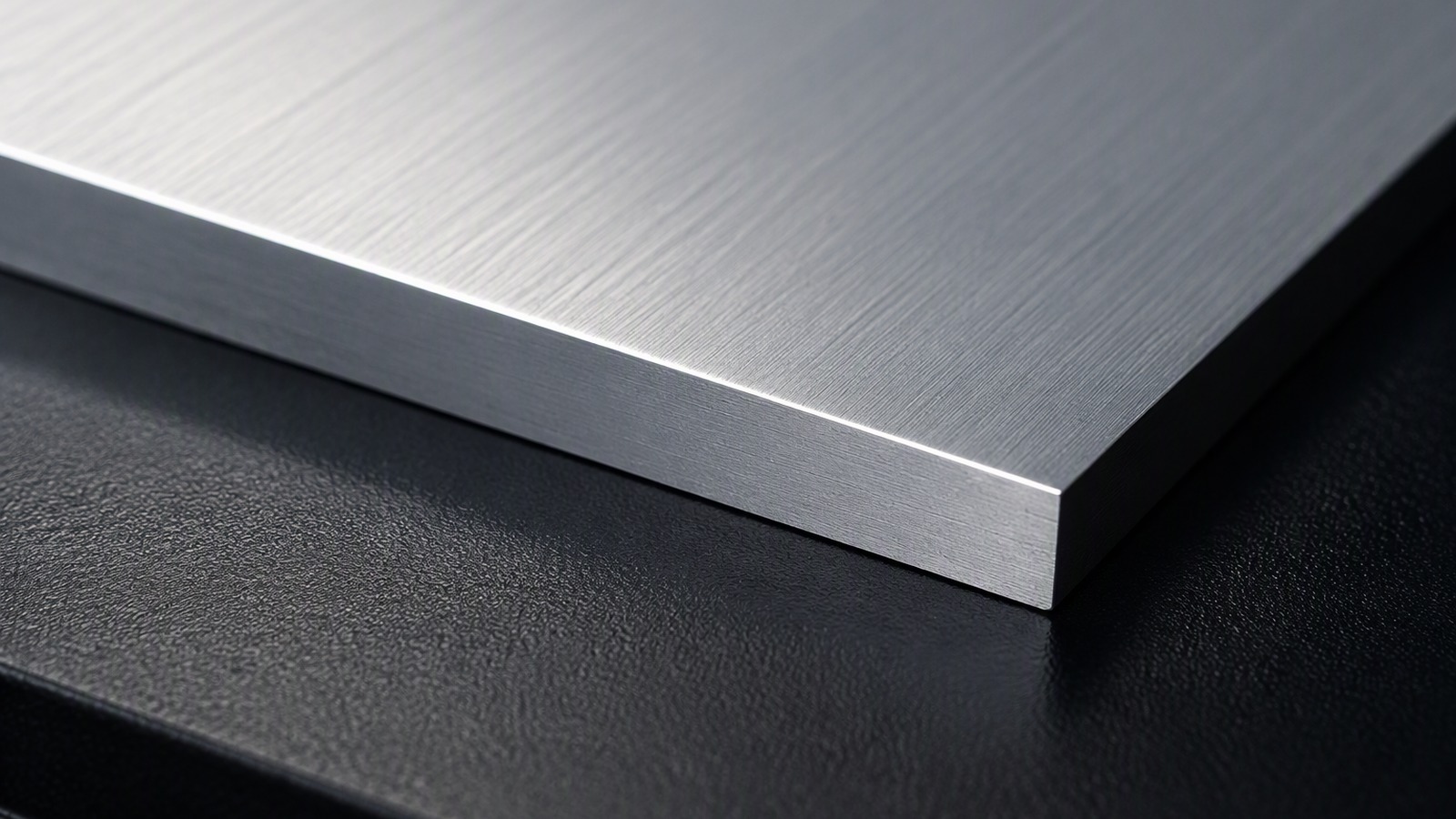
Why Does Gauge Consistency Across the Width Matter So Much?
In a foil winding the conductor and the spacer are the same sheet, so a crown in the strip becomes a crown in the coil.
Each layer sits on the foil beneath it. Thickness that varies across the width turns into height that varies across the coil, and the build stops being predictable.
Dive deeper
A rolled strip is rarely perfectly flat across its width. Mills work to a profile, and the profile is a deliberate choice: a strip slightly thicker in the middle than at the edges, or the reverse, behaves differently when wound under tension. What matters for a winding shop is that the profile is consistent and known, not that it is absent.
The reason is that the foil does two jobs at once. It is the conductor and it occupies space in the build, so a gauge band running along the roll becomes a band of extra height in every layer. Ten layers of a small variation is not a small variation any more: one side of the coil ends up taller, the insulation is compressed unevenly, and the winding no longer sits square on its axis.
Gauge also interacts with tension. A strip that is thicker in the centre winds tighter there and slacker at the edges, which shows up as a loose edge or a wrinkle several layers into the build. Tension cannot correct a profile. The practical answer is to agree gauge as a nominal with a defined measuring method, to ask for the profile to be declared, and to check a sample across the width. Industrial and technical foil is quoted this way.
Why Is Soft Temper Used for Tight Winding, and What Happens When Foil Is Too Stiff?
A tight coil needs a foil that follows the mandrel instead of arguing with it.
Soft temper lets the foil conform to the mandrel and to the layer below, so the coil winds tight. Foil that is too stiff springs back, traps air and leaves gaps.
Dive deeper
Temper describes the condition of the metal rather than its chemistry: how much cold work it has seen and how much it has been allowed to recover. O temper is the soft, fully annealed condition, and it is the usual starting point for foil that has to be wound tightly around a mandrel and pressed flat, layer on layer, without cracking at the bend.
The harder tempers behave differently. H14, H16, H18, H22 and H24 are progressively stronger and less willing to deform. That is useful where a foil must stay flat and self-supporting, and unhelpful where it has to wrap a small radius and lie down. A stiff foil resists the mandrel, springs back when tension is released, and leaves a coil that looks wound but is not tight.
Springback is the visible symptom. The inner layer lifts away from the mandrel, the next layer bridges the gap instead of following it, and air is trapped in the build. The shop compensates with more tension, which stretches the foil unevenly and can wrinkle the edge. A foil softer than the winding tension requires will also stretch, narrow and wrinkle. Aluminium foil in the soft condition is the normal starting point, with the exact temper confirmed against your winding design.
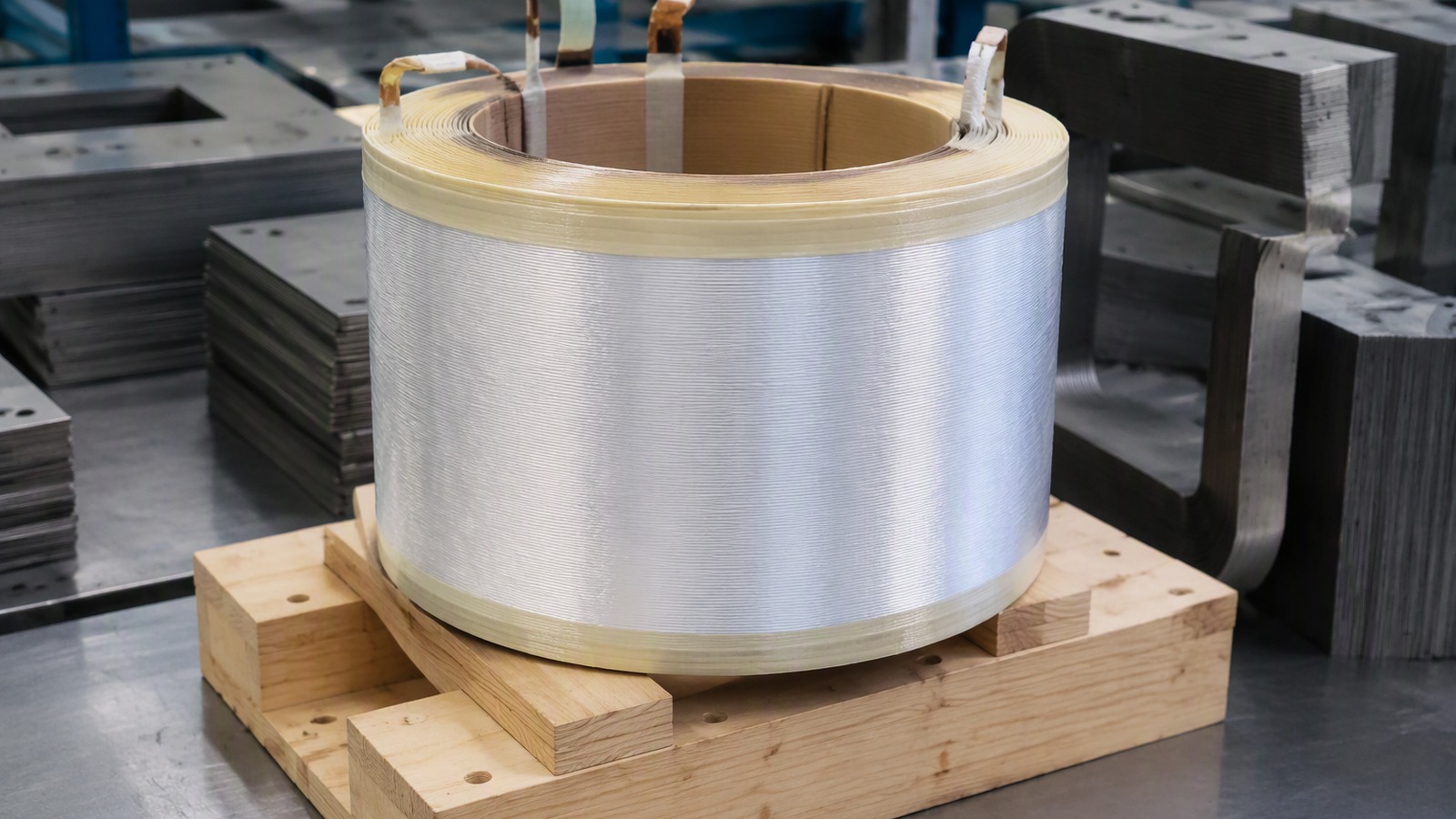
Why Do Surface Condition and Cleanliness Matter Before the Insulation Goes On?
The foil surface is an interface, and whatever sits on it sits inside the insulation system for the life of the transformer.
Insulation is wound directly against the foil, so the surface has to be clean, dry and free of slivers, oil and loose particles. Anything left on the foil stays in the coil.
Dive deeper
Foil leaves the mill with a surface that reflects how it was rolled: roll marks, a fine texture from the work rolls, and sometimes a residual film of rolling oil. Some of that is normal. What matters is that it is consistent and declared, because the winding shop is about to press insulation against that surface and leave it there.
Residue is the quiet problem. Oil that is heavier in one area than another holds dust, and dust under insulation is a particle between two surfaces that were meant to touch. Water stains from condensation in a warehouse leave a mark hard to distinguish from an oxide patch, and both look like a surface the shop did not order. Loose slivers are the third contaminant, and the one most likely to travel.
Handling decides much of this. A roll opened and left standing collects dust on its exposed face; a roll kept wrapped until it is mounted does not. Clean gloves, a clean bench and upright storage are cheap controls. What can be agreed is a surface described in plain terms and checked on a sample: uniform appearance, no heavy oil, no water staining, no loose particles. European Aluminium publishes background on rolling and handling.
Why Is the Mill's Job Consistency Rather Than an Electrical Promise?
The foil supplier does not design the transformer. It supplies a conductor whose dimensions and condition have to be the same, roll after roll.
The foil is the conductor, and the electrical design belongs to the transformer maker. The mill's responsibility is metallurgical and dimensional consistency: alloy, temper, gauge, width, edge and surface.
Dive deeper
A transformer designer chooses the alloy and the section that the winding needs, then writes a drawing. The foil mill turns that drawing into a roll: 1050, 1060, 1100, 1235, 3003, 3004, 8011, 8021 or 8079, in a temper from O to H24, at a thickness between 0.005 mm and 0.20 mm, slit to a width between 100 mm and 1500 mm. None of those is the mill's to choose.
What the mill can promise is repetition. The same alloy from the same source, the same temper after the same treatment, the same gauge band, the same slit width, the same edge condition and the same surface, roll after roll. That is what a winding shop is really buying, because a coil built from two rolls that behave differently is a coil with two personalities.
Consistency is also a matter of disclosure. If an alloy source or a rolling route changes, the shop should hear about it before the foil arrives. A supplier that states what it can hold, in writing, is more useful than one that promises an outcome it does not control. The designer owns the result, the mill owns the metal, and the enquiry is where the two meet. The Aluminum Association and the Aluminium Federation publish background on alloy families.
What Must a Winding Shop State in an Enquiry for Transformer Foil?
An enquiry that says only aluminium foil, soft, will be quoted against assumptions the shop never sees.
State the application, the alloy, the temper, the thickness in mm, the width in mm, the core, the roll mass and the quantity, then add edge, surface and packing requirements.
Dive deeper
Start with the application, because it sets everything else: a low-voltage foil winding for a dry-type transformer, wound layer on layer with interlayer insulation. Say whether the width is a winding height or a slitting width, because edge allowance makes them different numbers.
Then the material line: alloy from 1050, 1060, 1100, 1235, 3003, 3004, 8011, 8021 or 8079; temper from O, H14, H16, H18, H22 or H24; thickness within 0.005 mm to 0.20 mm; width within 100 mm to 1500 mm; core of 76 mm or 152 mm; roll mass and maximum splice count per roll. Ask for the gauge band, the width tolerance you will accept and the edge condition in writing.
Then the commercial frame: quantity against a minimum of 3 MT per size, packing that protects the edges, and a port of departure such as Qingdao, Tianjin or Shanghai.
Finish with the checks you will make: width, gauge across the width, edge, surface, roll identity and splice count. How to specify aluminium foil for industrial insulation jacketing sets out the same discipline for another product, and foil in cable wrap and shielding shows how a neighbouring application states its needs.
Foil for transformer windings is a dimensional product before it is an electrical one. Agree width, gauge, edge, temper and surface, and the layers look after themselves.