How Do You Dry and Cure a Coating on Aluminium Foil?
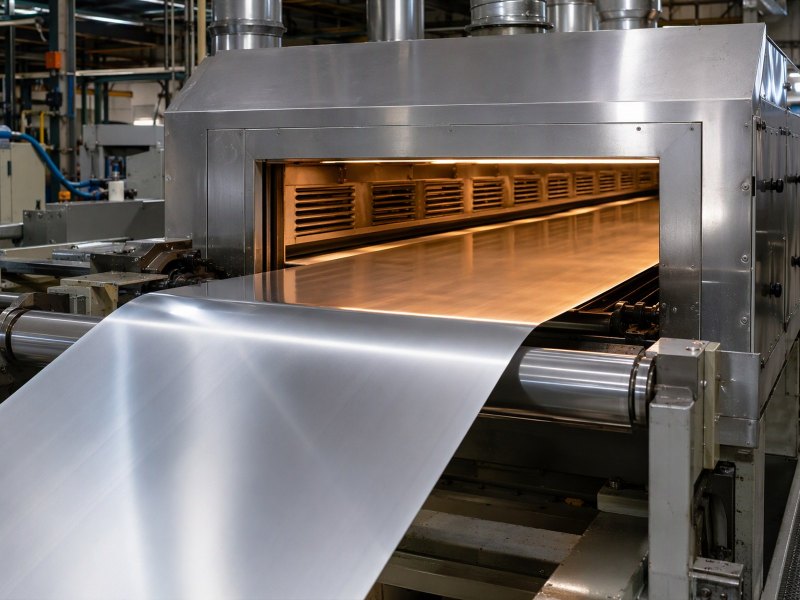
Dry is not cured: what must leave the film, what must set it, and how to run the line.
A coated coil that feels dry at rewind can still block, smell or fail at the seal. The fault is usually the drying and curing step.
Drying removes solvent or water from the film; curing sets it chemically. Both happen in the oven, but they are separate events, and a film that is merely dry will still fail once the coil is rewound or sealed.
The article follows the step in order: what leaves, what sets, how the oven is staged, and what to check first.
What Is the Difference Between a Dry Coating and a Cured Coating?
Dry means the carrier has gone. Cured means the polymer has built the structure it needs. A film can pass the first test and fail the second.
A dry coating has lost its solvent or water and feels firm. A cured coating has also reacted into its final structure, so it resists heat, pressure and the pack's contents.
Dive deeper
Drying is a mass-transfer event: the carrier, solvent or water, leaves the film and enters the air. Curing is a structural event: separate molecules join into a network, or a thermoplastic layer resolidifies into a skin. The first can finish while the second has barely begun, and that gap starts most complaints.
A hand on the web at the rewind proves only that the surface is not wet. It says nothing about the middle of the film, which cools and stiffens last. A solvent-borne lacquer can lose most of its carrier and still be a soft, slightly tacky layer that presses into the opposite face as the coil builds under tension. That is why a warm coil can pass a touch check and still fail at the sealer.
The two families differ. Thermoplastic heat-seal lacquers are meant to flow again when heated, so they are dried rather than crosslinked, and their quality depends on how completely the carrier left and how the film was cooled. Reactive lacquers and laminating adhesives must be dried and then given enough energy to react; an under-reacted film stays soft and creeps under load. The general reference article on aluminium foil shows how little metal the substrate holds, so the film's own history in the oven matters more than the oven's set point.
What Has to Leave the Film Before It Is Dry?
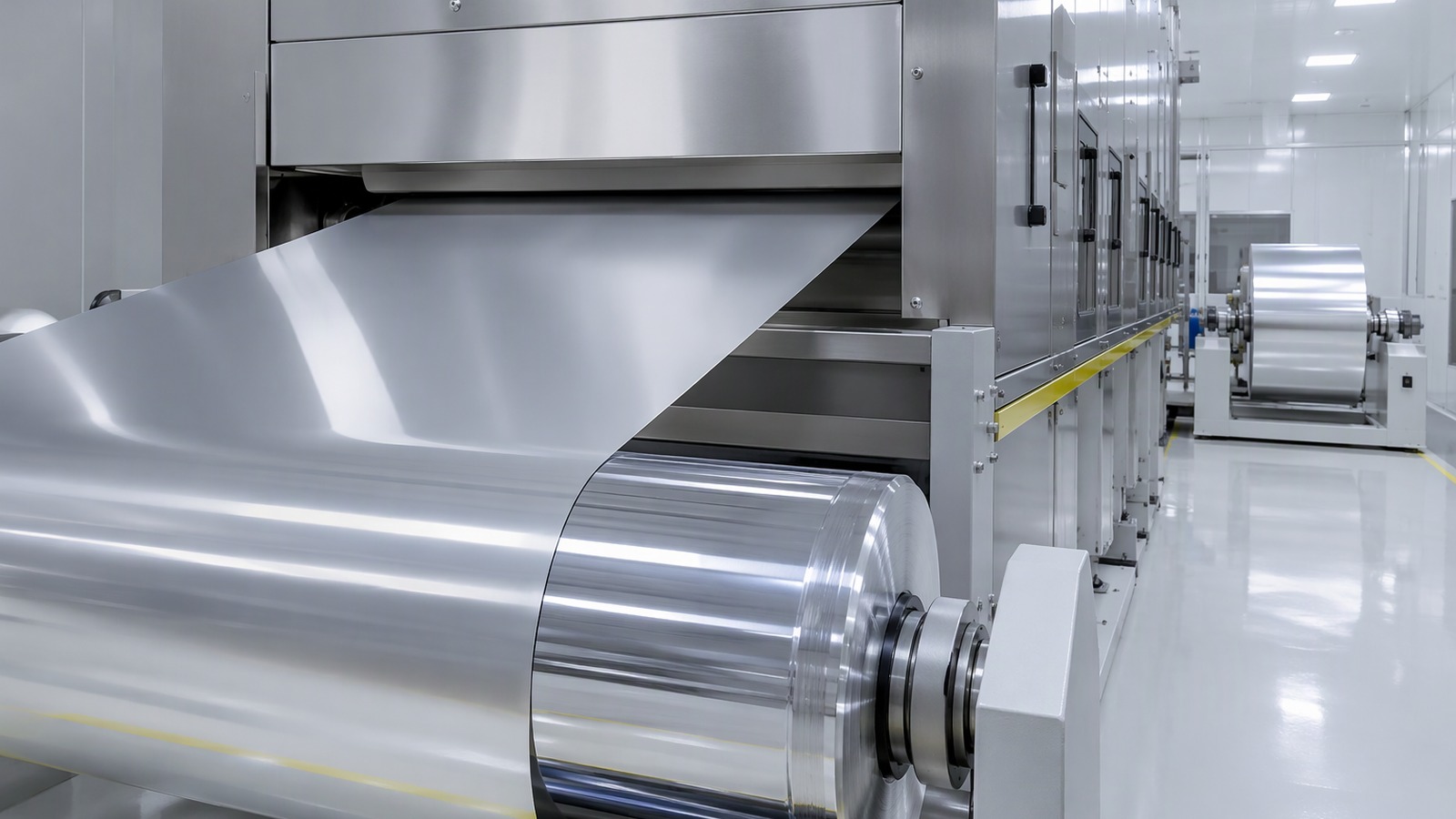
Solvent or water has to leave, and moving air has to carry it away. Heat without air exchange only warms a film that stays wet.
A coating is dry when its carrier has diffused to the surface and been carried off in the air stream. Until then the film stays soft, whatever the surface feels like.
Dive deeper
Every coating carries something that must go: an organic solvent, a water and co-solvent blend, or a reactive carrier that also joins the cure. The carrier makes the coating liquid enough to apply as a thin, even layer; once it is on the web it is a liability and must be removed completely.
Water and solvent behave differently. Water has a high latent heat, so a water-borne coat needs more energy to leave the film, and its surface tension makes wetting a thin web harder, so the early stage often needs more air than heat. Solvent leaves more easily but demands strong exhaust, because the air above the web saturates quickly and then stops accepting vapour, however hot the oven is.
Drying runs in two stages. First, carrier reaching the surface evaporates freely and the film loses weight at a steady rate. Then carrier has to travel from the middle of the film to the surface before it can leave, and the rate falls. That last carrier is the hardest to shift and the most likely to cause blocking later. If the surface skins over first, the film feels dry while it is still wet underneath, and the trapped carrier softens it from within. A coat supplied for packaging and container foil work is judged on exactly this point.
What Has to Happen Chemically for the Coating to Cure?
Curing needs reactive groups, enough energy and enough time together. Heat alone cannot finish a reaction that the chemistry does not allow.
Curing is the reaction that turns a dried film into its final structure: chains crosslink, or a two-part system completes its build. It needs energy and time, and it continues briefly after the oven.
Dive deeper
Drying and curing are confused because one oven drives both, but only one is chemical. In a reactive system, functional groups on neighbouring chains meet and bond, and the film stops being a collection of separate molecules and becomes one network. That network gives the coating its resistance to heat, to the pack's contents and to rewinding stress.
Systems reach that network by different routes. A two-part system begins to build as soon as the components are mixed, so its usable life on the machine is limited and its cure depends on the ratio actually applied. A moisture-cure system takes its reactant from the air and the substrate, so a very dry oven and a very dry room can slow it down. A radiation-cured system sets only where the energy reaches, so a thick film can be firm on top and soft underneath.
Two details decide whether the coil is usable. The first is through-cure: the film must be set from the metal interface to the outer surface, not just at the top. The second is what the reaction releases. Some systems give off something as they set, and if the coil is wound before that has escaped, it is trapped between laps and softens the film it came from.
Why Are Oven Zones Staged the Way They Are?
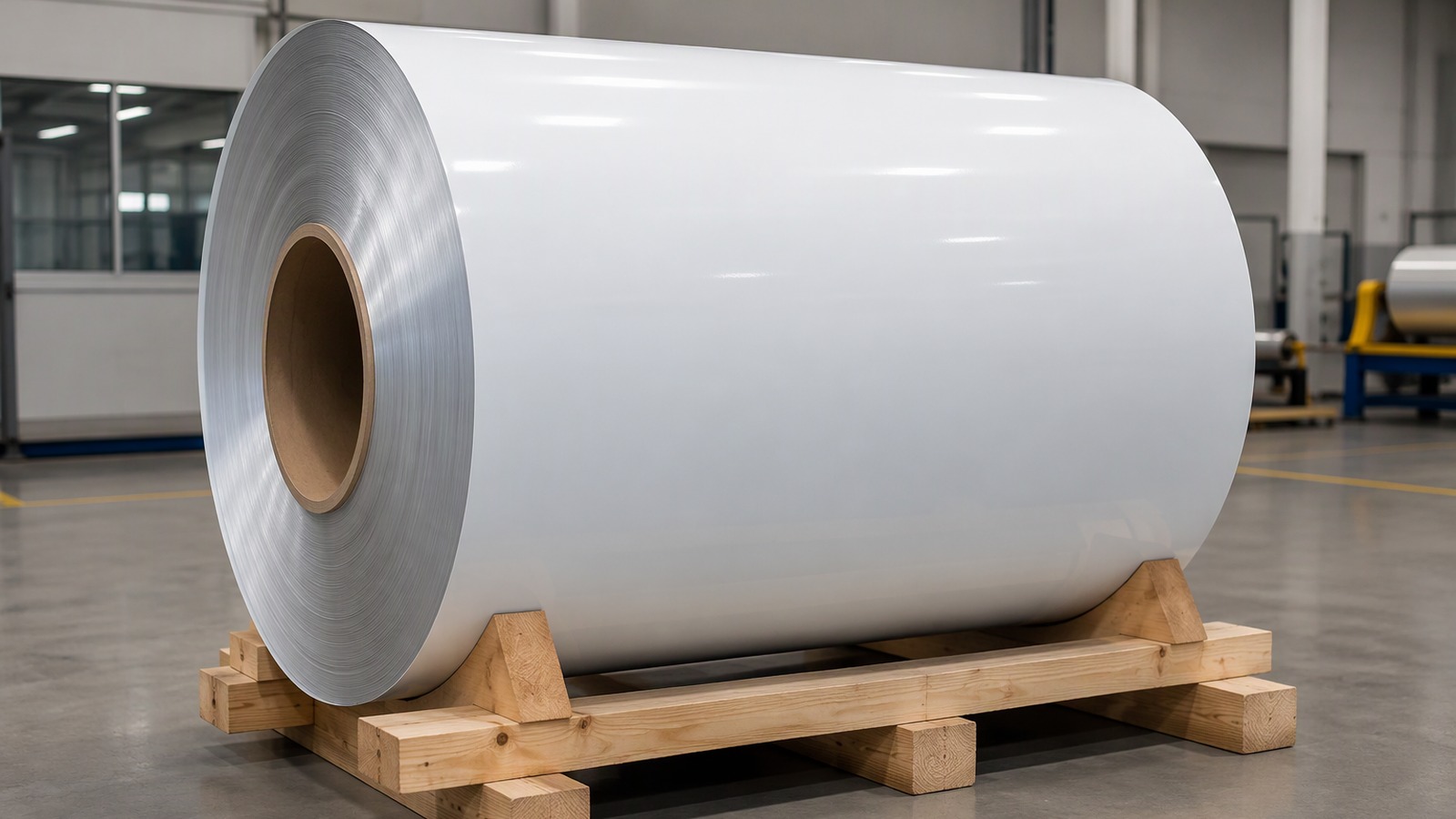
Early zones are gentle and late ones are stronger, and the end of the oven is about settling rather than heating. The order matters more than the total.
Zones are staged so the carrier leaves gradually before the film is asked to set. A gentle start prevents skinning and blistering; later stages finish the cure and settle the web.
Dive deeper
Each oven stage has a job, and the sequence exists because a film cannot be dried and cured at the same moment without damage.
The early stage removes the bulk of the carrier without sealing the surface. Air is exchanged so vapour is taken away as fast as it appears, and heat is kept modest so the surface does not skin. If this stage is pushed, vapour collects under the skin and the coating blisters. Blisters read as surface texture and become weak points at the seal.
The middle stage carries the slower, diffusion-limited part of drying and begins to warm the film towards its reaction. This is where the deepest carrier leaves, and it is the stage most often shortened when a line is pushed. The late stage finishes the chemistry, holding the web long enough for the reaction to complete without over-cooking the face that will later be sealed. The end of the oven cools the web to a winding temperature, where the reaction can continue slowly inside the coil. Vapour-laden air from the early stage must not be carried back into the later ones, and exhaust must be balanced against supply so the web does not flutter. The aluminium foil industry association publishes material on foil production that puts this step in context.
What Happens When the Web Runs Too Fast for the Oven?
Speed is the easiest variable to push and the most expensive to get wrong. A shortfall in the oven appears later, off the line.
Running faster than the oven can dry leaves carrier in the film. The coil then blocks on rewind, smells at goods-in, and fails at the seal or the print bond.
Dive deeper
When the web moves faster, every stage loses time, but not equally. The early, fast part of drying survives a speed increase well, because carrier leaves the surface quickly. The slow, diffusion-limited part does not, and that part decides whether the film is usable. A line can therefore run faster and still produce coils that look correct at the rewind while the middle of the film is loaded with carrier.
The first consequence is blocking on rewind. Carrier left in the film acts as a softener, and winding pressure presses the coated face into the back of the next lap. On unwind the laps resist separation, and the buyer sees torn or patchy surfaces. The effect grows with coil diameter, because inner laps carry more winding stress and get less time to relax. The second consequence is odour: carrier trapped in a wound coil has nowhere to go, so it migrates slowly and is released when the coil is unwound or the pack sits somewhere warm.
The third is failure at the seal. Carrier in the film lowers the cohesive strength of the coating, so the seal creeps, channels or peels. This fault reaches the consumer, which is why a coat intended for coated aluminium foil in 8079 alloy should never be qualified on a fast trial alone, or on one coil.
Why Do the Reverse Side and the Underside of the Web Behave Differently?
One face may be matte and the other bright, but the larger difference is mechanical: the underside rides on rolls while the top face meets air.
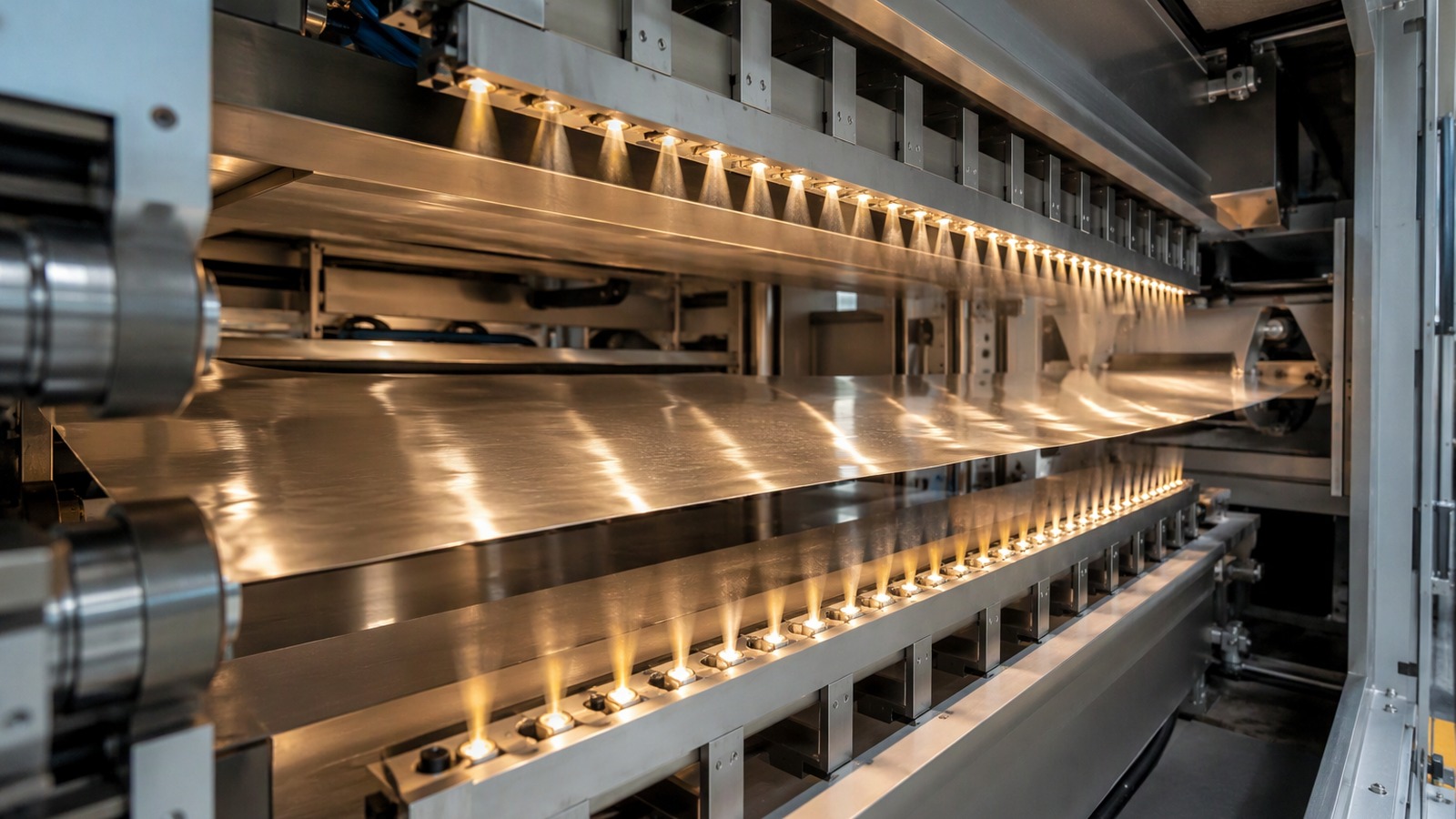
The underside touches rolls and traps vapour, while the top face meets the air. Unequal heat transfer and airflow leave one side drier, harder or tackier.
Dive deeper
Foil has two faces that were formed differently. The face that met the roll during rolling is matte and slightly more open; the face that ran free is bright and smoother. The two do not wet identically, so the same coating sits differently on each, and a coat on the matte face can look heavier than one on the bright face.
In the oven the asymmetry becomes thermal. Where the web is supported, the underside touches a roll or an air-bearing surface, so heat reaches it by contact, while the top face is heated by moving air. Contact heat is efficient but uneven: it follows the roll's temperature and the wrap angle, so the underside can be hot in one span and cool in the next. Airflow is unequal too, and the difference grows as the web gets wider. The top face sees the nozzles directly; the underside sits in a shadow where vapour accumulates, and on a humid day the underside is where condensation forms first.
Two-side work compounds the effect: the second pass re-heats the first coating, which may already be fully cured, and pushes it towards over-cure while the new face is still wet. That is one reason a converter running 8021 aluminium foil for narrow slit widths needs to know which face will be sealed before the second pass is set up.
How Does Curing Affect the Seal or Print the Coating Has to Take?
A heat-seal lacquer has to flow, then hold. Cure too little and it creeps; cure too much and it will not wet out.
Curing sets the seal window. Under-cured film creeps and channels; over-cured film will not flow, so the seal starts late and stays weak. Print adhesion needs the same balance.
Dive deeper
A coating is on the foil for a later operation: a heat seal to another web, a print that must adhere, or a lamination that must hold. Curing lets the coating do that job, and can also stop it doing that job if it goes too far.
Heat sealing depends on the coating softening, flowing into the other surface and setting again as it cools. An under-cured coating has low cohesive strength, so the seal may look closed and still creep under load, or open as a channel along the seam. An over-cured coating has a tighter network and a higher softening point, so it needs more energy to flow, wets less completely, and leaves a seal that starts late and carries less strength.
Printing behaves similarly but for a different reason. Ink adhesion depends on the surface accepting and holding the ink film; an over-cured surface can be too inert or too smooth to key well, while an under-cured surface can release carrier into the ink and soften the bond. That is why the drying and curing step cannot be set without knowing the next operation. Anyone who understands what aluminium foil lacquering is and when it is needed already knows that the coat is a means to an end, and that the end decides the cure more than the oven does.
What Can a Converter Check by Hand Before Running a Batch?
Before a line is committed, a few bench checks catch most drying and curing faults. None of them needs a laboratory.
Check the film warm at the rewind for tack, smell and blush, then seal a sample to the intended substrate and pull it. A dry but under-cured film fails both.
Dive deeper
The first check is at the rewind, with the web still warm: press a thumb into the coated face and twist. A film that marks or drags is not ready to be wound, and a sharp solvent note means carrier is still leaving.
The second check is a crease: fold coated face to coated face, press, open. If the faces cling or the coating transfers, the film is not ready; repeat coated to bare face. The third is a seal trial on the real substrate at the customer's settings, judged once cold, since a warm seal can look strong and fail later.
What the buyer should state in the order
Hand checks prove only that a batch is consistent with itself. The coater needs the end use: what the coating will be sealed to, what the pack holds, whether the fill is hot, fatty or acidic, whether one or both faces are coated, and whether the coated face will be printed. Coil width, core, temper and a note that the coating must survive later heat all help set the oven. How aluminium foil is printed before lamination covers the print side, while the aluminium industry association in the United States and the association representing aluminium producers in Europe publish general material on foil and its uses.
Drying removes what must leave; curing builds what must stay. Finish both before the rewind and the coil arrives usable.