How Do You Join Aluminium Foil to Itself?
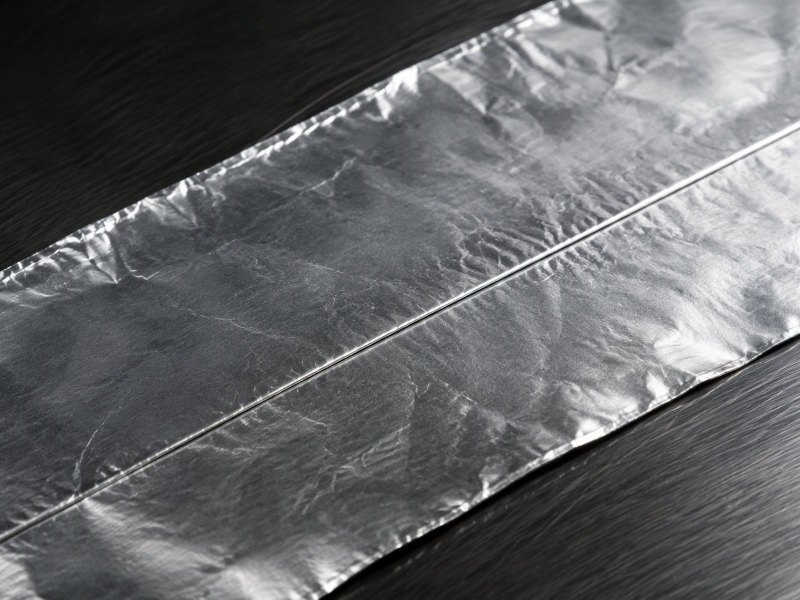
Four routes for joining aluminium foil to itself, and how to choose between them.
A supplier says the joint is sealed, the sample looks continuous, and the line still stops, because nobody can say what sealed means on foil.
The direct answer: bare aluminium foil cannot be heat sealed to itself, because the oxide layer will not bond. Every practical joint adds something - a heat-sealable coating, an adhesive, a fold or crimp, or enough energy to displace the oxide.
That explains why identical foil arrives with four different joint solutions attached, and why the choice belongs to the process, not the metal.
Why Can't Bare Aluminium Foil Be Heat Sealed to Itself?
Put two clean strips in a heated press and nothing useful happens: the metal will not wet itself.
Aluminium oxidises within moments of being exposed, and that thin oxide film does not soften at any temperature a converter would use. Heat and pressure cannot fuse two oxide films.
Dive deeper
Aluminium is a reactive metal. A surface exposed by rolling, slitting or trimming reacts with air almost at once, forming an extremely thin oxide film that is stable, hard and insulating. That film is the whole problem. It does not soften at temperatures a packaging line can produce, and it will not merge with the oxide on a second strip, so two bare faces pressed together stay two faces with a film between them.
Pressure alone changes nothing useful. A press can flatten the strips, thin the high points and bring the two films into intimate contact, but contact is not bonding. The strips spring back, the film remains, and the joint separates along the line it was made. Converters who try it describe a joint that looks closed on the reel and opens at the first handling step. The Wikipedia entry on aluminium foil covers the metal itself, though it says little about joining.
This is why the word sealed needs a second question. A joint can be closed to dust and still pass vapour; it can hold a fold and fail a vacuum. A real barrier joint needs one of three things at the interface: a polymer that bonds to a polymer, an adhesive that grips the oxide, or enough energy to displace the oxide so metal meets metal.
Which Four Routes Can Actually Join Foil to Itself?
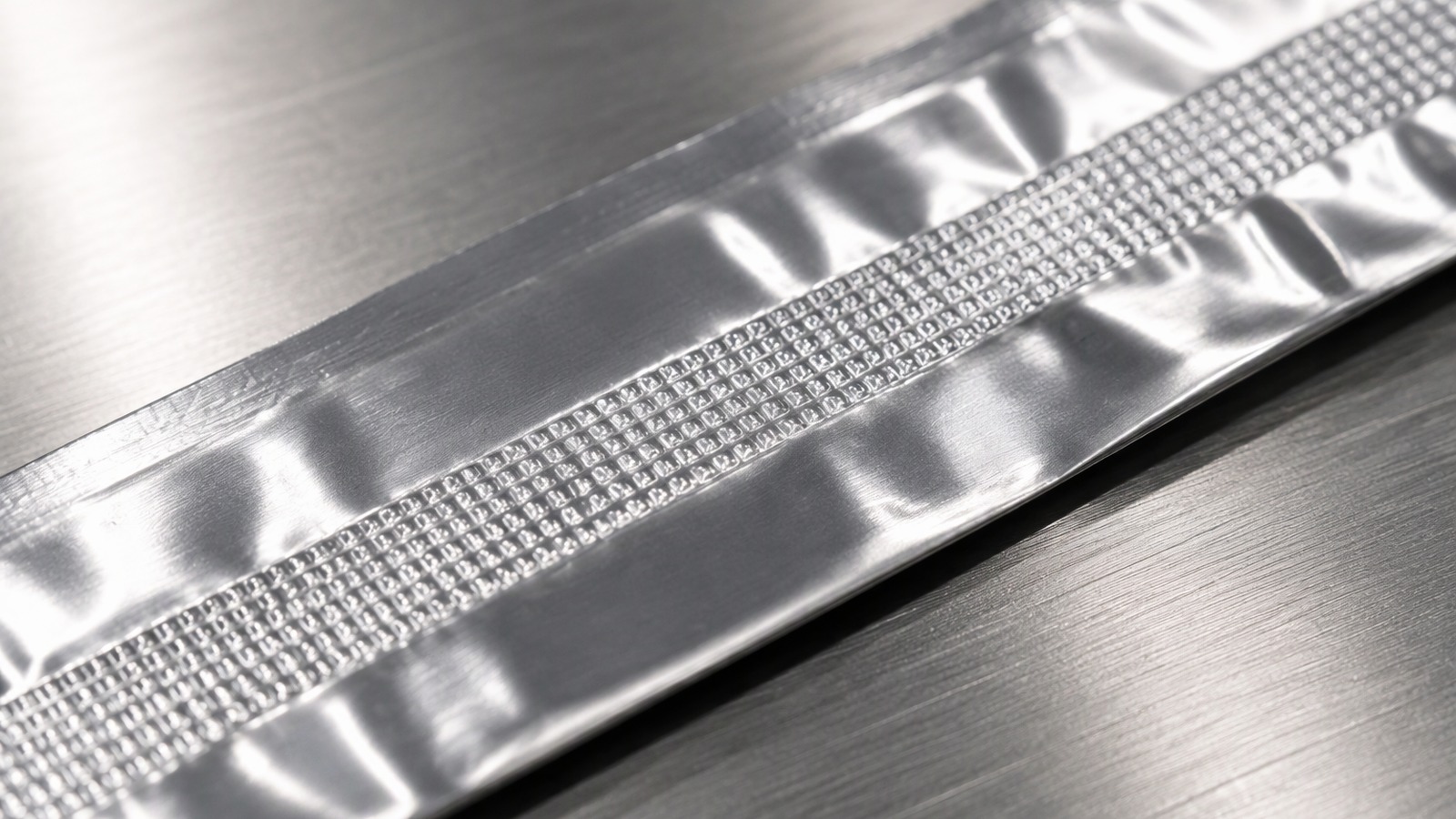
Four routes cover almost every industrial case, and each answers the oxide problem differently.
Heat sealing through a coating bonds coating to coating. Adhesive bonding grips the oxide with a cured polymer. Crimping and folding interlocks the metal mechanically. Welding and ultrasonic methods displace the oxide and join the metal.
Dive deeper
The first route is the packaging workhorse. One or both faces carry a heat-sealable layer, and the joint that forms is polymer to polymer. The foil contributes stiffness, barrier and heat transfer, but it is not the material that seals.
The second route puts an adhesive between the two foil faces. The adhesive wets the oxide, cures or dries, and holds by adhesion rather than by melting. It tolerates surfaces that heat sealing cannot and suits thin gauges that would distort under a heated tool.
The third route is purely mechanical. Folding the two edges over each other, or crimping them into a locked seam, creates a joint held by friction and geometry. Nothing has to melt, and the joint is as heat-resistant as the metal, but it is not a barrier unless something else seals the fold. The industrial and technical foil range is where such joints are usually specified, because fin material and shielding parts are joined for mechanical reasons.
The fourth route joins metal to metal. Welding and ultrasonic methods break the oxide mechanically or displace it with vibration and heat, allowing clean metal to meet clean metal. These are the only routes that produce a true metal joint. The European Aluminium industry association publishes background on how the metal is used across these sectors.
What Does Heat Sealing Through a Coating Ask of the Foil?
It asks for a coating that will melt into itself, and a foil that will carry that coating without failing.
The seal is a polymer weld. The coating must be continuous, evenly applied and firmly anchored, because any gap becomes the point where the seam opens.
Dive deeper
Think of the joint as a three-part assembly: foil, coating, coating. The foil only has to deliver heat to the interface and stay flat while it happens, so gauge and flatness matter more than alloy. Thin gauge heats through quickly and follows the tool, which is why light foil is common in lidding and sachet work. Heavy gauge holds its shape, which suits formed parts where the seam sits on a flange.
Coating quality decides the outcome. The layer must be continuous across the full joint width, with no skips at the edge and no thin band where the web was stretched. It must also be anchored well enough that the joint fails inside the polymer rather than between polymer and metal. That anchoring is a coating and primer question, covered in why foil is lacquered before it is sealed, and the same logic drives heat seal lacquer in a closure liner, where a coated disc is pressed onto a container lip.
One practical point causes most disputes: which face is coated. Seal to the coated face and the joint is strong; seal coated to bare and the result depends on how well the lacquer grips the oxide, a different and less forgiving mechanism. Two-side coated stock removes the ambiguity at a cost in stiffness and blocking risk on the roll.
When Is Adhesive Bonding the Better Route?
Adhesive bonding wins whenever heat is unwelcome, the gauge is thin, or the faces cannot be brought to a sealing tool.
An adhesive wets the oxide and holds by chemical and mechanical keying, so it does not need bare metal. It cures at line speed and tolerates formed geometry.
Dive deeper
Adhesive joints come in two families that behave differently. A cold-seal adhesive is applied to both faces, stays tacky, and bonds when the two coated faces are pressed together, which suits high-speed sachet and flow-wrap lines. A laminating adhesive is applied, dried and bonded under a nip, which suits foil-to-foil build-ups where the joint must also survive converting tension.
The foil's job is to be clean, dry and consistent. Residual rolling oil, water staining or loose debris sits between adhesive and oxide and creates a weak patch that no coat weight will fix. Surface texture helps, because a lightly textured face gives more to grip than a mirror face, but texture cannot compensate for contamination. Coating weight and uniformity are set by the adhesive supplier's own instructions rather than by the foil supplier, so the converter owns that part of the process.
The limits are thermal and time-dependent. Adhesive joints soften at high service temperatures, creep under sustained load, and can be attacked by the product if the adhesive is not chosen for it. They are excellent for tapes, sachets, lidding stock and technical laminates, and a poor choice for a joint that will sit under load at elevated temperature for years. When a buyer is told a joint is adhesive-bonded, the useful follow-up is which service conditions the adhesive was chosen for.
What Can Crimping and Folding Do Without Any Chemistry?
Quite a lot, provided the joint only has to hold mechanically and nothing has to stay sealed.
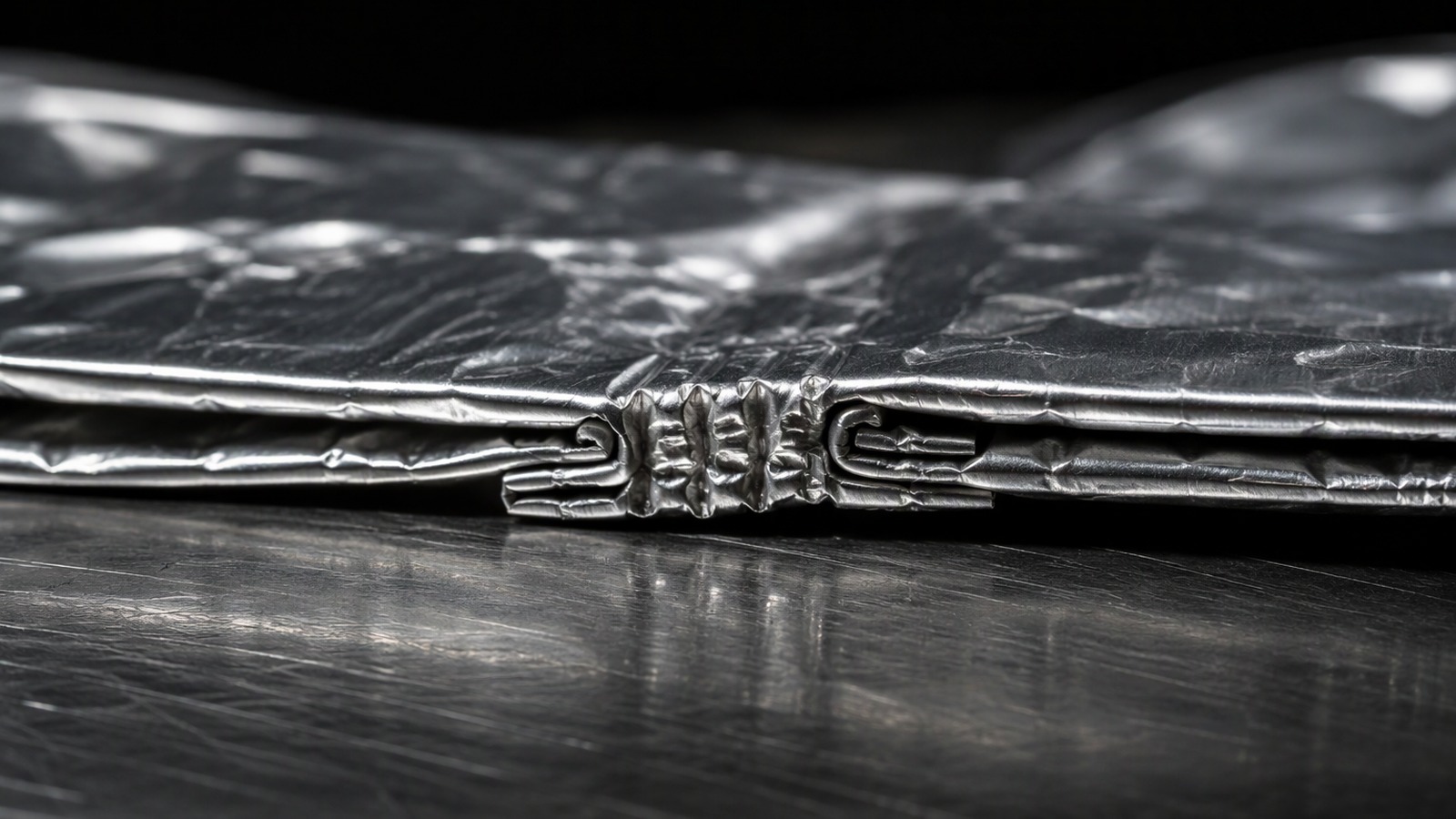
A fold uses the metal's own ductility: the two edges are turned over each other, pressed flat and locked by friction. A crimp adds interlocking serrations. Neither needs heat, coating or adhesive.
Dive deeper
The governing property is ductility, which means temper. Soft O temper folds and crimps cleanly, follows a tight radius without cracking, and produces the tightest mechanical lock. Half-hard tempers such as H22 and H24 fold but spring back more, so the joint is less intimate. Fully hard H18 resists folding: it will bend, but it cracks at a sharp radius and stores enough elastic energy to open a simple fold.
Gauge sets the geometry. Very light foil below roughly 0.02 mm folds easily but has little material to lock, so a mechanical joint needs several layers or a supporting substrate. Heavy foil in the 0.1 mm to 0.2 mm band behaves like thin sheet, and a folded or crimped joint there can carry real load, which is why heat-exchanger fin and container rims are joined this way. The American aluminium industry association covers the wider industrial context.
The honest limitation is sealing. A fold is a tortuous path, not a barrier. It resists dust and light handling, but vapour and liquid will find the fold line, and repeated flexing opens it further. This is why a pack that must hold moisture uses a fold for shape and a coating for closure, and why a mechanical part is content with the fold alone.
When Do Welding and Ultrasonic Methods Make Sense?
They make sense when the joint has to be metal, and when the foil is thick enough to survive the process.
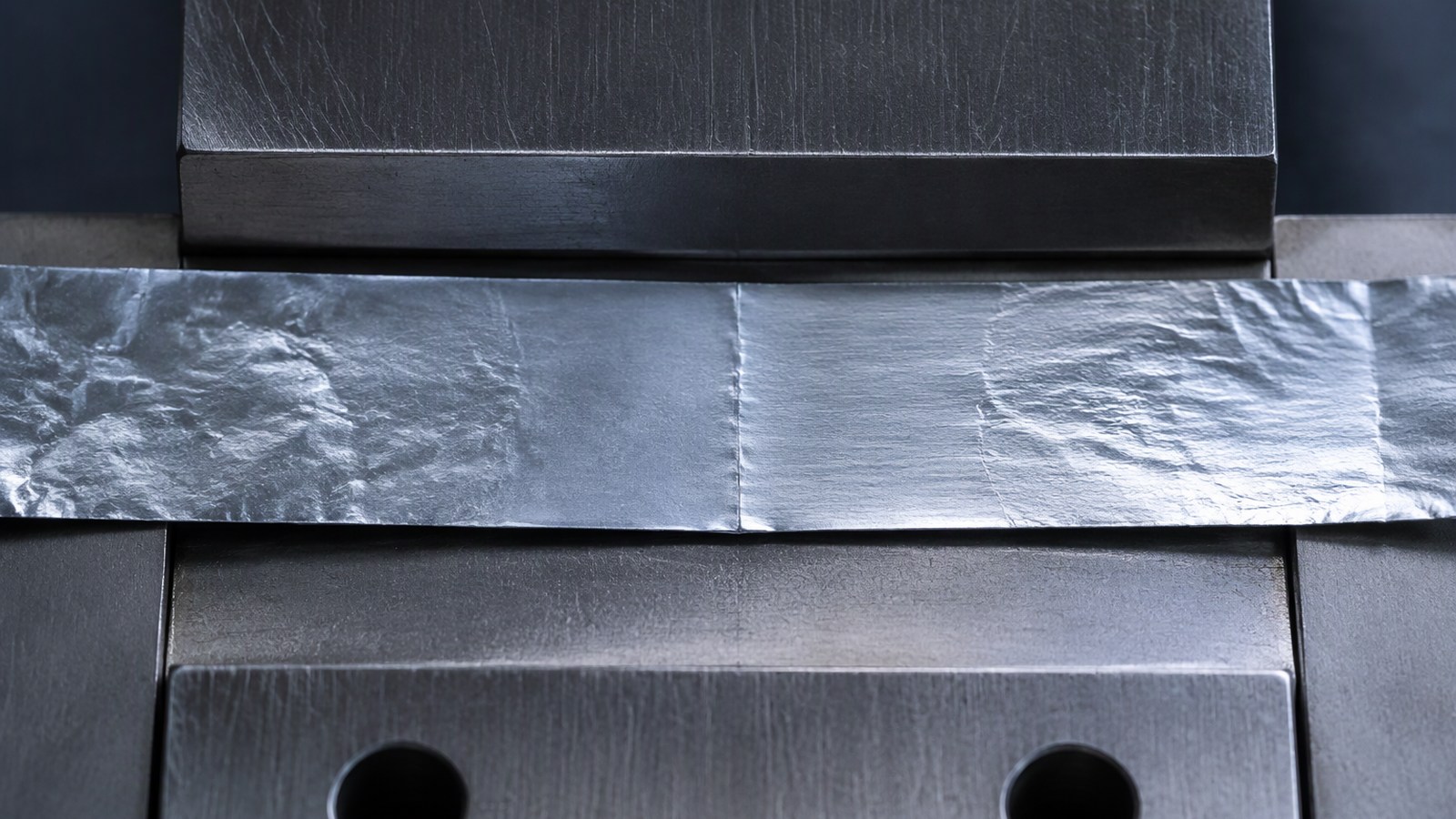
Both methods break or displace the oxide so that clean metal can bond to clean metal, giving a joint with no polymer in it that can take heat and carry current.
Dive deeper
Metal welding on foil is a thickness-limited process. The oxide has to be broken mechanically, by tool pressure and relative movement, and the softened metal then consolidates across the interface. Very light foil has too little material to absorb that movement: it tears, wrinkles or burns through before a sound joint forms. In practice the technique belongs to the heavier end of the range, where the strip behaves like thin sheet and the tool can work the interface without destroying it.
Ultrasonic methods are used in two quite different ways. On bare foil they work by the same principle as welding: vibration scrubs the oxide away and the metal consolidates. On coated or laminated foil they do something else entirely, softening and welding the polymer layers while the foil stays intact, which is a coated-route joint wearing a different name. Confusing the two is common and costly, because the joint properties are not interchangeable.
Alloy choice matters. Softer, unalloyed grades such as 1050, 1060 and 1100 deform readily and suit these processes, while stronger alloys resist the local deformation the tool needs. The foil producers' association is a useful orientation on where rolled foil is used in these technical roles. The honest question is not whether a method works, but whether the joint must be a seal, a conductor, a fastening, or all three.
How Do Temper, Gauge and Pack Duty Change the Answer?
Temper decides whether the metal will fold; gauge decides whether it will weld; the duty decides whether either matters.
A barrier pack needs a continuous polymer at the joint, so a coated heat-seal route dominates. A mechanical part needs shape retention and load capacity, so folding, crimping or welding dominates.
Dive deeper
Start with the duty. If the joint must hold moisture, oxygen, aroma or pressure, it has to contain a continuous polymer phase, which means a heat-sealable coating or an adhesive. If the joint must hold a shape, carry a load or simply keep two parts together, the metal itself can do the work and a mechanical joint is cheaper. Most specification errors come from asking a mechanical joint to be a barrier.
Then look at gauge. Thin material in the 0.006 mm to 0.03 mm band is normally the packaging case: it heat seals through a coating, bonds with adhesive, and is difficult to weld. Mid gauges can go either way and are often decided by the tooling on the floor. Heavy gauges from about 0.1 mm upwards behave like sheet and can be welded, which is the world of 1100 aluminium foil at 0.18 mm for formed and technical parts.
Temper then settles the detail. O temper is the safe choice for folding and crimping, H22 and H24 are workable but springier, and H18 belongs where stiffness matters more than joint intimacy. Where a thin coated web is wanted for a lidding or sachet structure, 1235 aluminium foil at 0.08 mm sits in the middle of the range where coating and handling requirements usually meet.
Why Is the Joint the Weakest Line, and How Do You Judge One Without a Laboratory?
Because the joint is where the material stops being continuous, and where every small process error collects.
A joint concentrates stress, interrupts the barrier and depends on conditions in one narrow band of the web. It is judged by making that band fail on purpose, in the way it will be used.
Dive deeper
Why the seam fails first
Foil is homogeneous; a joint is not. At the seam, thickness changes, coating may be thinner, the metal may be work-hardened, and the geometry creates an edge where stress concentrates. This is why a pack can pass every flat-sample check and still leak from a seal corner.
Designing around the seam
Keep the joint away from corners and folds, widen it rather than thinning the coating to gain speed, and avoid ending a seam where the pack will be flexed. Where a fold is used for shape, let a coated band do the sealing so each element does one job. Where a welded or crimped joint carries load, add material at the joint rather than relying on the foil's full section.
What to tell a converter at enquiry
State what the joint must do: hold a barrier, carry a load, conduct, or simply stay closed. State which faces may be coated and which must stay bare. State the product and whether the pack will be flexed, frozen or sterilised. State the joint width and where it sits.
Judging a joint on the bench
Three checks need no laboratory. First, look: a seam should be continuous, evenly bonded and free of channels, wrinkles and dull patches. Second, pull it apart by hand and note where it fails; failure inside the polymer is a process result, failure between coating and metal is an anchoring problem, and clean separation means no joint was made. Then form the joint as the pack will be formed.
A joint is a process, not a property of the metal. Ask what carries the bond, then test the seam as it will be used.